
Project budgets fail more often than they succeed. Despite better tools, more data, and improved planning methods, cost overruns remain one of the biggest reasons projects struggle or collapse entirely. In 2026, rising material prices, labour shortages, supply chain volatility, and tighter margins make cost accuracy non-negotiable. Even small estimation errors can quickly turn a well-planned project into a financial liability.
This is where project cost management stops being a theoretical discipline and becomes a survival skill. It is no longer enough to prepare a budget at the start and hope it holds. Successful projects are not defined by how well they begin, but by how closely real costs align with expectations as work progresses. When cost visibility is lost, decisions are delayed, and profitability erodes quietly. Understanding the real numbers behind successful projects reveals patterns that planning templates and static spreadsheets simply cannot show.
Modern project cost management is built on continuous tracking, realistic forecasting, and disciplined decision-making. Teams that perform well rely on clear estimating foundations, often supported by structured systems such as https://builderexpert.uk/about-building-estimating/, where cost logic is defined before work begins. From there, costs must be monitored against commitments and actual spend using reliable estimating and control processes like those outlined in https://builderexpert.uk/construction-estimating/.
What separates profitable projects from failing ones is not access to more data, but the ability to interpret and act on it. Strong project cost management connects early estimates with live project performance, allowing teams to spot risk early, adjust scope intelligently, and protect margins without sacrificing quality. This is why many high-performing teams adopt dedicated tools and workflows similar to https://builderexpert.uk/construction-estimating-software/, where cost control becomes part of daily decision-making rather than a monthly reporting exercise.
This article breaks down what actually works in project cost management today. It focuses on real metrics, proven behaviours, and practical decisions that successful projects make consistently — and that costly projects tend to ignore until it is too late.
What Project Cost Management Really Means (Beyond Budgeting)
Many teams confuse project cost management with setting a budget and tracking expenses. In reality, it is a continuous decision-making process that runs from early planning to final delivery.
Effective project cost management includes:
- realistic cost estimation
- continuous cost monitoring
- early variance detection
- forecasting final outcomes
- corrective action before losses become irreversible
Successful projects treat cost management as a live system, not a static spreadsheet. Costs are reviewed regularly, assumptions are challenged, and decisions are updated based on current data, not original plans.
This mindset shift is one of the strongest indicators of long-term project success.
Planned vs Actual Costs: The Gap That Destroys Projects
One of the most revealing numbers in project cost management is the gap between planned and actual costs. This gap rarely appears overnight. In most failing projects, it grows slowly, quietly, and often unnoticed until corrective action becomes expensive or impossible. Teams may feel the project is “mostly on track,” while the numbers are already telling a very different story.
Planned costs are built on assumptions. Actual costs are built on reality. When those two drift apart, it is not a reporting problem — it is a decision-making problem. Effective project cost management exists precisely to identify this gap early and force honest conversations before financial damage compounds.
Why Cost Gaps Appear So Early
Cost gaps usually form long before teams realise they exist. Early-stage estimates are often optimistic, especially when timelines are tight or commercial pressure is high. Initial pricing may be based on incomplete information, productivity assumptions that prove unrealistic, or risks that are underestimated or ignored altogether. Without a solid estimating foundation, such as the principles outlined in https://builderexpert.uk/about-building-estimating/, the gap is built into the project from day one.
As work progresses, scope changes are another major contributor. Small design adjustments, client requests, or technical clarifications are frequently absorbed informally, without proper cost adjustment. Over time, these “minor” changes accumulate into significant overruns. Weak project cost management allows scope creep to hide inside the programme instead of confronting it financially.
Delayed or inconsistent reporting makes the problem worse. When cost data is reviewed monthly or only at key milestones, warning signs are missed. By the time overruns are formally recognised, the opportunity to correct them cheaply has already passed. Strong teams rely on structured estimating and cost breakdown processes like those described in https://builderexpert.uk/construction-estimating/, ensuring costs are visible and traceable throughout delivery.
The Behavioural Side of the Cost Gap
Beyond systems and tools, human behaviour plays a critical role. Teams often ignore small overruns early, believing they will “balance out later.” In reality, small overruns rarely disappear on their own. They multiply. Poor communication between commercial, technical, and delivery teams further widens the gap, as cost signals fail to reach decision-makers in time.
Successful projects treat early cost deviations as signals, not failures. This mindset is central to effective project cost management. Weekly cost reviews, short feedback loops, and clear accountability ensure that issues are addressed while options still exist. Many high-performing teams support this approach with dedicated platforms such as https://builderexpert.uk/construction-estimating-software/, where planned, committed, and actual costs are continuously aligned.
Why Weekly Tracking Changes Everything
Successful projects track the planned-versus-actual gap weekly, not monthly. Weekly tracking transforms cost control from a reactive process into a proactive one. It allows teams to adjust sequencing, renegotiate scope, refine resource allocation, or trigger corrective actions before losses become embedded.
Closing the gap early is one of the most cost-effective actions in project cost management. The earlier the intervention, the lower the financial impact. Projects that master this discipline do not eliminate cost gaps entirely — they manage them intelligently. That is the difference between projects that recover and projects that quietly fail.
The Core Metrics Behind Successful Projects
Projects that consistently perform well focus on a small set of clear metrics rather than dozens of complex reports. These numbers are reviewed frequently and understood by decision-makers.
Key project cost management metrics include:
- Cost Variance (CV)
- Cost Performance Index (CPI)
- Forecast at Completion
- Committed vs Actual Spend
- Contingency Usage Rate
These metrics provide clarity. They answer one critical question: are we spending money at the right speed for the value delivered?
Projects that ignore these signals often discover problems only after profitability is already lost.
Why “On Budget” Does Not Always Mean Successful
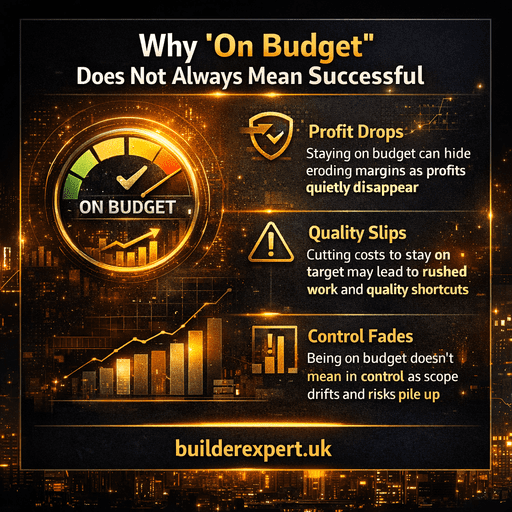
A project can finish on budget and still fail. This is one of the most misunderstood realities in project cost management. Budget compliance is often celebrated as success, yet many projects that meet their original cost targets underperform commercially, operationally, or strategically once delivery is complete.
Projects fail when profit margins quietly collapse behind the scenes. Aggressive cost cutting may protect the headline budget, but it often erodes value in less visible ways. Quality can be compromised, rework increases, and long-term performance suffers. In residential and construction-focused environments, this approach frequently leads to higher maintenance costs, dissatisfied clients, and reputational damage that extends well beyond a single project.
Another common failure point is team burnout. When budgets are treated as rigid constraints rather than management tools, teams are pushed to absorb inefficiencies through overtime, reduced resources, or unrealistic productivity expectations. Over time, pressure replaces planning. This weakens decision-making and undermines effective project cost management, even when reported costs appear controlled.
Cash flow instability is another hidden indicator of failure. A project may remain “on budget” while suffering delayed payments, poorly phased spending, or mismatched commitments. Strong projects monitor not only total cost, but also when money is spent and recovered. This approach aligns closely with structured estimating and planning principles such as those outlined in https://builderexpert.uk/construction-estimating/, where financial timing is treated as strategically as totals.
Successful projects measure cost performance alongside value, quality, and risk. They recognise that cutting the wrong cost can be more damaging than exceeding the budget slightly. Industry guidance, including frameworks promoted by organisations like the Construction Leadership Council (https://www.constructionleadershipcouncil.co.uk/), consistently highlights the importance of balanced decision-making over short-term cost fixation.
The real number that matters in project cost management is not the original budget, but the final financial outcome. Profitability, cash stability, delivery quality, and long-term value define success far more accurately than budget compliance alone.
Cost Control Behaviours That Separate Winners from Losers
Tools matter, but behaviour matters more. Data from successful projects shows consistent cost control habits across industries.
Winning teams:
- review costs frequently
- challenge assumptions early
- document decisions clearly
- act quickly on negative trends
- align commercial and technical teams
Project cost management succeeds when cost ownership is shared, not isolated within finance or project controls.
Forecasting: The Most Powerful Cost Management Skill
Forecasting accuracy is one of the strongest predictors of project success. Projects rarely fail because of one bad month; they fail because forecasts are ignored, delayed, or fundamentally inaccurate. When leadership relies on outdated assumptions instead of current data, decisions are made too late to protect profitability. This is why forecasting sits at the heart of effective project cost management.
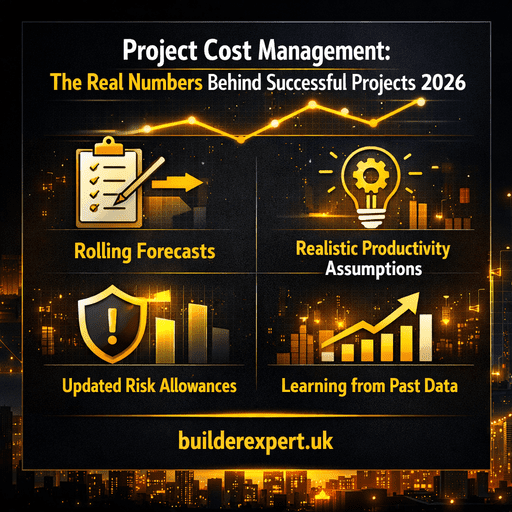
Good forecasting is not about predicting the future perfectly. It is about creating a realistic view of where the project is heading based on current performance. Strong project cost management focuses on rolling forecasts that evolve as the project progresses, rather than static projections created at the start and never meaningfully updated. These rolling forecasts force teams to confront reality early and adjust course while options still exist.
Accurate forecasts depend on realistic productivity assumptions. Many projects fail when teams assume productivity will improve “later” without evidence. Instead, successful teams base forecasts on actual output, measured performance, and verified benchmarks. This approach aligns closely with structured estimating workflows such as those described in https://builderexpert.uk/building-estimating-software-uk-industry-guide/, where assumptions are documented, tested, and refined over time.
Updated risk allowances are another critical component. Risk is not a one-time exercise completed during planning. As conditions change, risks evolve. Effective project cost management continuously reassesses risk exposure and adjusts forecasts accordingly. Ignoring emerging risks leads to false confidence and sudden financial shocks. Industry guidance, including principles outlined in the UK Government’s Construction Playbook (https://www.gov.uk/government/publications/the-construction-playbook), reinforces the importance of dynamic risk and cost forecasting throughout the project lifecycle.
Finally, strong forecasting is built on learning from past data. Projects that capture historical cost and productivity data improve forecasting accuracy over time. This feedback loop transforms forecasting from guesswork into a strategic advantage.
The ability to predict where the project will end — not where it started — gives leaders time to intervene, protect margins, and steer outcomes deliberately rather than reactively. That is the true power of forecasting within project cost management.
The Numbers Behind Successful Projects: Patterns That Repeat
Analysis of successful projects shows that financial performance rarely improves by accident. When projects finish strong, the numbers follow clear and repeatable patterns. These patterns appear across different sectors, team sizes, and delivery models, and they consistently point back to disciplined project cost management rather than individual heroics or last-minute fixes.

Successful teams do not rely on hope or optimism. They rely on early signals. Cost variance, margin movement, and forecast shifts are treated as meaningful indicators that guide action. This proactive use of data allows leaders to intervene early, test assumptions, and adjust strategy before financial pressure escalates. When project cost management is embedded into daily decision-making, numbers become tools for clarity and control — not retrospective explanations for why outcomes went wrong.
Early Cost Variance Is Treated as Urgent Information
One of the strongest numerical patterns in high-performing projects is how early cost variance is handled. In successful projects, even small deviations from planned costs are addressed within weeks, not months. Early variance is not dismissed as noise or temporary fluctuation. It is treated as critical information.
This approach reflects mature project cost management. Teams understand that early cost variance rarely fixes itself. Instead, they investigate root causes immediately — whether the issue lies in productivity, scope interpretation, sequencing, or procurement. Structured estimating practices, such as those described in https://builderexpert.uk/construction-estimating/, make it easier to trace where and why variance appears.
Contingency Is Used Strategically, Not Emotionally
Another clear pattern is how contingency is managed. In failing projects, contingency is often treated as emergency funding, released reactively under pressure. In successful projects, contingency is used deliberately and strategically.
Strong project cost management defines contingency rules early. Teams know when contingency can be used, why it exists, and what signals justify its release. This discipline prevents emotional decisions made during stressful moments and preserves financial control. Projects that apply structured cost logic, supported by systems like https://builderexpert.uk/about-building-estimating/, maintain clarity around what contingency protects and what it does not.
Final Cost Deviation Stays Within Controlled Limits
Successful projects rarely finish exactly on the original estimate. What sets them apart is that final cost deviation remains within controlled and predictable limits. This outcome is not achieved by freezing decisions or avoiding change, but by continuously managing trade-offs with clear financial intent. Teams understand that flexibility, when guided by data, is a strength rather than a risk.
Effective project cost management allows teams to forecast final outcomes early and adjust deliberately. Scope, resources, and sequencing are refined in response to cost signals rather than after damage is done. Instead of reacting to overruns at the end, teams make smaller, smarter adjustments throughout delivery. Teams using live estimating and tracking platforms, such as https://builderexpert.uk/construction-estimating-software/, gain visibility into how decisions today affect final results, turning cost control into an active management process rather than a post-project explanation.
Profit Erosion Is Identified Early, Not Hidden
One of the most dangerous behaviours in struggling projects is hiding profit erosion. In contrast, successful projects expose margin pressure early and address it directly. Leaders track not only costs, but also how those costs affect profitability, cash flow, and commercial sustainability over time. This wider financial view prevents teams from celebrating short-term savings while long-term value quietly disappears.
This transparency is a hallmark of strong project cost management. It allows teams to see the true financial trajectory of the project while there is still time to influence the outcome. When profit erosion is identified early, teams retain flexibility. They can renegotiate scope, adjust delivery methods, reallocate resources, or change sequencing before losses become permanent. Early visibility turns financial pressure into informed choice rather than forced reaction.
Numbers as Signals, Not Threats
The most important pattern is cultural. Successful projects treat numbers as signals, not threats. Cost data is not used to assign blame, but to guide decisions and create alignment across teams. When people feel safe reporting real figures, issues surface earlier, discussions become more productive, and corrective action happens while options still exist.
This culture of transparency is a core driver of effective project cost management. It replaces fear with responsibility and defensiveness with problem-solving. Teams stop hiding overruns or delaying bad news and start using financial data as a shared language for decision-making. Leaders who encourage this mindset create environments where honesty is rewarded, not punished.
Projects that embrace this approach turn project cost management into a strategic advantage rather than a defensive exercise. The numbers speak early — and successful teams listen, respond, and adjust before small signals turn into irreversible outcomes.
Lessons for 2026: What Projects Must Do Differently
In 2026, project cost management must be faster, clearer, and more honest. Complexity is increasing, but tolerance for cost failure is decreasing.
Key lessons include:
- simpler reporting beats complex dashboards
- speed of response matters more than precision
- transparency protects profitability
- early decisions save exponential cost later
The projects that succeed are not perfect — they are responsive.
Conclusion: Control Comes From Clarity, Not Perfection
Project Cost Management: The Real Numbers Behind Successful Projects (2026) shows that success is not accidental. It is built deliberately through visibility, discipline, and informed decision-making at every stage of delivery. Projects that perform well do not avoid problems — they see them early and respond intelligently.
When project cost management is treated as a continuous process rather than a one-off planning task, teams gain control over outcomes instead of reacting to surprises. Cost data becomes a working tool, not a historical record. Decisions are based on current performance, not outdated assumptions. This shift creates confidence across teams, from commercial leads to delivery managers, because everyone is working from the same financial reality.
Strong outcomes are supported by clear estimating foundations. Projects that invest time in understanding how costs are built, as outlined in https://builderexpert.uk/about-building-estimating/, are better equipped to manage change without losing control. From there, structured workflows like those described in https://builderexpert.uk/construction-estimating/ ensure that cost visibility is maintained as the project evolves, rather than eroded by complexity.
The most successful teams do not chase perfect forecasts or flawless budgets. They focus on responsiveness. By using reliable estimating systems and live tracking tools such as https://builderexpert.uk/construction-estimating-software/, they create feedback loops that allow early intervention. Small issues are addressed while they are still manageable, and financial risks are surfaced before they become irreversible.
The real numbers always tell the truth. They reveal whether assumptions hold, whether productivity matches expectations, and whether profitability is protected or slipping away. Projects that listen to these signals finish stronger — not just cheaper, but more stable, more predictable, and more resilient.
In 2026, effective project cost management is no longer optional. It is the difference between projects that drift and projects that are deliberately steered to successful outcomes. Teams that embrace this discipline do not rely on luck. They rely on clarity — and clarity is what delivers control.
🔗 https://www.gov.uk/government/publications/the-construction-playbook
🔗https://www.constructionleadershipcouncil.co.uk/
📞 Contact our team to discuss your projecthttps://builderexpert.uk/contact-builder-expert/