
Best Construction Cost Planning Software UK: Ultimate Guide for Builders to Increase Profit (2026)
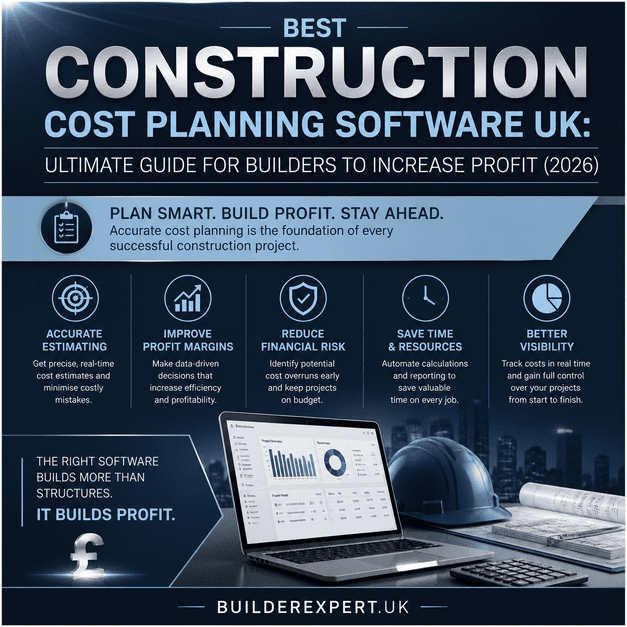
Construction cost planning software is becoming a critical tool for UK builders who want to stay competitive in an increasingly demanding market
. Managing project costs accurately is no longer just a financial task—it is a strategic advantage that determines whether a project succeeds or fails. Rising material prices, ongoing labour shortages, and supply chain disruptions have made traditional estimating methods unreliable.
Builders who continue to rely on guesswork or outdated spreadsheets often find themselves underpricing projects, absorbing unexpected costs, and struggling to maintain consistent profit margins.
In today’s environment, every decision made during the planning stage has a direct impact on the final outcome of a project. Even small inaccuracies in early cost planning can escalate into significant financial losses once construction begins. This is particularly important in the UK residential sector, where budgets are tight, timelines are strict, and client expectations are high. Builders must not only deliver quality work but also maintain financial control from start to finish. By adopting modern construction cost planning software, professionals can create accurate estimates, track costs in real time, and ensure that every project remains profitable from start to completion.
What Is Construction Cost Planning Software?
Construction cost planning software is a digital solution designed to help builders estimate, manage, and optimise project costs throughout the entire construction lifecycle. Unlike basic spreadsheets, it provides structured workflows, real-time data, and automated calculations that significantly improve both accuracy and efficiency.
With the right construction cost planning software, builders can forecast expenses with greater confidence, identify risks early, and maintain tighter control over budgets. These tools allow users to break down projects into detailed cost components, ensuring that nothing is overlooked during the planning stage. Instead of relying on assumptions, builders can make decisions based on reliable, up-to-date data.
Key benefits include:
- Accurate forecasting of labour and material costs
- Real-time cost tracking and reporting
- Reduced risk of human error
- Improved consistency across multiple residential projects
Ultimately, construction cost planning software transforms cost estimation into a structured, data-driven process that supports better decision-making and long-term business growth.
Why UK Builders Need Construction Cost Planning Software in 2026
The UK construction industry is evolving rapidly, and builders are facing increasing pressure to deliver projects faster, more efficiently, and within tighter budgets.
In this environment, relying on manual processes or outdated systems is no longer sustainable.
Construction cost planning software provides the tools needed to navigate these challenges with confidence and precision.
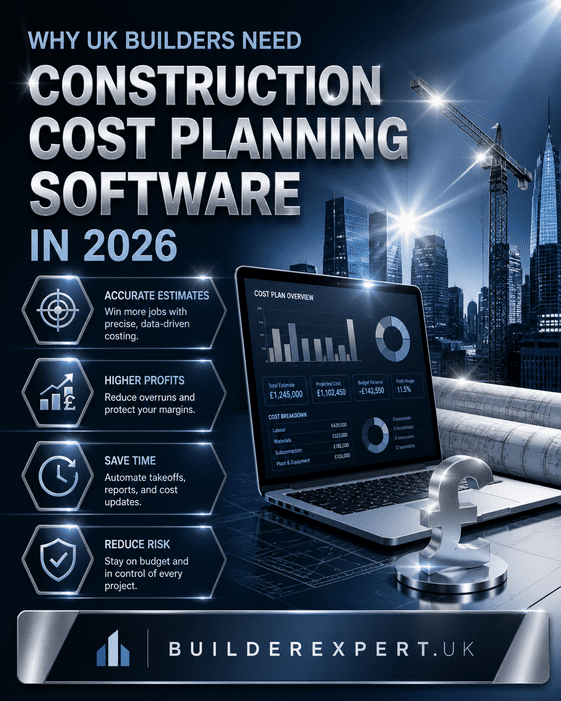
One of the key reasons builders need this technology is the growing complexity of residential projects.
From fluctuating material costs to changing regulations, there are more variables than ever to consider. Without accurate cost planning, builders risk underestimating expenses and compromising their profit margins.
Construction cost planning software allows professionals to manage these variables effectively by providing real-time insights and data-driven decision-making.
Additionally, competition within the UK market is stronger than ever. Clients expect fast, accurate quotes and transparent pricing. Builders who can deliver this consistently are far more likely to win high-value projects. By using construction cost planning software, businesses can respond quickly to enquiries, produce detailed cost breakdowns, and present themselves as professional and reliable.
Another important factor is financial control. Many builders struggle not because they lack work, but because they lack visibility over their costs. Without clear tracking, small overruns can accumulate and significantly impact overall profitability. Construction cost planning software eliminates this issue by offering full visibility across every stage of the project.
Looking ahead to 2026, digital transformation will continue to reshape the construction industry. Builders who invest in the right tools now will be better positioned to scale their operations, improve efficiency, and secure long-term profitability. Those who fail to adapt risk falling behind competitors who are already leveraging technology to gain an advantage.
Key Features to Look for in Construction Cost Planning Software
Choosing the right construction cost planning software is essential for maximising efficiency and profitability. Not all tools offer the same capabilities, so understanding the key features can help builders make informed decisions.
- Accurate Cost Databases
Reliable cost data is the foundation of any successful estimate. High-quality construction cost planning software provides access to up-to-date UK pricing information, ensuring that material and labour costs reflect current market conditions. This reduces the risk of underpricing projects and helps builders maintain realistic budgets. Without accurate data, even the best planning process can fail. - Automated Calculations
Manual calculations are time-consuming and prone to error, especially in complex residential projects. Automated features allow builders to generate accurate totals instantly based on project inputs. This not only saves time but also ensures consistency across all estimates, reducing the risk of costly mistakes. - Real-Time Budget Tracking
Real-time tracking enables builders to monitor project costs as they occur. This level of visibility allows for quick adjustments, helping prevent cost overruns before they become serious problems. Builders can maintain control over budgets and make informed decisions throughout the project lifecycle. - Customisable Templates
Custom templates allow builders to standardise their estimating process while still adapting to different types of residential projects. This improves efficiency, ensures consistency in pricing, and reduces the time required to prepare new estimates from scratch. - Integration with Estimating Tools
Modern construction workflows require seamless integration between systems. Construction cost planning software that integrates with platforms like Builder Expert estimating tools allows for a smooth transition from initial estimate to detailed cost planning. This reduces duplication of work, improves accuracy, and increases overall productivity.
How Construction Cost Planning Software Improves Profit Margins
Profitability in construction depends heavily on accuracy and control. Even small pricing errors can result in significant financial losses over time. Construction cost planning software helps builders eliminate these risks by providing a structured approach to estimating and cost management.
By using construction cost planning software, builders can identify hidden costs early, set realistic pricing strategies, and avoid underestimating labour or materials. This ensures that projects are priced correctly from the start, reducing the likelihood of unexpected losses.
Key advantages include:
- Improved estimate accuracy
- Better cost visibility
- Reduced financial risk
- Consistent profit margins across projects
Over time, these improvements allow builders to scale their operations while maintaining strong financial performance and stability.
Story: From Cost Uncertainty to Consistent Profit
Mark, a residential builder based in Surrey, had built a strong reputation for delivering high-quality home extensions. However, behind the scenes, his business was facing a growing problem—unpredictable profit margins. Despite winning regular projects, Mark often found that the final costs were higher than expected, leaving little room for profit.
On one particular £250,000 renovation project, the issue became clear. The initial estimate, created using spreadsheets, failed to account for fluctuating material prices and underestimated labour hours. By the halfway point of the project, costs had already exceeded projections by nearly 12%. What should have been a highly profitable job quickly became a stressful and financially tight situation.
Determined to avoid repeating the same mistake, Mark decided to implement construction cost planning software across his business. The transition was straightforward, but the impact was immediate. Instead of relying on static spreadsheets, he began using structured cost plans supported by real-time data and automated calculations.
Within the next three projects, the difference was significant. Each estimate was more detailed, more accurate, and easier to adjust as market conditions changed. Labour costs were properly accounted for, material pricing was kept up to date, and contingency planning became part of every quote.
The results spoke for themselves:
- Average project value: £220,000–£300,000
- Cost accuracy improved by over 15%
- Budget overruns reduced by 20%
- Profit margins stabilised between 18–22%
More importantly, Mark gained something he hadn’t had before—confidence. Instead of reacting to cost issues during construction, he was able to plan ahead, price projects correctly, and communicate clearly with clients from the start.
Today, construction cost planning software is a core part of his workflow. It has not only improved profitability but also strengthened his reputation as a builder who delivers projects on time, on budget, and without surprises.
Construction Cost Planning Software vs Excel
Limitations of Excel
While Excel has been widely used in construction for many years, it has significant limitations when it comes to modern cost planning. Spreadsheets rely heavily on manual input, which increases the likelihood of errors and inconsistencies. As projects become more complex, managing large datasets becomes time-consuming and difficult to scale.
Excel also lacks real-time tracking capabilities, making it harder for builders to monitor costs as projects progress. Additionally, collaboration can be challenging, as multiple users working on the same file often create version control issues and data discrepancies. These limitations make Excel unsuitable for managing complex residential construction projects in today’s fast-paced environment.
Advantages of Construction Cost Planning Software
Construction cost planning software is specifically designed to handle the demands of modern construction projects. It offers automated workflows, centralised data management, and real-time updates that improve both accuracy and efficiency. Builders can access live cost data, generate detailed reports, and make informed decisions based on reliable information.
Collaboration is significantly improved, as teams can work within a shared system without risking inconsistencies. This leads to better communication, faster workflows, and more accurate project outcomes. Overall, construction cost planning software provides a more structured, scalable, and professional approach to cost management compared to traditional spreadsheets.
Common Cost Planning Mistakes Builders Make
Many builders continue to make avoidable mistakes when planning project costs. These errors can lead to reduced profitability and increased financial risk.
Common mistakes include:
- Underestimating labour costs
- Ignoring material price fluctuations
- Failing to include contingency budgets
- Using outdated pricing data
- Relying on guesswork instead of structured data
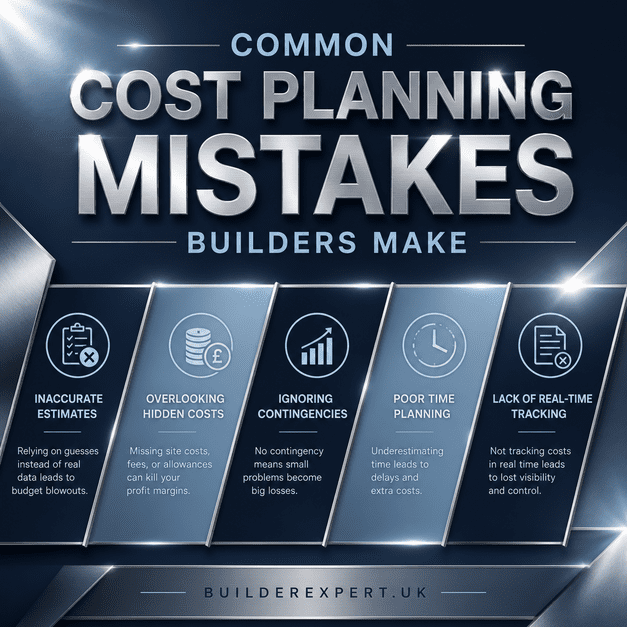
Construction cost planning software helps eliminate these issues by providing accurate data, structured workflows, and real-time tracking, ensuring that every aspect of a project is properly accounted for.
How to Choose the Best Construction Cost Planning Software UK
Selecting the right construction cost planning software is a strategic decision that can directly influence the long-term success of a building business. In the UK residential sector, where margins can be tight and competition is high, builders need more than just basic functionality—they need a solution that aligns with their day-to-day operations and future growth plans. The ideal software should be tailored to UK market conditions, offering accurate, up-to-date cost data that reflects current material prices, labour rates, and regulatory requirements.
Ease of use is a critical factor. Builders and estimators need a system that can be adopted quickly without extensive training, allowing teams to transition smoothly from traditional methods. At the same time, scalability is essential. As a business grows and takes on larger or more complex projects, the software must be capable of handling increased data and more advanced cost planning requirements without compromising performance.
Compatibility with existing workflows is equally important. The best construction cost planning software integrates seamlessly with estimating and project management tools, creating a unified system that reduces duplication and minimises errors. This level of integration improves efficiency, ensures consistency across projects, and enhances overall productivity.
Ultimately, choosing the right solution is not just about ticking off features. It is about investing in a tool that supports accuracy, strengthens financial control, and enables builders to deliver consistently profitable projects while positioning their business for sustainable growth.
Real UK Case Study: Improving Profit with Cost Planning Software
A residential builder in Manchester was struggling with inconsistent pricing and low profit margins due to inaccurate estimates. After implementing construction cost planning software, the company experienced significant improvements.
Project details:
- Residential extension project
- Value: £180,000
- Timeline: 14 weeks
Results achieved:
- 12% improvement in estimate accuracy
- 18% reduction in unexpected costs
- 10% increase in overall profit margin
Key success factors:
- Use of structured cost planning templates
- Real-time budget monitoring
- Accurate material pricing data
- Improved workflow efficiency
“We finally have full visibility over our costs. Every project is now predictable and profitable.” — James
The Future of Construction Cost Planning in the UK
The construction industry is rapidly moving towards digital transformation, reshaping how projects are planned, managed, and delivered across the UK residential sector. Builders who adopt modern tools early are not simply improving efficiency—they are positioning themselves at the forefront of a more intelligent, data-driven approach to construction. This shift is being driven by the need for greater accuracy, tighter cost control, and faster decision-making in an increasingly competitive market.
Emerging technologies are playing a central role in this evolution. AI-driven cost forecasting, for example, enables builders to predict future expenses based on historical data and current market trends, reducing uncertainty and improving long-term planning. Cloud-based collaboration tools are also transforming how teams work, allowing real-time communication and data sharing between estimators, project managers, and site teams. This ensures that everyone involved in a project operates with the same up-to-date information.
Real-time data integration further enhances visibility, giving builders immediate insight into project performance and financial status. At the same time, automated reporting systems eliminate time-consuming manual processes, allowing professionals to focus on strategic decision-making rather than administrative tasks.
As construction cost planning software continues to evolve, it will offer even greater precision, scalability, and integration. Builders who embrace these advancements will not only improve project outcomes but also strengthen their ability to compete, grow, and adapt in a rapidly changing industry landscape.
Conclusion
Effective cost planning is the foundation of every successful construction project. Builders who fail to control costs risk losing money, missing opportunities, and falling behind competitors. In today’s challenging UK construction environment, accuracy, efficiency, and financial control are more important than ever.
By adopting construction cost planning software, builders can completely transform the way they plan, price, and manage their projects. These tools provide the structure, data, and insight needed to improve accuracy, reduce risk, and maintain consistent profit margins across every job.
Beyond just improving individual projects, construction cost planning software enables long-term business growth. Builders gain the confidence to take on larger projects, provide more competitive quotes, and build a reputation for reliability and precision. Over time, this leads to stronger client relationships and more consistent work.
As the industry continues to evolve, investing in the right technology is no longer optional—it is essential. Builders who use construction cost planning software today will be better prepared to handle future challenges, scale their business, and achieve long-term success.
🚀 Use Builder Expert to estimate precisely, track costs, and manage your projects with confidence.
📊 Need help choosing the right construction cost planning software? Get in touch with our team here
- 🔗 https://www.gov.uk/government/publications/the-construction-playbook
- 🔗 https://www.bcis.co.uk/
- 🔗 https://www.constructionleadershipcouncil.co.uk/
- 🔗 https://www.rics.org/
- 🔗 https://www.ciob.org/
FAQ
- What does construction cost planning software do?
Construction cost planning software helps builders estimate, track, and control project costs accurately, reducing financial risk and improving overall project management. - Is construction cost planning software suitable for small builders in the UK?
Yes, construction cost planning software is highly beneficial for small builders, as it improves accuracy, saves time, and helps maintain consistent profit margins even on smaller residential projects. - How does construction cost planning software improve accuracy?
Construction cost planning software uses structured data, automated calculations, and real-time updates to reduce human error and ensure precise cost estimates. - Can construction cost planning software reduce project costs?
Yes, by identifying inefficiencies, tracking expenses, and preventing budget overruns, construction cost planning software helps builders reduce overall project costs. - What features should I prioritise in construction cost planning software?
You should prioritise accurate cost databases, automation, real-time tracking, and integration with estimating tools when choosing construction cost planning software. - Is cloud-based construction cost planning software better?
Cloud-based construction cost planning software allows real-time access, better collaboration, and improved data security, making it a strong choice for modern construction businesses. - How quickly can builders implement construction cost planning software?
Most builders can start using construction cost planning software within a few days, especially if the platform is designed for ease of use and quick onboarding. - Does construction cost planning software replace estimators?
No, construction cost planning software supports estimators by improving accuracy and efficiency, allowing them to focus on decision-making rather than manual calculations. - Can construction cost planning software integrate with other tools?
Yes, most modern construction cost planning software integrates with estimating, scheduling, and project management tools to create a complete workflow. - What is the difference between estimating software and construction cost planning software?
Estimating software focuses on creating initial project quotes, while construction cost planning software manages costs throughout the entire project lifecycle. - How does construction cost planning software help win more jobs?
It enables builders to produce faster, more accurate quotes, increasing client trust and improving the chances of securing projects. - Is construction cost planning software worth the investment?
Yes, the long-term savings from improved accuracy and reduced financial risk often outweigh the initial cost of construction cost planning software.