

Bathroom renovation projects often start with a clear vision but end with unexpected costs. Many homeowners and residential builders underestimate how quickly expenses can add up once demolition, plumbing, and finishing works begin. Without a structured approach to budgeting, even a small bathroom renovation can exceed its original budget by a significant margin.
This is where a bathroom renovation cost estimator becomes essential. Instead of relying on rough assumptions, a structured estimator helps break down materials, labour, and hidden costs before work begins. In this guide, we explain exactly how bathroom renovation costs are calculated, what influences pricing, and how to achieve accurate estimates using a clear, professional cost breakdown.
What a Bathroom Renovation Really Includes
A bathroom renovation involves far more than replacing tiles and fixtures. It is a multi-stage construction process that requires careful planning, coordination between trades, and accurate budgeting from the very beginning. Understanding the full scope of works is the first step toward reliable cost estimation and realistic project expectations.
A typical residential bathroom renovation includes demolition and waste removal, plumbing modifications, electrical upgrades, waterproofing systems, tiling, fixture installation, and final testing. Each of these stages requires specific skills, materials, and time allowances. Even small changes, such as relocating plumbing points or upgrading electrical circuits, can significantly affect the final cost if they are not identified early.
This is where a bathroom renovation cost estimator becomes particularly valuable. Instead of viewing the renovation as a single lump sum, an estimator breaks the project into individual components. This allows builders and homeowners to see exactly where money is being spent and how each task contributes to the overall budget. A clear breakdown also makes it easier to compare quotes, adjust material choices, and prioritise spending.
Using a structured bathroom renovation cost estimator also reduces the risk of missing critical tasks. Waterproofing, preparation works, and compliance-related upgrades are often underestimated or overlooked entirely. When these items are not included from the outset, they frequently lead to cost overruns and project delays.
Modern estimating tools, such as professional construction estimating platforms, support this process by offering detailed task-based costing and better cost control throughout the project. Platforms allow users to manage labour and materials separately, improving accuracy and transparency.
By applying a bathroom renovation cost estimator consistently across all project stages, stakeholders gain better visibility, stronger financial control, and fewer surprises during construction. Ultimately, this approach leads to more predictable outcomes and better decision-making for residential bathroom renovation projects.
Bathroom Renovation Cost Breakdown – Materials
Material costs usually represent a large portion of the total renovation budget, often accounting for a significant percentage of the overall project value. These costs can vary widely depending on the quality, brand, finish, and availability of materials. Without clear planning, material selection is one of the most common reasons bathroom renovation budgets exceed their limits.
Common material categories include floor and wall tiles, sanitary ware such as toilets and basins, showers or bathtubs, taps and mixers, bathroom furniture, mirrors, waterproofing membranes, adhesives, grout, and finishing trims. Each category offers a wide range of price points, from budget-friendly options to high-end designer products. Premium materials can easily double material costs compared to standard specifications, especially when imported or custom-made items are selected.
A bathroom renovation cost estimator allows these materials to be organised into clear categories, making it easier to compare alternatives and control spending. Instead of selecting products based purely on appearance, estimators help assess how each choice impacts the overall budget. This structured approach supports informed decision-making before any materials are ordered.
The Bathroom Renovation Cost Estimator: Full Cost Breakdown for Materials and Labour is particularly effective at highlighting the long-term cost implications of material choices. For example, higher-quality waterproofing systems or durable fittings may increase upfront costs but reduce maintenance and replacement expenses over time. A reliable bathroom renovation cost estimator helps balance initial investment with long-term value.
Professional estimating methods also reduce the risk of under-allowing for essential consumables such as adhesives, sealants, and fixing systems. These smaller items are often overlooked but can add up quickly. Tools supported by https://builderexpert.uk/construction-estimating/ ensure that all materials are fully accounted for.
By using a bathroom renovation cost estimator during the planning stage, builders and homeowners gain greater cost certainty, improved budget control, and fewer financial surprises during construction.
Bathroom Renovation Labour Costs Explained
Labour is often the most underestimated element in bathroom renovations, despite being one of the most critical cost drivers. Bathroom projects require skilled trades at multiple stages, and even small delays or coordination issues can significantly increase labour costs. When labour is not planned accurately from the outset, it often leads to schedule overruns and unexpected budget pressure.
Typical labour costs include plumbers, electricians, tilers, general installers, and project coordination or supervision time. Each trade works under different conditions and productivity rates, depending on the layout, existing services, and overall complexity of the bathroom. Rates may be charged daily, hourly, or as fixed-price packages, and these pricing models can have a major impact on total labour expenditure.
A professional bathroom renovation cost estimator separates labour costs by trade and by task. This allows builders and homeowners to understand how much time each activity realistically requires and how trades interact throughout the project timeline. By using a structured bathroom renovation cost estimator, labour productivity assumptions become more transparent and easier to justify.
One of the most common causes of labour cost overruns is rework. Design changes, inaccurate measurements, or missing information can force trades to return to site multiple times. A reliable bathroom renovation cost estimator helps reduce this risk by defining clear work sequences and realistic labour allowances from the beginning.
Modern estimating workflows supported by https://builderexpert.uk/construction-estimate-tasks-breakdown/ also improve coordination between trades. When labour tasks are clearly defined, scheduling becomes more efficient and disputes over scope are reduced.
Ultimately, a well-structured bathroom renovation cost estimator improves labour cost accuracy, supports better scheduling decisions, and contributes to a smoother, more predictable bathroom renovation process.
Cost Per Square Metre – Small vs Large Bathrooms
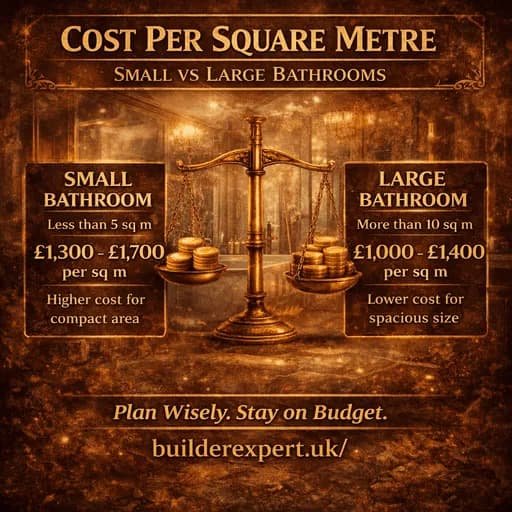
Bathroom size plays a crucial role in determining renovation costs, but not always in the way people expect. While larger bathrooms naturally require more materials, smaller bathrooms often cost more per square metre due to limited working space, tighter layouts, and a higher concentration of services. This makes size-based assumptions one of the most common sources of inaccurate budgeting.
A small bathroom of 4–5 square metres may require the same plumbing connections, electrical upgrades, ventilation, and waterproofing systems as a larger space. However, trades typically work less efficiently in compact areas, which increases labour time and costs. Restricted access, tight corners, and complex detailing all contribute to higher labour intensity in small bathrooms.
Larger bathrooms, by contrast, allow fixed costs to be spread across more surface area. While total costs may be higher, the average cost per square metre often decreases. A professional bathroom renovation cost estimator helps highlight this difference by analysing cost drivers beyond simple floor area measurements.
Rather than relying solely on square metre rates, a bathroom renovation cost estimator evaluates layout complexity, number of fixtures, service density, and sequencing requirements. For example, a large bathroom with minimal plumbing changes may cost less per square metre than a small bathroom with extensive service relocation.
The Bathroom Renovation Cost Estimator: Full Cost Breakdown for Materials and Labour enables realistic cost comparisons by accounting for both physical size and technical complexity. This approach avoids misleading averages and supports better financial decision-making during the planning stage.
Using structured estimating approaches ensures that size-related assumptions are properly tested. When size, layout, and scope are assessed together, budgets become more reliable and easier to manage.
By applying a bathroom renovation cost estimator that considers size alongside complexity, builders and homeowners gain a clearer understanding of true renovation costs and reduce the risk of budget surprises.
Hidden Costs That Most Bathroom Budgets Miss
Many bathroom renovation budgets fail because they overlook hidden or secondary costs. These costs rarely appear at the planning stage and usually emerge once demolition begins and existing conditions are exposed. Older properties, in particular, carry a higher risk of unforeseen issues that can quickly push a project beyond its original budget.
Common Hidden Costs in Bathroom Renovations
One of the most frequent hidden costs is replacing outdated or damaged pipework. Old plumbing systems may not meet current standards or may be unsuitable for modern fixtures. Electrical systems often require upgrading to comply with safety regulations, especially when additional lighting, ventilation, or electric showers are introduced.
Structural issues are another common surprise. Rotten floor joists, uneven substrates, or water damage behind walls are often discovered only after demolition. Improving ventilation to prevent future moisture problems, as well as paying for waste removal and skip hire, can also add unplanned expenses. A reliable bathroom renovation cost estimator helps identify these risks early and assigns realistic allowances before work begins.
Design Changes and Scope Creep
Design changes during construction are a major contributor to budget overruns. Switching tiles, upgrading fixtures, or altering layouts once work is underway usually leads to additional labour, material waste, and scheduling delays. Without clear cost control, these changes can accumulate quickly.
A structured bathroom renovation cost estimator helps quantify the financial impact of design decisions before they are approved. By showing how each change affects labour and materials, it supports better decision-making and prevents emotional or impulsive upgrades that strain the budget.
The Importance of Contingency Allowances
No renovation project is completely risk-free. This is why a structured bathroom renovation cost estimator includes contingency allowances, typically between 10–15% of the total project value. Contingency is not an optional extra; it is a necessary safeguard against unknown conditions and unavoidable variations.
Rather than treating contingency as unused money, professional estimating treats it as controlled risk management. When hidden issues arise, the contingency absorbs the cost without disrupting cash flow or project momentum. A well-prepared bathroom renovation cost estimator ensures that contingency is planned, justified, and used only when genuinely required.
By recognising hidden costs early and planning for uncertainty, bathroom renovation projects become more predictable, less stressful, and far more likely to finish within budget.
Why a Bathroom Renovation Cost Estimator Improves Accuracy
Accurate estimating is not about guessing lower numbers to win a project but about planning realistically from the start. In bathroom renovations, even small miscalculations can lead to major cost overruns. A bathroom renovation cost estimator improves accuracy by breaking the project into clear, measurable components that can be assessed, priced, and reviewed before work begins.
From Assumptions to Measurable Data
Traditional estimating often relies on assumptions, past experience, or rough averages. While experience is valuable, it is not enough on its own. A professional bathroom renovation cost estimator replaces assumptions with measurable data by identifying every task, material, and labour requirement involved in the renovation.
By separating the project into logical sections, such as demolition, plumbing, electrical work, waterproofing, tiling, and fit-out, a bathroom renovation cost estimator creates transparency. Each component can be reviewed individually, making it easier to validate costs and identify potential risks before construction starts.
Clear Separation of Labour and Materials
One of the key strengths of a bathroom renovation cost estimator is the clear separation between labour and material costs. Labour productivity rates, trade availability, and sequencing are analysed independently from material pricing. This avoids common mistakes where labour is under-allowed or material costs are grouped too broadly.
Professional estimating methods apply realistic productivity rates based on site conditions, bathroom size, and complexity. A structured bathroom renovation cost estimator also allows revisions without losing cost clarity. When changes occur, updated figures can be applied instantly without distorting the overall budget.
Why Software-Based Estimating Outperforms Spreadsheets
Spreadsheets and informal pricing methods struggle to handle the complexity of modern bathroom renovations. They often lack version control, detailed task breakdowns, and the ability to track revisions accurately. In contrast, a bathroom renovation cost estimator built on structured estimating principles maintains consistency throughout the project lifecycle.
The Bathroom Renovation Cost Estimator: Full Cost Breakdown for Materials and Labour demonstrates how structured estimating supports better decision-making. Builders gain confidence in their pricing, homeowners understand where their money is going, and discussions focus on value rather than surprises.
Building Client Confidence Through Accuracy
Accurate estimates build trust. When clients see a well-prepared bathroom renovation cost estimator, they are more likely to approve budgets, accept realistic timelines, and commit to informed decisions. Clear documentation reduces disputes, supports smoother project delivery, and improves overall satisfaction.
Ultimately, a bathroom renovation cost estimator is not just a pricing tool. It is a planning framework that improves budget control, reduces risk, and delivers more predictable outcomes for residential bathroom renovation projects.
Example Bathroom Renovation Estimate – UK Residential Project
Consider a mid-range residential bathroom renovation of approximately 6 square metres. The project includes standard plumbing relocation, electrical upgrades, waterproofing, ceramic wall and floor tiles, and the installation of modern fixtures. While the bathroom size is relatively modest, the scope of work is typical for many residential properties and highlights why structured cost planning is essential.
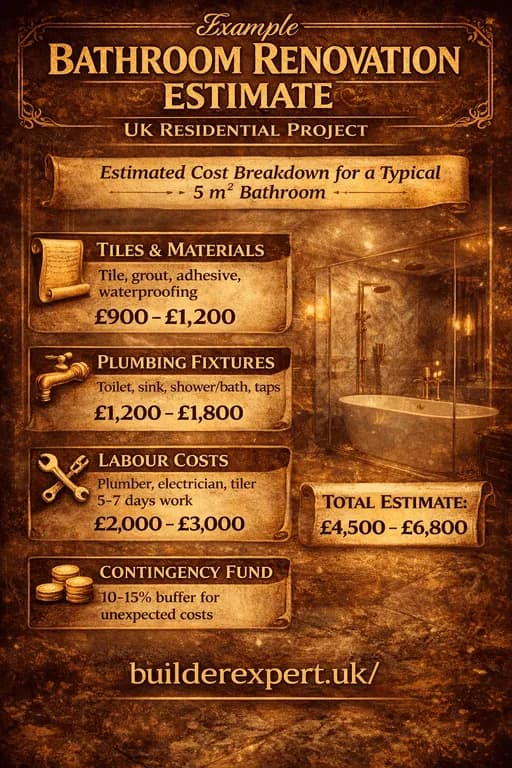
In this scenario, materials represent a controlled but significant portion of the budget. Ceramic tiles, sanitary ware, taps, waterproofing systems, and fittings are selected at mid-range quality to balance durability and cost. Labour is scheduled over a three to four-week timeline, allowing for proper sequencing of trades without unnecessary delays. A clear separation between materials and labour ensures that spending remains transparent throughout the project.
Using a bathroom renovation cost estimator, each phase of the renovation is priced individually. Demolition, plumbing, electrical work, tiling, and installation are allocated realistic labour hours based on site conditions and access. This structured approach makes it easier to monitor progress and identify potential risks before they escalate into cost overruns.
One of the key benefits of a bathroom renovation cost estimator in this type of project is predictable cash flow. When costs are broken down clearly, payments can be planned in line with progress milestones. This reduces financial pressure on both the builder and the homeowner and supports smoother project delivery.
Market benchmarks and regional cost data also play an important role in validating estimates. Referencing reliable industry sources such as https://www.bcis.co.uk/ helps ensure that material prices and labour rates reflect current UK conditions rather than outdated assumptions.
Overall, a mid-range renovation of this scale demonstrates how a bathroom renovation cost estimator improves transparency, supports realistic timelines, and reduces stress during construction. By applying structured estimating from the outset, both builders and homeowners gain confidence that the project can be delivered within budget and without unnecessary surprises.
Common Estimating Mistakes in Bathroom Renovations
Even experienced professionals make estimating mistakes when projects are rushed or poorly defined. Bathroom renovations often appear straightforward, which can lead to overconfidence during the estimating stage. Common errors include underestimating labour hours, ignoring preparation work, failing to include contingency allowances, and relying on outdated material prices that no longer reflect current market conditions.
One of the most frequent mistakes is under-allowing for labour. Small bathrooms, tight access, and sequencing issues often increase labour time, yet these factors are easily overlooked. A bathroom renovation cost estimator helps address this by breaking labour down by trade and task, making time requirements more visible and realistic.
Another recurring issue is assuming that previous projects provide an accurate pricing reference. Labour rates, material availability, and regulatory requirements change regularly. What was accurate six or twelve months ago may no longer apply. Without structured updates, estimates quickly become unreliable. A professional bathroom renovation cost estimator relies on current data and consistent pricing logic rather than assumptions based on past work.
Preparation work is also commonly ignored. Surface preparation, levelling, waterproofing preparation, and protection of adjacent areas are essential but often underestimated. When these tasks are missing from the estimate, they almost always result in additional costs during construction. Using structured estimating processes such as those outlined in https://builderexpert.uk/construction-project-workflow-builder-expert/ helps ensure that preparation activities are properly included.
Failing to include contingency is another major risk. Without a buffer for unforeseen issues, even minor variations can disrupt the entire budget. A reliable bathroom renovation cost estimator includes contingency as a planned and controlled element rather than an afterthought.
Ultimately, a bathroom renovation cost estimator helps eliminate common estimating mistakes by applying structured data, clear documentation, and consistent pricing methods. This leads to more accurate budgets, fewer disputes, and smoother project delivery for residential bathroom renovations.
Conclusion
Bathroom renovations may appear simple at first glance, but they involve multiple trades, detailed coordination, and strict budgeting control. Plumbing, electrical work, waterproofing, tiling, and finishing must all be carefully sequenced. Without a structured approach to estimating, even well-planned projects can experience cost overruns, delays, and unnecessary stress for both builders and homeowners.
A bathroom renovation cost estimator provides clarity, accuracy, and confidence throughout the entire project lifecycle. By breaking the renovation into measurable components, it allows costs to be reviewed, adjusted, and controlled before work begins. This level of preparation reduces uncertainty and supports better financial decision-making at every stage.
By using the Bathroom Renovation Cost Estimator: Full Cost Breakdown for Materials and Labour, builders and homeowners can plan realistically, monitor spending effectively, and respond to changes without losing control of the budget. Structured estimating not only protects profitability but also improves communication, builds trust, and leads to more successful bathroom renovation outcomes.
🔗 https://www.gov.uk/government/publications/the-construction-playbook
🔗 https://www.constructionleadershipcouncil.co.uk/
To contact us, click here and speak with our estimating team.