
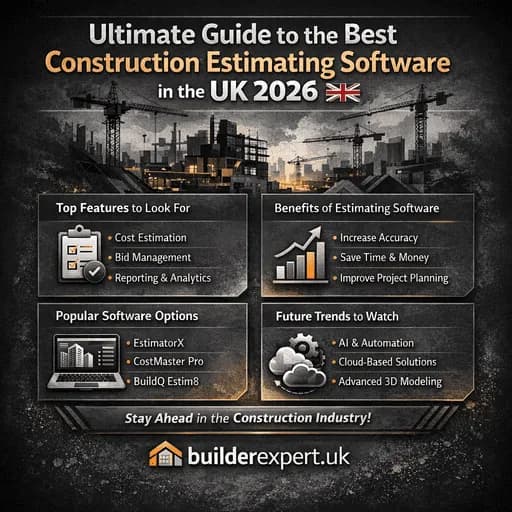
Accurate cost estimation remains one of the biggest challenges for UK residential builders. Rising material prices, labour shortages, and tighter client budgets mean that even small estimating errors can quickly turn a profitable project into a loss. Many contractors still rely on spreadsheets or manual calculations, which are slow, inconsistent, and difficult to update when costs change. These traditional methods also increase the risk of missed costs, duplicated entries, and poor version control across projects.
In 2026, digital tools are no longer optional for builders who want to remain competitive. The Best Construction Estimating Software enables residential contractors to move away from guesswork and towards structured, data-driven estimating. Instead of manually adjusting figures every time prices change, builders can rely on organised cost libraries, predefined templates, and automatic calculations that reflect real project conditions. Platforms such as professional estimating systems outlined by Builder Expert’s construction estimating software guide</a> demonstrate how modern tools improve accuracy and consistency across residential projects.
Another key advantage of using the Best Construction Estimating Software is improved cost control before work even begins. Clear, itemised estimates help builders understand where money is being spent and where risks may arise. This level of visibility supports better decision-making and reduces disputes with clients later in the build. According to industry guidance from the accurate and up-to-date cost data is essential for managing financial risk in the UK construction sector.
This guide explains how estimating software works, why it matters for residential construction, and how builders can choose the Best Construction Estimating Software to suit their business. By adopting the right digital tools, UK residential builders can protect profit margins, improve client confidence, and deliver projects with greater financial certainty.
Table of Contents
- What Construction Estimating Software Is
- Why UK Residential Builders Need Better Estimating in 2026
- Key Benefits of the Best Construction Estimating Software in the UK 2026
- Common Estimating Problems in Residential Projects
- Core Features to Look For
- Cloud vs Desktop Estimating Software
- Choosing the Right Software for Your Business Size
- Final Thoughts for UK Builders in 2026
What Construction Estimating Software Is
Construction estimating software is a digital system that helps builders calculate project costs accurately and consistently. It brings together labour, materials, subcontractor rates, overheads, and profit margins into one structured estimate. By centralising all cost elements, builders gain a clear overview of a project’s financial requirements before work begins, reducing uncertainty and improving planning.
Instead of starting from scratch each time, builders use templates and cost libraries to speed up pricing and maintain consistency across similar residential projects. The Best Construction Estimating Software is designed to support this process by allowing users to reuse proven estimate structures while still adjusting figures to suit each project’s scope. Guidance on how these systems are applied in practice can be found in detailed resources such as which explains how structured estimating improves accuracy and control.
Modern estimating tools also play a crucial role in reducing human error. Automatic calculations remove the risk of incorrect formulas, while standardised workflows ensure that no key cost items are overlooked. Version control allows builders to track changes to estimates as designs or specifications evolve, ensuring that the most up-to-date figures are always used. This is particularly important in residential construction, where small design changes can significantly affect overall costs.
By using the Best Construction Estimating Software, builders can also improve transparency with clients. Clear, itemised breakdowns make it easier to explain pricing decisions and manage expectations from the outset. Industry bodies such as the consistently highlight the importance of digital tools in improving efficiency and professionalism across the UK construction sector.
Ultimately, adopting the Best Construction Estimating Software helps residential builders work more efficiently, minimise risk, and maintain consistent pricing standards across all projects.
Why UK Residential Builders Need Better Estimating in 2026
Residential construction in the UK has become significantly more complex in recent years. Extensions, loft conversions, and refurbishments often involve tight site access, strict planning conditions, and high client expectations. Builders must work around existing structures, neighbouring properties, and occupied homes, all of which increase both risk and uncertainty during the estimating stage. At the same time, material prices fluctuate frequently, making outdated or static estimates increasingly risky for builders operating on tight margins.
Small changes in scope or specification can quickly impact overall project costs. Without a flexible estimating process, builders may struggle to keep estimates aligned with real-world conditions. This is where digital tools play an increasingly important role. The Best Construction Estimating Software helps residential builders respond to changing inputs by allowing costs to be reviewed and updated efficiently, rather than relying on fixed assumptions made early in the project.
As competition increases across the UK residential market, accuracy and responsiveness have become key differentiators. Builders who can produce clear, realistic estimates are better positioned to manage client expectations, protect profit margins, and deliver projects successfully despite growing complexity.
Responding Faster to Cost and Scope Changes
Using the Best Construction Estimating Software allows residential builders to respond quickly when project conditions change. When material prices rise or the scope of work shifts, estimates can be updated in minutes rather than hours. This flexibility is critical in today’s market, where delays in repricing can lead to underquoted jobs, reduced margins, or uncomfortable conversations with clients after work has already begun.
Digital estimating tools help builders stay in control by centralising all cost data in one place. Labour rates, material prices, and subcontractor costs can be reviewed and adjusted without rebuilding the estimate from scratch. With the Best Construction Estimating Software, every change is reflected consistently across the entire estimate, reducing the risk of missed costs or outdated figures being shared with clients.
Another important advantage is improved communication. When revisions are required, builders can clearly show clients what has changed and why. Itemised updates support transparency and help maintain trust, even when costs increase due to external factors beyond the builder’s control. Tools and workflows explained in show how digital estimating supports rapid and accurate revisions across residential projects.
In a fast-moving construction environment, responsiveness has become a competitive advantage. Builders who rely on manual methods often struggle to keep up, while those using the Best Construction Estimating Software can adapt quickly, protect profitability, and make informed decisions before small issues become major financial problems.
Improving Transparency and Client Trust
Clients now expect greater transparency before committing to a residential project. Clear, itemised estimates help explain where money is being spent and reduce misunderstandings later in the build. When costs are presented in a structured and professional way, clients feel more confident in both the pricing and the builder’s competence. This level of clarity is increasingly important in a market where budgets are closely scrutinised.
The Best Construction Estimating Software produces detailed cost breakdowns by trade and task, making estimates easier to justify and discuss during pre-contract stages. Builders can clearly show how figures are calculated, which supports honest conversations and helps avoid disputes once work is underway. Practical guidance on presenting professional estimates can be found in which explain how transparency improves project outcomes.
According to the improved clarity and communication are essential to reducing disputes across construction projects. By using the Best Construction Estimating Software, residential builders can set realistic expectations, strengthen client relationships, and create a smoother path from agreement to completion.
Staying Competitive in a Demanding Market
In a competitive market, professional estimates can be the difference between winning or losing a job. UK residential builders are increasingly competing on clarity, realism, and trust, not just price. Clients are more informed than ever and expect detailed, transparent breakdowns before committing to a project. Builders who rely on outdated methods such as spreadsheets or rough allowances often struggle to present estimates that reflect real-world conditions. As highlighted in the Ultimate Guide to the Best Construction Estimating Software in the UK 2026, digital estimating is no longer just about speed—it is about consistency, confidence, and control.
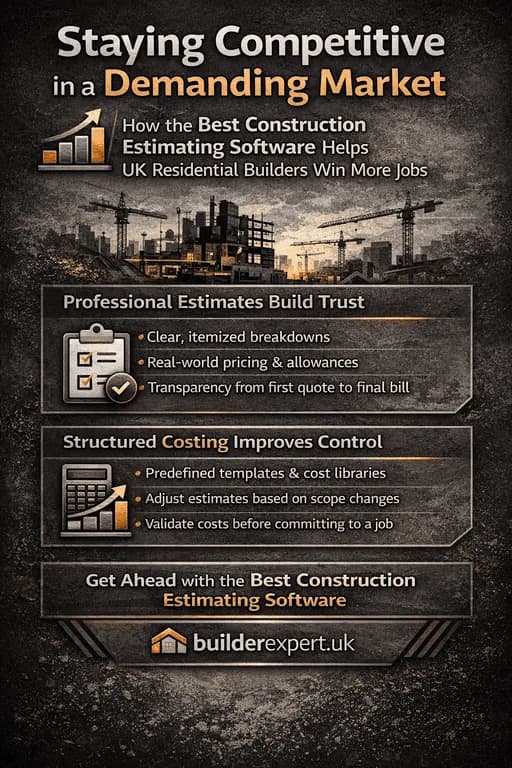
Structured estimating systems allow builders to apply the same logic, pricing rules, and cost assumptions across all projects, reducing risk and improving reliability. Further insights into how structured estimating improves accuracy and professionalism can be found in which explain how organised cost management supports better outcomes in residential construction.
Adopting the Best Construction Estimating Software also helps builders move away from reactive pricing decisions. Instead of adjusting figures under pressure, contractors can rely on predefined templates, historical cost data, and consistent workflows that support confident decision-making. This is particularly important in residential projects, where variations, design changes, and client requests are common. Digital estimating tools make it easier to assess the financial impact of changes before work begins, rather than absorbing costs later. Guidance on applying these principles in everyday projects is also outlined in which demonstrates how structured systems improve control from early planning through to completion.
By adopting the Best Construction Estimating Software, UK residential builders can manage complexity more effectively while maintaining visibility over costs. Clear, itemised estimates help protect profit margins by ensuring that all labour, materials, and overheads are properly accounted for from the outset.
Over time, consistent use of the Best Construction Estimating Software strengthens a builder’s reputation. Accurate estimates lead to fewer disputes, stronger client relationships, and projects that are delivered with greater financial certainty—key advantages in an increasingly demanding residential market.
Key Benefits of the Best Construction Estimating Software in the UK 2026
Clients now expect greater transparency before committing to a residential project. Clear, itemised estimates help explain where money is being spent and reduce misunderstandings later in the build. When costs are presented in a structured and professional way, clients feel more confident in both the pricing and the builder’s competence. This level of clarity is increasingly important in a market where budgets are closely scrutinised.
The Best Construction Estimating Software produces detailed cost breakdowns by trade and task, making estimates easier to justify and discuss during pre-contract stages. Builders can clearly show how figures are calculated, which supports honest conversations and helps avoid disputes once work is underway. Practical guidance on presenting professional estimates can be found in which explain how transparency improves project outcomes.
According to the improved clarity and communication are essential to reducing disputes across construction projects. By using the Best Construction Estimating Software, residential builders can set realistic expectations, strengthen client relationships, and create a smoother path from agreement to completion.
Common Estimating Problems in Residential Projects
Many residential builders face similar estimating issues, especially when relying on manual methods. Handwritten notes or basic calculations often miss small but critical costs such as waste removal, scaffolding adjustments, site access constraints, or specialist labour requirements. While each individual item may seem minor, together they can significantly affect the final project cost and reduce profit margins.
Spreadsheets are also difficult to maintain over time. When material or labour prices change, multiple formulas must be updated manually, increasing the risk of errors. A single incorrect cell can distort an entire estimate without being immediately noticed. Without proper version control, builders may send outdated estimates to clients, leading to confusion, disputes, or underpriced contracts. Research from the Building Cost Information Service highlights how volatile pricing conditions in the UK construction market make manual cost tracking increasingly unreliable.
The Best Construction Estimating Software addresses these challenges by centralising all project data into a single system. Instead of managing multiple spreadsheets, builders can store labour rates, material costs, and subcontractor pricing in one structured environment. When a cost is updated, the change is applied consistently across all related estimates, reducing the risk of inconsistencies. This approach aligns with wider digital transformation principles promoted by the which encourages standardisation and data-driven decision-making.
Another major advantage of using the Best Construction Estimating Software is improved accuracy over time. As builders complete more projects, they can analyse past estimates against actual costs, identifying patterns and improving future pricing. This continuous feedback loop is almost impossible to achieve with manual methods alone. Industry guidance from the consistently stresses the importance of digital tools in improving efficiency and reducing financial risk across construction projects.
By adopting the Best Construction Estimating Software, residential builders can eliminate repetitive errors, improve confidence in their pricing, and ensure that every estimate reflects current market conditions and project realities.
Core Features to Look For
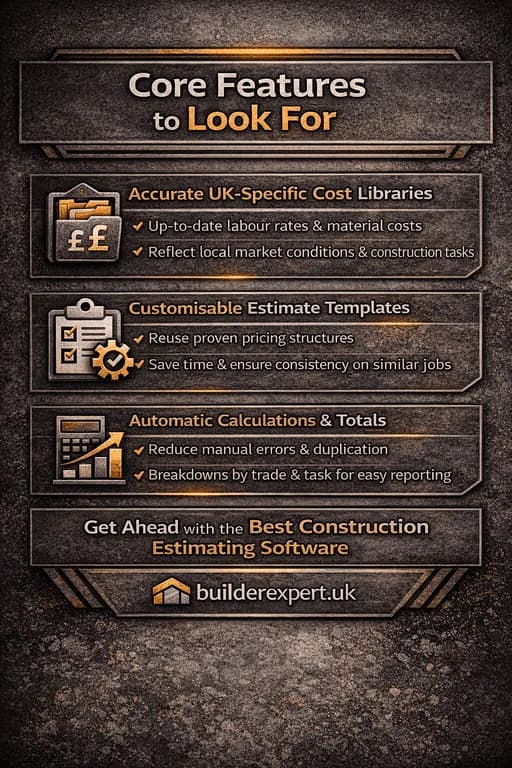
Not all estimating tools are the same, and residential builders should be careful when choosing a solution. Small to medium-scale projects have very different requirements compared to large commercial developments. Overly complex systems can slow down the estimating process instead of improving it. That is why builders should focus on features that directly support everyday residential work.
Key features include UK-specific cost libraries, which ensure that labour rates, materials, and typical construction tasks reflect local market conditions. Customisable estimate templates allow builders to reuse proven pricing structures for extensions, refurbishments, and new builds, saving time and improving consistency.
Automatic calculations and totals reduce the risk of manual errors, while clear breakdowns by trade and task make estimates easier to understand and manage. Resources such as explain how structured estimating improves control across residential projects.
The Best Construction Estimating Software should also allow builders to adjust labour rates and material costs easily. Prices in the UK construction market change frequently, and estimates must be updated quickly to remain accurate. Flexible cost editing ensures that builders are not relying on outdated figures when pricing new work. Detailed guidance on software capabilities can also be found in which outlines what residential builders should prioritise.
Reporting is another critical feature. Clear summaries help builders explain costs to clients and justify pricing decisions confidently. Well-presented reports also support internal planning and cash flow management. As highlighted throughout the Ultimate Guide to the Best Construction Estimating Software in the UK 2026, choosing tools that balance simplicity with accuracy is essential for long-term success.
Ultimately, the Best Construction Estimating Software helps residential builders work faster, price more accurately, and communicate more professionally with clients, all while maintaining control over project costs.
Cloud vs Desktop Estimating Software
In 2026, many residential builders prefer cloud-based solutions because of their flexibility and ease of access. Cloud estimating software allows builders to work from site, office, or home without installing complex systems on individual computers. This is especially valuable for small and medium-sized residential businesses where time and resources are limited, and teams often need to collaborate remotely.
The Best Construction Estimating Software often runs in the cloud, offering automatic updates and secure data storage. Builders no longer need to worry about manually updating cost databases or backing up files. Pricing data, templates, and estimates are stored centrally, ensuring that everyone is working with the most up-to-date information. Practical examples of how cloud-based estimating supports residential projects are outlined in which highlights the benefits of centralised cost management.
Desktop estimating software may still suit some builders who prefer offline access or work in areas with limited internet connectivity. However, desktop systems usually require manual updates, local backups, and individual installations. This can increase the risk of data loss or outdated estimates, particularly when multiple people are involved in the estimating process. Over time, maintaining desktop software can become time-consuming and less efficient.
For growing residential businesses, cloud solutions offer greater scalability. As project volumes increase, builders can add users, update pricing structures, and standardise workflows without changing systems. The **Best Construction Estimating Software** supports this growth by adapting to changing business needs rather than limiting them. Further insights into scalable estimating practices can be found in which explains how digital tools improve efficiency.
Ultimately, while both options have their place, the Best Construction Estimating Software gives residential builders the flexibility, security, and long-term efficiency needed to compete in the UK construction market.
Choosing the Right Software for Your Business Size
Small builders often need simplicity and speed. Large systems with unnecessary features can slow down estimating rather than help. The Best Construction Estimating Software in the UK 2026 for small residential contractors focuses on ease of use and clear outputs.
Medium-sized builders may need additional controls, such as cost tracking across multiple projects and standardised pricing rules. In both cases, the software should match the way the business actually works.
Before choosing any system, builders should consider:
- Number of projects per year
- Typical project value
- Team size and estimating experience
Final Thoughts for UK Builders in 2026
Accurate estimating is no longer just a technical task carried out at the start of a project. In today’s competitive UK residential market, it has become a core business skill that directly affects profitability, reputation, and long-term growth. Builders who consistently underprice work struggle with cash flow, while those who overprice risk losing clients to more efficient competitors. Relying on outdated methods makes it increasingly difficult to respond to changing market conditions.
The Best Construction Estimating Software provides structure, accuracy, and confidence throughout the estimating process. By using standardised templates, organised cost libraries, and automated calculations, builders can ensure that every estimate is complete and consistent. Detailed explanations of how structured estimating supports better decision-making can be found in which outline best practices for residential projects.
Modern estimating tools also improve communication with clients. Clear, professional breakdowns make it easier to explain costs and manage expectations from the outset. This reduces misunderstandings and helps build trust, which is essential for repeat work and referrals. As discussed in transparency in estimating plays a key role in project success.
By investing in the Best Construction Estimating Software, UK residential builders can work more efficiently, protect margins, and manage costs before problems arise. Over time, this approach helps businesses scale with confidence, strengthen their reputation, and remain competitive well beyond 2026.
🔗https://www.constructionleadershipcouncil.co.uk/
🔗https://www.gov.uk/government/publications/the-construction-playbook
📩 Get in touch with our teamhttps://builderexpert.uk/contact-builder-expert/