
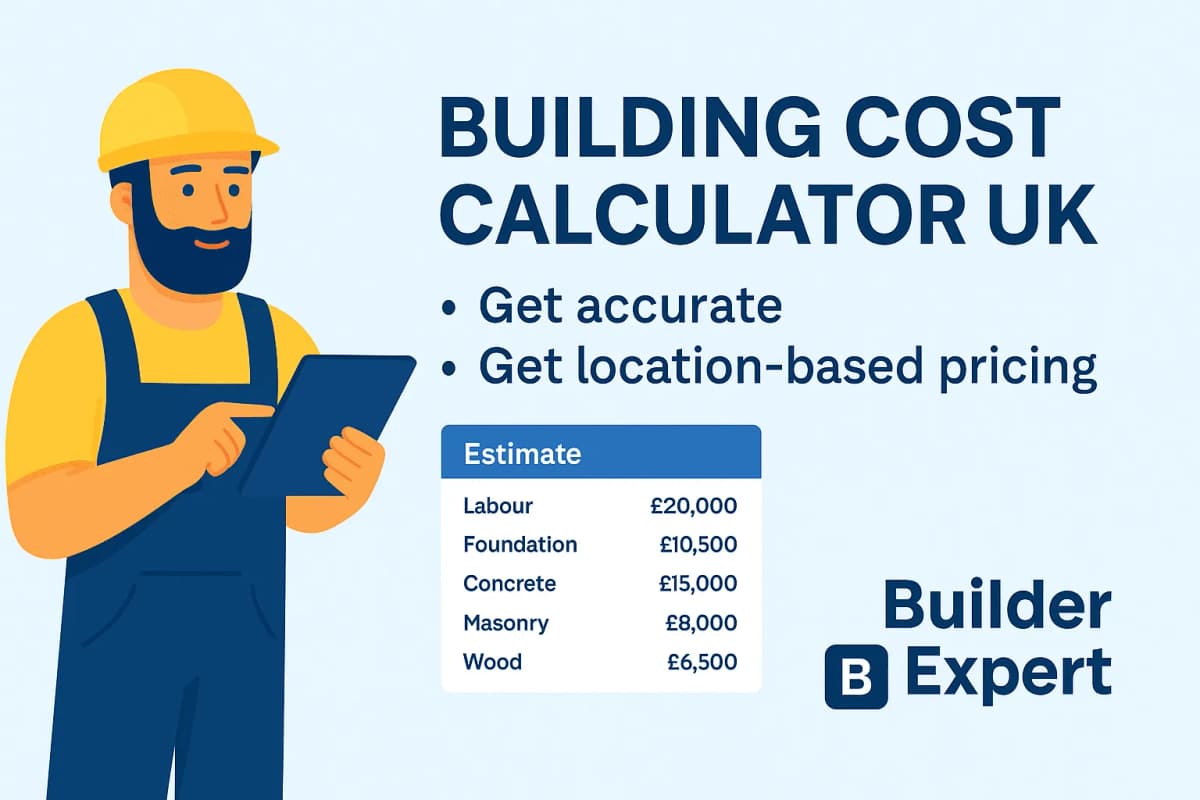
In short: UK building work typically costs between £1,400 and £3,000 per square metre in 2026, depending on specification, location and project type — so an average new home lands around £250,000. A building cost calculator turns those ranges into a project-specific, itemised estimate in minutes, using current UK material and labour rates instead of guesswork.
Worried about hidden costs in your next project? You're not alone — homeowners, developers and contractors all get caught out when a budget is built on rough guesses rather than real rates.
Builder Expert's Building Cost Calculator UK gives you accurate, location-based estimates fast, so you can plan with confidence from day one. Register for free and start estimating today.

Key takeaways
- UK building work costs roughly £1,400–£3,000 per m² in 2026, with the average new home near £250,000.
- A calculator converts those ranges into an estimate tailored to your project, location and spec.
- Labour alone makes up around 40–45% of a typical build — the single biggest variable to get right.
- UK building-material prices rose 6.0% in the year to June 2026, so estimates built on old rates drift fast.
- Suitable for homeowners, developers and contractors planning builds, extensions or renovations.
- Always add a contingency of around 10–15% on top of the headline figure.
How much does it cost to build in the UK in 2026?
Most UK building work costs £1,400 to £3,000 per square metre in 2026, depending on specification and location. On that basis a standard new-build home averages around £250,000, while a detached four-bedroom house with a standard spec typically runs from £320,000 to £400,000 or more.
These are starting ranges, not fixed prices. Two projects of the same size can differ by tens of thousands of pounds once you factor in finish quality, ground conditions and regional labour rates.
| Guide figure | Typical 2026 range | Source |
|---|---|---|
| Cost per square metre | £1,400–£3,000 | Checkatrade |
| Average UK new-build home | ~£250,000 | MyBuilder |
| Detached 4-bed, standard spec | £320,000–£400,000+ | MyBuilder |
| Labour as share of build cost | ~40–45% | Urbanist Architecture |
Two rules of thumb from the industry are worth building into any budget: labour accounts for around 40–45% of the total, so it's the number most worth pinning down, and it's sensible to hold back a contingency of roughly 10–15% for the extras a headline per-m² figure leaves out.

Why do building cost estimates go wrong?
Estimates go wrong when they lean on guesswork instead of current rates. UK construction is complex, and material and labour prices move constantly — according to government data, the material price index for all construction work rose 6.0% in the year to June 2026 (GOV.UK). A figure that felt right last year can be well out of date by the time work starts.
The usual culprits:
- Out-of-date rates — using old material or labour prices in a market that shifted 6% in a year.
- Missing scope — forgetting groundworks, fees, waste or finishes in the headline figure.
- No contingency — leaving nothing for the unexpected on site.
- Ignoring location — applying national averages to a high-cost region.
Any one of these can push a budget over and pile stress on everyone involved. A calculator built on live UK data removes the guesswork at the point it does the most damage — the very start.
What is the Building Cost Calculator UK?
The Building Cost Calculator UK is an online tool that estimates construction costs using a database of current UK-specific material and labour rates. You enter your project details and it returns a detailed, itemised cost breakdown in minutes — no spreadsheet, no waiting.
What sets it apart from a generic calculator:
- UK-specific rates — material and labour costs tailored to the UK market, not a global average.
- Regular updates — figures are refreshed to reflect market and regulatory changes.
- Detailed breakdowns — you see where the money goes, line by line.
That detail is what makes it useful for real budgeting, whether you're planning a small fix-up or a full build, and helps you present a clear, transparent figure to clients or lenders.
How does the calculator work?
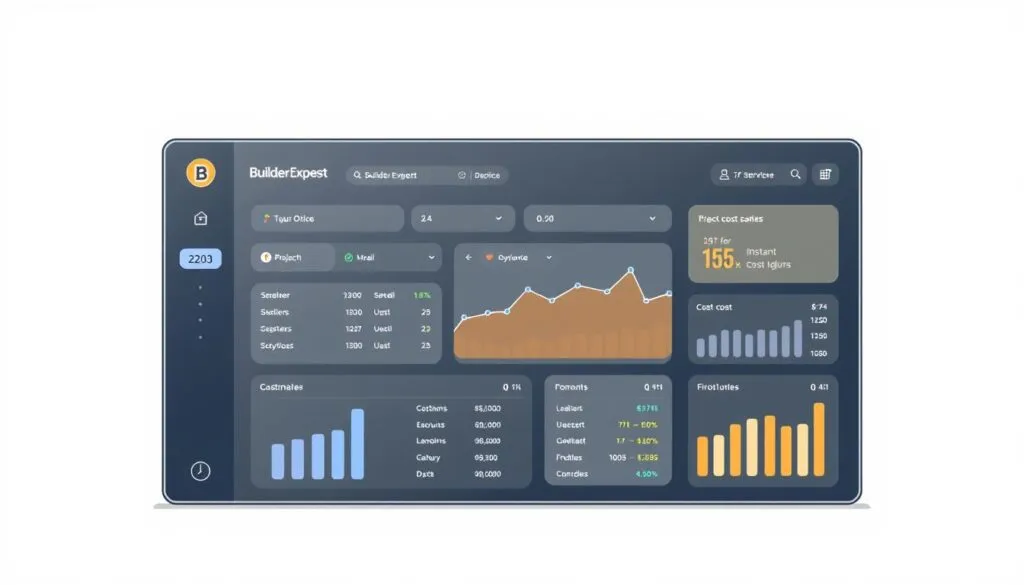
The calculator combines your project inputs with a database of current UK rates, then applies estimating logic to produce a costed breakdown. Because labour is such a large share of any build — around 40–45% of the total — it weights labour and materials separately rather than lumping them into a single rate.
The underlying rates draw on trusted UK sources — leading material suppliers such as Travis Perkins, Jewson and Wickes, alongside contractor feedback and industry pricing — so estimates stay grounded in what things actually cost right now. It also reflects the latest UK building regulations, so your plan starts on a compliant footing.
The result is a full view of your project's costs that you can download and share, rather than a single vague number.

What projects can you estimate with it?
The calculator covers residential, commercial and renovation work, using up-to-date material and labour rates for each. That means one tool for most of what UK homeowners, developers and builders take on.
Residential construction
For homeowners and builders planning new homes — from single houses to custom builds and apartment blocks. Enter materials, labour and project size and the tool returns a precise, UK-rated estimate.
Commercial building
For developers planning offices, retail units or industrial facilities. It accounts for the specialist labour and materials commercial projects demand.
Renovation and extension
For kitchen and bathroom refits, loft conversions, house extensions and garage builds. It's built to handle the added complexity of working around an existing structure.
How do building costs vary by UK region?
Location is one of the biggest drivers of cost. London and the South East are consistently the most expensive places to build in the UK, thanks to higher labour rates, stronger demand for materials and competitive tendering. Northern England, Wales and Scotland typically sit below the national average — though skilled-labour availability and local rules bring their own challenges.
This is exactly why a national per-m² figure can mislead: the same house can cost noticeably more inside the M25 than in the North East. The calculator applies a location adjustment to your inputs, so your estimate reflects where you're actually building rather than a UK-wide average.

How do you use the Building Cost Calculator UK?
Using the calculator takes three steps: enter your project details, review the costed breakdown, then save and compare estimates. Most people get a usable figure in a few minutes.
- Input your project details. Tell the tool whether it's residential or commercial, then give the location, the floor area to be built or renovated, and the type of work. The more accurate your inputs, the more accurate the estimate.
- Review your results. You'll get a detailed breakdown across materials, labour and more, with the biggest cost drivers highlighted — so you can see where there's room to trim.
- Save and compare. Store multiple estimates and view them side by side to weigh up options, specs or budgets before you commit.

Calculator vs quantity surveyor vs generic online tools
A calculator sits between a full quantity surveyor and a generic online estimator: far quicker and cheaper than a QS, and far more accurate than a one-size-fits-all web tool. For early-stage budgeting, that balance is usually exactly what you need.
| Feature | Quantity surveyor | Generic online tool | Building Cost Calculator UK |
|---|---|---|---|
| Cost | High | Free/low | Low |
| Speed | Days | Instant | Instant |
| UK-specific rates | Yes | Rarely | Yes |
| Detailed breakdown | Yes | No | Yes |
| Updates with the market | Manual | Rarely | Regularly |
A quantity surveyor is still the gold standard for large or complex jobs, and worth the fee at that scale. But for planning, comparing options and pricing quotes, a digital estimator gives you most of the accuracy in a fraction of the time — and its consistency helps you present a clear estimate to clients.

How does it keep up with market changes?
Material prices can move sharply with global events and supply pressures — official UK figures show construction material prices rose 6.0% in the year to June 2026 (GOV.UK) — so estimates built on last year's rates quickly drift. Because the calculator draws on regularly updated UK data, you can re-run an estimate as prices shift and keep your budget grounded in current conditions rather than stale figures.
That means you can track how cost changes affect your project over time, and adjust your budget and contingency before a gap becomes a problem on site.

How accurate is a building cost calculator?
A good calculator gets you within a reliable planning range — accurate enough to set a budget, secure finance and compare options, but not a replacement for a formal, measured quote on a complex job. Accuracy depends on the quality of your inputs: the more precise your floor area, spec and location, the tighter the estimate.
For most homeowners and builders it closes the gap between a wild guess and a full quantity-surveyor report — fast enough to run several scenarios, detailed enough to trust. For large or unusual projects, use it to frame the budget, then confirm with a QS before you commit.
Take the guesswork out of your construction budget
A building cost calculator replaces rough guesses with precise, itemised estimates built on current UK rates — so you can plan, compare and quote with confidence. It shows every cost, from materials to labour, and keeps pace as the market moves.
Estimate smart, build right. Register for free with Builder Expert, upload your plans, and start with a clear financial picture of your project today.