
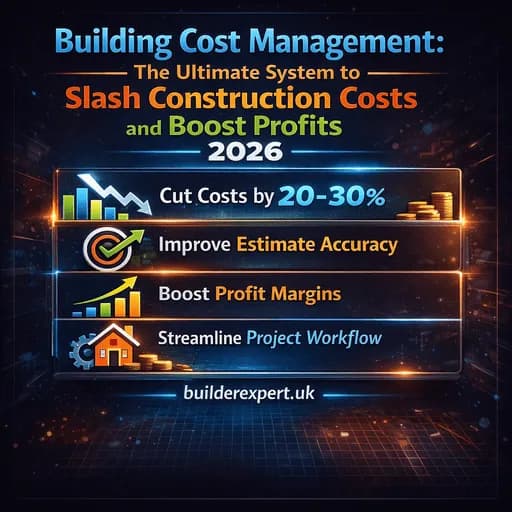
Building Cost Management is one of the most critical challenges facing the construction industry in 2026, as rising material prices, labour shortages, and shrinking profit margins continue to put pressure on residential builders and contractors.Residential builders and contractors are expected to deliver high-quality projects on time and on budget, while clients demand greater transparency, detailed cost breakdowns, and accurate forecasts from day one. In this environment, even small pricing errors or uncontrolled variations can quickly turn a profitable residential project into a financial liability.
Without a structured and disciplined approach to cost control, many builders rely on outdated estimates, disconnected spreadsheets, or reactive decision-making once construction is already underway. The result is often the same: budget overruns, reduced margins, and lost confidence when pricing future work. This is precisely why the principles outlined in “Building Cost Management: The Ultimate System to Slash Construction Costs and Boost Profits 2026” are no longer optional for modern construction businesses.
This is where Building Cost Management becomes a critical business system rather than a back-office task. When implemented correctly, it allows residential builders to forecast costs accurately, control spending in real time, and protect profitability across every stage of a project. Instead of reacting to financial problems after they appear, contractors gain the ability to identify risks early and take corrective action before margins are compromised.
Modern Building Cost Management also depends heavily on structured estimating and planning processes. Tools such as professional construction estimating software and proven construction estimating methods provide the foundation for reliable budgets and consistent financial control. When these systems are combined with live cost tracking and reporting, builders gain a clear financial picture of each residential project at all times.
In this article, we break down a modern, practical framework for Building Cost Management that works in real-world residential construction environments in 2026. The goal is simple: help builders reduce unnecessary costs, protect profit margins, and run more predictable, scalable construction businesses.
What Is Building Cost Management?
Building Cost Management is the structured process of planning, estimating, monitoring, and controlling all costs associated with a construction project from concept to completion. It goes far beyond basic estimating or spreadsheet tracking, providing builders with a complete financial framework that supports decision-making throughout the entire project lifecycle.
At its core, Building Cost Management integrates material pricing, labour rates, subcontractor costs, overheads, and contingencies into a single, connected system. Instead of treating estimating, budgeting, and cost tracking as separate tasks, this approach ensures that all financial data is aligned and continuously updated as the project progresses. As a result, decisions are based on accurate, current information rather than assumptions or outdated figures.
Modern Building Cost Management relies heavily on structured estimating processes and digital tools. Professional construction estimating software enables builders to create detailed cost breakdowns, apply consistent pricing logic, and generate reliable budgets from the outset. These estimates then form the financial baseline for ongoing construction cost planning and control, allowing builders to track actual spend against forecasts in real time.
For residential builders, effective Building Cost Management means knowing exactly where money is being spent, where financial risks exist, and how design changes or variations will impact final profitability before they become problems. This level of visibility is especially important in today’s market, where material prices fluctuate and labour availability can change rapidly. According to UK industry guidance from, accurate cost data and continuous monitoring are essential for maintaining financial stability in residential construction projects.
Ultimately, Building Cost Management transforms cost control from a reactive exercise into a proactive system. Builders who adopt this approach gain greater confidence when pricing work, stronger control during delivery, and clearer insights that improve profitability across future residential projects.
Why Building Cost Management Is Critical in 2026
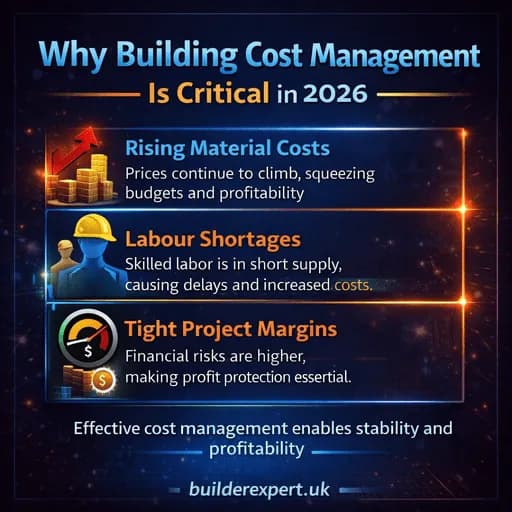
Construction costs are no longer stable. Material prices fluctuate monthly, labour availability changes rapidly, and regulatory requirements continue to evolve across the UK construction sector. In this environment, relying on outdated estimates or static budgets is one of the fastest ways for residential builders to lose money. Even well-planned projects can quickly fall off track when cost assumptions are not reviewed and adjusted in real time.
Building Cost Management provides builders with financial visibility at every stage of a residential project. Instead of reacting to cost overruns after they occur, contractors can anticipate them early and take corrective action before profit margins are damaged. This proactive approach is especially important in 2026, where inflationary pressures and supply chain volatility continue to affect residential construction.
Modern Building Cost Management is closely linked to accurate estimating and structured cost planning. Using professional building estimating software allows contractors to base decisions on consistent, data-driven cost models rather than assumptions. When estimates are connected to live cost tracking, builders gain a clear understanding of how changes in materials, labour, or scope affect overall project viability.
From a regulatory and policy perspective, effective cost control is increasingly becoming a strategic requirement rather than a best practice. Guidance such as the UK Government’s **Construction Playbook** emphasises the importance of early cost planning, cost transparency, and long-term value creation in construction projects. Although the framework is primarily designed for public sector procurement, its principles are now shaping expectations across the wider residential and private construction markets.
In 2026, builders who treat Building Cost Management as a strategic advantage—rather than an administrative burden—are the ones who win more work, price more confidently, and scale sustainably. Strong cost management is no longer just about avoiding losses; it is a key driver of competitive advantage in modern residential construction.
The Core Pillars of Building Cost Management
A successful Building Cost Management system is built on several core pillars that work together to create consistency, accuracy, and financial control across residential construction projects. When these pillars are applied in isolation, cost management remains reactive. When they are aligned, it becomes a scalable business system.
The first pillar is accurate upfront estimating. This step establishes a realistic financial baseline for the entire project. Without a detailed and structured estimate, every decision that follows is compromised. Inaccurate assumptions at this stage often lead to underpriced work, unrealistic client expectations, and margin erosion during delivery. Using proven estimating frameworks and tools such as ensures that early budgets are grounded in real data rather than optimism.
The second pillar is cost planning. Once an estimate is approved, costs must be allocated correctly across trades, materials, preliminaries, and project phases. Effective cost planning transforms a static estimate into a working financial plan. This process allows builders to understand cash flow requirements, identify high-risk cost areas, and manage resources efficiently throughout the build.
The third pillar is continuous cost tracking. Comparing actual spend against forecasts in real time allows builders to spot deviations early and take corrective action. Modern Building Cost Management systems rely on integrated workflows and tools, such as those outlined in to ensure cost data remains accurate and up to date.
The final pillar is reporting and analysis. Regular financial reporting allows builders to review performance, refine future estimates, and improve margins over time. Industry bodies such as the consistently emphasise the importance of data-driven decision-making in improving construction productivity and profitability.
When these pillars are aligned, Building Cost Management becomes a repeatable system rather than a one-off task. This is the foundation of the approach outlined in Building Cost Management: The Ultimate System to Slash Construction Costs and Boost Profits 2026—a framework designed to help residential builders achieve long-term financial control and sustainable growth.
Common Cost Control Mistakes Builders Still Make
Many residential builders believe they are managing costs effectively, yet the same mistakes continue to undermine profitability across projects of all sizes. One of the most damaging issues is separating estimating from project delivery. In practice, this means the original budget is approved, filed away, and never properly monitored once construction begins. When costs are not actively tracked against the estimate, overspending becomes invisible until it is too late to correct.
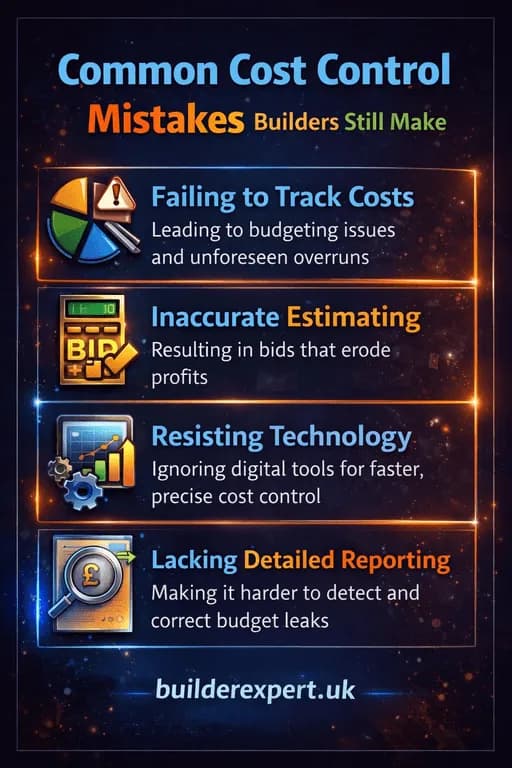
Another frequent and costly mistake is failing to update budgets when variations occur. Design changes, material substitutions, and client requests are inevitable in residential construction. Without a strong Building Cost Management process, these small changes quietly accumulate into major overruns. Builders often assume variations will “balance out” by the end of the project, only to discover that margins have been eroded beyond recovery.
Manual cost tracking further increases financial risk. Disconnected spreadsheets, delayed invoice processing, and inconsistent reporting create blind spots in project finances. When cost data is fragmented, builders lose the ability to make informed decisions in real time.
Modern residential projects demand integrated workflows, not reactive end-of-project reconciliations. Tools that support structured estimating and tracking, such help eliminate these gaps by linking tasks, budgets, and actual spend.
Industry guidance consistently reinforces this point. Organisations such as the highlight the importance of continuous cost monitoring and early intervention to protect project value and productivity.
Avoiding these mistakes requires a disciplined approach where Building Cost Management is embedded into daily project workflows, not reviewed only at the end. Builders who integrate cost control into planning, procurement, and site operations gain clarity, reduce risk, and maintain control over profit margins from start to finish.
How Building Cost Management Improves Profit Margins
Profit is not created at the end of a project—it is protected throughout it. Residential construction margins are often lost gradually through small inefficiencies, untracked variations, and delayed decisions. Building Cost Management allows contractors to identify margin erosion early and respond strategically, before financial damage becomes irreversible.
By tracking costs at task and trade level, builders gain clear visibility into which areas of a project are underperforming. Labour overruns, material waste, or subcontractor inefficiencies can be identified in real time rather than discovered during final reconciliation. This level of insight enables builders to take corrective action while options still exist, whether that means adjusting workflows, renegotiating procurement, or managing scope changes more effectively.
Accurate forecasting is another critical benefit. When cost data is consistently tracked and analysed, builders can price future residential projects with far greater confidence. Instead of relying on assumptions or “gut feel,” estimates are based on real performance data from previous builds. This reduces the need to guess margins and significantly lowers the risk of underpricing work. Using structured systems such as ensures that profitability is built into projects from the outset.
Consistent Building Cost Management also improves cash flow, which is often a bigger challenge than headline profit. When builders understand when costs are incurred and how they align with payment schedules, they can plan cash requirements more accurately and avoid unnecessary financial strain. Integrated tools like support this by linking budgets, actual spend, and forecasting into a single system.
Over time, disciplined Building Cost Management leads to stronger cash flow, more predictable profits, and increased confidence when tendering for residential work. Builders who control costs consistently are better positioned to scale their businesses, take on larger projects, and compete on value rather than price alone.
Technology and Modern Building Cost Management Systems
.In 2026, effective Building Cost Management is impossible without digital tools. Residential construction projects are simply too complex, fast-moving, and data-heavy to be controlled using manual processes or disconnected spreadsheets. Modern platforms centralise estimating, budgeting, and cost tracking into a single environment, reducing errors, eliminating duplication, and significantly improving speed and accuracy.
Cloud-based systems allow builders to access live cost data from anywhere, update estimates instantly, and collaborate with teams in real time. This is particularly valuable for residential projects, where decisions are often made on site and variations must be assessed quickly. When cost data is available immediately, builders can evaluate the financial impact of changes before approving them, rather than discovering problems weeks later.
Modern Building Cost Management platforms also create a direct link between estimating and project delivery. Estimates are no longer static documents; they become active financial models that evolve as the project progresses. Tools such as enable builders to track actual costs against forecasts continuously, providing clear insight into where projects are performing well and where intervention is required.
Another key advantage of digital systems is consistency. Standardised templates, structured cost breakdowns, and automated calculations reduce reliance on individual judgement and minimise the risk of human error. Builders who follow structured workflows, such as those outlined in, benefit from repeatable processes that improve predictability across all residential projects.
Technology does not replace experience—it amplifies it. By providing accurate, real-time data when decisions matter most, digital tools allow experienced builders to apply their knowledge more effectively. When combined with disciplined processes, Building Cost Management systems transform cost control from a reactive exercise into a proactive, strategic advantage.
Applying Building Cost Management Across Residential Projects
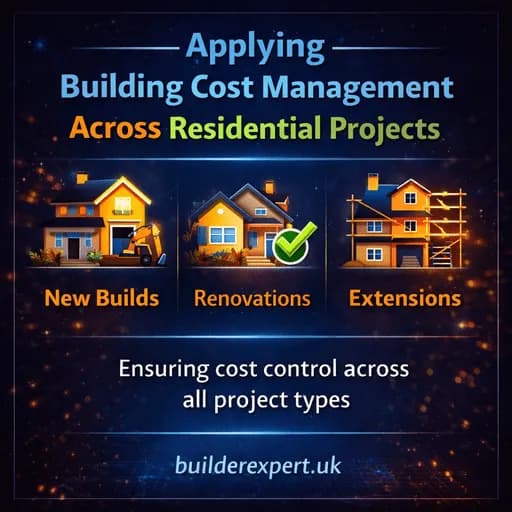
Residential construction presents unique challenges: tight margins, frequent client-driven changes, and fast-moving schedules that leave little room for financial error. In this environment, Building Cost Management must be flexible enough to adapt to change while remaining structured and disciplined. Without this balance, even well-planned residential projects can quickly drift off budget.
From small home extensions to full new-build developments, applying consistent cost control processes ensures that each project benefits from lessons learned previously. Standardised estimating methods, clear cost breakdowns, and regular financial reviews allow builders to carry proven practices from one project to the next. Over time, this consistency reduces uncertainty and improves pricing confidence across all types of residential work.
When builders standardise Building Cost Management across their residential portfolio, they reduce risk and increase efficiency at scale. Financial performance becomes more predictable, decision-making improves, and teams develop a shared understanding of cost control expectations. This structured approach aligns closely with the principles outlined in Building Cost Management: The Ultimate System to Slash Construction Costs and Boost Profits 2026, where repeatable processes form the foundation of long-term profitability.
External industry guidance reinforces the importance of this consistency. Organisations such as the Construction Leadership Council</a> emphasise structured planning, transparency, and continuous improvement as key drivers of performance across the UK construction sector. Applying these principles at residential level allows builders to operate with greater control, resilience, and confidence as projects increase in size and complexity.
Measuring Success in Building Cost Management
The success of Building Cost Management is measured not just by staying within budget, but by improving predictability and profitability over time. Residential builders who focus only on whether a project finished “on budget” often miss deeper performance signals. More meaningful indicators include reduced cost overruns, improved estimate accuracy, stronger gross margins, and fewer financial surprises during delivery.
Tracking these indicators consistently requires structured data and disciplined review processes. Comparing estimated costs against actual outcomes at task and trade level highlights where assumptions were accurate and where adjustments are needed. Over time, this insight allows builders to refine pricing strategies and improve the reliability of future estimates. Using structured frameworks such as professional construction estimating processes ensures that performance measurement is consistent across all residential projects.
Regular reviews and post-project analysis turn cost control into a continuous improvement loop. Instead of treating each build as a standalone exercise, builders can apply lessons learned to future work. Analysing labour productivity, material usage, and subcontractor performance helps identify repeatable efficiencies and eliminate recurring issues. Platforms that support structured workflows, such as integrated construction project workflows, make this analysis faster and more reliable.
When used consistently, this review process strengthens Building Cost Management as a long-term business system. Each completed project improves the accuracy of the next, leading to more predictable outcomes, healthier margins, and greater confidence when pricing and delivering residential construction work.
Conclusion
In 2026, residential builders can no longer afford to treat cost control as an afterthought. Rising prices, tighter margins, and increased client expectations mean that every financial decision has a direct impact on profitability. Building Cost Management is the system that connects estimating, planning, and delivery into a single, coherent financial strategy—one that supports better decisions from the first quote to final handover.
When cost control is approached systematically, builders gain clarity and confidence at every stage of a project. Accurate estimates provide a strong foundation, structured cost planning keeps budgets aligned, and continuous tracking ensures that deviations are identified early. Tools and frameworks such as modern construction estimating software and proven building estimating principles play a critical role in making this process reliable and repeatable.
When applied consistently, Building Cost Management helps builders slash unnecessary costs, protect profit margins, and run more confident, scalable residential construction businesses. It transforms cost control from a reactive exercise into a proactive management discipline. Builders who adopt this approach are better positioned to price work accurately, manage risk effectively, and compete on value rather than price alone.
In today’s residential construction market, strong cost management is no longer optional. It is a competitive necessity—and a defining factor between businesses that struggle to maintain margins and those that grow sustainably year after year.
Frequently Asked Questions (FAQ)
1. What is Building Cost Management in residential construction?
Building Cost Management in residential construction is the structured approach to planning, estimating, tracking, and controlling project costs from initial design through to completion. It ensures that budgets remain aligned with actual spend and that financial decisions are based on accurate, up-to-date information rather than assumptions.
2. Why is Building Cost Management important for builders in 2026?
In 2026, rising material prices, labour shortages, and increased market volatility make cost control a critical business priority. Building Cost Management helps residential builders anticipate financial risks early, respond proactively to cost changes, and protect profit margins in an increasingly competitive environment.
3. How does Building Cost Management differ from basic estimating?
a) Basic estimating focuses only on pricing a project at the start.
b) Building Cost Management connects the initial estimate to continuous cost tracking, forecasting, and reporting throughout the build.
c) This allows builders to manage costs proactively rather than reviewing performance only at project completion.
4. Can small residential builders benefit from Building Cost Management?
Yes. Building Cost Management is especially valuable for small and medium-sized residential builders where margins are tight and financial errors have a greater impact. A structured cost management approach improves pricing confidence, cash flow predictability, and long-term business stability regardless of company size.
5. What tools support effective Building Cost Management?
a) Digital estimating and budgeting platforms
b) Integrated cost tracking and reporting systems
c) Cloud-based construction estimating software that links pricing, budgets, and actual spend https://builderexpert.uk/construction-project-workflow-builder-expert/
🔗http://• https://www.bcis.co.uk/
🔗http://• https://www.gov.uk/government/publications/the-construction-playbook
🔗http://• https://www.constructionleadershipcouncil.co.uk/
✦ Contact us for professional estimating services:https://builderexpert.uk/contact-builder-expert/