

Building Renovation Cost Estimation Software is no longer a luxury for professionals working on historic and high-risk renovation projects. It has become a critical operational requirement for accuracy, risk control, and long-term financial survival in complex building restorations where uncertainty is unavoidable and margins are constantly under pressure.
Historic renovation projects differ significantly from standard residential construction. Original drawings are often missing, materials may be protected or obsolete, and structural conditions can only be partially assessed before work begins. In these conditions, manual spreadsheets or generic tools fail to reflect real project risk. This is why Building Renovation Cost Estimation Software has become essential for professionals who need structured, defensible cost planning from the earliest stages of a project. Modern estimating platforms, such as those explained in professional construction estimating software, allow estimators to break down costs systematically while accounting for uncertainty and phased work.
Another major challenge in historic renovation is regulatory compliance. Planning restrictions, conservation requirements, and approval delays can add significant cost if not anticipated early. Without a clear estimating framework, these risks often emerge too late. Advanced estimating workflows, aligned with established construction estimating principles, help professionals forecast regulatory impacts before they affect programme and cash flow. This approach is particularly important in high-risk renovation environments where budget flexibility is limited.
Building Renovation Cost Estimation Software also supports transparency and trust between contractors, clients, and stakeholders. Detailed estimates, version control, and cost histories allow teams to explain pricing decisions clearly and justify changes when unexpected conditions arise. As outlined in modern building estimating software guidance for the UK industry, this level of clarity is increasingly expected in professional renovation work.
In this article, we explore how Professional Historic Building Renovation Cost Estimation Software for High-Risk Projects strengthens decision-making, protects budgets, and delivers financial control in one of the most demanding segments of the construction industry, where precision is not optional but essential.
Understanding the Complexity of Historic Building Renovations
Historic buildings differ significantly from modern structures, both in their physical composition and in the way renovation work must be planned and executed. Materials are often undocumented, construction methods are outdated, and original structural calculations may no longer exist. In many cases, the true condition of load-bearing elements, foundations, and concealed services can only be partially assessed before work begins. This creates a level of uncertainty that makes early-stage budgeting particularly fragile. In such environments, assumptions replace facts unless a structured estimating approach is in place.
Using generic estimating tools or simple spreadsheets creates dangerous blind spots in historic renovation projects. These tools are typically designed for predictable, repeatable construction scenarios and fail to account for phased investigations, hidden defects, and conservation-driven interventions. Building Renovation Cost Estimation Software designed specifically for complex renovation work addresses these gaps by allowing estimators to break projects into logical stages, assign provisional sums intelligently, and manage contingencies in a controlled way. As outlined in professional approaches to construction estimating, this structure is essential when scope clarity evolves gradually rather than upfront.
Another critical challenge is the cumulative impact of small discoveries. In historic buildings, minor findings such as decayed timbers, incompatible past repairs, or non-compliant materials can quickly escalate into major cost drivers. Without a system that tracks these changes in real time, budgets lose credibility. Building Renovation Cost Estimation Software enables dynamic updates, ensuring that every new discovery is reflected immediately in the overall cost forecast. This prevents the disconnect between site reality and financial reporting that often undermines high-risk renovation projects.
Professional Historic Building Renovation Cost Estimation Software for High-Risk Projects goes further by applying risk-weighted costing models. Instead of treating uncertainty as a single contingency line, it distributes risk across relevant work packages, providing a more realistic financial picture. As highlighted in modern building estimating software guidance for the UK industry, this approach supports better decision-making, clearer client communication, and stronger cost control throughout the project lifecycle.
By combining structured breakdowns, live revisions, and transparent risk modelling, Building Renovation Cost Estimation Software becomes a foundational tool for managing uncertainty in historic renovation projects where precision and accountability are essential.
Why High-Risk Renovation Projects Require Advanced Cost Estimation
High-risk projects amplify small errors into major financial losses, especially in complex renovation environments where uncertainty is the norm rather than the exception. A single miscalculated structural repair, an overlooked conservation requirement, or a delayed compliance approval can add tens of thousands of pounds to a project almost overnight. In historic renovations, these risks are compounded by restricted access, specialist labour, and materials that are difficult to source or replicate. Without precise financial modelling, even experienced professionals can find themselves reacting to problems rather than controlling them.
This is why Building Renovation Cost Estimation Software must go far beyond basic pricing or static cost summaries. High-risk renovation work requires estimation systems that support scenario planning, allowing teams to evaluate multiple outcomes before committing resources. By modelling best-case, expected, and worst-case scenarios, professionals gain a realistic understanding of potential exposure. As outlined in established construction estimating practices, this proactive approach transforms cost estimation from a reactive task into a strategic decision-making tool.
Version control is another critical requirement in high-risk projects. Renovation scopes evolve constantly as site conditions change, approvals are granted, or unforeseen issues are uncovered. Without a structured system, cost updates become fragmented, leading to confusion and loss of accountability. Building Renovation Cost Estimation Software ensures that every revision is tracked, documented, and aligned with the latest project assumptions, preserving financial clarity throughout the project lifecycle.
Real-time cost tracking further strengthens budget control by connecting site discoveries directly to financial forecasts. Instead of waiting for periodic reviews, estimators can update costs as issues arise, maintaining alignment between site reality and financial reporting. Professional Historic Building Renovation Cost Estimation Software for High-Risk Projects provides this visibility, enabling teams to understand how each decision impacts the overall budget before those decisions are implemented on site.
By combining scenario modelling, structured revisions, and live cost updates, Building Renovation Cost Estimation Software empowers professionals to manage risk proactively rather than absorb losses after the fact. In high-risk renovation environments, this level of financial foresight is not optional—it is essential for protecting both profit and reputation.
Key Risks in Historic Building Renovation Projects
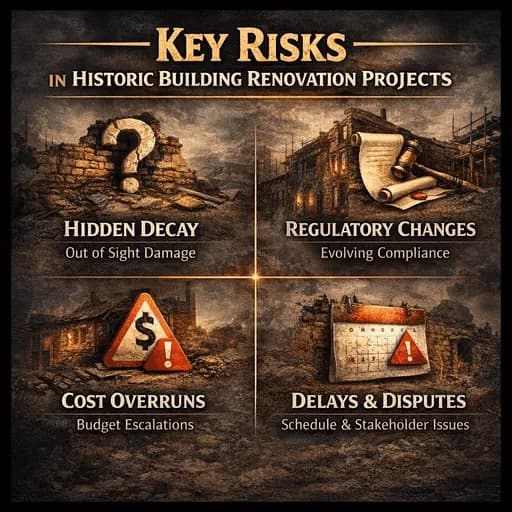
Historic renovations introduce a range of cost-related risks that standard renovation projects rarely encounter. Unknown structural decay hidden behind walls or beneath floors can significantly alter the scope of work once construction begins. Heritage material sourcing presents another major challenge, as original or compliant replacement materials are often scarce, expensive, and subject to long lead times. In addition, conservation-grade workmanship requires specialist labour with higher rates and limited availability, while strict regulatory oversight can delay approvals and impose unplanned design changes. Each of these factors increases financial uncertainty and makes early-stage budgeting particularly fragile.
Without Building Renovation Cost Estimation Software, these risks are frequently underestimated or entirely overlooked during the initial budgeting phase. Traditional estimating methods tend to assume predictable conditions and linear workflows, which do not reflect the realities of historic renovation projects. As a result, contingency allowances are often arbitrary, either too small to absorb genuine risk or so large that they undermine project viability. This lack of precision leaves project teams exposed to financial shock when unavoidable issues surface during construction.
Professional Historic Building Renovation Cost Estimation Software for High-Risk Projects addresses this problem by enabling structured risk allocation rather than blanket contingencies. Instead of treating uncertainty as a single line item, the software allows estimators to assign risk-based allowances to specific work packages, such as structural stabilisation, heritage finishes, or compliance-driven modifications. This approach provides a clearer picture of where costs are most likely to escalate and why.
In addition, Building Renovation Cost Estimation Software supports early identification of key cost drivers by breaking estimates into detailed, traceable components. When combined with phased budgeting, this allows teams to prioritise investigations and allocate resources more effectively before committing to full construction. By maintaining live visibility over risk exposure, professional estimation systems help prevent sudden budget overruns and protect financial stability throughout the renovation process.
Through realistic contingency planning, early risk identification, and continuous cost visibility, Building Renovation Cost Estimation Software becomes an essential safeguard in historic renovation projects where financial control is as critical as technical expertise.
Core Features Required in Building Renovation Cost Estimation Software
Not all estimation tools are suitable for historic renovation work, particularly in projects where uncertainty, regulatory pressure, and technical complexity intersect. Generic estimating software is often built around standard construction assumptions, repeatable assemblies, and predictable workflows. Historic renovations rarely follow these patterns. The software used in this context must support highly detailed cost breakdowns, flexible assemblies that can be adjusted as discoveries are made, and rapid revisions without compromising data integrity. Without these capabilities, estimates quickly become outdated and unreliable.
Essential features begin with versioned estimates. In historic renovation projects, scope evolves continuously as surveys, investigations, and approvals progress. A professional system must allow teams to create, compare, and audit multiple estimate versions, ensuring that every cost change is traceable. Building Renovation Cost Estimation Software with robust version control prevents confusion, protects accountability, and supports informed decision-making when budgets are reviewed or approved.
Labour and material rate libraries are equally critical. Historic projects often rely on specialist trades and non-standard materials, both of which fluctuate in availability and cost. Estimation software must support custom rate libraries that reflect real market conditions rather than generic averages. Building Renovation Cost Estimation Software enables estimators to maintain accurate pricing models that align with specialist supply chains and regional labour markets.
Risk-adjusted contingencies represent another core requirement. Rather than applying a single percentage across the entire project, advanced estimation tools allow risk allowances to be distributed intelligently across high-exposure work packages. This creates more realistic budgets and reduces the likelihood of unexpected overruns. Cost tracking across multiple project phases further strengthens control by linking early assumptions with actual outcomes as the project progresses.
Professional Historic Building Renovation Cost Estimation Software for High-Risk Projects is designed to integrate seamlessly with planning and project management workflows. This integration ensures that cost data remains aligned with programme changes, regulatory milestones, and site realities. By managing complexity without sacrificing clarity, Building Renovation Cost Estimation Software provides the structure and flexibility required to deliver historic renovation projects with confidence and financial discipline.
Accuracy vs Guesswork in Historic Renovation Budgeting
Many renovation overruns stem from early-stage guesswork disguised as estimates, a practice that creates false confidence and unstable budgets. This is particularly dangerous in heritage buildings, where unknown conditions are not the exception but an inherent part of the project. Hidden structural weaknesses, undocumented alterations, and ageing materials mean that early assumptions are almost guaranteed to change as work progresses. When these assumptions are not clearly defined and managed, cost overruns become inevitable rather than unexpected.
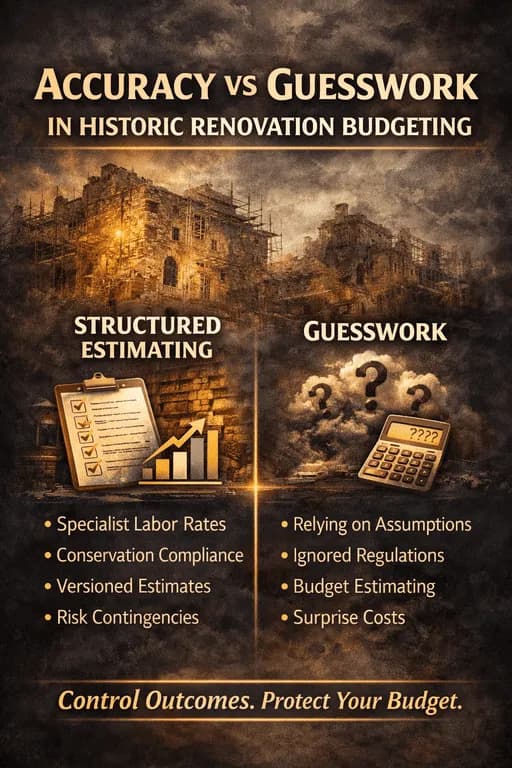
Building Renovation Cost Estimation Software replaces guesswork with structured estimation logic that makes uncertainty visible instead of hiding it. Rather than presenting a single fixed number, professional estimation systems allow estimators to document assumptions explicitly, identify areas of uncertainty, and apply probability-based cost ranges. This approach acknowledges risk at the outset and provides a more realistic financial picture for decision-makers. As new information emerges from surveys, investigations, or site work, figures can be adjusted systematically without undermining the integrity of the estimate.
In heritage projects, where early access is limited and discoveries are frequent, the ability to revise estimates intelligently is essential. Building Renovation Cost Estimation Software ensures that cost models remain aligned with evolving site conditions rather than becoming outdated snapshots. This continuous alignment prevents the disconnect between financial forecasts and on-site reality that often leads to disputes and loss of trust.
Professional Historic Building Renovation Cost Estimation Software for High-Risk Projects ensures that estimates evolve alongside the project lifecycle. By maintaining structured logic, clear assumptions, and controlled revisions, it transforms estimation into an active management tool rather than a one-off exercise completed before construction begins.
Managing Change Orders and Scope Adjustments
Change is inevitable in historic renovation projects, where uncertainty is built into the fabric of the work itself. Structural discoveries such as hidden decay, unstable foundations, or undocumented alterations frequently emerge once access is gained. Conservation requirements may evolve as authorities review findings on site, while client-driven changes often arise when new possibilities or constraints become visible. Each of these changes has a direct impact on cost, programme, and overall project viability, making change management a critical financial discipline rather than an administrative task.
Without Building Renovation Cost Estimation Software, managing change becomes a manual, fragmented process. Revised costs are often calculated in isolation, spreadsheets are duplicated or overwritten, and assumptions are lost between versions. This creates delays in approvals, inconsistencies in pricing, and confusion among stakeholders about which figures are current. In high-risk renovation environments, this lack of control frequently leads to disputes, strained client relationships, and erosion of profit margins as decisions are made without a clear understanding of their financial consequences.
Building Renovation Cost Estimation Software introduces structure and speed into the change process. When a variation arises, estimators can reprice the affected work packages instantly, ensuring that labour, materials, and risk allowances are updated consistently across the entire estimate. Changes are logged, assumptions are preserved, and the financial impact is visible before commitments are made. This allows project teams to respond proactively rather than react defensively to evolving conditions.
Professional Historic Building Renovation Cost Estimation Software for High-Risk Projects goes further by maintaining full audit trails across all revisions. Every change is traceable, justified, and aligned with the latest project scope, protecting both accountability and profitability. By ensuring that cost control evolves alongside the project, Building Renovation Cost Estimation Software enables teams to manage inevitable change with confidence, clarity, and financial discipline throughout the entire project lifecycle.
Regulatory Compliance and Cost Control

Historic renovations operate under strict regulatory frameworks that significantly influence both scope and cost. Conservation officers, local planning authorities, and heritage bodies impose detailed requirements designed to protect historical value, but these obligations often introduce additional layers of complexity into renovation projects. Listed building consent, conservation methodologies, approved materials, and specialist workmanship are mandatory considerations that must be reflected accurately in the project budget from the earliest stages.
Building Renovation Cost Estimation Software plays a critical role in forecasting compliance-related costs before they become disruptive. Regulatory requirements frequently affect multiple areas of a project, including extended design phases, specialist surveys, conservation inspections, and approval timelines. When these factors are not captured early, they often emerge later as costly variations. Structured estimating systems, such as those explained in allow project teams to integrate regulatory cost drivers into the initial estimate rather than treating them as unexpected add-ons.
Another challenge in historic renovation work is regulatory uncertainty. Approval conditions may evolve as authorities review site discoveries or request additional documentation. Without a robust estimating framework, each regulatory adjustment can destabilise budgets and delay decision-making. Building Renovation Cost Estimation Software supports scenario planning and controlled revisions, ensuring that compliance-related changes are priced accurately. This approach aligns closely with the professional estimating principles described in
where cost control is directly linked to informed decision-making rather than reactive corrections.
Professional Historic Building Renovation Cost Estimation Software for High-Risk Projects strengthens compliance planning by linking cost data with regulatory obligations from the outset. By integrating estimating workflows with recognised UK industry standards, as outlined in
project teams maintain continuous visibility over how compliance requirements affect cost, programme, and risk exposure
By embedding regulatory compliance into the estimating process, Building Renovation Cost Estimation Software transforms compliance from a budgetary threat into a predictable and manageable component of historic renovation delivery.
Long-Term Value of Professional Estimation Software
While professional estimation software represents an upfront investment, its long-term value far exceeds its initial cost, particularly in complex and high-risk renovation environments. Reduced cost overruns, improved forecasting accuracy, and stronger risk management directly protect both professional reputation and long-term profitability. In historic renovation work, where margins can be eroded quickly by unforeseen issues, even small improvements in cost control translate into significant financial resilience over time.
Building Renovation Cost Estimation Software evolves from a simple pricing mechanism into a strategic business asset. Rather than focusing solely on producing estimates, it supports informed decision-making across the entire project lifecycle. Accurate early forecasting enables firms to select the right projects, price risk appropriately, and avoid commitments that expose them to unacceptable financial uncertainty. Over time, this leads to a more stable project portfolio and consistent performance in specialist renovation markets.
The strategic value also lies in scalability. As firms grow, managing multiple complex renovation projects becomes increasingly difficult without structured systems. Building Renovation Cost Estimation Software provides consistency across teams, standardises estimating logic, and preserves institutional knowledge, reducing reliance on individual experience alone. This consistency supports sustainable growth while maintaining control over risk and quality.
Professional Historic Building Renovation Cost Estimation Software for High-Risk Projects ultimately enables firms to approach complex work with confidence rather than fear. By replacing uncertainty with visibility and structure, it allows professionals to focus on delivering technically challenging renovations while maintaining financial discipline. In specialist historic renovation markets, this confidence becomes a competitive advantage that supports long-term success.
Conclusion
Building Renovation Cost Estimation Software sits at the core of successful historic renovation delivery. In high-risk projects, accuracy, adaptability, and transparency are non-negotiable.
Professional Historic Building Renovation Cost Estimation Software for High-Risk Projects empowers teams to control uncertainty, protect budgets, and deliver complex renovations with confidence.
For professionals operating in the historic building sector, investing in the right Building Renovation Cost Estimation Software is no longer optional — it is essential.
🔗 https://historicengland.org.uk/advice/technical-advice/
📞 Contact Our Team https://builderexpert.uk/contact-builder-expert/