
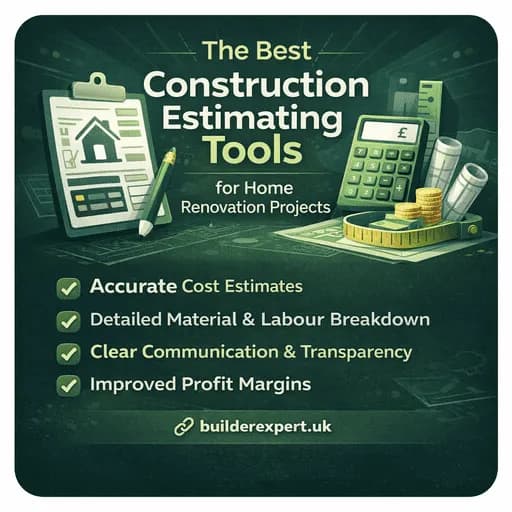
Introduction
Home renovation projects have become increasingly complex in the UK residential sector, as builders face rising material prices, ongoing labour shortages, and increasingly tight client budgets. In this environment, even small errors in cost planning can quickly turn a profitable home renovation into a costly mistake. Homeowners now expect accurate pricing, clear cost breakdowns, and realistic budgets from the very first discussion, placing additional pressure on renovation professionals to deliver precise estimates and maintain full financial control throughout the project.
This is where Construction Estimating Tools become essential for modern residential renovation work. By using Construction Estimating Tools, builders can calculate labour, materials, and overheads with far greater accuracy, reducing uncertainty and minimising financial risk. These tools support better forecasting, faster quoting, and clearer cost visibility across all stages of a renovation project.
Whether working on home extensions, loft conversions, kitchen refurbishments, or full property renovations, Construction Estimating Tools allow professionals to adjust estimates quickly when conditions change and to protect profit margins more effectively. In today’s competitive UK renovation market, relying on accurate Construction Estimating Tools is no longer optional but a critical factor that separates successful renovation projects from those affected by delays, disputes, and unexpected cost overruns.
Table of Contents
- Why Accurate Estimating Matters in Home Renovations
- What Construction Estimating Tools Are
- Key Features Needed for Residential Renovation Projects
- Reducing Risk and Cost Overruns in Renovation Work
- Improving Client Trust and Quote Transparency
- Using Construction Estimating Tools for Extensions and Refurbishments
- Integrating Estimating with Residential Project Planning
- UK Compliance and Pricing Accuracy
- Choosing the Right Estimating Solution for Renovation Builders
- Case Study: UK Residential Renovation Project
- Conclusion
- Call to Action
- Frequently Asked Questions
Why Accurate Estimating Matters in Home Renovations
Residential renovation projects are fundamentally different from new builds. Older properties often hide structural weaknesses, outdated electrical or plumbing systems, and unforeseen site conditions that only become visible once work has started. These unknown factors make cost planning far more challenging, and without accurate estimating, even experienced builders can see profit margins disappear quickly. Renovation work requires flexibility, careful allowances, and a deep understanding of how small changes can impact overall costs.
This is where Construction Estimating Tools provide real value for residential builders. Instead of relying on rough assumptions or manual spreadsheets, builders can break down costs methodically and consistently. Labour, materials, subcontractors, overheads, and contingency allowances can be calculated realistically based on current market conditions and previous project data. This structured approach is particularly important for renovation projects, where design changes, client variations, and unexpected repairs are common throughout the build.
Reliable estimating also supports smarter decision-making early in the project lifecycle. Before committing time, labour, and materials, builders can assess whether a renovation project is financially viable and whether the expected return justifies the risk. By applying proven estimating principles, as outlined in professional building estimating practices, renovation specialists gain greater confidence when pricing complex residential work. More insight into this structured approach can be found at https://builderexpert.uk/about-building-estimating/, where residential-focused estimating fundamentals are explained in detail.
Accurate cost data also helps builders align their pricing with recognised industry benchmarks. External construction cost intelligence, such as data provided by the Building Cost Information Service at https://www.bcis.co.uk/, allows renovation professionals to validate estimates against current UK market trends. When combined with Construction Estimating Tools, this data-driven approach improves accuracy, reduces financial risk, and enables builders to deliver renovation projects that remain profitable despite uncertainty.
What Construction Estimating Tools Are
Construction Estimating Tools are digital solutions designed to calculate, organise, and control construction costs. For residential renovation projects, they focus on smaller-scale but highly detailed cost planning.
These tools replace spreadsheets and manual calculations with structured estimating workflows. Builders can create itemised quotes, adjust pricing instantly, and reuse templates across similar renovation projects.
For renovation professionals, estimating tools provide consistency. Whether pricing a kitchen refurbishment or a full property upgrade, the same structured approach applies.
Internal reference:
https://builderexpert.uk/construction-estimating/
Key Features Needed for Residential Renovation Projects
Not all estimating tools are suitable for renovation work, and this distinction is critical in the residential sector. Home renovation projects demand far more flexibility and detailed cost control than new builds, as builders are often working with existing structures, occupied homes, and evolving client requirements. Tools that are designed only for large-scale construction frequently lack the adaptability needed for extensions, refurbishments, and property upgrades.
Effective Construction Estimating Tools for renovation projects must allow builders to break costs down in a highly granular way. Itemised labour and material costing is essential, as even small changes to finishes or specifications can significantly affect the overall budget. Adjustable contingencies are equally important, helping builders account for unknown conditions such as hidden structural issues or outdated services that are common in older properties. Reusable residential templates also save time and improve consistency when pricing similar renovation projects, while clear profit margin tracking ensures builders remain financially protected.

As discussed in The Best Construction Estimating Tools for Home Renovation Projects, professional renovation builders also benefit from estimating solutions that integrate seamlessly with project planning. When estimating tools connect with scheduling and task breakdowns, builders gain a clearer picture of how time, labour, and costs interact across the entire renovation process. This integrated approach supports more realistic timelines and helps prevent delays caused by poor cost forecasting. A deeper understanding of how estimating fits into the wider construction workflow can be found at https://builderexpert.uk/construction-estimating-software/, which outlines how modern estimating systems support residential projects.
Beyond internal planning, reliable estimating should also be informed by trusted industry data. External construction benchmarks, such as those provided by the Building Cost Information Service at https://www.bcis.co.uk/, help renovation professionals validate pricing against current UK market conditions. When builders combine market intelligence with well-structured Construction Estimating Tools, they are better equipped to deliver accurate quotes, manage risk, and maintain profitability across residential renovation projects.
Reducing Risk and Cost Overruns in Renovation Work
Cost overruns are one of the biggest risks in residential renovations. Unexpected repairs, structural adjustments, and client changes are common.
Construction Estimating Tools help manage these risks by allowing rapid re-estimation. When scope changes occur, builders can update costs immediately rather than absorbing losses.
By tracking estimated versus actual costs, renovation professionals gain better insight into where money is being lost and how to prevent repeat issues on future projects.
External reference:
https://www.constructionleadershipcouncil.co.uk/
Improving Client Trust and Quote Transparency
Homeowners want clarity when it comes to renovation costs. Vague estimates or lump-sum quotes often create uncertainty and suspicion, especially in residential renovation projects where budgets are tight and expectations are high. When homeowners do not fully understand how costs are calculated, even minor variations can quickly lead to disputes, delays, and a breakdown in trust between client and builder.
Using Construction Estimating Tools, builders are able to present transparent and fully itemised quotations that clearly explain where every pound is allocated. Labour, materials, subcontractors, and allowances are shown in a structured and easy-to-understand format, giving homeowners confidence that the pricing is fair and well considered. This level of transparency helps clients feel more involved in the decision-making process and significantly reduces the likelihood of disagreements later in the project. Clear, professional estimates also set realistic expectations from the outset, which is essential for maintaining positive working relationships throughout a renovation.
As highlighted in The Best Construction Estimating Tools for Home Renovation Projects, accurate and well-documented estimates are not only beneficial for clients but also provide critical protection for builders. Clear documentation creates a solid contractual foundation, especially when additional work or unforeseen changes arise during a renovation. When variations are required, builders can refer back to detailed estimates to justify cost adjustments and avoid misunderstandings.
Construction Estimating Tools also support better project control by aligning cost information with the overall project workflow. When estimating is connected to task planning and project management, builders gain greater visibility over how costs evolve at each stage of the renovation. This integrated approach strengthens accountability and ensures that financial decisions remain aligned with project progress. A clear example of how estimating fits into the wider residential workflow can be found at https://builderexpert.uk/construction-project-workflow-builder-expert/, where the importance of structured documentation and cost control is explained in detail. By combining transparency with accurate estimating, builders can protect their business while delivering a smoother, more trustworthy renovation experience for homeowners.
Using Construction Estimating Tools for Extensions and Refurbishments
Residential extensions and refurbishments require careful coordination between existing structures and new work.
Estimating tools allow builders to separate renovation costs from new construction elements, ensuring accurate pricing. This clarity is crucial when working within tight residential budgets.
By using historical data from previous projects, builders can improve estimating accuracy for similar home renovation work.
Integrating Estimating with Residential Project Planning
Estimating should never operate in isolation, especially in residential renovation projects where time, labour, and costs are closely interconnected. The most successful renovation projects are those where cost estimating is aligned from the beginning with project planning, scheduling, and task coordination. When estimating and planning are treated as separate processes, builders are far more likely to encounter delays, inefficiencies, and budget pressures as the project progresses.
Accurate estimates play a vital role in supporting realistic construction schedules. By understanding the true cost and scope of each task, builders can plan labour resources more effectively and avoid overcommitting teams across multiple projects. This is particularly important in renovation work, where access constraints, live-in homeowners, and sequencing issues can quickly disrupt timelines if not properly planned. As highlighted in The Best Construction Estimating Tools for Home Renovation Projects, linking estimating with planning helps builders maintain control over both time and cost from start to finish.
When Construction Estimating Tools are integrated with project planning, builders gain a clearer view of how financial decisions affect delivery timelines. This integration allows for more accurate forecasting, better coordination of subcontractors, and improved visibility across all stages of a renovation project. Builders are able to identify potential bottlenecks early and adjust schedules before problems escalate on site.
Clear alignment between estimating and scheduling also improves communication within the project team. Everyone involved understands the financial and time implications of their tasks, leading to smoother collaboration and fewer disruptions. A practical guide on creating realistic construction schedules and aligning them with cost planning can be found at https://builderexpert.uk/how-to-create-a-realistic-construction-schedule/. By connecting estimating with planning, builders can deliver residential renovation projects more efficiently, on time, and with greater financial confidence.
UK Compliance and Pricing Accuracy
UK residential renovation projects must comply with a wide range of regulations, safety standards, and recognised best practice guidance. From waste disposal and health and safety requirements to building regulations and site management obligations, compliance plays a critical role in the successful delivery of any home renovation project. Failure to account for these requirements early can lead to unexpected costs, delays, or even legal issues that negatively impact both builders and homeowners.

As highlighted in The Best Construction Estimating Tools for Home Renovation Projects, accurate cost planning should always include compliance-related expenses from the very beginning. Construction Estimating Tools help builders ensure that essential regulatory costs are not overlooked during the estimating process. This includes allowances for waste management, site safety measures, inspections, and other statutory requirements that are mandatory on UK residential renovation sites.
By incorporating compliance costs into early estimates, builders are better equipped to price renovation projects realistically and transparently. This approach not only protects profit margins but also helps set clear expectations with homeowners, reducing the risk of disputes later in the project. Reliable guidance on construction best practice and regulatory compliance in the UK is outlined in the government’s Construction Playbook, available at https://www.gov.uk/government/publications/the-construction-playbook. Aligning accurate estimating with regulatory requirements enables builders to deliver renovation projects that are compliant, well-managed, and financially sustainable from start to finish.
Choosing the Right Estimating Solution for Renovation Builders
Selecting the right estimating solution depends on several key factors, including business size, project volume, and the level of specialisation in residential renovation work. Builders operating in the UK renovation market face very different challenges compared to large commercial contractors, and the tools they use should reflect those differences. Choosing an estimating system that aligns with day-to-day renovation workflows is essential for maintaining accuracy and efficiency.
Choosing the Right Estimating Tool for Residential Renovation Builders
Builders focused on residential renovations should prioritise tools that are simple to use, flexible in structure, and designed specifically for UK construction practices. Renovation projects often involve frequent changes, evolving scopes, and close collaboration with homeowners, which means estimating systems must allow quick updates and clear cost visibility. Tools that are too rigid or overly complex can slow down the estimating process and make it harder to respond to changes effectively.
Overly complex enterprise systems are often built for large-scale commercial projects and can introduce unnecessary cost and administrative burden without delivering meaningful benefits for residential builders. These systems may include features that are rarely used in renovation work, while lacking the adaptability needed for extensions, refurbishments, and smaller residential projects. In contrast, well-designed Construction Estimating Tools tailored to the UK residential market support faster pricing, clearer documentation, and better financial control.
Understanding the specific needs of the UK construction industry is a key part of making the right choice. A detailed overview of how estimating software is used across the UK building sector can be found at https://builderexpert.uk/building-estimating-software-uk-industry-guide/. By selecting an estimating solution that matches their renovation focus, builders can improve accuracy, reduce unnecessary overheads, and create a more efficient and profitable estimating process.
Case Study: UK Residential Renovation Project
A residential builder in Manchester undertook a full home renovation valued at £185,000, including a rear extension and internal refurbishment.
Timeline: 7 months
Estimated Profit Margin: £27,000
Using Construction Estimating Tools, the builder achieved:
- Accurate initial pricing
- Controlled material cost increases
- Faster quote approvals
- Reduced client variations
- Improved cash flow visibility
<blockquote> “Using proper estimating tools completely changed how we price renovations. We stayed profitable even when costs shifted.” — James </blockquote>
Conclusion
Home renovation projects demand a high level of precision, flexibility, and transparency at every stage. Unlike new builds, renovation work often involves existing structures, live-in homeowners, and evolving project scopes, all of which increase uncertainty. Builders must balance client expectations, tight budgets, and unpredictable site conditions while still delivering quality results on time. In this challenging environment, even small estimating errors can have a significant impact on project outcomes and overall profitability.
This is why Construction Estimating Tools play a crucial role in modern residential renovation projects. These tools provide renovation builders with the control they need to plan costs accurately from the outset. By breaking down labour, materials, subcontractors, and allowances into clear cost components, builders gain better visibility over where money is spent and where risks may arise. Accurate estimating supports more informed decision-making, helping builders assess project viability before committing resources and reducing exposure to unexpected financial pressures.
Flexibility is equally important in renovation work, where changes are often unavoidable. When conditions on site change or clients request variations, builders need the ability to update estimates quickly and transparently. Reliable estimating systems make it easier to adjust costs, communicate changes clearly, and maintain trust with homeowners. This level of control supports smoother project delivery and helps prevent disputes caused by unclear pricing or undocumented variations.
Ultimately, Construction Estimating Tools help renovation builders manage risk more effectively and protect profit margins in a competitive residential market. By combining accuracy, adaptability, and transparency, builders are better positioned to deliver successful renovation projects that meet client expectations while remaining financially sustainable from start to finish.
FAQ
What are Construction Estimating Tools?
They are digital tools used to calculate and manage construction costs accurately.
Are Construction Estimating Tools suitable for home renovations?
Yes, especially when designed for residential and renovation projects.
Can estimating tools reduce renovation cost overruns?
They significantly reduce risk by improving accuracy and cost tracking.
Are these tools suitable for small renovation builders?
Yes, many tools are designed specifically for small and medium residential builders.
Do Construction Estimating Tools improve client trust?
Yes, transparent quotes improve communication and client confidence.
📌https://www.gov.uk/government/publications/the-construction-playbook
📌https://www.constructionleadershipcouncil.co.uk/
✉️ Contact the Builder Expert Teamhttps://builderexpert.uk/contact-builder-expert/