
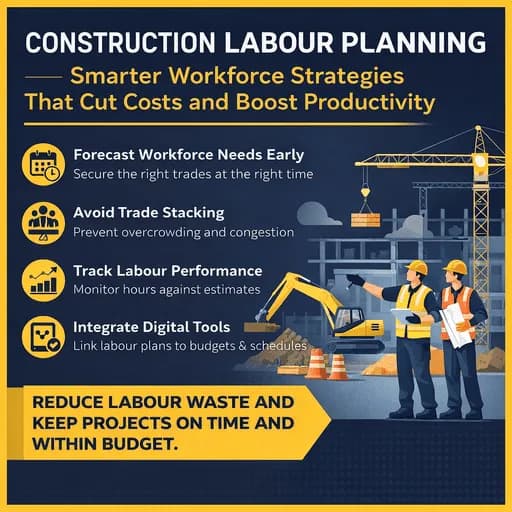
The residential construction sector in 2026 is operating under intense pressure. Skilled labour shortages, rising wage expectations, stricter regulations, and tighter client deadlines have made workforce management one of the most critical challenges for UK builders. While materials pricing often dominates industry discussions, labour remains the single largest controllable cost on most residential projects. Even small inefficiencies in workforce allocation can quickly escalate into significant budget overruns and schedule delays, especially on multi-phase residential builds.
This challenge is at the core of Construction Labor Planning – Smarter Workforce Strategies that Cut Costs and Boost Productivity. As projects become more complex and margins tighter, builders can no longer rely on informal scheduling or last-minute decisions. Workforce planning now directly influences cash flow stability, programme reliability, and overall build quality.
This is where Construction Labor Planning becomes a decisive competitive advantage. Builders who plan their workforce strategically—rather than reactively—are consistently able to deliver projects faster, reduce wasted hours, and protect profit margins. In 2026, labour planning is no longer about filling gaps on site; it is about aligning people, schedules, and budgets with precision, using data-driven forecasts to maintain control from groundworks to final handover.
Table of Contents
The sections below provide a structured, practical guide to managing workforce challenges in modern residential construction. Each chapter is designed to address a specific aspect of labour planning, from early forecasting and scheduling to cost control, productivity, and subcontractor coordination. Together, they form a complete framework that UK residential builders can apply directly to real-world projects in 2026.
This guide builds on the principles outlined in Construction Labor Planning – Smarter Workforce Strategies that Cut Costs and Boost Productivity, translating strategic concepts into actionable steps. Rather than focusing on theory, each section explores common on-site problems, proven solutions, and best practices that help builders maintain control over labour-intensive phases of construction.
You will learn how to identify hidden inefficiencies, prevent labour-driven delays, and align workforce decisions with project schedules and budgets. The content also highlights how digital tools and structured estimating methods are reshaping Construction Labor Planning, enabling builders to move from reactive decision-making to proactive control.
From understanding why labour planning has become critical, to applying smarter workforce strategies through a practical UK residential case study, the following sections are intended to support better planning, stronger profitability, and more predictable project outcomes across residential builds.
- Why Labour Planning Is Critical for Residential Builders in 2026
- Common Labour Planning Mistakes That Increase Costs
- Forecasting Labour Requirements with Accuracy
- Aligning Labour Planning with Construction Schedules
- Reducing Labour Costs Without Compromising Quality
- Boosting On-Site Productivity Through Workforce Optimisation
- Digital Tools Reshaping Construction Labor Planning
- Managing Subcontractors and Trades More Effectively
- UK Residential Case Study: Smarter Labour Planning in Action
- Frequently Asked Questions
Why Labour Planning Is Critical for Residential Builders in 2026
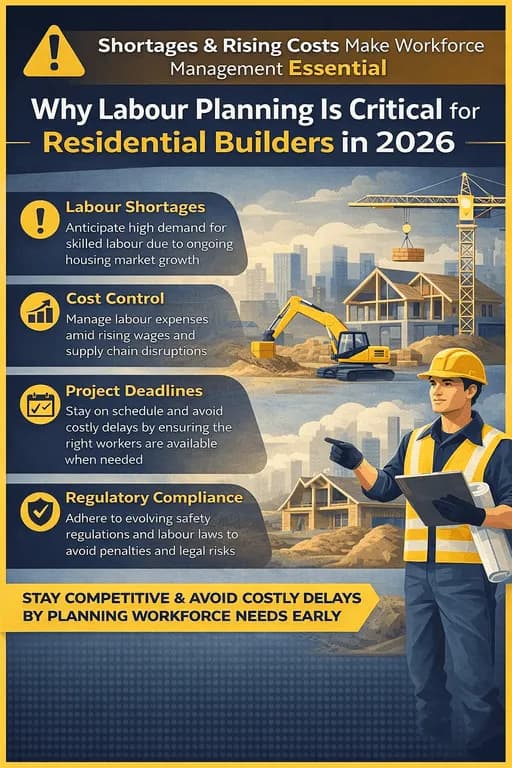
Labour inefficiency is one of the most underestimated risks in residential construction. When workforce requirements are poorly planned, even well-funded projects quickly fall behind schedule. Delays trigger overtime, disrupt subcontractor availability, and erode client confidence. Over time, these issues compound, creating a cycle of reactive decision-making that is difficult to reverse once a project is underway.
In 2026, the UK construction industry faces a shrinking pool of skilled trades, particularly in carpentry, bricklaying, and finishing works. This means builders can no longer rely on last-minute labour availability or informal networks to fill gaps on site. Construction Labor Planning allows contractors to forecast workforce demand early, secure the right skills at the right time, and avoid costly scheduling conflicts during critical build phases.
This challenge sits at the heart of Construction Labor Planning – Smarter Workforce Strategies that Cut Costs and Boost Productivity. As residential projects become more complex, effective labour planning directly influences delivery speed, cost certainty, and build quality. Builders who adopt structured planning approaches are better positioned to manage fluctuating workloads and maintain consistent site momentum.
Well-structured labour planning also supports compliance and safety. Overworked crews are more likely to make mistakes, increasing rework costs and health and safety risks. A balanced labour plan ensures realistic workloads, consistent productivity, and safer working conditions across all trades. In addition, proactive planning improves communication between site managers and subcontractors, reducing misunderstandings and downtime.
Builders who integrate labour planning with their estimating processes—using platforms such as construction estimating software—gain a clearer understanding of how labour hours translate directly into project cost and delivery timelines. When Construction Labor Planning is treated as a core operational discipline rather than an administrative task, residential builders gain greater control, predictability, and long-term profitability.
Common Labour Planning Mistakes That Increase Costs
Many residential builders still rely on informal or experience-based labour decisions. While experience is valuable, it often leads to blind spots that increase costs when it is not supported by structured processes. Decisions based purely on past projects fail to account for changing site conditions, workforce availability, and the growing complexity of residential builds in 2026.
One of the most common mistakes is underestimating labour duration. Tasks are frequently scheduled based on ideal conditions rather than realistic site constraints such as weather delays, restricted access, or overlapping activities. This approach results in rushed work, extended hours, and declining quality. Without accurate forecasting, Construction Labor Planning becomes reactive, forcing site managers to rely on overtime to recover lost time.
Another frequent issue is trade stacking—multiple trades scheduled simultaneously in confined spaces. Instead of improving speed, this creates congestion, reduces productivity, and increases the risk of errors and rework. Effective Construction Labor Planning requires clear sequencing that allows each trade to work efficiently without unnecessary interference.
Poor communication with subcontractors is also a major contributor to labour inefficiency. When schedules are vague or frequently change, trades arrive late, leave early, or struggle to coordinate with other teams. This leads to idle time that quietly inflates labour costs.
Finally, many builders fail to link labour planning with cost tracking. Without clear visibility into actual labour performance versus the estimate, overruns often go unnoticed until budgets are already exceeded. When Construction Labor Planning is integrated with estimating and monitoring, builders can identify inefficiencies early and take corrective action before costs escalate beyond control.
Forecasting Labour Requirements with Accuracy
Accurate labour forecasting starts at the estimating stage. Each residential project should include a detailed breakdown of labour hours by trade, phase, and task. This level of detail allows builders to anticipate workforce needs weeks or even months in advance.
Using structured estimating methods, such as those outlined in professional building estimating guides, helps standardise labour assumptions across projects. This reduces reliance on guesswork and improves consistency.
Forecasting should also account for variability. Weather conditions, material lead times, and client changes all impact labour productivity. Smart Construction Labor Planning includes contingency allowances that prevent schedules from collapsing when unexpected issues arise.
By regularly reviewing forecasted versus actual labour hours, builders can refine their assumptions and improve accuracy over time. This feedback loop is essential for long-term cost control.
Aligning Labour Planning with Construction Schedules
Labour planning cannot exist in isolation. It must be fully aligned with the project schedule to deliver predictable outcomes on residential construction projects. A well-sequenced construction programme ensures that trades are deployed efficiently, materials arrive on time, and crews are not left waiting for access or instructions. Without this alignment, even experienced teams struggle to maintain momentum.

Linking labour plans to realistic construction schedules is a core principle of effective labour planning for residential and commercial builders. When labour planning is aligned with construction schedules developed through structured project workflows, it helps avoid gaps and overlaps that quietly erode productivity. These inefficiencies often go unnoticed until delays and cost overruns appear on site.
Each phase of work should have clearly defined labour requirements, realistic durations, and confirmed start dates. This approach allows builders to allocate the right trades at the right time without overcrowding or idle labour. Schedules must be supported by real site conditions, not optimistic assumptions or best-case scenarios. Weather, material lead times, access constraints, and sequencing all need to be reflected accurately.
Builders who follow structured scheduling practices, such as those outlined in gain better control over labour flow from groundworks through to final finishes. Strong labour planning combined with realistic scheduling improves productivity, stabilises costs, and reduces disruption across the entire construction programme.
When labour and scheduling are aligned, site managers can anticipate resource constraints before they occur. This proactive approach allows adjustments to be made early, such as resequencing tasks or reallocating crews, rather than reacting to problems once work has already slowed. Effective Construction Labor Planning relies on this forward visibility to minimise downtime and avoid costly last-minute changes.
Clear scheduling also improves subcontractor relationships. Trades who receive accurate, reliable programmes are far more likely to prioritise your projects and deliver consistent performance. When labour planning is integrated with estimating and scheduling—supported by tools such as gain a clearer picture of how labour availability, time, and cost interact across the entire build. Ultimately, aligning schedules and workforce planning through Construction Labor Planning creates smoother site operations, stronger collaboration, and more predictable project delivery.
Reducing Labour Costs Without Compromising Quality
Reducing labour costs does not mean paying lower wages or cutting corners. In fact, the most effective and sustainable savings come from eliminating inefficiencies and waste rather than reducing rates. In residential construction, labour overruns are rarely caused by high hourly costs, but by poor coordination, idle time, and rework that quietly inflate budgets.
Idle time is one of the biggest sources of labour waste. Crews waiting for materials, instructions, inspections, or access to work areas generate cost without adding value. Proper planning ensures that labour is deployed only when productive work can take place and that tasks are sequenced logically. Builders who rely on structured planning methods supported by better equipped to reduce downtime and keep teams productive throughout the build.
Another key strategy is matching skill levels to task complexity. Overqualified labour performing basic tasks increases costs unnecessarily, while underqualified labour increases the risk of errors and rework. A structured labour plan assigns the right skills to the right work, which is a core principle of effective Construction Labor Planning.
Standardisation also plays a critical role. Repeating proven construction methods, specifications, and details reduces learning curves and improves efficiency across multiple residential projects. When combined with consistent estimating practices—such as those outlined in gain clearer visibility into how labour hours should perform against the plan.
When labour costs are monitored against estimates using reliable construction estimating frameworks, deviations can be identified early and corrected before they escalate. By treating labour as a planned resource rather than a variable expense, Construction Labor Planning enables builders to protect margins while maintaining quality, safety, and long-term workforce stability.
Boosting On-Site Productivity Through Workforce Optimisation
Productivity gains come from clarity, consistency, and coordination. Workers perform best when expectations are clear and workflows are predictable.
Daily and weekly labour planning meetings help align site teams with upcoming tasks. These sessions allow potential issues to be identified early and resolved collaboratively.
Clear task sequencing reduces rework. When each trade understands how their work fits into the overall build process, quality improves and delays decrease.
Investing in training also supports productivity. Even small improvements in skill levels can significantly reduce task durations and error rates over time.
Ultimately, Construction Labor Planning is about creating an environment where workers can focus on doing their job efficiently, without unnecessary disruptions.
Digital Tools Reshaping Construction Labor Planning
In 2026, digital tools play a central role in labour planning, as manual spreadsheets and paper schedules are no longer able to handle the complexity of modern residential construction projects. Builders are increasingly expected to deliver accurate timelines, predictable costs, and transparent reporting, all of which require more advanced systems.
Integrated estimating and planning platforms allow builders to link labour forecasts directly to budgets and schedules, creating real-time visibility into workforce requirements and costs. This level of insight supports better decision-making and reduces the risk of labour-driven overruns. Solutions such as https://builderexpert.uk/construction-estimating-software/enable residential builders to model labour accurately and adjust plans as projects evolve.
Tools designed specifically for the UK market, including https://builderexpert.uk/building-estimating-software-uk-industry-guide/, support more reliable labour assumptions and scenario planning. When combined with structured Construction Labor Planning, digital systems also improve accountability by tracking actual labour hours against planned values.
Builders who embrace digital labour planning gain greater efficiency, stronger cost control, and a more professional, data-driven image with clients, consultants, and subcontractors.
Managing Subcontractors and Trades More Effectively
Subcontractors are a critical component of residential construction, and effective labour planning depends on strong coordination with external trades. Inconsistent availability, unclear expectations, or last-minute changes can quickly disrupt schedules and inflate labour costs if subcontractor work is not planned with the same discipline as direct labour.
Clear scopes of work, defined start dates, and realistic task durations significantly reduce misunderstandings. Subcontractors who understand exactly what is expected of them—and when—are far more likely to deliver on time and to the required standard. This clarity also helps them allocate their own resources efficiently, reducing the risk of delays caused by overcommitment elsewhere.
Regular communication is essential to maintaining alignment. Sharing updated schedules, progress reports, and upcoming requirements allows trades to adjust their workforce proactively rather than reacting to problems on short notice. Consistent communication also helps identify potential conflicts between trades before they impact site productivity.
Fair and transparent labour planning builds trust over time. Subcontractors are more willing to prioritise builders who respect their time, provide reliable programmes, and avoid unrealistic sequencing. By integrating subcontractor labour into overall Construction Labor Planning, builders gain greater control over coordination, reduce friction on site, and achieve more predictable project outcomes across residential builds.
UK Residential Case Study: Smarter Labour Planning in Action
A fictional residential developer in the South East undertook a £1.8 million housing extension and refurbishment project scheduled for 10 months. Previous projects had suffered from labour overruns and inconsistent trade availability.
For this project, the builder implemented structured Construction Labor Planning from the estimating stage. Labour hours were broken down by trade and aligned with a detailed construction schedule.
Throughout the project, actual labour performance was reviewed weekly against the plan. Adjustments were made early, preventing small delays from escalating.
Project outcomes:
- Project completed 3 weeks ahead of schedule
- Labour cost savings of £92,000
- Improved subcontractor retention
- Increased client satisfaction
Key success factors included:
- Accurate labour forecasting
- Clear trade sequencing
- Consistent performance monitoring
- Strong subcontractor communication
- Use of digital estimating and planning tools
“Planning our labour properly changed everything. We stopped reacting to problems and started controlling them,” said James, Project Manager.
Conclusion: Building Profitability Through Smarter Labour Planning
In 2026, residential builders can no longer afford reactive workforce management. Construction Labor Planning is a strategic discipline that directly impacts cost control, productivity, and project success.
By forecasting labour accurately, aligning workforce plans with schedules, and using modern digital tools, builders can reduce waste and deliver projects more efficiently.
The builders who succeed in the coming years will be those who treat labour planning as a core business process—not an afterthought.
🚀 Use Builder Expert to estimate precisely, track costs, and manage your projects confidently.
Call to Action
📞 **Contact Us for Estimating Services**
or
🧾 **Register for Free Estimating Software**
Frequently Asked Questions
What is Construction Labor Planning?
Construction Labor Planning is the process of forecasting, scheduling, and managing workforce resources to ensure projects are delivered efficiently and within budget.
Why is Construction Labor Planning important in 2026?
Labour shortages, rising costs, and tighter deadlines make proactive planning essential for maintaining profitability.
How does Construction Labor Planning reduce costs?
It minimises idle time, overtime, rework, and inefficient task sequencing.
Can small residential builders benefit from Construction Labor Planning?
Yes. Even small projects see significant improvements when labour is planned systematically.
What tools support effective Construction Labor Planning?
Integrated estimating and planning software designed for the construction industry provides the best results.
https://www.gov.uk/government/publications/the-construction-playbook
https://www.constructionleadershipcouncil.co.uk/
Contact us for more informationhttps://builderexpert.uk/contact-builder-expert/
Useful Links
• Construction Estimating Methods
https://builderexpert.uk/construction-estimating-methods-2025/
• What a Construction Estimate Should Include
https://builderexpert.uk/what-should-a-construction-estimate-include-uk/
• Construction Estimating Software for Builders
https://builderexpert.uk/construction-estimating-software/
• Free Construction Estimating Software Guide
https://builderexpert.uk/free-construction-estimating-software/
• How Builders Find New Projects in 2025
https://builderexpert.uk/how-builders-find-new-projects-in-2025/