
Cost estimating software construction is rapidly becoming the foundation of success in today’s highly competitive UK construction market, where pricing accuracy is no longer optional — it is essential.
Contractors, builders, and developers who continue to rely on outdated spreadsheets or manual calculations often face costly mistakes, project delays, and missed opportunities.
In a sector where margins are already tight, even a minor estimating error can result in significant financial losses, reduced profitability, or damage to client trust.
The challenge is not just about calculating numbers; it is about managing risk, maintaining consistency, and delivering confidence at every stage of a project. Clients now expect detailed, transparent, and professionally structured quotes, particularly in the residential sector where competition is intense and decisions are made quickly. Without a reliable system in place, construction professionals may struggle to keep up with demand, respond promptly to enquiries, or maintain accuracy across multiple projects.
This is where digital transformation plays a critical role. Modern estimating tools are reshaping how builders approach pricing, replacing guesswork with structured, data-driven processes. By automating calculations, improving accuracy, and streamlining workflows, these solutions allow professionals to produce faster, more reliable quotes while maintaining full control over costs. The ability to standardise estimating processes also ensures consistency, which is essential when managing multiple residential projects simultaneously.
In 2026, adopting advanced estimating solutions is no longer just a strategic advantage — it is a necessity for survival and growth. Builders who embrace smarter systems can respond faster to opportunities, present more competitive and accurate pricing, and ultimately win more work. Those who fail to adapt risk falling behind in an industry that is becoming increasingly digital, efficient, and performance-driven.
Why Accurate Estimating Matters More Than Ever
Accurate estimating sits at the heart of every successful construction project, forming the foundation upon which profitability, efficiency, and client satisfaction are built. Whether you are managing residential extensions, refurbishments, or new builds, your ability to forecast costs with precision directly influences your bottom line. In an increasingly competitive UK market, even small inaccuracies can quickly escalate into major financial setbacks, making reliable estimating processes more critical than ever.
Many builders still underestimate the true cost of inaccurate pricing. Time lost correcting mistakes, money absorbed through underestimation, and the stress of managing unexpected overruns can all have a lasting impact on a business. Without cost estimating software construction, projects are often based on assumptions rather than structured, data-driven insights. This lack of precision creates a ripple effect across the entire project lifecycle, leading to avoidable risks such as budget overruns, underpriced jobs, reduced profit margins, and even client disputes that can damage long-term relationships.
In today’s construction environment, precision is not just preferred — it is expected. Clients demand clear, transparent, and well-documented quotes that demonstrate professionalism and build trust from the outset. At the same time, competition across the UK residential sector continues to intensify, meaning contractors must not only price accurately but also respond quickly and confidently to new opportunities.
By implementing cost estimating software construction, professionals can move away from uncertainty and adopt a more structured, efficient approach. Access to real-time data, historical cost tracking, and automated calculations enables builders to produce consistent and reliable estimates every time. This significantly reduces the risk of human error while improving overall efficiency, ensuring that every project starts with a solid financial foundation and a higher likelihood of success.
What Is Cost Estimating Software Construction?
At its core, cost estimating software construction is a digital tool designed to simplify and enhance the process of calculating project costs. It replaces manual spreadsheets and guesswork with structured, automated systems.
This type of software typically includes:
- Material cost databases
- Labour cost tracking
- Quantity takeoff tools
- Automated pricing calculations
- Reporting and forecasting features
Instead of spending hours building estimates from scratch, contractors can generate accurate quotes in a fraction of the time.
More importantly, cost estimating software construction allows users to standardise their pricing process. This means every quote follows the same structure, reducing inconsistencies and improving professionalism.
For UK builders, this level of consistency is crucial when competing for residential projects where trust and transparency play a major role in winning work.
Key Benefits of Using Cost Estimating Software Construction
The benefits of adopting cost estimating software construction extend far beyond simple time savings. In reality, it introduces a complete shift in how construction businesses manage pricing, plan projects, and maintain control over profitability. As the UK residential market becomes more competitive and fast-paced, builders who rely on structured, technology-driven solutions gain a clear operational advantage over those still using manual methods.
One of the most immediate improvements comes in the speed of delivering quotes. In a competitive environment, responding quickly to enquiries can be the difference between winning or losing a project. With cost estimating software construction, what once took hours of manual input and recalculations can now be completed in a matter of minutes. This allows contractors to handle more enquiries, respond professionally, and secure opportunities before competitors even finish their estimates.
Accuracy is another critical advantage. Manual estimating processes are highly vulnerable to human error, whether through incorrect calculations, missed items, or outdated pricing. By using cost estimating software construction, these risks are significantly reduced. Automated calculations ensure that every detail is accounted for, while structured templates create consistency across all projects. This level of precision not only protects profit margins but also builds credibility with clients who expect reliable and transparent pricing.
Cost control also becomes far more manageable. Instead of reacting to budget issues during the project, contractors can proactively monitor and adjust costs from the estimating stage. With cost estimating software construction, access to real-time data and historical insights allows builders to make informed decisions, identify potential overruns early, and maintain tighter control over project finances. This leads to more predictable outcomes and fewer financial surprises.
Profitability naturally improves as a result of better accuracy and control. When estimates are based on solid data rather than assumptions, pricing strategies become more effective. Builders using cost estimating software construction are less likely to underprice their work or overlook critical costs, which helps preserve margins and ensures that each project contributes positively to the business.
Finally, presentation plays a key role in winning client trust. A well-structured, detailed estimate reflects professionalism and confidence. Clients are far more likely to engage with contractors who provide clear, organised proposals rather than rough or inconsistent figures. By using cost estimating software construction, builders can produce polished, professional quotes that not only communicate value but also differentiate them in a crowded market.
Manual Estimating vs Software: A Clear Difference
Many construction professionals still rely on traditional estimating methods, but the gap between manual processes and modern digital solutions is growing wider every year. While spreadsheets and handwritten notes may have been sufficient in the past, they are no longer equipped to meet the demands of today’s fast-moving and highly competitive construction environment. The increasing complexity of residential projects, combined with rising client expectations, makes accuracy and efficiency more important than ever.
Manual estimating typically depends on fragmented systems and repetitive tasks. Builders often work across multiple spreadsheets, handwritten notes, and disconnected data sources, which increases the likelihood of mistakes. Calculations must be checked repeatedly, and even then, errors can easily go unnoticed. This approach not only consumes valuable time but also creates inconsistencies between estimates, especially when managing multiple projects simultaneously. The lack of structure and automation means that every estimate becomes a time-intensive process with a high risk of human error.
In contrast, cost estimating software construction introduces a far more efficient and reliable way of working. Instead of relying on scattered information, all data is centralised within a single platform. Automated workflows handle calculations instantly, while real-time updates ensure that pricing remains accurate and up to date. This structured approach allows contractors to standardise their estimating process, creating consistency across all projects and significantly reducing the chances of costly mistakes.
The difference becomes even more apparent when looking at real-world scenarios. A builder pricing a residential extension manually may spend several hours gathering data, calculating material quantities, and estimating labour costs. With cost estimating software construction, the same process can be completed in under 30 minutes, with far greater precision and confidence in the final figures. This not only accelerates the estimating process but also improves the overall quality of the output.
Ultimately, this level of efficiency transforms how construction businesses operate. By reducing time spent on manual tasks, contractors can redirect their focus towards higher-value activities such as client communication, project planning, and securing new work. Adopting cost estimating software construction is not just about working faster — it is about working smarter, improving accuracy, and positioning your business for sustainable growth in an increasingly digital industry.
Essential Features to Look For
Not all tools deliver the same level of performance, and selecting the right solution can make a significant difference to how efficiently your business operates.
Choosing the right cost estimating software construction is not just a short-term decision — it is an investment that directly impacts accuracy, productivity, and long-term growth.
With so many options available, builders need to focus on features that genuinely support their day-to-day work rather than adding unnecessary complexity.
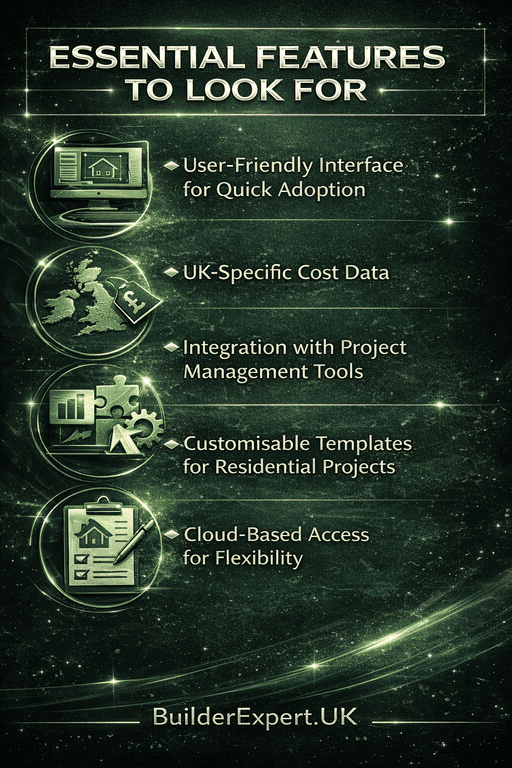
A well-designed cost estimating software construction platform should be intuitive and easy to use from the start.
A user-friendly interface allows teams to adopt the system quickly without extensive training, ensuring that estimates can be produced efficiently from day one. At the same time, having access to UK-specific cost data and pricing structures is essential.
Localised data ensures that estimates reflect real market conditions, which is particularly important when working on residential projects where margins can be tight and pricing must be accurate.
Integration is another key factor to consider. A reliable cost estimating software construction solution should connect seamlessly with project management tools, allowing information to flow smoothly from estimating to execution. This reduces duplication of work and ensures that all project data remains consistent across different stages. In addition, customisable templates play an important role in standardising estimates. Builders can create structured formats tailored to residential projects, saving time while maintaining a professional and consistent approach.
Flexibility is equally important in today’s working environment. Cloud-based cost estimating software construction allows contractors to access their estimates from anywhere, whether on-site, in the office, or working remotely. This level of accessibility improves collaboration and ensures that updates can be made in real time without delays.
As construction businesses grow, their needs become more complex. This is where scalability becomes essential. The right cost estimating software construction should be able to handle larger projects, increased workloads, and more detailed cost breakdowns without slowing down performance. Builders who invest in a scalable solution early position themselves for smoother expansion, avoiding the need to switch systems later.
Ultimately, those who choose the right technology gain a clear competitive advantage. By adopting a robust cost estimating software construction system, builders can work more efficiently, produce more accurate estimates, and stay ahead of competitors who continue to rely on outdated and less reliable methods.
Real Example: Residential Project Impact
Consider a small UK builder working on a £180,000 home extension project. Using manual estimating methods, the initial quote underestimated labour costs by 8%, resulting in a loss of over £10,000.
After switching to cost estimating software construction, the same builder was able to:
- Accurately calculate labour and material costs
- Reduce estimating time by 60%
- Increase profit margins by 15%
- Deliver consistent quotes across multiple projects
This example highlights how technology directly impacts profitability and efficiency.
How Cost Estimating Software Construction Helps You Win More Jobs
Winning projects is not just about pricing low — it is about pricing smart. Clients look for builders who provide clarity, transparency, and confidence.
With cost estimating software construction, you can:
- Deliver detailed breakdowns that build trust
- Respond faster than competitors
- Adjust pricing strategies based on real data
- Present professional, structured proposals
In a competitive market, these advantages can be the difference between winning and losing a project.
Common Mistakes to Avoid
Even with the right tools in place, mistakes can still occur if estimating processes are not properly structured and consistently followed.
Technology alone is not enough — it must be supported by clear workflows, regular reviews, and disciplined practices.
While cost estimating software construction significantly reduces the risk of errors, poor habits or outdated approaches can still lead to inaccurate results and financial setbacks.
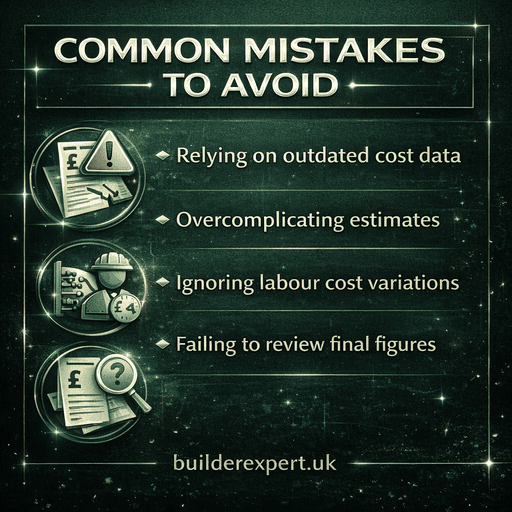
One of the most common issues is relying on outdated cost data. Material prices, labour rates, and supplier costs can change frequently, especially in the UK construction market. If estimates are based on old figures, even the most advanced cost estimating software construction will produce inaccurate results. Keeping data updated and aligned with current market conditions is essential for maintaining accuracy and protecting profit margins.
Another frequent mistake is overcomplicating the estimating process. While detail is important, adding unnecessary layers of complexity can slow down workflows and increase the likelihood of confusion or miscalculations. A well-structured approach using cost estimating software construction should focus on clarity and efficiency, ensuring that every cost element is included without making the process unnecessarily difficult to manage.
Labour cost variations are also often overlooked. Differences in skill levels, project duration, and site conditions can all affect labour expenses. Ignoring these variables can result in underpricing and reduced profitability. By using cost estimating software construction, contractors can account for these variations more effectively, but it still requires careful input and consideration during the estimating stage.
Finally, failing to review final figures remains a critical error. Even with automated calculations, every estimate should be checked before submission. A quick review ensures that all components are included, assumptions are correct, and the final price reflects the true scope of the project. Combining this level of attention to detail with cost estimating software construction creates a far more reliable and professional estimating process.
Ultimately, the most successful builders are those who combine smart technology with strong estimating discipline. By using cost estimating software construction alongside best practices, contractors can minimise risks, improve accuracy, and deliver consistently reliable results across every residential project.
The Future of Construction Estimating in the UK
The construction industry is rapidly evolving, and digital tools are becoming the standard. Builders who adopt cost estimating software construction early position themselves ahead of the competition.
In the coming years, we can expect:
- Increased automation
- AI-driven cost predictions
- Real-time data integration
- Greater focus on efficiency and profitability
Contractors who embrace these changes will be better equipped to handle complex residential projects and scale their businesses effectively.
Conclusion
In 2026, relying on manual methods is no longer a sustainable option for construction professionals who aim to grow and remain competitive. The demands of the UK residential market require speed, precision, and consistency — all of which are difficult to achieve without the support of cost estimating software construction. Businesses that continue to depend on outdated processes risk falling behind, both in efficiency and in their ability to secure new projects.
By adopting the right solution, builders can significantly reduce errors, streamline their workflows, and operate with greater confidence at every stage of the estimating process. Whether managing small residential projects or larger developments, having a structured and reliable system in place allows for better decision-making and improved financial control. Over time, this leads to stronger client relationships, more consistent results, and a clear competitive advantage.
Ultimately, success in construction is no longer just about experience — it is about combining expertise with the right tools. If your goal is to save time, cut costs, and increase profitability, embracing cost estimating software construction is a strategic step towards transforming how you price, plan, and deliver your projects.
FAQ: Cost Estimating Software Construction
What is cost estimating software construction and how does it work?
Cost estimating software construction is a digital tool that helps builders calculate project costs accurately by combining material prices, labour rates, and project data into automated calculations, allowing fast and reliable estimates.
Why should builders use cost estimating software construction instead of spreadsheets?
Builders should use cost estimating software construction because it reduces errors, saves time, and improves consistency, while automating calculations and delivering structured, professional cost breakdowns.
Is cost estimating software construction suitable for small builders in the UK?
Yes, cost estimating software construction is ideal for small builders as it improves pricing accuracy, supports residential project management, and helps smaller companies compete with larger contractors.
How much time can cost estimating software construction save?
Cost estimating software construction can reduce estimating time by up to 50–70%, turning tasks that take hours into processes completed within minutes.
Does cost estimating software construction improve profitability?
Yes, cost estimating software construction improves profitability by ensuring accurate pricing, reducing costly mistakes, and protecting profit margins throughout construction projects.
Can cost estimating software construction be used for residential projects only?
Cost estimating software construction is highly effective for residential projects such as home extensions, refurbishments, and new builds, especially within the UK market.
What features should I look for in cost estimating software construction?
Key features to look for in cost estimating software construction include automated calculations, UK cost databases, labour tracking, quantity takeoff tools, and cloud-based accessibility.
Is cost estimating software construction difficult to learn?
Most cost estimating software construction tools are user-friendly, allowing builders to quickly understand the system and start producing accurate estimates in a short time.
🔗 https://www.bcis.co.uk/
🔗 https://www.gov.uk/government/publications/the-construction-playbook
🔗 https://www.constructionleadershipcouncil.co.uk/
📞 If you want to contact us directly, click here