
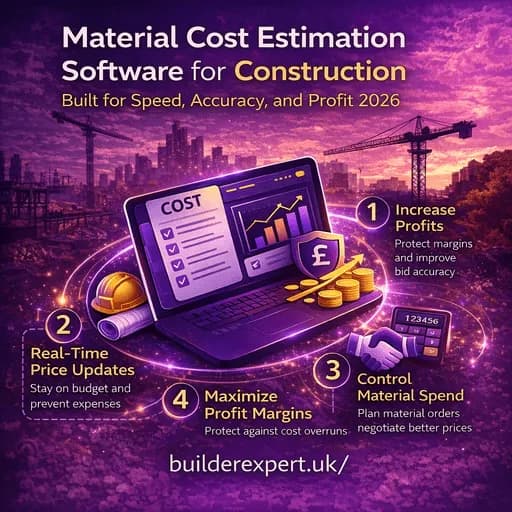
Material costs remain one of the most unpredictable and financially critical elements in residential construction. Price volatility, ongoing supply chain disruptions, and steadily increasing demand for building materials have made accurate material estimation more challenging than ever. For builders and contractors operating in the UK residential sector, even minor pricing inaccuracies can quickly escalate into serious budget overruns, programme delays, and reduced overall profitability.
The challenge is further compounded by rising client expectations for transparency and fixed pricing. Homeowners increasingly expect detailed cost breakdowns and predictable budgets, leaving little room for estimation errors. When material prices fluctuate unexpectedly, builders relying on outdated data or manual processes often find themselves absorbing additional costs or renegotiating contracts, both of which can damage trust and long-term business relationships.
In 2026, successful builders are no longer relying on spreadsheets or manual calculations alone. Instead, they are adopting material cost estimation software for construction to improve accuracy, streamline estimating workflows, and maintain tighter control over project costs from start to finish. These digital tools allow estimators to work with structured material databases, apply consistent pricing logic, and respond quickly to market changes.
By using material cost estimation software for construction, builders gain real-time visibility into material pricing and quantities, enabling them to make informed decisions at every project stage. Estimates can be updated instantly when supplier prices change, reducing risk and improving financial predictability. Over time, this level of control supports stronger margins, more competitive tenders, and greater confidence when committing to residential construction projects. As a result, material cost estimation software for construction has become a core component of modern, professional estimating practices in the UK market.
Why Material Costs Represent the Greatest Financial Risk
In most residential construction projects, materials account for a substantial proportion of the total build cost, often representing the largest single expense category. Timber, concrete, steel, insulation, roofing systems, and finishing materials are all subject to frequent and sometimes unpredictable price changes. When these costs are underestimated at the estimating stage, profit margins can erode rapidly, leaving builders exposed to financial pressure as the project progresses.
Material price volatility is rarely isolated to a single trade. In practice, fluctuations often occur across multiple material categories simultaneously, compounding their financial impact. This makes accurate forecasting increasingly difficult when relying on static pricing models or manual estimating methods. Without a structured approach to managing material costs, even well-planned residential projects can quickly move beyond their original budgets.
Industry data from BCIS (https://www.bcis.co.uk/) consistently shows that material price fluctuations are a major contributor to cost overruns in UK construction projects. These fluctuations affect not only direct material spending but also procurement timelines and cash flow planning. In the absence of reliable forecasting tools, builders are frequently forced to absorb unexpected cost increases or renegotiate with clients, both of which can undermine profitability and client confidence.
As a result, demand for material cost estimation software for construction has grown significantly, particularly among residential contractors seeking greater cost certainty and financial control. By adopting material cost estimation software for construction, builders can analyse material pricing trends, improve forecasting accuracy, and reduce exposure to sudden market changes. Many professionals begin this transition by strengthening their estimating foundations through structured guidance such as https://builderexpert.uk/construction-estimating/, before fully integrating material cost estimation software for construction into their project workflows.
The Problem with Spreadsheets and Manual Estimating
While spreadsheets are familiar and flexible, they were never designed to manage the complexity of modern construction pricing. Manual data entry increases the likelihood of errors, particularly when estimates involve hundreds of individual material line items. Outdated pricing is difficult to track, and multiple versions of the same estimate can quickly create confusion across project teams, especially when changes are made by different stakeholders.
As residential construction projects evolve, material specifications often change in response to design updates, client preferences, or supplier availability. Spreadsheets struggle to reflect these changes in real time, making it difficult to maintain an accurate and up-to-date cost position. Estimators are forced to manually adjust figures, increasing the risk of omissions, duplicated costs, or miscalculations that only become apparent once construction is underway.
By contrast, material cost estimation software for construction centralises material data within a structured and controlled environment. Automated calculations ensure that quantities, rates, and totals are consistently applied across all estimates. When prices or specifications change, updates are reflected instantly throughout the entire estimate, reducing uncertainty and improving accuracy. With material cost estimation software for construction, builders can maintain consistency across multiple projects while responding quickly to market changes.
Builders moving away from manual systems gain clearer cost visibility and reduce reliance on guesswork. This shift enables more confident decision-making during tendering and procurement, as well as improved communication with clients. Many professionals begin this transition by exploring estimating best practices through resources such as https://builderexpert.uk/about-building-estimating/, before fully integrating material cost estimation software for construction into their daily workflows.
What Is Material Cost Estimation Software for Construction?
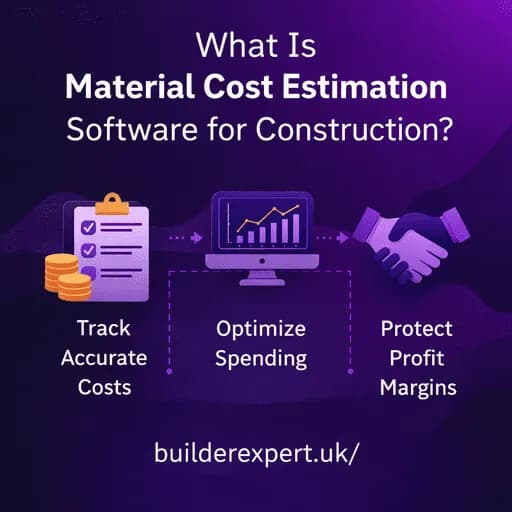
Material cost estimation software for construction is a digital solution designed specifically to calculate, manage, and monitor the cost of building materials throughout a project’s lifecycle. It brings together structured cost databases, automated calculation logic, and project-specific variables within a single, integrated platform. This allows estimators to move beyond static estimates and adopt a more dynamic, data-driven approach to material pricing.
At its core, material cost estimation software for construction replaces fragmented spreadsheets with a centralised system that maintains consistency across all estimates. Material quantities, unit rates, waste allowances, and supplier pricing can be standardised, reducing variability and improving accuracy. As a result, estimates become more reliable and easier to review, both internally and when presented to clients.
Unlike simple calculators, this software enables estimators to break material costs down by trade, task, or construction phase. This level of detail supports clearer cost planning and better decision-making during pre-construction. With material cost estimation software for construction, builders can adjust quantities, update prices, and instantly see how changes affect the overall project budget. This real-time visibility is particularly valuable when responding to design revisions or market-driven price fluctuations.
Another key advantage of material cost estimation software for construction is its ability to support consistency across multiple projects. By working from shared material libraries and pricing structures, builders ensure that estimates are aligned with current market conditions and internal pricing strategies. Over time, this improves benchmarking and supports more accurate forecasting for future residential projects.
More detailed insights into how professional estimating platforms support modern construction workflows are available at https://builderexpert.uk/construction-estimating-software/. For builders seeking greater control, transparency, and confidence in their material pricing, material cost estimation software for construction has become an essential tool in 2026.
Key Features That Drive Speed and Accuracy
Modern estimating platforms are built to reduce the time and effort required to produce reliable cost estimates, while significantly improving accuracy. As residential construction projects become more complex, builders need tools that can handle large volumes of material data without sacrificing clarity or control. This is precisely where material cost estimation software for construction delivers measurable value.
Centralised Material Libraries and Data Consistency
One of the most important advantages of material cost estimation software for construction is the use of centralised material libraries. Instead of relying on scattered spreadsheets or individual pricing files, all material data is stored in a single, structured environment. This ensures consistency across estimates and reduces discrepancies between projects.
Centralised libraries allow builders to standardise material descriptions, units of measurement, waste allowances, and pricing logic. When updates are made, they are applied universally, helping teams avoid errors caused by outdated or inconsistent data. This approach aligns closely with best practices outlined in professional estimating frameworks such as https://builderexpert.uk/construction-estimating/.
Automated Calculations That Eliminate Manual Errors
Manual calculations are one of the most common sources of estimating errors. Automated calculation engines within material cost estimation software for construction remove this risk by applying predefined formulas consistently across all estimates. Quantities, rates, and totals are calculated instantly, reducing reliance on manual input and repetitive tasks.
Automation not only improves accuracy but also frees estimators to focus on higher-value activities such as cost analysis and risk assessment. Over time, this leads to faster estimate turnaround and improved productivity across estimating teams.
Real-Time Price Updates and Market Responsiveness
Material prices rarely remain static. Timber, steel, insulation, and finishing materials are all subject to frequent market fluctuations. Material cost estimation software for construction allows estimators to update prices in real time and instantly see how changes affect the overall project cost.
This responsiveness is critical when preparing tenders or responding to client changes. Builders can make informed decisions quickly, rather than relying on assumptions or outdated figures. Real-time cost visibility also supports better procurement planning and reduces the likelihood of unexpected cost overruns later in the project lifecycle.
Detailed Cost Breakdowns for Better Control
Another key feature of material cost estimation software for construction is the ability to produce detailed cost breakdowns by trade, task, or construction phase. This level of transparency helps builders understand exactly where costs are concentrated and identify potential areas for optimisation.
Detailed breakdowns support clearer communication with clients and improve internal review processes. They also make it easier to manage variations and scope changes without losing control of the overall budget. Builders seeking deeper insight into structured estimating workflows often reference guidance such as https://builderexpert.uk/about-building-estimating/.
Reporting, Scenario Analysis, and Smarter Decisions
Advanced reporting tools further enhance the value of material cost estimation software for construction. Estimators can compare multiple scenarios, test alternative material options, and assess the financial impact of design changes before committing to them.
Scenario comparisons support smarter decision-making during pre-construction and tendering. By analysing different cost outcomes, builders can balance competitiveness with profitability. UK-specific insights into how estimating software supports these processes are explored in https://builderexpert.uk/building-estimating-software-uk-industry-guide/.
Supporting Professional Estimating in 2026
Together, these features explain why Material Cost Estimation Software for Construction Built for Speed, Accuracy, and Profit 2026 has become a defining standard for professional residential builders. The growing complexity of construction projects, combined with volatile material pricing and tighter regulatory expectations, has created a clear need for more intelligent estimating systems. Builders who rely on fragmented tools or manual processes increasingly find it difficult to maintain accuracy and financial control at scale.
By combining automation, real-time data, and structured reporting, material cost estimation software for construction supports faster estimating while reducing the risk of costly errors. Automated workflows ensure that estimates are produced consistently, regardless of project size or complexity. This consistency is particularly valuable for residential builders managing multiple projects simultaneously, where even small discrepancies can compound into significant financial exposure.
Another important advantage lies in the ability to support strategic decision-making. Modern estimating platforms provide builders with clear insights into cost drivers, allowing them to identify trends, benchmark projects, and refine pricing strategies over time. With material cost estimation software for construction, estimators are better equipped to evaluate alternative materials, assess supply risks, and plan procurement more effectively.
As the industry continues to evolve, digital estimating is also becoming a key differentiator in client relationships. Transparent, data-driven estimates build trust and improve communication with homeowners, architects, and project stakeholders. In this environment, material cost estimation software for construction is no longer simply a productivity tool; it is a foundation for sustainable growth, improved profitability, and long-term competitiveness in the UK residential construction market.
Protecting Profit Margins Through Accurate Material Estimation
In residential construction, profit margins are often tight, leaving little room for error. Even small inaccuracies in material pricing can have a disproportionate impact on overall profitability, particularly when multiple trades and suppliers are involved. When estimates are based on outdated data or assumptions, builders risk committing to projects that appear viable on paper but quickly become financially challenging during delivery.
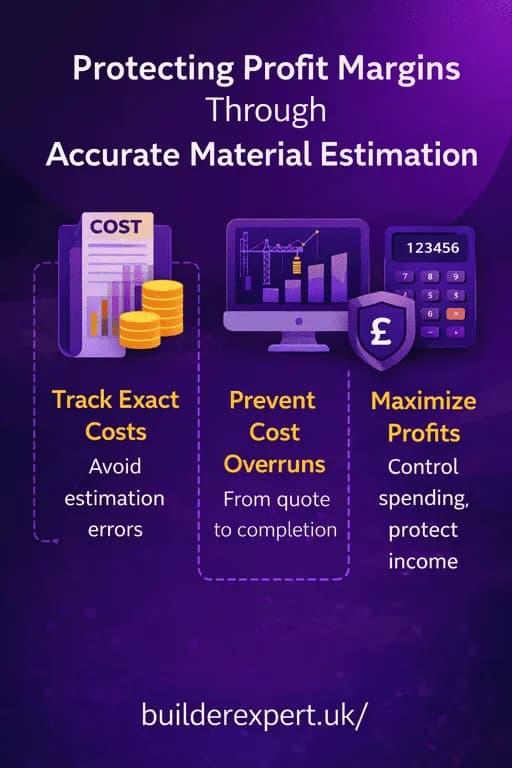
Accurate estimating enables builders to price projects realistically while maintaining sufficient contingency to manage risk. It also supports more confident tendering, as estimates are grounded in reliable data rather than guesswork. In an environment where clients expect transparency and cost certainty, this accuracy plays a critical role in protecting both margins and professional reputation.
By using material cost estimation software for construction, contractors gain significantly better control over procurement decisions. Material quantities, unit rates, and supplier pricing can be analysed together, allowing builders to identify cost pressures early and explore alternative options before committing. This proactive approach reduces the likelihood of unexpected material cost increases once construction is underway and supports more strategic purchasing decisions.
Another important benefit of material cost estimation software for construction is its ability to align estimating with broader project planning. When material costs are clearly structured and accurately forecast, builders can coordinate procurement schedules more effectively, reduce waste, and improve cash flow management. These practices reflect modern estimating principles outlined in resources such as https://builderexpert.uk/construction-estimating/ and https://builderexpert.uk/construction-estimating-software/.
This approach closely aligns with UK government recommendations for improving efficiency and value in construction, as outlined in The Construction Playbook (https://www.gov.uk/government/publications/the-construction-playbook). The guidance emphasises the importance of data-driven decision-making, cost transparency, and early risk management—principles that are directly supported by material cost estimation software for construction.
Ultimately, builders who adopt material cost estimation software for construction are better positioned to protect profit margins while remaining competitive. By reducing uncertainty around material pricing and strengthening procurement control, these tools help residential contractors deliver projects that are not only well-priced but also financially resilient.
Managing Material Costs Across the Project Lifecycle
Cost control does not end once a project begins. Materials must be monitored throughout procurement, delivery, and installation. Digital estimating tools provide continuity from pre-construction through completion.
By integrating material cost estimation software for construction into daily workflows, builders can track planned versus actual costs and manage variations more effectively. When combined with structured project workflows, such as those outlined in https://builderexpert.uk/construction-project-workflow-builder-expert/, this approach leads to smoother project delivery and fewer financial surprises.
UK Residential Case Study – Fictional Example
A fictional residential refurbishment project in Kent illustrates the impact of improved material cost control in a realistic UK setting. The project involved a full internal renovation and extension of a detached property, with a total contract value of £320,000 and a construction period of 24 weeks. At the outset, estimates were produced using spreadsheets, which required frequent manual updates and created uncertainty around supplier pricing and material availability.
As the project progressed, price fluctuations across several key material categories led to repeated estimate revisions. This made it difficult for the project team to maintain a clear view of costs and created pressure on cash flow planning. Recognising the risk, the builder decided to implement material cost estimation software for construction midway through the pre-construction phase to regain control and improve forecasting accuracy.
After adopting material cost estimation software for construction, the builder achieved a measurable improvement in cost management. Material overspend was reduced by 11%, and procurement planning became more structured and predictable. Accurate quantity tracking ensured that orders aligned closely with project requirements, reducing waste and last-minute purchases at inflated prices. Real-time price updates allowed the team to respond quickly to supplier changes and secure more favourable terms.
Clearer cost data also improved communication with suppliers and subcontractors, helping to avoid disputes and delays. With material cost estimation software for construction, the project team was able to monitor material spending throughout the build, rather than reacting to issues after they occurred. This proactive approach contributed to smoother delivery and protected the project’s profit margin.
“Having reliable material cost data allowed us to plan confidently and protect our margin,” said Daniel, the project manager. “It completely changed how we approach estimating and procurement.”
Why UK Builders Are Embracing Digital Estimating in 2026

Digital transformation is accelerating across the UK construction sector, driven by rising client expectations, increased regulatory scrutiny, and growing cost pressures. Homeowners and developers now expect greater transparency, accurate pricing, and predictable project outcomes. As a result, builders who invest in modern digital tools are gaining a clear competitive advantage and are better positioned to respond to ongoing market changes.
The adoption of material cost estimation software for construction reflects a broader shift towards data-driven decision-making across the industry. Digital estimating enables builders to demonstrate professionalism, provide clearer cost breakdowns, and manage client expectations more effectively. These capabilities are becoming increasingly important in a market where trust and accountability play a central role in winning and retaining work.
This industry transition is actively promoted by organisations such as the Construction Leadership Council (https://www.constructionleadershipcouncil.co.uk/), which consistently highlights the role of digital tools in improving productivity, efficiency, and long-term resilience. As supply chains remain volatile and margins continue to tighten, builders who rely on manual estimating methods face growing risk.
In this environment, material cost estimation software for construction is no longer a nice-to-have solution. It is fast becoming a standard requirement for sustainable growth, enabling residential builders to operate more efficiently, adapt to change, and remain competitive in an increasingly digital construction landscape.
Conclusion – Building with Confidence in 2026
As material prices continue to fluctuate, accurate cost estimation has become a critical success factor in residential construction. Builders who rely on outdated methods expose themselves to unnecessary financial risk, reduced margins, and avoidable disputes with clients. In an environment where cost certainty and transparency are increasingly expected, the ability to produce reliable and up-to-date estimates is essential for long-term success.
Material cost estimation software for construction provides the speed, accuracy, and visibility needed to manage material costs effectively throughout the project lifecycle. By replacing manual calculations with structured, data-driven workflows, builders gain greater control over pricing, procurement, and budget performance. This level of insight supports better decision-making and reduces the likelihood of unexpected cost overruns that can undermine profitability.
For builders seeking a reliable way to estimate material costs, track spending, and manage residential projects with confidence, Builder Expert offers a proven digital solution. Designed to support modern residential construction workflows, Builder Expert helps professionals work more efficiently, improve accuracy, and protect their profit margins. To explore how digital estimating can strengthen your projects and support sustainable growth, learn more at https://builderexpert.uk.
🔗https://www.gov.uk/government/publications/the-construction-playbook
🔗https://www.constructionleadershipcouncil.co.uk/
👉 Get in touch with us todayhttps://builderexpert.uk/