
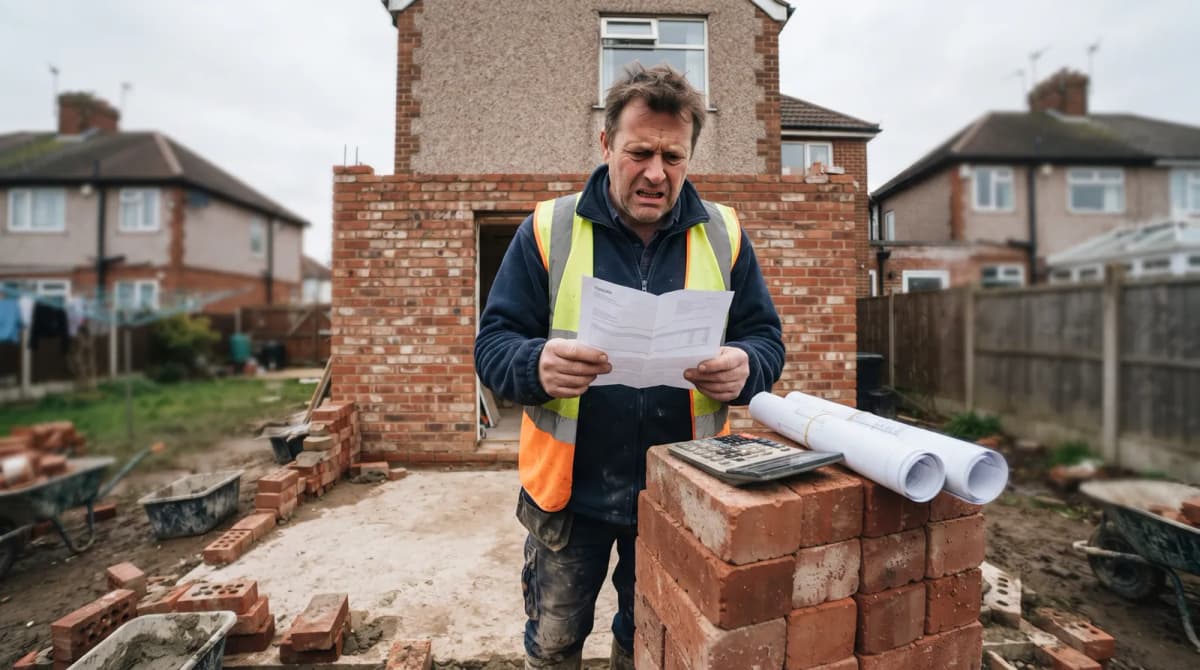
The cost of inaccurate construction estimates in the UK is typically 8% to 12% of a job's value. On a £75,000 single-storey extension that is around £9,000 of margin gone, money that was never billed because it was never counted. The cost of inaccurate construction estimates is not a vague risk: it is a figure you can calculate for your own jobs before you submit a quote.
This article is for builders, estimators and small construction firms who price their own jobs and want to see, in pounds, what gets lost when an estimate is wrong, and what it costs to fix it.
UK figures below are based on 2026 trade rates and typical margins; material and labour costs move, so treat the table figures as a guide and check current rates before pricing a job.
What counts as an inaccurate estimate
An estimate is inaccurate when the final cost diverges materially from the figure you quoted, for reasons that a proper estimate should have caught:
- Labour priced on an assumed programme that the site never achieves
- A structural element (commonly a steel beam) missed entirely
- Material prices taken from an old supplier list
- Scaffold and access left out of the sum
- No allowance for skips, permits or welfare
- No contingency or risk allowance for the unknowns every job carries
A ballpark figure scribbled on a site visit is not held to the same standard as a tender-level estimate, but when a "quick number" gets treated as a firm price, the gap between the two is where the loss sits.
The cost of inaccurate construction estimates by UK job type
The table below shows typical 2026 UK job values, the gross margin a builder would normally expect to keep, and what a common underpricing error (in the 8–12% range, depending on job complexity) actually costs in lost margin. Material price movement is one of the reasons the error keeps repeating: the government's building materials price indices, published monthly by the Department for Business and Trade, show how far individual materials can move in the weeks between quoting and ordering, and an estimate priced on last year's supplier list carries that movement as a straight loss.
| Job type | Typical job value | Typical gross margin | Typical underpricing | £ lost per job |
|---|---|---|---|---|
| Single-storey rear extension | £75,000 | 18% | 12% | £9,000 |
| Loft conversion | £45,000 | 20% | 9% | £4,050 |
| Full house refurbishment | £120,000 | 15% | 10% | £12,000 |
| New build house | £350,000 | 12% | 8% | £28,000 |
| Commercial fit-out | £180,000 | 14% | 10% | £18,000 |
The bigger and more complex the job, the larger the absolute loss, even though the percentage error looks similar across job types. A new build or commercial fit-out carries more subcontract packages and more pricing assumptions, so a small percentage slip becomes a large cash figure.
Worked example: a £75,000 rear extension that lost £9,000
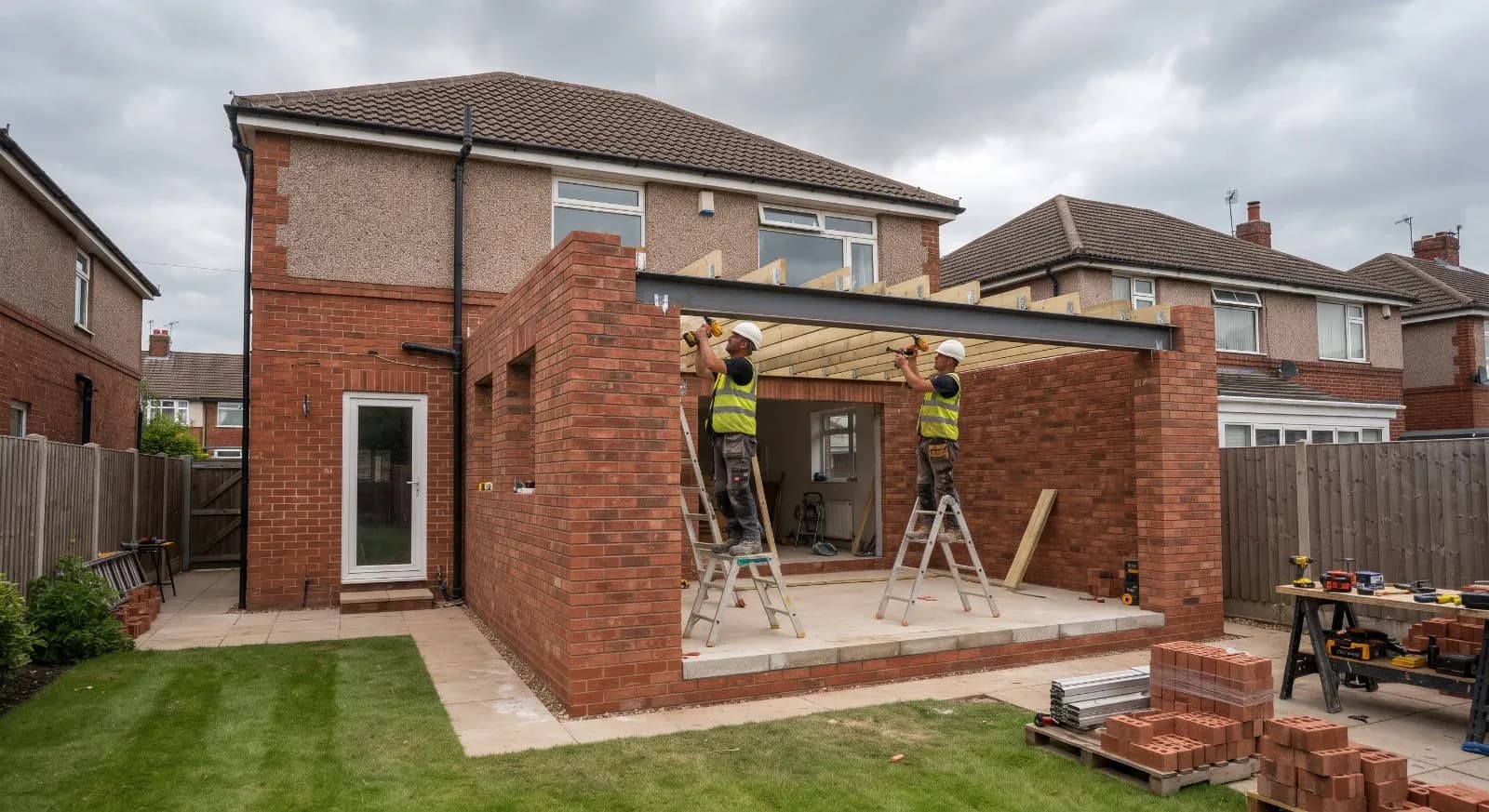
Here is how a single-storey rear extension actually loses its margin, item by item. None of these are exotic errors, they are the ones estimators miss every week.
| Error | What happened | Loss |
|---|---|---|
| Labour over-run | 8 weeks priced, 10 weeks actual (delays, weather, no-shows) | £3,300 |
| Missed structural steel | Beam required but not identified at estimate stage | £1,800 |
| Material price rise | Insulation rose from £30/m² to £38/m² between quote and order | £900 |
| Scaffold and access | Scaffold to the rear wall and roof not priced, then hired for 6 weeks | £2,400 |
| Skip and permit | No skip allowance, no parking/road permit included | £600 |
| Total loss | £9,000 |
The labour figure counts productive time only, the two extra weeks of trades actually working. It does not include standing time, where labour is paid or held but no work happens; that is costed separately below and sits on top of this total.
£9,000 against a £75,000 contract is exactly 12% of the job's value, enough to turn a reasonable profit into a job that barely breaks even, once overheads are taken out.
The eight most expensive estimating errors and what each one costs
Across UK residential jobs, the same errors recur, and most of the cost of inaccurate construction estimates comes from a short list of them. This table gives a typical £ or % impact on a £75,000 job, so you can see where the risk concentrates.

| Error | Typical impact on a £75k job |
|---|---|
| Labour hours under-counted | £2,000–£4,000 (3–5%) |
| Missed structural steel or beam | £1,500–£2,500 |
| Material price movement between quote and order | £500–£1,200 |
| Scaffold and access missed | £1,500–£3,000 |
| Waste, skips and permits | £300–£600 |
| Preliminaries under-priced | £800–£1,500 |
| Welfare and site set-up | £400–£900 |
| No risk/contingency allowance | 3–5% of contract value |
Labour and missed structural items, a steel beam, or the scaffold needed to reach the work, are consistently the two most expensive single errors. Both come from pricing on assumptions rather than checked figures.
Labour is the worst of them because the error multiplies: an extra week is not one line but every trade on site for that week, plus the overhead the business carries while the job is still open. Price labour by the hours each task genuinely takes, costed on the full employment rate (gross pay, employer's National Insurance, holiday pay, pension and non-productive time), not on a day rate taken off the top of your head, see calculating labour cost in construction for the method.
VAT and CIS are a different kind of error, and worth being clear about: handled correctly, neither costs you margin. A VAT-registered builder reclaims VAT charged by a subcontractor, and under the domestic reverse charge, which since March 2021 applies to most construction services supplied between VAT-registered businesses within CIS, the subcontractor doesn't charge it at all; the detail is on gov.uk. CIS deductions are tax paid over on the subcontractor's behalf, not a cost to you.
What does hurt is getting the VAT treatment on your own quote wrong: charging standard rate where the reverse charge applies (or the other way round), or missing a reduced or zero rate the job qualifies for. That doesn't show up as lost margin on the job sheet, it shows up as a cash-flow hole and an HMRC correction later. For the full list of what goes wrong and why, see common construction estimating mistakes.
How much extra work it takes to recover an underpriced job

Lost margin doesn't come back on its own, you have to earn it back on other work, at whatever margin you're actually running.
Extra turnover needed = loss ÷ gross margin %
Losing £9,000 at a 15% margin, a realistic working margin once overheads are carried, rather than the headline 18% on the quote, means you need to win:
£9,000 ÷ 0.15 = £60,000 of additional turnover just to break even on that one error.
That's not £9,000 of extra sales, it's £60,000, because every pound of new turnover only returns 15p of profit. One underpriced extension can cost you the equivalent of an entire extra job's worth of work, just to stand still.
Run your own numbers:
What an underpriced job costs you
- Margin lost on this job
- £9,000
- Extra turnover needed to recover it
- £60,000
Based on typical UK underpricing ranges for 2026. Figures are a guide, use your own margin and check current rates before pricing a job.
Delay and disruption: the cost per week of site time
An inaccurate estimate doesn't only cost money at the point of quoting, a wrong programme allowance creates delay, and delay has its own price. On a small residential job, a week of unplanned site time typically costs:
| Cost item | Typical weekly cost |
|---|---|
| Labour standing time (2–3 trades) | £1,500–£2,500 |
| Plant and scaffold hire, extended | £150–£400 |
| Site welfare (toilet, cabin, fencing) | £100–£250 |
A programme that overruns by four weeks on a misjudged groundworks estimate can add £1,750–£3,150 per week in direct standing costs, before counting the knock-on effect of pushing back every following trade. This is separate from, and additional to, the margin lost on the original price.
Two things make the delay cost worse than the weekly figure suggests. First, standing time is rarely clean: trades booked for a fixed window either wait, go elsewhere and come back late, or have to be paid to hold the slot. Second, a job that runs four weeks long is four weeks of your next job not starting, so the loss shows up twice, once as cost on this site and again as turnover you never invoiced. A builder running back-to-back work can lose more to the second effect than the first. For the wider causes and effects of overruns, see our guide to construction cost overruns.
How accurate should an estimate be? Accuracy bands and what each error range costs
UK estimating practice recognises different levels of accuracy depending on how the figure was built. Each level carries an expected error range, and that range has a real cost on a £100,000 job:
| Estimate level | Typical accuracy | £ error on a £100,000 job |
|---|---|---|
| Order of cost / ballpark | ±20–30% | £20,000–£30,000 |
| Detailed estimate | ±10% | £10,000 |
| Tender / BoQ-based | ±5% | £5,000 |
A ballpark figure given on a site visit is not meant to be relied on as a firm price, treating it as one is where most disputes start. A detailed estimate narrows that range considerably, and a full tender estimate, priced against a bill of quantities, narrows it further still.
Which cost estimate is most accurate?
A fully measured, bill-of-quantities-based tender estimate is the most accurate, because every item is quantified and priced against current rates rather than assumed or averaged, it removes the guesswork that drives the wider bands above.
What are the 5 levels of cost estimation?
UK and RICS practice generally recognises: order of cost estimate, elemental cost plan, detailed cost plan, pre-tender estimate, and the tender (or contract sum) itself, each one narrowing the accuracy range as more design and pricing detail becomes available.
What is the 0.6 rule for cost estimating?
The 0.6 rule (also called the six-tenths rule) is an industrial cost-scaling formula: cost₂ = cost₁ × (capacity₂ ÷ capacity₁)^0.6, used to estimate the cost of a larger plant or process unit from a known smaller one. It comes from chemical and process engineering, not UK residential construction, it has no real use for pricing a house extension or fit-out, where costs come from measured quantities, not capacity scaling.
How to do an estimate for construction?
In outline: get a full set of drawings and specification, measure or take off quantities for every element, price labour, materials and subcontractors at current rates, add preliminaries, waste, overheads and a risk allowance, then check the total against a second method (rate per m² or a past comparable job) before issuing it. For the full method, see the construction estimating process.
The annual picture: what estimating errors cost across a year of work
A single underpriced job is bad enough. Most builders repeat the same estimating habits on every job, which means the loss compounds across a year.
Take a builder running 8 jobs a year at an average £60,000 each, underpricing by a typical 10%:
- Total annual turnover: £480,000
- Average loss per job: £6,000
- Annual margin lost: £48,000
Put that next to what the same year should have produced. At a properly priced 18% gross margin, £480,000 of turnover returns about £86,000 of gross margin; underpricing by 10% leaves roughly £38,000. Overheads, vehicles, insurance, yard, office time, your own unpaid hours, come out of what is left, and on a business of this size they can take most of it. Seen over a year, the cost of inaccurate construction estimates isn't a line-item problem: left unchecked, it is the difference between a profitable year and a year spent working for nothing. See how much profit a builder should make for a fuller breakdown of healthy margins.
The checklist of items most often missed from UK estimates
Run your next estimate past this list before you send it:
- The right VAT treatment on your quote (reverse charge or standard rate)
- Waste disposal and skip hire
- Parking and road permits
- Scaffold hire and extensions
- Site welfare (toilet, cabin, fencing)
- Temporary works (propping, shoring)
- Risk and contingency allowance
- An allowance for material price inflation between quote and order
Several of these, scaffold and welfare especially, sit among the hidden construction costs that rarely make it onto a quick quote but always show up on site. A bill of quantities is the standard way to make sure every one of these lines is captured rather than assumed.
What accuracy costs to buy
Set against a £9,000 loss on one extension, the cost of getting the estimate right in the first place is small. A professionally priced estimate from Builder Expert, or a subscription to our construction estimating software, typically costs a fraction of what one underpriced job loses, see what an estimate costs for current pricing.
If carrying the risk of pricing your own jobs isn't where you want to spend your time, our construction estimating services deliver a priced estimate, tender, detailed or basic, built to the accuracy levels above, so the number you quote is one you can stand behind.
Either way, the comparison to make is not fee against fee. It is the known, one-off cost of buying accuracy against the cost of inaccurate construction estimates spread across a year's work: £6,000 to £12,000 of margin on each job where the labour allowance, the steel or the scaffold was a guess.
Frequently asked questions
How much money does an inaccurate construction estimate actually cost a UK builder? Typically 8–12% of the job's value. On a £75,000 extension that's around £9,000; on a £350,000 new build it can be £28,000 or more.
How much do builders typically underestimate by? Most underpricing errors in UK residential work fall between 8% and 12% of contract value, with labour and missed structural items the two biggest single causes.
Which job types lose the most money to estimating errors? In absolute £ terms, new build houses and commercial fit-outs lose the most, because they carry more subcontract packages and a larger base value, even though the percentage error is similar to smaller jobs.
Who pays when the estimate is wrong? Contractually, the builder does, a fixed-price quote that turns out too low is the builder's loss unless the contract allows for variations. The client only pays more if the scope changed or the contract specifically provides for cost increases.
What does a week of delay cost on a small UK site? Typically £1,750–£3,150 in direct standing costs (labour, plant, scaffold, welfare), before counting the knock-on effect on following trades.
Is paying for an estimate or estimating software cheaper than the losses from underpricing? Almost always. The cost of a professional estimate or a software subscription is a small, known figure, set against a £9,000–£28,000 loss that only shows up after the job is already under way, when the money is gone.