

Advantage in UK Construction Projects has become a decisive factor in today’s increasingly competitive UK construction market. Builders are no longer competing only on price, but also on speed, relationships, and visibility. Many capable construction companies struggle to secure enough work not because of a lack of technical skills or experience, but because they enter opportunities too late. By the time a project reaches the open market or formal tender stage, key decisions have often already been influenced, limiting options and increasing competition.
In today’s residential construction environment, timing is just as important as cost control and workmanship. Clients, developers, and homeowners increasingly value early input, clear guidance, and confidence long before construction begins. Builders who rely solely on advertised tenders or late-stage enquiries often face intense competition, reduced margins, and limited room to negotiate. In contrast, companies that position themselves earlier gain insight, trust, and leverage before the project becomes crowded, allowing them to build stronger pipelines and more predictable workloads.
Understanding how to position your business ahead of competitors allows builders to create stronger pipelines, negotiate from a position of strength, and reduce reliance on tender-driven work. Early visibility enables better forecasting, smarter resource planning, and more selective project choices. Instead of reacting to opportunities, builders can proactively shape their workload. This shift in approach is a defining benefit of First-Mover Advantage in UK Construction Projects, especially for small to mid-sized residential builders looking to grow sustainably.
Early access to reliable information plays a major role in this process. Planning approvals, development intentions, and early-stage project data offer valuable signals about future construction activity. When used correctly, this information allows builders to approach potential clients at the right moment, with the right message. Industry data and benchmarks from organisations such as https://www.bcis.co.uk/ also highlight how early cost awareness and planning alignment can significantly improve project outcomes.
At the same time, government-backed guidance such as the UK Construction Playbook reinforces the importance of early collaboration, transparency, and informed decision-making across the construction lifecycle. Builders who align their approach with these principles naturally strengthen their position in the market.
This article, First-Mover Advantage in UK Construction Projects for Builders Who Want More Work 2026, explores how early access changes outcomes, why it matters more than ever, and how builders can apply this thinking to residential projects across the UK. By adopting a strategy built around First-Mover Advantage in UK Construction Projects, construction companies can move away from reactive bidding and toward long-term, controlled growth supported by better information, stronger relationships, and earlier involvement.
What First-Mover Advantage Really Means in Construction
In construction, being first does not mean starting work first. It means knowing about a project before it becomes public or crowded. First-Mover Advantage in UK Construction Projects is about early awareness, early conversations, and early trust.
Builders who understand this concept move from reactive bidding to proactive planning. Instead of chasing advertised work, they position themselves before competition even appears.
This shift is at the heart of First-Mover Advantage in UK Construction Projects for Builders Who Want More Work 2026.
Why Builders Who Move First Win More Work
When builders act early, they control more variables across the entire project lifecycle. This is the practical power behind First-Mover Advantage in UK Construction Projects. Early involvement allows builders to influence budgets before they are locked, timelines before they become unrealistic, and design decisions before they create unnecessary cost or risk. Instead of inheriting a fixed scope that limits flexibility, builders using First-Mover Advantage in UK Construction Projects actively shape how a residential project develops.
By engaging earlier, construction companies gain visibility over cost drivers and sequencing long before estimates are finalised. This creates space for realistic pricing, clearer assumptions, and fewer disputes later. Builders who apply First-Mover Advantage in UK Construction Projects are better positioned to align scope, budget, and client expectations from the start, rather than correcting problems once construction is already underway. This early control also improves estimating accuracy.
Beyond technical control, First-Mover Advantage in UK Construction Projects significantly strengthens professional relationships. Early movers engage clients, architects, and consultants while decisions are still open. These conversations build trust and position the builder as a problem-solver rather than just a service provider. Over time, this trust becomes a competitive asset that late entrants cannot easily replicate.
Repeated early collaboration often leads to preferred-builder status, negotiated work, and repeat projects. Builders who consistently apply First-Mover Advantage in UK Construction Projects move away from one-off wins and toward predictable pipelines. This stability reduces reliance on competitive tendering and supports better long-term planning. Many of these benefits connect directly to structured workflows and early-stage project visibility, as outlined at https://builderexpert.uk/construction-project-workflow-builder-expert/.
Importantly, First-Mover Advantage in UK Construction Projects also improves internal efficiency. Teams can plan labour, materials, and cash flow with greater confidence. Estimating becomes more strategic rather than rushed, especially when supported by structured systems such as https://builderexpert.uk/construction-estimating/. Builders who understand and apply First-Mover Advantage in UK Construction Projects are not simply faster to respond—they are better prepared, better informed, and better positioned to grow sustainably in a competitive residential market.
The Cost of Being Late to Construction Opportunities
Late entry usually means price pressure, lower margins, and higher overall risk. Builders who enter projects at tender stage often compete against many firms offering almost identical services, timelines, and capabilities. At this point, the client’s decision is frequently reduced to cost alone. First-Mover Advantage in UK Construction Projects directly reduces this pressure by limiting competition before it forms and by shifting conversations away from price and toward value.
When builders rely on late-stage tenders, they inherit constraints they did not help define. Budgets are already set, scopes are fixed, and timelines are often unrealistic. Without early input, builders have little influence over risk allocation or project structure. First-Mover Advantage in UK Construction Projects changes this dynamic by allowing builders to engage before these constraints are locked in, creating room for more balanced and profitable agreements.

Builders who ignore early-stage intelligence often fall into volume bidding. This approach depends on submitting many tenders in the hope of winning a small percentage. Over time, this damages profitability and internal morale. Estimating teams are stretched, site teams face rushed starts, and management spends more time chasing work than delivering quality projects. First-Mover Advantage in UK Construction Projects offers an alternative by focusing effort on fewer, higher-quality opportunities with a greater chance of success.
Late entry also increases financial risk. Competitive tenders often push builders to reduce margins to unsustainable levels. Unexpected site conditions, design changes, or material cost fluctuations then have a much greater impact. Builders who operate without First-Mover Advantage in UK Construction Projects are more exposed to these risks because they have less opportunity to influence scope clarity and cost assumptions early on. Clear estimating foundations, as discussed at https://builderexpert.uk/construction-estimating/, become much harder to establish once a project reaches tender.
From an operational perspective, tender-heavy strategies create instability. Workloads fluctuate, pipelines are unpredictable, and planning becomes reactive. First-Mover Advantage in UK Construction Projects supports a more controlled approach, where builders can plan labour, procurement, and cash flow with greater confidence. This leads to healthier teams, more consistent delivery, and better long-term performance. Structured workflows, such as those outlined at https://builderexpert.uk/construction-project-workflow-builder-expert/, become far more effective when projects are secured earlier.
External industry guidance also highlights the limitations of late-stage competition. The UK Construction Playbook (https://www.gov.uk/government/publications/the-construction-playbook) emphasises early engagement, collaboration, and better risk management across projects. Builders who align with these principles through First-Mover Advantage in UK Construction Projects naturally reduce adversarial tendering and move toward more sustainable working models.
Ultimately, builders who depend on late entry are forced into defensive positions. Those who prioritise First-Mover Advantage in UK Construction Projects operate proactively, protecting margins, reducing stress on teams, and improving overall business resilience. In a market where competition continues to intensify, avoiding late-stage pressure is not just beneficial—it is essential for long-term stability.
How Early Project Awareness Changes Business Strategy
Early awareness allows builders to plan resources with far greater accuracy. When upcoming projects are visible early, companies can assess labour availability, subcontractor capacity, and material lead times without pressure. First-Mover Advantage in UK Construction Projects supports smarter decision-making by giving builders time to prepare rather than react. This reduces last-minute changes, overtime costs, and operational stress that often accompany rushed project starts.
Cash flow forecasting also improves significantly with early visibility. Builders who understand what work is likely to start months in advance can manage payment schedules, supplier commitments, and financing needs more confidently. First-Mover Advantage in UK Construction Projects enables businesses to move away from short-term thinking and toward controlled, predictable growth. This level of financial clarity is extremely difficult to achieve when work is secured only at tender stage.
Strategic project selection is another key benefit. Instead of accepting every opportunity out of necessity, builders using First-Mover Advantage in UK Construction Projects can be selective. They can prioritise residential projects that match their technical strengths, preferred locations, and operational capacity. This selectivity leads to better delivery outcomes and stronger reputations. Accurate early estimating plays a major role in this process, as outlined at https://builderexpert.uk/construction-estimating-software/.
Reactive growth often forces builders into unsuitable work. Projects may be too far from core operating areas, too complex for existing teams, or too tight on margin. First-Mover Advantage in UK Construction Projects reduces this risk by aligning opportunity selection with long-term business goals. Builders who plan early can say no to poor-fit projects without fear of pipeline gaps. Guidance on structuring this approach is also explored at https://builderexpert.uk/building-estimating-software-uk-industry-guide/.
Industry-wide research supports this strategic mindset. Organisations such as the Construction Leadership Council (https://www.constructionleadershipcouncil.co.uk/) consistently highlight the importance of early planning, productivity, and sustainability. Builders who adopt First-Mover Advantage in UK Construction Projects naturally align with these principles and position themselves for long-term resilience.
This strategic shift—from chasing volume to choosing value—is a core theme of First-Mover Advantage in UK Construction Projects for Builders Who Want More Work 2026. Builders who embrace it gain control over growth, protect their teams, and build businesses that are profitable, stable, and future-ready.
Planning Data and Early Signals
Many residential projects leave clear signals long before construction starts. Planning submissions, outline approvals, and early design discussions all indicate future work well ahead of site activity. First-Mover Advantage in UK Construction Projects is built on the ability to identify, track, and correctly interpret these signals while opportunities are still forming. Builders who understand where to look gain visibility months before competitors become aware.
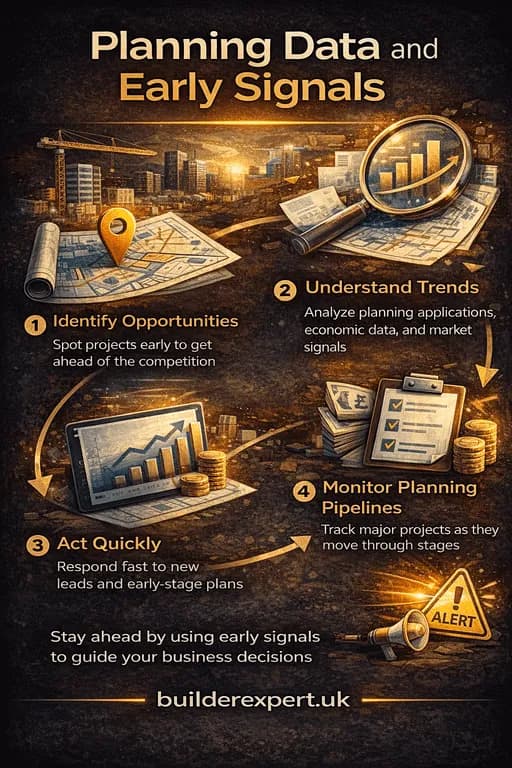
Early indicators often reveal not only that a project is coming, but also its potential scale, complexity, and timing. This information allows builders using First-Mover Advantage in UK Construction Projects to assess suitability early and decide whether to engage. Rather than reacting to fully defined tenders, builders can initiate conversations when clients are still shaping ideas and budgets. This early engagement often leads to more collaborative relationships and stronger influence over project direction.
Planning data is particularly valuable in the residential sector, where approvals typically precede contractor involvement by a significant margin. Builders who actively monitor these indicators gain practical insight into future workloads and can align estimating and resourcing accordingly. Structured estimating approaches, such as those described at https://builderexpert.uk/about-building-estimating/, become far more effective when applied early rather than under tender pressure.
Builders who monitor early indicators consistently outperform those who wait for formal invitations. First-Mover Advantage in UK Construction Projects enables companies to move from passive recipients of work to proactive participants in project development. This early intelligence-driven approach creates a measurable edge in securing suitable, profitable residential work while competitors remain unaware.
Relationship Building Before the Crowd Arrives
.Early contact allows builders to become trusted advisors rather than just contractors. When builders engage before decisions are fixed, conversations move beyond price and into problem-solving. First-Mover Advantage in UK Construction Projects creates space for collaboration instead of competition, allowing builders to contribute knowledge that shapes better residential outcomes. This advisory role is difficult to establish once a project reaches tender, where interactions are often transactional and time-limited.
Clients are significantly more open to advice when designs, budgets, and timelines are still flexible. Builders who apply First-Mover Advantage in UK Construction Projects can guide choices around buildability, sequencing, and cost efficiency before mistakes are embedded in the design. This early guidance reduces rework, delays, and disputes later in the project. It also positions the builder as a partner invested in success rather than a supplier focused only on delivery.
This collaborative dynamic improves communication across the project team. Architects and consultants are more receptive to input when builders are involved early, which leads to clearer scopes and more realistic expectations. Over time, builders who consistently leverage First-Mover Advantage in UK Construction Projects develop reputations for reliability and insight, making them a preferred choice for future residential work.
Smoother projects benefit both sides. Clients experience fewer surprises and greater confidence, while builders benefit from reduced risk and improved margins. Early collaboration also supports more accurate estimating and cost control, areas where early-stage involvement provides measurable advantages. Resources such as https://builderexpert.uk/construction-estimating-software/ highlight how early input strengthens financial outcomes.
Ultimately, First-Mover Advantage in UK Construction Projects transforms relationships. Instead of competing for attention at the final stage, builders earn trust early and convert it into long-term partnerships, repeat work, and sustainable growth across the residential construction sector.
Risk Reduction Through Early Involvement
Early involvement reduces uncertainty. Builders can flag issues before they become costly problems. First-Mover Advantage in UK Construction Projects helps avoid scope gaps, unrealistic budgets, and rushed schedules.
This proactive approach improves delivery quality and protects reputation.
Building a Consistent Pipeline, Not Just One-Off Wins
Sustainable growth requires predictability. Construction businesses cannot rely on occasional wins or short bursts of work if they want to remain stable and profitable. First-Mover Advantage in UK Construction Projects supports consistent lead flow by creating visibility long before projects reach the open market. This early visibility allows builders to plan ahead instead of constantly reacting to gaps in their pipeline.
When builders systemise early access, momentum builds naturally. Rather than starting from zero each time work slows down, opportunities overlap and reinforce one another. First-Mover Advantage in UK Construction Projects turns growth into a process rather than an event. Builders can move from chasing individual projects to managing a continuous flow of suitable residential work.
This compounding effect becomes more powerful over time. Each early conversation leads to stronger relationships, repeat enquiries, and referrals. Builders who consistently apply First-Mover Advantage in UK Construction Projects begin to see patterns in where work comes from and which early signals produce the best outcomes. This insight allows further refinement of strategy, improving efficiency and selectivity.
Predictability also improves internal stability. Teams benefit from clearer forward planning, reduced uncertainty, and more balanced workloads. First-Mover Advantage in UK Construction Projects helps businesses avoid sudden peaks and troughs that strain resources and morale. Instead, work arrives in a more controlled and manageable rhythm.
This approach is a defining message in First-Mover Advantage in UK Construction Projects for Builders Who Want More Work 2026. Builders who prioritise predictability over volume create businesses that are resilient, scalable, and prepared for long-term success rather than short-term survival.
Competitive Positioning in a Tight Market
As demand fluctuates, early movers remain resilient. Market cycles, seasonal slowdowns, and shifts in residential demand are inevitable in construction. Builders who rely on late-stage opportunities often feel these changes immediately, as competition increases and margins tighten. First-Mover Advantage in UK Construction Projects allows builders to stay selective even when the market slows, because opportunities have already been identified and relationships established in advance.
Early movers are not forced to accept unsuitable work simply to keep teams busy. Instead, they can choose projects that align with capacity, expertise, and financial goals. First-Mover Advantage in UK Construction Projects provides a buffer against volatility by spreading risk across a planned pipeline rather than a reactive scramble for work.
This positioning separates growing companies from those constantly under pressure. Builders who plan ahead operate with confidence, while those without early visibility face uncertainty and stress. Over time, First-Mover Advantage in UK Construction Projects becomes a defining factor in which construction businesses adapt and grow, and which remain stuck responding to market conditions rather than shaping them.
Conclusion: Moving First Is a Business Decision
Securing more work is not about working harder, but working earlier. Many builders invest huge amounts of time chasing tenders, revising estimates, and competing on price, often with uncertain results. First-Mover Advantage in UK Construction Projects shifts this effort upstream, where decisions are still flexible and competition is limited. By engaging earlier, builders gain control over how projects are shaped rather than reacting to conditions set by others.
This early control brings clarity. Builders can assess whether a project fits their business before committing resources. They can plan estimating, scheduling, and resourcing with realistic assumptions instead of compressed timelines. First-Mover Advantage in UK Construction Projects supports more accurate forecasting and better decision-making, especially when combined with structured estimating processes such as those outlined at https://builderexpert.uk/about-building-estimating/ and https://builderexpert.uk/construction-estimating/.
Confidence naturally follows. When builders understand what work is coming and why they are well positioned for it, pressure reduces across the organisation. Teams operate with purpose rather than urgency. First-Mover Advantage in UK Construction Projects allows businesses to move away from survival mode, where every job feels critical, and toward strategic growth built on visibility and preparation.
That shift is the real value behind First-Mover Advantage in UK Construction Projects for Builders Who Want More Work 2026. Builders who adopt this approach create businesses that are stable, intentional, and capable of growing on their own terms rather than reacting to market pressure.
🔗 https://www.gov.uk/government/publications/the-construction-playbook
🔗 https://www.constructionleadershipcouncil.co.uk/
📝 Contact Form https://builderexpert.uk/contact-builder-expert/