

For many UK homeowners, a kitchen renovation is one of the most exciting home improvement projects—but also one of the most financially risky. Budgets often spiral, timelines stretch, and final costs can be far higher than expected. In most cases, the issue is not poor design choices or unrealistic expectations, but a lack of structured planning from the outset. Without a clear financial framework, even well-intentioned projects can quickly become stressful and expensive.
A clear and realistic Kitchen renovation cost calculation allows homeowners to make informed decisions before work begins, rather than reacting to unexpected expenses halfway through the project. When costs are understood early, it becomes far easier to balance design ambition with financial control. Homeowners can prioritise what truly matters to them, whether that is high-quality cabinetry, durable worktops, or energy-efficient appliances, without compromising overall affordability.
In the UK, kitchen renovations often involve additional considerations such as VAT, compliance with building regulations, and variations in labour costs depending on location. These factors make an accurate Kitchen renovation cost calculation even more important. Relying on rough estimates or headline figures can create a false sense of security, leading to overspending once work is underway. A structured approach, by contrast, highlights potential cost pressures before they become problems.
Another common challenge is comparing contractor quotes that appear similar on the surface but differ significantly in scope. Without understanding what is included—and excluded—homeowners may choose a lower price only to face additional charges later. A detailed Kitchen renovation cost calculation helps clarify these differences, ensuring that decisions are based on real value rather than initial price alone.
This article explains how UK homeowners can approach kitchen renovation costs professionally, avoid common budgeting mistakes, and plan a beautiful, functional kitchen without overspending. By understanding how costs are built up and how professionals assess them, readers will be better equipped to manage their renovation with confidence, clarity, and financial peace of mind.
What Kitchen Renovation Cost Calculation Really Means
Kitchen renovation cost calculation is not simply an estimate or a rough price range. It is a structured breakdown of every cost involved in the project, from initial strip-out work to final finishes. This process transforms a renovation from a vague idea into a clearly defined financial plan, allowing homeowners to understand exactly where their money will be spent.
A proper Kitchen renovation cost calculation includes materials, labour, fixtures, professional services, waste removal, VAT, and contingency allowances. Each of these elements plays a critical role in the final outcome. For example, labour costs are often underestimated, despite being one of the largest portions of a kitchen renovation budget in the UK. Similarly, VAT and disposal costs are frequently overlooked, only to appear later as unexpected additions.
Crucially, an accurate cost calculation also defines what is included and what is not. This level of detail is essential when comparing contractor quotes, as two prices that appear similar can differ significantly in scope. Without a structured breakdown, homeowners may unknowingly compare incomplete figures, leading to confusion and disputes once work begins. Tools and professional methods commonly used in construction estimating—such as those outlined in reliable industry guides how clarity at this stage prevents problems later on.
For UK homeowners, this process provides clarity and control. Instead of guessing what the final cost might be, you are working with a realistic financial framework that supports better planning and fewer surprises. A well-prepared Kitchen renovation cost calculation also makes conversations with builders more productive, as expectations are aligned from the outset.
Ultimately, this structured approach shifts the renovation experience from reactive to proactive. Rather than responding to rising costs as they occur, homeowners can make informed decisions in advance, protecting both their budget and the overall success of the project.
The Main Cost Categories in a UK Kitchen Renovation
Understanding where money is typically spent is the foundation of any accurate kitchen renovation cost calculation. In most UK residential projects, costs fall into several key categories:
- Removal and disposal of the existing kitchen
- Cabinetry and storage units
- Worktops and splashbacks
- Appliances and fittings
- Plumbing and electrical works
- Flooring, plastering, and decoration
- Labour and project management
Each category can vary significantly depending on quality level, layout changes, and property type. A terraced house renovation, for example, may involve different access and waste considerations compared to a detached home.
Breaking costs down in this way ensures that no major expense is overlooked during the planning stage.
Factors That Can Significantly Affect Final Costs
Several factors can cause kitchen renovation costs in the UK to increase unexpectedly. These include structural alterations, relocating services, upgrading electrics to meet current regulations, or discovering hidden issues such as damp, asbestos, or outdated pipework once the existing kitchen is removed. Older UK properties, in particular, often conceal problems that are impossible to identify during an initial site visit, making early planning even more important.
Regulatory requirements also play a significant role. Electrical upgrades to meet Part P standards, plumbing adjustments to comply with modern safety expectations, and ventilation improvements are all common cost drivers. Without a structured Kitchen renovation cost calculation, these regulatory elements are frequently underestimated or excluded from early budgets, only to surface later as unavoidable expenses.
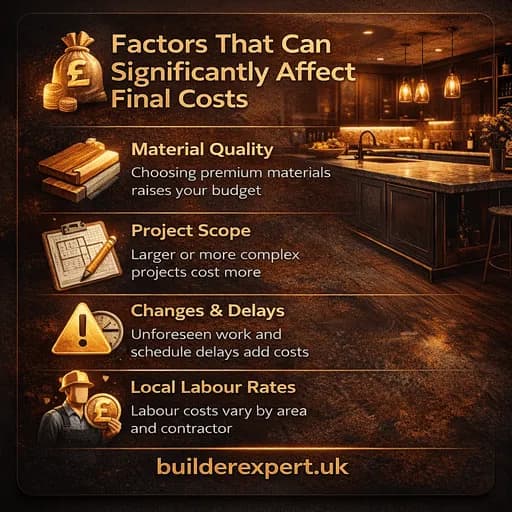
Material choices can further influence costs in a substantial way. Bespoke cabinetry, stone or composite worktops, and premium-brand appliances can quickly elevate the overall budget beyond initial expectations. While these upgrades may add long-term value and visual appeal, they should always be assessed within the context of a realistic Kitchen renovation cost calculation. When decisions are made purely on aesthetics, homeowners often lose sight of cumulative costs.
Another overlooked factor is project sequencing. Delays caused by material lead times, design changes, or contractor availability can increase labour costs and extend hire periods for equipment. Professional estimating methods—such as those used in structured construction workflows outlined at https://builderexpert.uk/construction-project-workflow-builder-expert/ how planning order and timing directly affect final costs.
By identifying these variables early, homeowners gain greater control over where their money is spent. A detailed Kitchen renovation cost calculation allows informed trade-offs, helping homeowners decide where to invest for impact and where to remain cost-conscious without compromising functionality or quality.
Ultimately, anticipating cost drivers before work begins reduces stress, limits disruption, and protects the renovation budget. When potential risks are acknowledged and planned for from the outset, the renovation process becomes more predictable, transparent, and financially manageable.
How Professionals Approach Kitchen Renovation Cost Calculation
Professional builders and estimators do not rely on guesswork when pricing a kitchen renovation. Instead, they work from clearly defined scopes of work, measured layouts, established labour rates, and up-to-date supplier pricing to build a reliable and transparent cost structure. This disciplined approach ensures that every stage of the project is accounted for before work begins.
A professional Kitchen renovation cost calculation considers not only what work will be carried out, but also the order in which tasks must be completed. Sequencing is critical in kitchen renovations, where delays in one trade—such as cabinetry installation or electrical work—can have a knock-on effect on the entire programme. By planning the sequence properly, professionals reduce downtime and prevent unnecessary labour cost increases.
Realistic labour durations are another key component. Experienced estimators understand how long tasks genuinely take in a residential setting, factoring in access constraints, working hours, and coordination between trades. Without this level of detail, a Kitchen renovation cost calculation can appear accurate on paper while failing in practice. Professionals avoid this by using proven benchmarks and past project data.
Allowances for unforeseen issues are also built into professional budgets. Older UK homes frequently present surprises once work starts, from uneven floors to outdated wiring. A structured Kitchen renovation cost calculation includes a contingency—typically between 10 and 15 percent—to absorb minor variations without causing financial stress or forcing rushed decisions.
This methodical approach is one of the main reasons professionally prepared budgets tend to stay closer to the final cost. When every element is considered upfront, there is less need for reactive changes during the build. A well-prepared Kitchen renovation cost calculation provides homeowners with confidence, clarity, and a far greater chance of completing their renovation on time and within budget.
Common Budgeting Mistakes UK Homeowners Make
One of the most common mistakes UK homeowners make is underestimating labour costs. It is easy to focus on visible elements such as cabinetry, worktops, and appliances, while overlooking the time, coordination, and technical skill required to install them correctly. In reality, labour often represents a significant portion of the overall renovation budget, particularly in projects involving electrical, plumbing, and structural work.

Another frequent issue is failing to account properly for VAT. Some quotes may appear competitive at first glance but exclude VAT or list it separately, creating confusion when final costs are reviewed. Without a clear and structured Kitchen renovation cost calculation, homeowners may not realise this omission until invoices are issued, at which point there is little room to adjust the budget.
Assuming that all quotes include the same scope of work is also a common pitfall. Two contractors may quote similar totals while covering very different levels of detail. One may include waste removal, certification, and final finishes, while another excludes them entirely. Guidance on breaking down and comparing construction estimates, such as the approach outlined at https://builderexpert.uk/construction-estimate-tasks-breakdown/ , highlights why scope clarity is essential from the outset.
Setting an unrealistically low contingency is another mistake that weakens the Kitchen renovation cost calculation. Even well-planned projects can encounter minor variations, particularly in older UK properties. A contingency that is too small leaves homeowners exposed, forcing rushed decisions or compromises later in the project.
Avoiding these issues requires clear documentation, careful quote comparison, and realistic expectations. A well-prepared Kitchen renovation cost calculation provides a reliable framework for decision-making, helping homeowners maintain control over costs while ensuring the renovation progresses smoothly and professionally.
Building a Realistic Kitchen Renovation Budget Step by Step
Start with a Clearly Defined Scope of Work
A strong kitchen renovation budget always begins with clarity. Before requesting quotes, homeowners should define exactly what the renovation includes—and just as importantly, what it does not include. This means being specific about layout changes, appliance upgrades, electrical or plumbing alterations, storage requirements, and any structural work.
Without a clearly defined scope, quotes are difficult to compare and often misleading. Contractors may interpret requirements differently, resulting in prices that vary widely for reasons that are not immediately obvious. Establishing scope early provides the foundation for an accurate Kitchen renovation cost calculation and prevents misunderstandings that can lead to budget overruns later in the project.
Break Costs into Logical and Transparent Categories
Once the scope is agreed, costs should be broken down into clear, logical categories. Typical categories include demolition, cabinetry, worktops, appliances, services, finishes, and labour. This structure allows homeowners to see exactly where their budget is being allocated and identify areas that may require adjustment.
Breaking costs down also improves transparency when reviewing quotes. Rather than comparing headline totals, homeowners can assess whether allowances are realistic and complete. Guidance on structuring and understanding cost breakdowns, such as the estimating principles explained at https://builderexpert.uk/construction-estimating/, reinforces why categorisation is essential for a reliable Kitchen renovation cost calculation.
Prioritise Where Quality Delivers Long-Term Value
Not every element of a kitchen renovation needs to be premium. A realistic budget requires homeowners to decide early where quality matters most. Items such as cabinetry construction, hinges, worktops, and core appliances often justify higher investment due to daily use and long-term durability.
Other elements—such as decorative finishes or accessories—may offer opportunities for cost savings without compromising performance. Making these decisions early ensures that the Kitchen renovation cost calculation reflects priorities rather than impulse upgrades introduced later in the project.
Build in a Sensible Contingency from the Start
Even well-planned renovations can encounter unforeseen issues, particularly in older UK homes. Hidden pipework, uneven subfloors, or outdated wiring may only become visible once work begins.
Including a contingency allowance—typically 10 to 15 percent—should be a standard part of every Kitchen renovation cost calculation. This buffer protects homeowners from minor variations and allows the project to continue smoothly without constant budget reassessment or rushed compromises.
Review, Test, and Finalise the Budget Before Work Begins
Before committing to the renovation, homeowners should review the full budget carefully and ask critical questions. Does the Kitchen renovation cost calculation include everything required to complete the project? Are assumptions realistic? Are there areas where costs could escalate?
Stress-testing the budget by considering potential changes or delays helps identify pressure points early. Reviewing and refining the budget at this stage allows confident decision-making and significantly reduces stress once work is underway. A well-prepared Kitchen renovation cost calculation turns budgeting into a practical planning tool rather than a source of uncertainty.
How Accurate Cost Planning Prevents Overspending
Accurate planning changes the way decisions are made throughout a kitchen renovation. When homeowners fully understand the cost implications of each design and material choice, they are far less likely to approve expensive changes late in the project. Instead of reacting emotionally or under time pressure, decisions are made with clarity and confidence, supported by a realistic Kitchen renovation cost calculation.
A structured Kitchen renovation cost calculation encourages thoughtful planning from the very beginning. When costs are clearly broken down, homeowners can assess the true value of each upgrade before committing. This approach reduces impulse decisions and ensures that design choices align with the overall budget rather than gradually eroding it.
Clear cost planning also significantly improves communication with contractors. When expectations are defined from the outset, conversations become more productive and less confrontational. A shared Kitchen renovation cost calculation acts as a reference point, helping both parties understand what has been agreed and why certain decisions were made. This transparency minimises misunderstandings and reduces the likelihood of disputes during the build.
Another important benefit is smoother project workflow. When costs are planned accurately, trades can be scheduled more efficiently, materials can be ordered on time, and delays caused by budget uncertainty are avoided. A reliable Kitchen renovation cost calculation supports better coordination between trades, which is especially important in kitchens where multiple disciplines must work in sequence.
Most importantly, accurate cost planning gives homeowners peace of mind. Knowing that finances are under control allows them to focus on the positive aspects of the renovation rather than worrying about unexpected expenses. A well-prepared Kitchen renovation cost calculation transforms the renovation experience from a source of stress into a structured, manageable process—one that delivers both a beautiful kitchen and financial confidence.
Conclusion: Planning with Confidence
A successful kitchen renovation is not just about aesthetics—it is fundamentally about planning. While design trends and visual appeal often take centre stage, long-term satisfaction depends far more on whether the project has been planned realistically from a financial perspective. A clear and realistic Kitchen renovation cost calculation gives UK homeowners the confidence to move forward, knowing that ambition is balanced with affordability.
When costs are understood from the outset, homeowners are empowered to make informed decisions rather than reactive ones. Understanding cost categories, recognising potential risk factors, and budgeting professionally all contribute to a renovation process that feels controlled rather than overwhelming. A structured Kitchen renovation cost calculation transforms uncertainty into clarity, allowing each decision to be weighed carefully against the overall budget.
Crucially, good planning also protects the quality of the final result. Projects that run out of budget late in the process often suffer from rushed compromises—cheaper finishes, delayed works, or unfinished details. By contrast, a well-prepared Kitchen renovation cost calculation ensures that quality is protected from start to finish, with allowances made for both priorities and contingencies.
Beyond finances, careful cost planning improves the overall renovation experience. Communication with contractors becomes clearer, timelines are easier to manage, and expectations remain aligned throughout the project. This reduces stress, minimises disruption to daily life, and creates a more positive working relationship between homeowner and builder.
Ultimately, Kitchen renovation cost calculation: How to Plan a Stunning Kitchen Without Overspending is about control, clarity, and making smart decisions from day one. It is about replacing guesswork with structure and transforming what could be a risky investment into a confident, well-managed improvement to the home. For UK homeowners, this approach is not simply advisable—it is essential for achieving a kitchen that is both beautiful and financially sustainable.
🔗 https://www.gov.uk/government/publications/the-construction-playbook