
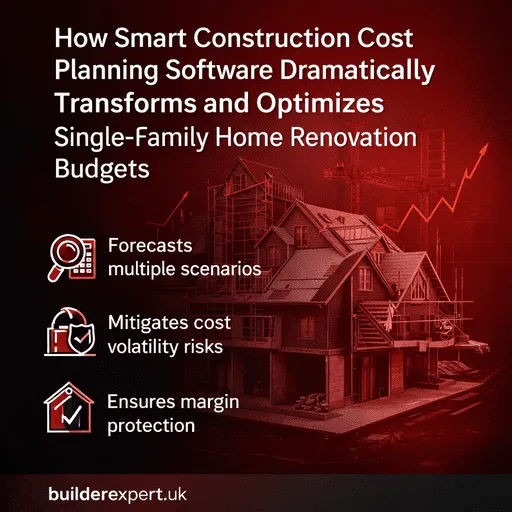
Smart Construction Cost Planning Software is redefining how UK residential builders approach financial control in single-family home renovations. Single-family home renovations in the UK are financially complex, technically demanding, and increasingly exposed to cost volatility. Material inflation, labour availability constraints, Building Regulations compliance, planning conditions, and mid-project design revisions all create financial pressure that can quickly erode carefully projected margins. Unlike new-build developments, refurbishment projects involve working within existing structures where unknown variables are almost guaranteed. Hidden structural defects, outdated electrical and plumbing systems, insufficient insulation, damp remediation requirements, and irregular substrates introduce layers of uncertainty that cannot be fully identified at tender stage.
In this environment, pricing accuracy is not simply about winning work — it is about protecting viability. A marginal 5–8% forecasting error on a £250,000 renovation can eliminate the contractor’s entire profit buffer. Labour productivity assumptions may shift once strip-out begins. Steel requirements may increase after structural exposure. Energy efficiency upgrades may require specification adjustments to meet Part L requirements. Each of these variables carries measurable financial impact.
For residential builders operating under these conditions, precision is no longer optional; it is operationally critical. Smart Construction Cost Planning Software transforms cost management from a static pre-construction exercise into a dynamic, continuously monitored financial framework. Instead of relying on spreadsheet-based assumptions or retrospective adjustments, contractors can forecast multiple pricing scenarios, model risk exposure by trade, structure markups strategically, and monitor margin performance throughout the project lifecycle.
Crucially, Smart Construction Cost Planning Software supports decision-making before financial damage occurs. It enables contractors to analyse supplier volatility, simulate labour productivity sensitivity, and allocate contingency based on probability rather than guesswork. Rather than reacting to cost overruns at valuation stage, builders can identify early warning indicators and take corrective action while margins remain protected.
Equally important is transparency. Modern homeowners expect detailed cost breakdowns and financial accountability. Smart Construction Cost Planning Software allows builders to present structured cost plans, explain contingency allocations, and demonstrate how variations affect the overall budget in real time. This level of clarity reduces disputes, strengthens professional credibility, and enhances trust between contractor and client.
In practical terms, this means cost planning evolves from being a reactive document to becoming a strategic control system. From pre-construction feasibility and tender submission through procurement, contract administration, and final account reconciliation, Smart Construction Cost Planning Software provides measurable financial visibility at every stage. In a market defined by uncertainty, that visibility is what separates controlled profitability from uncontrolled exposure.
The Core Financial Problem in Residential Renovation
Detached and single-family home refurbishments rarely begin with perfect clarity. Even when contractors commission structural surveys, drainage inspections, and service reports, there are always variables that only become visible once demolition and strip-out works are underway. Load-bearing walls may require additional steel once exposed. Floor structures may reveal rot or inadequate spans. Damp penetration may extend further than initial moisture readings suggested. Existing plumbing and electrical systems often fail to meet current standards, requiring partial or complete replacement. These uncertainties are not exceptions — they are typical characteristics of residential renovation.
The financial implications of this incomplete information can be significant. A minor oversight in structural reinforcement can add thousands of pounds to fabrication and installation costs. An underestimated labour schedule can disrupt sequencing and increase preliminaries. A late-stage design alteration requested by the homeowner can trigger cascading changes across trades. In refurbishment work, cost risk is layered, interconnected, and frequently underestimated during initial pricing.
Typical budget vulnerabilities include:
- Underestimated steel requirements and structural reinforcement upgrades
- Labour productivity miscalculations due to restricted site access or unforeseen complexity
- Supplier price fluctuations, particularly in timber, insulation, and roofing materials
- Scope creep initiated by homeowners during construction
- Poorly structured contingency allowances applied as flat percentages
- Weak margin visibility across trades and cost centres
- Inadequate allowance for Building Regulations upgrades
- Insufficient forecasting for energy efficiency compliance
When these risks are managed informally, profit becomes dependent on favourable circumstances rather than disciplined planning. Builders may believe they have priced accurately, yet without structured cost modelling, exposure remains hidden until it directly impacts margin.
This is precisely where Smart Construction Cost Planning Software provides measurable advantage. Instead of relying on static estimates, Smart Construction Cost Planning Software enables contractors to break down costs hierarchically, assign risk weightings to high-exposure elements, and monitor trade-level performance throughout the project. By transforming isolated cost items into an integrated financial framework, Smart Construction Cost Planning Software shifts renovation budgeting from reactive estimating to proactive financial management.
Rather than discovering problems during interim valuations or final account negotiations, builders using Smart Construction Cost Planning Software can anticipate potential overruns through structured forecasting and scenario modelling. Contingency is applied with intention, not approximation. Margins are engineered by trade rather than assumed at project level. Supplier volatility can be analysed in advance, and labour productivity risks can be modelled against realistic site conditions.
In residential refurbishment, uncertainty cannot be eliminated — but it can be quantified. Through disciplined structuring, continuous monitoring, and data-informed forecasting, Smart Construction Cost Planning Software replaces guesswork with control.
Before: Spreadsheet-Based Estimating on a £210,000 Renovation
Consider the renovation of a 4-bedroom detached property in Leeds with a total contract value of approximately £210,000. The scope included structural alterations, partial reconfiguration of internal layouts, replacement glazing, electrical upgrades, kitchen installation, and internal finishes. At tender stage, the pricing was prepared using a traditional spreadsheet-based estimating approach built on previous project templates and adjusted line by line.
The initial figures appeared commercially sound:
- Structural works estimated at £42,000
- Labour forecast at 1,400 hours across trades
- Materials priced using supplier quotes valid for 30 days
- Contingency applied as a flat 7% across total construction cost
- Overall projected margin: 17%
On paper, the numbers were balanced. Subcontractor allowances were inserted, preliminaries calculated as a percentage of duration, and profit applied at the end of the build-up. The tender was competitive and successfully secured.
However, the weaknesses of sprint-based, spreadsheet-driven estimating began to surface once construction commenced.
During strip-out, additional steel support was required due to previously concealed load paths. Fabrication and installation costs increased, pushing structural expenditure beyond the original £42,000 allowance. At the same time, labour productivity declined slightly because of restricted access and sequencing clashes between trades. The forecast of 1,400 hours was exceeded by 9%, adding unplanned wage costs and extending preliminaries.
Simultaneously, steel prices rose by 11% during procurement. Because the pricing model was static and supplier fluctuations had not been scenario-tested, the increase was absorbed rather than strategically managed. Midway through the project, the homeowner upgraded the glazing specification to a higher-performance unit to improve thermal efficiency. While the variation was agreed commercially, the knock-on impact on margin was not fully modelled across procurement and installation phases.
By completion, the final margin had dropped to 9.8% — almost half of the projected 17%. The contractor had not underpriced deliberately, nor had the project been poorly managed. The issue was structural: the cost plan lacked dynamic modelling, risk sensitivity analysis, and live margin tracking.
The spreadsheet approach treated contingency as a blanket safety net and profit as a static percentage. It did not simulate labour overruns, material inflation exposure, or cumulative variation impact. As a result, what appeared to be a profitable £210,000 renovation gradually transformed into a tightly constrained project with limited financial buffer.
The problem was not pricing ambition — it was the absence of adaptive financial control.
After: Financial Control Using Smart Construction Cost Planning Software
Using Smart Construction Cost Planning Software, the same £210,000 renovation project in Leeds would have been approached with a fundamentally different level of financial structure, visibility, and control. Rather than building the estimate as a static spreadsheet with fixed assumptions, the contractor would create a fully structured cost plan organised by trade, work package, and risk exposure. Each cost element would be coded, measurable, and continuously monitored from pre-construction through procurement and delivery.
At tender stage, Smart Construction Cost Planning Software would apply structured cost coding by trade, separating structural works, labour allocation, glazing, electrical upgrades, and finishes into individual cost centres. This allows each package to be analysed independently rather than being absorbed into a single overall construction sum. Structural steel, for example, would be isolated as its own cost element, enabling sensitivity analysis against potential supplier price fluctuations before the contract is finalised.
One of the most significant advantages of Smart Construction Cost Planning Software is labour sensitivity modelling. Instead of assuming labour hours will align perfectly with initial forecasts, the software allows contractors to simulate productivity variations of +5%, +10%, or more. In this Leeds renovation scenario, modelling a potential 10% labour increase would immediately show the projected margin impact. This allows the contractor to either adjust pricing strategically, refine labour planning, or strengthen contingency allocation to protect profitability.
Procurement exposure is also managed differently. Smart Construction Cost Planning Software tracks supplier pricing dynamically, allowing contractors to identify volatile materials such as steel or glazing early in the planning phase. Rather than locking estimates to fixed supplier quotes, the system allows scenario comparisons across multiple supplier options and timing strategies. This prevents sudden procurement cost increases from eroding margin unexpectedly.
Contingency allocation is no longer applied as a flat percentage. Instead, Smart Construction Cost Planning Software applies risk-weighted contingency to specific trades and cost elements. Structural works, which carry higher uncertainty, receive targeted contingency allowances, while predictable work packages such as finishes or fixtures receive proportionally lower allocation. This ensures contingency is both sufficient and efficient, protecting margin without inflating tender value unnecessarily.
Most importantly, Smart Construction Cost Planning Software continuously monitors margin performance across individual cost centres. Rather than only calculating profit at project level, contractors can see margin distribution across structural works, labour, glazing, and finishes. If labour productivity begins to shift or supplier pricing changes, the software immediately recalculates financial exposure and shows the projected outcome. This enables early corrective action rather than late-stage financial surprises.
In this controlled environment, the original projected margin of 17% would remain stable throughout project delivery. Even with labour adjustments and supplier cost movements, structured modelling and targeted contingency allocation would secure a final margin of approximately 16.4%. This difference is not achieved through higher pricing or reduced competitiveness, but through disciplined cost planning and proactive financial management.
The outcome demonstrates a critical distinction. Without structured planning, profit depends on favourable conditions. With Smart Construction Cost Planning Software, profit is actively engineered, monitored, and protected. The difference is financial control, not optimism.
How a Structured Cost Plan Is Built
A professional residential cost plan should never be a single summary figure or a loosely organised spreadsheet. It must be layered, measurable, auditable, and strategically aligned with project risk. In single-family home renovations, where uncertainty is inherent, cost structure is what separates predictable margin from financial exposure.
Smart Construction Cost Planning Software enables contractors to construct a fully layered hierarchy that reflects both the physical build sequence and the financial control framework. Rather than grouping costs generically, the system organises them into structured levels that allow analysis, forecasting, and margin protection.
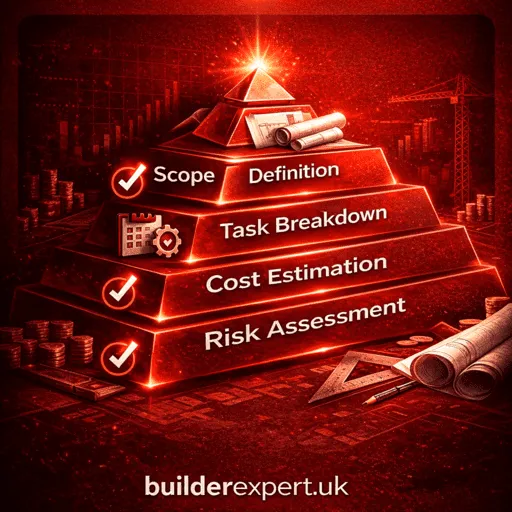
Level 1 – Executive Financial Framework
At the highest level, the cost plan defines the financial architecture of the renovation project. This layer acts as an executive control dashboard, confirming viability before construction begins and monitoring profitability throughout delivery.
It establishes:
- Total projected construction cost
- Preliminaries and site overheads
- Direct versus indirect costs
- Risk-adjusted contingency
- Target gross margin
- Net projected profit
Total projected cost includes all labour, materials, subcontractor packages, and plant. Indirect costs cover site management, temporary works, compliance, insurances, and administration. Clear separation between these categories prevents hidden overhead erosion — a common issue in residential refurbishment.
Preliminaries must be measured explicitly, as programme extensions or sequencing inefficiencies can significantly increase site costs. Contingency should be risk-weighted rather than applied as a flat percentage, reflecting actual exposure across trades.
Gross margin represents pricing ambition; net profit reflects true financial outcome after overhead absorption. Confusing the two can distort profitability expectations.
Using Smart Construction Cost Planning Software, this executive layer updates dynamically. Any change in labour productivity, procurement pricing, or scope automatically recalculates the overall position. Level 1 ensures financial clarity — replacing periodic reconciliation with continuous control.
Level 2 – Trade-Based Cost Control and Operational Clarity
While Level 1 defines overall financial viability, Level 2 is where operational control begins. This layer structures the renovation into clearly defined trade packages aligned with real site delivery. In single-family refurbishments, cost exposure is uneven — structural works and M&E typically carry higher financial risk than finishes. Trade-level clarity is therefore essential.
Using Smart Construction Cost Planning Software, contractors organise the project into coded packages such as:
- Demolition and strip-out
- Structural alterations and steelwork
- Roofing and envelope
- Windows and glazing
- Mechanical and electrical installations
- Internal finishes
- External works
This structure converts each trade into a measurable cost centre rather than a blended construction total. With Smart Construction Cost Planning Software, contractors can isolate overruns immediately. If steel quantities increase or labour productivity drops within M&E works, the margin impact is visible at trade level before it affects the entire project.
Level 2 also enables trade-specific margin strategy. Not every package justifies the same markup. Higher-risk works may require stronger margin buffers, while predictable finish packages can operate on leaner percentages. Smart Construction Cost Planning Software allows differentiated markup allocation while maintaining overall competitive pricing.
Procurement control is strengthened through trade mapping. Supplier quotes are benchmarked within their specific cost centre, improving negotiation leverage and reducing price volatility exposure. Smart Construction Cost Planning Software supports scenario comparison across suppliers without distorting unrelated trades.
Cash flow planning also benefits. Because trade packages reflect sequencing, Smart Construction Cost Planning Software forecasts stage-based expenditure, helping contractors manage working capital during front-loaded structural phases and later finish stages.
Variation management becomes clearer as well. Scope changes are applied within the relevant trade package, and Smart Construction Cost Planning Software recalculates both trade-level and executive-level impact instantly.
Level 2 transforms monitoring from retrospective review into continuous oversight. Through Smart Construction Cost Planning Software, contractors track budget consumption in real time, protecting margin through early corrective action. In residential refurbishment, structured trade control is where profitability is actively secured rather than assumed.
Risk, Margin and Strategic Control
Many residential builders apply flat contingency allowances of 5–10%. While simple, this approach is financially weak. Contingency should reflect measurable risk, not assumption.
With Smart Construction Cost Planning Software, contingency is allocated by risk category, weighted by probability, and applied to specific trades. For example:
- Structural exposure: 15% probability × £30,000
- M&E rerouting risk: 10% × £18,000
- Damp remediation: 20% × £12,000

Instead of adding £20,000 arbitrarily, the system calculates a risk-adjusted contingency of £11,400 — protecting margin without inflating tender value. This structured approach aligns with disciplined risk management principles reflected in UK Construction Playbook guidance.
Risk management must also account for inflation and market volatility. Using BCIS benchmarking data and inflation index monitoring, Smart Construction Cost Planning Software supports sensitivity modelling and supplier trend analysis.
If roofing materials trend upward by 6% annually, pricing can be adjusted proactively rather than reactively. Risk weighting ensures price movements do not silently erode profitability.
Profit strategy is equally important. Margin should not be applied as a flat percentage at the end of an estimate. Through Smart Construction Cost Planning Software, markup becomes trade-specific and risk-based. Higher-risk structural works may carry stronger margin buffers, while predictable finish packages operate at leaner percentages. A weighted example might produce an overall 17.8% margin through differentiated allocation rather than uniform markup. This strengthens competitiveness without sacrificing protection.
A £320,000 detached house refurbishment in Surrey illustrates this approach. The project included structural steel insertion, rear extension, full M&E replacement, and kitchen installation over 32 weeks. Initial target margin was 16%. Using Smart Construction Cost Planning Software, the contractor modelled supplier scenarios, applied risk-weighted contingency, structured trade-specific margins, and tracked provisional sums dynamically. The final contract value reached £334,500 with an achieved margin of 19.1%, securing an additional £9,920 beyond target. The improvement came from modelling and control — not inflated pricing.
Financial clarity also strengthens client trust. Homeowners increasingly expect transparent breakdowns and justification for costs. Smart Construction Cost Planning Software enables contractors to explain contingency logic, document variation impact instantly, and generate structured reports. When flooring is upgraded from £48/m² to £82/m² across 110m², the system calculates material increase, installation variance, and margin effect immediately. Transparency replaces uncertainty, reinforcing professionalism.
Variations, often the primary source of profit erosion, are controlled through real-time comparison of original and revised scope. With Smart Construction Cost Planning Software, margin impact is visible before approval, overhead allocation is protected, and undercharging is avoided.
By integrating benchmarking logic, inflation awareness, structured contingency, and trade-level margin engineering, Smart Construction Cost Planning Software transforms residential cost planning from reactive estimation into disciplined financial management. In a competitive 2026 market, builders who combine technical delivery with structured financial intelligence gain measurable strategic advantage.
Conclusion
Single-family home renovations demand more than technical expertise — they demand financial discipline. In an environment shaped by material volatility, labour fluctuation, regulatory compliance, and evolving client expectations, profitability cannot depend on assumptions or static spreadsheets. Without structure, even well-managed projects can experience gradual margin erosion through small, cumulative cost shifts.
Smart Construction Cost Planning Software provides the framework required to manage this complexity with confidence. By structuring cost plans hierarchically, applying risk-weighted contingency, engineering trade-specific margins, and monitoring performance in real time, Smart Construction Cost Planning Software converts uncertainty into measurable exposure. Decisions are based on data rather than optimism, and financial performance is actively managed rather than reviewed retrospectively.
Beyond internal control, Smart Construction Cost Planning Software strengthens external credibility. Transparent reporting, clear variation impact analysis, and structured cost breakdowns reinforce trust with homeowners who expect accountability and clarity. Financial transparency becomes a competitive advantage rather than a vulnerability.
In a competitive UK residential market, builders who adopt Smart Construction Cost Planning Software do more than improve estimating accuracy — they secure predictability, protect margin, and position their businesses for sustainable growth. Structured financial control is no longer optional in modern refurbishment projects. With Smart Construction Cost Planning Software, profitability is not hoped for — it is engineered.
🔗 https://www.gov.uk/government/publications/the-construction-playbook
🔗 https://www.constructionleadershipcouncil.co.uk/
🔗 https://www.planningportal.co.uk/
🔗 https://www.gov.uk/government/organisations/hm-treasury
💼 Want structured financial control for your projects? Contact our team.