
Renovation vs rebuilding costs are a critical consideration for homeowners deciding whether to renovate or rebuild a residential property in the UK.Rising building material costs, tightening regulations, new energy-efficiency standards, and shifting homeowner expectations mean that choosing between renovation and rebuilding is becoming increasingly complex.
Many people assume renovation is always the more affordable option, but this assumption is often incorrect once hidden defects, regulatory upgrades, and long-term maintenance costs are factored in. Effective construction cost control plays a critical role in making the right decision. Understanding the full comparison of Renovation vs. Rebuilding: Proven Cost-Saving Strategies That Maximize Long-Term Value & Boost Property Performance is crucial for any homeowner looking to protect their budget and maximise the overall performance of their property.

In recent years, UK homeowners have increasingly turned to rebuilds because they offer predictable costs, modern structural performance, and the ability to incorporate high-efficiency systems. However, renovation still has a strong place, especially when structural integrity remains good, the layout is functional, and only selective improvements are needed. Understanding renovation vs rebuilding costs is essential, and the key is having accurate information, professional estimating insights, and a clear strategic understanding. This article explores Renovation vs. Rebuilding: Proven Cost-Saving Strategies That Maximize Long-Term Value & Boost Property Performance from every angle—from cost factors to energy savings, material considerations, compliance obligations, and long-term property market appeal.
Table of Contents
- Understanding Renovation and Rebuilding Costs
- Structural Integrity and Its Influence on Cost
- Planning Permissions, Regulations, and Compliance
- Long-Term Energy Savings and Performance
- Timeline Predictability and Project Management
- Material Efficiency and Modern Design Flexibility
- Maximising Property Value and Marketability
- Common Mistakes When Comparing Renovation vs. Rebuilding
- UK Residential Case Study
- Conclusion
- Contact Builder Expert
- FAQ Section
Understanding Renovation and Rebuilding Costs
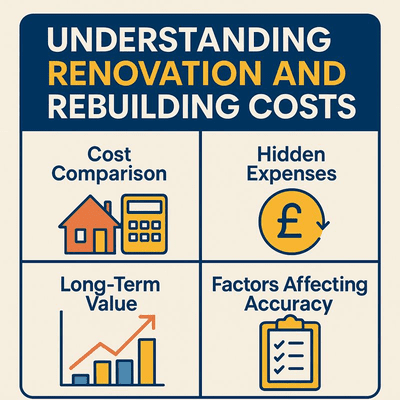
When analysing Renovation vs. Rebuilding: Proven Cost-Saving Strategies That Maximize Long-Term Value & Boost Property Performance, the first question is always about cost. Renovation tends to appear cheaper at the outset, but many renovation projects escalate as hidden defects emerge. For homeowners comparing renovation vs rebuilding costs, older UK homes—particularly those built before 1970—frequently contain outdated wiring, inadequate insulation, ageing roofs, timber rot, damp issues, pipe corrosion, and unsafe structural components that are not visible during initial inspections. Without proper construction cost control, renovation budgets can be undermined by these unanticipated problems.
Rebuilding, by contrast, offers clarity and predictability from the beginning. Even though the upfront cost may be higher, homeowners eliminate hidden risks and can build using modern methods of construction. This approach makes it easier to assess renovation vs rebuilding costs accurately, as rebuilds allow for precise estimating with far fewer unknowns. Homeowners using professional construction estimating software such as https://builderexpert.uk/construction-estimating-software/ can compare the lifecycle cost of renovation versus rebuilding with data-backed accuracy.
External benchmarks from https://www.bcis.co.uk/ provide UK-wide averages for rebuild costs, helping homeowners validate their decisions with objective figures. These benchmarks often show that rebuilding can be more cost-effective for properties with severe structural deterioration.
For further estimating guidance, homeowners can review https://builderexpert.uk/construction-estimating/ for in-depth cost frameworks tailored to residential construction.
Structural Integrity and Its Influence on Cost
Structural condition is one of the most defining factors in the Renovation vs. Rebuilding: Proven Cost-Saving Strategies That Maximize Long-Term Value & Boost Property Performance comparison. When assessing renovation vs rebuilding costs, renovations must work within existing structural constraints, which often limits what can be changed. Removing load-bearing walls, correcting foundation issues, or replacing major structural elements can be prohibitively expensive.
When comparing Renovation vs Rebuilding, a rebuild avoids these constraints entirely. Starting fresh means structural performance can be optimised from the outset. Reinforced foundations, updated load paths, modern roofing structures, and high-efficiency insulation systems can be integrated without compromise. Homeowners benefit from improved durability, enhanced safety, and superior long-term stability.
For a deeper understanding of structural estimating principles, resources such as https://builderexpert.uk/about-building-estimating/ offer guidance on how structural decisions impact cost and performance. For regulatory considerations, the government’s Construction Playbook (https://www.gov.uk/government/publications/the-construction-playbook) outlines structural best practices that apply across the industry.
The structural reality is clear: when a home requires significant intervention just to reach a safe baseline, rebuilding is often the more cost-effective option.
Structural decision-making plays a pivotal role in achieving long-term performance, and this becomes especially clear when assessing Renovation vs. Rebuilding: Proven Cost-Saving Strategies That Maximize Long-Term Value & Boost Property Performance 2026. When evaluating renovation vs rebuilding costs, many homeowners underestimate how significantly structural integrity influences cost, safety standards, and the overall functionality of a property. When existing foundations, load-bearing walls, or roofing assemblies no longer meet modern engineering expectations, renovation can quickly become an ongoing cycle of patchwork repairs.
Each upgrade must work within the limitations of an outdated frame, reducing efficiency and increasing long-term expenses. In contrast, understanding the structural condition early allows homeowners to make informed decisions about whether to continue investing in remedial work or consider a full rebuild. This clarity eliminates guesswork and helps ensure that both current and future project budgets remain predictable, realistic, and aligned with long-term investment goals.
When exploring Renovation vs. Rebuilding: Proven Cost-Saving Strategies That Maximize Long-Term Value & Boost Property Performance 2026, structural performance becomes one of the most critical deciding factors. For homeowners weighing renovation vs rebuilding costs, renovation may appear cost-effective initially, but when major structural elements need reinforcement or replacement, the financial benefits diminish rapidly. Issues such as subsidence, outdated materials, or weakened load paths often demand extensive corrective work that offers limited long-term value.
Rebuilding, however, provides a clean structural slate and enables homeowners to integrate modern engineering principles, enhanced insulation, improved airtightness, and more efficient spatial layouts from the very beginning. This approach not only increases structural resilience but also reduces maintenance requirements throughout the property’s lifecycle. For homeowners seeking maximum return on investment, evaluating structural integrity with a forward-looking perspective ensures that every decision supports durability, performance, and overall financial sustainability.
Planning Permissions, Regulations, and Compliance
The regulatory environment around UK residential construction is becoming increasingly rigorous. Homeowners comparing Renovation vs. Rebuilding: Proven Cost-Saving Strategies That Maximize Long-Term Value & Boost Property Performance must consider how regulations impact each option. When assessing renovation vs rebuilding costs, renovations can trigger regulatory upgrades when key elements are modified. For example, changing the layout, replacing staircases, altering structural walls, or extending your home may require full building control approval.

Rebuilds must meet full regulatory compliance from the beginning, but achieving compliance with a new build is often far simpler than upgrading ageing structures that contain outdated materials and inefficient energy systems. Heritage properties, in particular, introduce additional layers of complexity that can make extensive renovations extremely expensive and difficult to certify. When evaluating Renovation vs. Rebuilding, regulatory demands often reveal how limited renovation options can be compared to the streamlined compliance pathway of a full rebuild.
Industry leadership guidance from organisations such as the Construction Leadership Council (https://www.constructionleadershipcouncil.co.uk/) helps clarify best practices for compliance, risk assessment, and modern construction expectations. Meanwhile, schedule-planning resources like https://builderexpert.uk/how-to-create-a-realistic-construction-schedule/ support homeowners in understanding regulatory timelines and required documentation. These factors become even more important when analysing renovation vs rebuilding costs within Renovation vs. Rebuilding: Proven Cost-Saving Strategies That Maximize Long-Term Value & Boost Property Performance 2026, as regulatory efficiency directly influences budget accuracy and long-term project performance. Compliance is not just a cost factor—it directly affects safety, longevity, and sustainability.
Long-Term Energy Savings and Performance
Energy performance is one of the strongest factors influencing Renovation vs. Rebuilding: Proven Cost-Saving Strategies That Maximize Long-Term Value & Boost Property Performance. Older homes often struggle to achieve modern energy-efficiency standards due to thermal bridging, air leakage, ageing windows, and outdated heating systems. Renovations can improve efficiency, but they rarely match the performance of newly built homes.

Rebuilding enables homeowners to incorporate:
• High-performance insulation
• Triple-glazed windows
• Renewable energy heating systems
• Air-source heat pumps
• Solar PV integration
• Mechanical ventilation with heat recovery (MVHR)
• Advanced airtightness systems
These energy upgrades dramatically reduce operational costs. Homeowners can also use tools from https://builderexpert.uk/building-estimating-software-uk-industry-guide/ to calculate long-term energy savings. Over 20–30 years, rebuilds often outperform renovations financially due to lower heating bills and reduced maintenance costs.
Energy efficiency also plays a key role in resale value and EPC ratings, further supporting rebuild strategies. Modern insulation systems, improved airtightness, and high-performance glazing significantly reduce operational costs and make a property more attractive to future buyers. These upgrades allow a rebuilt home to meet or exceed current energy regulations, offering long-term advantages that older structures struggle to match. When examining renovation vs rebuilding costs, energy performance becomes a decisive factor, as rebuilds can incorporate advanced heating systems, low-carbon technologies, and optimised building envelopes from the start. This level of efficiency not only enhances day-to-day comfort but also strengthens the property’s market position and long-term value retention.
Timeline Predictability and Project Management
Predictability is often overlooked in the Renovation vs Rebuilding comparison. When evaluating renovation vs rebuilding costs, renovations are vulnerable to unpredictable delays caused by hidden structural issues, material shortages, sudden regulatory updates, or unforeseen remedial work. These uncertainties increase labour costs, prolong project timelines, and significantly elevate stress for homeowners. Rebuilding, by contrast, offers a cleaner, more structured process. Builders can sequence tasks logically, avoid reactive adjustments, and maintain a steady workflow. This stability reduces project disruption and allows homeowners to plan accommodation or temporary living arrangements with far greater confidence. Timeline reliability is not just a convenience but an economic factor—every unexpected delay carries financial consequences.
Understanding these time-related risks is essential when evaluating Renovation vs Rebuilding, particularly for homeowners seeking both value and certainty. When considering renovation vs rebuilding costs, renovation often appears more convenient on the surface, but variable site conditions and unpredictable construction obstacles can quickly compromise schedules. Rebuilding provides a more controlled environment where modern planning tools, regulated sequencing, and improved structural clarity eliminate many common sources of delay. This helps ensure that projects progress with fewer interruptions, enabling more accurate forecasting of labour, materials, and long-term financial outcomes. Ultimately, time predictability becomes a decisive factor for those seeking efficient delivery and reduced risk exposure.
When examining Renovation vs. Rebuilding: Proven Cost-Saving Strategies that Maximize Long-Term Value and Boost Property Performance 2026, it becomes clear that timeline efficiency directly influences overall project success. When analysing renovation vs rebuilding costs, a rebuild supports consistent task coordination, predictable subcontractor scheduling, and streamlined inspections, all of which contribute to smoother progress and fewer costly interruptions. These advantages reduce onsite disruption, limit contingency spending, and improve communication between builders and homeowners. Renovation vs. Rebuilding decisions must therefore consider not only structural performance and budget implications, but also the ability to maintain schedule integrity. Homeowners who prioritise long-term planning, accurate forecasting, and stability in project delivery often find rebuilding to be the option that delivers the strongest long-term advantage.
Material Efficiency and Modern Design Flexibility
Material selection varies dramatically when examining Renovation vs. Rebuilding: Proven Cost-Saving Strategies That Maximize Long-Term Value & Boost Property Performance. When analysing renovation vs rebuilding costs, renovations often require bespoke materials to match existing components, which can be costly and difficult to source. Period-specific finishes, non-standard windows, and custom joinery increase budgets quickly.
When comparing Renovation vs Rebuilding, it becomes clear that rebuilding opens the door to modern, efficient, and durable materials. For homeowners assessing renovation vs rebuilding costs, engineered timber, steel framing, modular panels, advanced insulation, and modern roofing systems offer excellent performance while reducing waste and long-term maintenance costs. Additionally, rebuilds allow seamless integration of modern design features such as open-plan layouts, larger windows, higher ceilings, and improved natural light.
Material efficiency in rebuilding often leads to a stronger cost-to-value return over the property’s life cycle. Homeowners evaluating materials can explore construction estimating guidance at https://builderexpert.uk/construction-estimate-tasks-breakdown/.
Material efficiency also shapes long-term value, influencing everything from energy performance to future adaptability. When assessing renovation vs rebuilding costs, homeowners must consider how modern materials improve durability, structural resilience, and lifecycle performance. Rebuilds allow the use of engineered timber, advanced composites, prefabricated structural components, and high-efficiency insulation systems that outperform materials found in older properties. These upgrades not only enhance the home’s aesthetic appeal but also significantly reduce waste, improve energy retention, and lower recurring maintenance costs.
Additionally, the flexibility of modern materials enables architects and builders to design spaces that better support evolving lifestyle needs, including multi-functional rooms, improved daylight strategies, and optimised layouts. When evaluating renovation vs rebuilding costs, material performance becomes a decisive factor for homeowners prioritising long-term sustainability, as it directly affects property value, comfort, and operational efficiency. Understanding these benefits ensures that the chosen construction approach aligns with both immediate and future goals.
When comparing Renovation vs. Rebuilding: Proven Cost-Saving Strategies That Maximize Long-Term Value & Boost Property Performance 2026, material choice plays a central role in determining long-term financial efficiency. When analysing renovation vs rebuilding costs, rebuilding provides the advantage of integrating modern materials from the start, allowing higher performance and greater durability. Renovation vs. Rebuilding decisions must therefore account for how these materials influence energy savings, structural integrity, and maintenance predictions. The ability to incorporate cutting-edge systems and design features makes rebuilding particularly attractive to homeowners seeking to future-proof their investment and minimise lifecycle costs.
Maximising Property Value and Marketability
Whether renovating or rebuilding, increasing property value is a core objective. Renovations generally increase value by enhancing aesthetics, layout, and functionality, but they remain limited by the original structure. Buyers recognise these limitations, which can cap resale value.
Rebuilding offers significantly greater potential. Completely modernising a property improves aesthetics, energy performance, layout flexibility, and long-term durability. New builds often attract premium buyers and typically achieve higher market prices. This strengthens the long-term investment benefits of rebuilding in the Renovation vs. Rebuilding: Proven Cost-Saving Strategies That Maximize Long-Term Value & Boost Property Performance analysis.
Market evidence consistently shows that new builds in desirable UK areas achieve strong resale uplift due to higher efficiency standards and modern architecture.
Buyers in the UK market increasingly favour homes that demonstrate long-term performance, low running costs, and modern flexibility. When assessing renovation vs rebuilding costs, properties that incorporate high-quality materials, efficient layouts, and enhanced energy features consistently outperform older, partially updated homes. As homeowners evaluate the best approach to maximising resale value, it becomes clear that future-proofing a property is equally as important as improving its appearance. Ensuring strong architectural design, durable materials, and compliance with modern standards significantly boosts buyer confidence and reduces perceived risk. These advantages often translate into faster sales, stronger offers, and long-term appreciation potential.
These factors become even more important when analysing Renovation vs. Rebuilding: Proven Cost-Saving Strategies That Maximize Long-Term Value & Boost Property Performance 2026. When considering renovation vs rebuilding costs, a modern rebuild often delivers superior value because every component—from insulation and structure to layout and glazing—can be designed to meet current expectations. Buyers increasingly look for energy-efficient systems, improved internal comfort, and long-term durability, all of which contribute to stronger market performance. Renovated homes may offer aesthetic upgrades, but rebuilds typically achieve the greatest uplift in market value due to their enhanced efficiency, reduced maintenance costs, and alignment with modern buyer priorities.
Common Mistakes When Comparing Renovation vs. Rebuilding
Homeowners make several predictable mistakes when evaluating Renovation vs. Rebuilding: Proven Cost-Saving Strategies That Maximize Long-Term Value & Boost Property Performance. When misjudging renovation vs rebuilding costs, these errors often stem from incomplete information, unrealistic budgeting assumptions, and a lack of long-term performance planning:
• Underestimating renovation costs by ignoring hidden defects
• Assuming renovation is always cheaper
• Failing to conduct proper estimating
• Underestimating regulatory impact
• Overlooking energy savings
• Misjudging how much structural work is required
• Comparing short-term cost rather than long-term value
• Failing to consider resale potential
The most expensive mistake is starting a renovation that later requires a partial rebuild due to structural problems. Proper professional estimating and early structural investigation eliminate these risks.
Rebuilding enables the integration of high-performance materials, enhanced insulation, modern ventilation systems, and optimised internal layouts that significantly improve long-term durability and day-to-day living comfort. These upgrades reduce ongoing maintenance demands and energy consumption, making the home easier and more affordable to manage over its lifespan. When assessing renovation vs rebuilding costs within Renovation vs. Rebuilding: Proven Cost-Saving Strategies That Maximize Long-Term Value & Boost Property Performance 2026, homeowners gain a clearer understanding of how structural quality, energy efficiency, and modern design principles influence total project value. By using accurate estimating tools, structural reports, and long-term financial forecasting, they can confidently choose the approach that delivers superior safety, stronger performance, and long-lasting return on investment.
UK Residential Case Study
Project: Full Rebuild of a 1970s Detached Property in Kent
Total Project Value: £860,000
Timeline: 12 months
Post-Rebuild Market Value Increase: £145,000
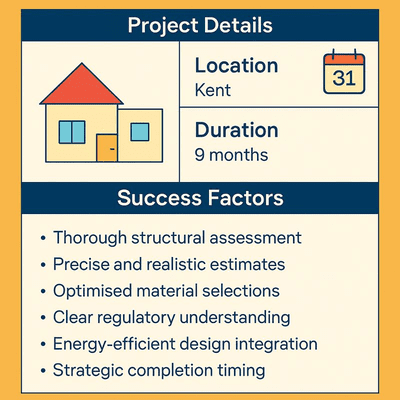
A family purchased a dated 1970s detached home with poor insulation, inefficient layout, and multiple structural issues including sagging floors and roof failure. Initial renovation estimates suggested £310,000, but a structural survey revealed extensive hidden defects that would multiply costs. By carefully comparing renovation vs rebuilding costs, the homeowners used Renovation vs. Rebuilding: Proven Cost-Saving Strategies That Maximize Long-Term Value & Boost Property Performance to evaluate their options and ultimately determined that rebuilding was the more secure long-term investment.
Rebuilding allowed for:
• A modern, open-plan interior layout
• Triple-glazed windows and full MVHR installation
• Solar PV and air-source heat pump integration
• Stronger structural foundations
• Reduced maintenance costs for 30+ years
• Higher EPC rating, improving resale value <blockquote>”Rebuilding was a bigger decision financially, but it gave us a higher-performing home with much lower running costs. The long-term value far exceeded any renovation option we considered.” — Jonathan</blockquote>
Conclusion
Renovation vs. Rebuilding: Proven Cost-Saving Strategies That Maximize Long-Term Value & Boost Property Performance offers a clear framework for UK homeowners evaluating the most cost-effective path. When comparing renovation vs rebuilding costs, renovations work well for properties with strong structural integrity and limited upgrades needed. Rebuilds, however, excel when major structural, regulatory, or energy-efficiency challenges exist. Rebuilding often provides superior long-term value, reduced maintenance expenses, predictable costs, and stronger resale prospects.
FAQ
Q1: How do I accurately compare Renovation vs. Rebuilding: Proven Cost-Saving Strategies That Maximize Long-Term Value & Boost Property Performance?
A: Use detailed construction estimating, structural assessments, and lifecycle cost analysis to make an informed comparison.
Q2: Is rebuilding always more expensive than renovating?
A: Not necessarily—hidden defects and compliance upgrades often make renovation more costly over time.
Q3: Which approach improves energy efficiency more effectively?
A: Rebuilding enables optimal energy performance by integrating modern systems and insulation.
Q4: Does rebuilding add more value to a UK home?
A: In many cases, yes—new builds achieve higher resale value due to modern design and efficiency.
Q5: Which option has more predictable timelines?
A: Rebuilding typically offers clearer schedules and fewer unexpected delays.
BCIS – UK Construction Cost Benchmarking
https://www.bcis.co.uk/
UK Government – The Construction Playbook
https://www.gov.uk/government/publications/the-construction-playbook
Construction Leadership Council (CLC)
https://www.constructionleadershipcouncil.co.uk/
To reach our team https://builderexpert.uk/contact-builder-expert/