
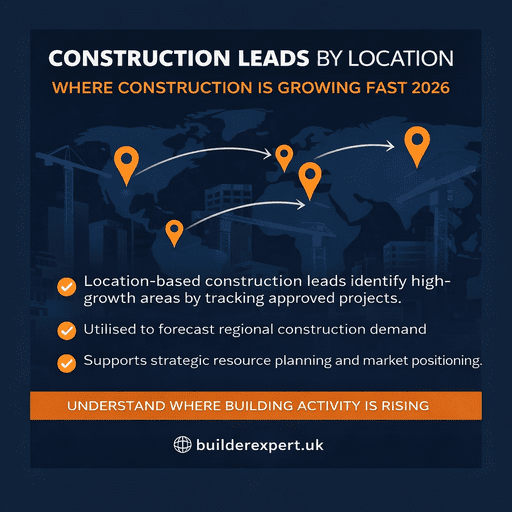
Understanding where construction activity is increasing is critical for professionals operating in today’s competitive building environment. Construction demand does not grow evenly across all regions. Instead, it shifts according to population trends, housing demand, investment levels, infrastructure priorities, and local planning decisions. These factors constantly reshape the construction landscape, making it increasingly important for companies to understand not only what is happening today, but where future opportunities are forming. This is why Construction Leads by Location: Where Construction Is Growing Fast has become a key topic for construction companies, contractors, and industry professionals seeking long-term stability and growth.
In an environment where margins are under pressure and competition is increasing, relying on general market assumptions is no longer sufficient. Regions that appeared strong in previous years may experience slowdowns, while emerging areas can quickly become centres of high construction activity. Without accurate insight, businesses risk misallocating resources, pursuing low-demand areas, or reacting too late to shifts in market conditions. A structured understanding of regional construction growth is therefore essential for informed decision-making, particularly when combined with accurate cost forecasting and project planning practices such as those outlined in professional construction estimating methodologies:
https://builderexpert.uk/about-building-estimating/
Rather than relying on assumptions or outdated information, businesses that analyse construction leads by location gain a clearer picture of where real opportunities exist. Location-based insights allow professionals to assess regional demand, identify development pipelines, and evaluate whether growth is short-term or sustained. This level of understanding supports strategic planning, enabling companies to allocate labour, equipment, and capital more efficiently while reducing exposure to uncertainty. When aligned with structured estimating and planning tools, such as modern construction estimating software, decision-making becomes more precise and controlled:
https://builderexpert.uk/construction-estimating-software/
By using construction leads by location, construction professionals can position themselves proactively in areas with consistent development activity, stronger project pipelines, and long-term demand. This approach helps businesses move from reactive decision-making to a more strategic, data-informed model, ensuring they remain competitive in a rapidly changing construction environment. Integrating location-based insights into broader project workflows further strengthens operational planning and long-term performance:
https://builderexpert.uk/construction-project-workflow-builder-expert/
Understanding Construction Leads by Location
In the construction sector, leads represent verified indicators of upcoming or active work. These may include approved planning applications, scheduled residential developments, or projects moving toward construction phases. Such indicators provide early visibility into where activity is likely to materialise, allowing companies to prepare before demand becomes widely apparent. When assessed geographically, construction leads by location provide structured insight into where construction activity is concentrated and how regional demand is evolving over time.
The value of Construction Leads by Location: Where Construction Is Growing Fast lies in its ability to transform raw planning and development data into actionable intelligence. Rather than relying on fragmented information or reacting to market changes after they occur, companies can anticipate growth and align their operations accordingly. This supports more informed decisions around project selection, workforce planning, and regional expansion.
When location-based leads are integrated with professional estimating and planning practices, decision-making becomes significantly more robust. For example, combining regional development insight with structured estimating approaches, such as those outlined in construction estimating guidance, helps improve forecasting accuracy and cost control:
https://builderexpert.uk/construction-estimating/
Additionally, embedding location intelligence into broader project workflows allows businesses to maintain consistency across planning, delivery, and resource management. Aligning early-stage project insight with operational processes, as discussed in construction project workflow best practices, further strengthens long-term performance:
https://builderexpert.uk/construction-project-workflow-builder-expert/
By applying construction leads by location in this structured way, construction companies can move from reactive market participation to proactive, data-informed strategic positioning.
Why Location Plays a Central Role in Construction Growth
Construction performance is closely linked to regional factors. Economic development, housing shortages, infrastructure investment, and local authority planning decisions all influence where projects emerge. While skills and experience remain essential, location often determines access to consistent work and long-term project continuity. Regions with strong population growth, active housing markets, and supportive planning frameworks are more likely to sustain steady construction activity over time.
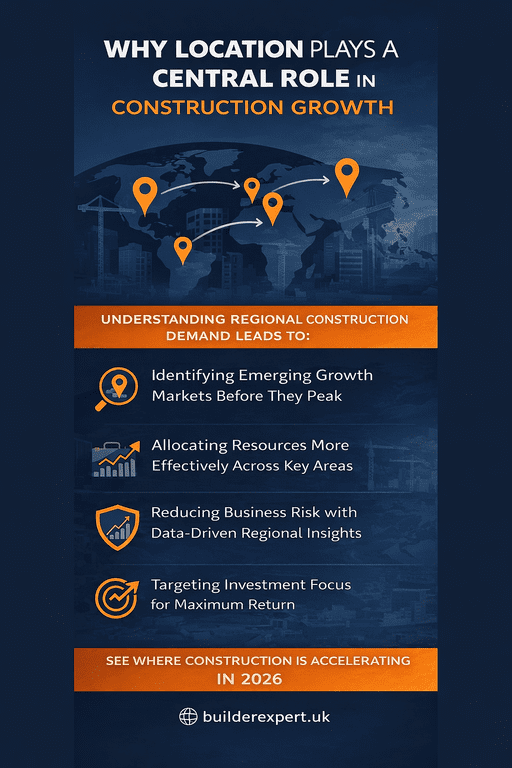
In contrast, areas lacking investment or facing planning constraints may experience irregular project flow, creating uncertainty for construction businesses. Understanding these regional differences allows companies to evaluate risk more effectively and avoid overreliance on markets that may not support long-term operations. As competition intensifies across the industry, the ability to assess location-based demand has become a strategic advantage rather than a secondary consideration.
By tracking construction leads by location, companies can identify regions experiencing sustained development rather than short-term spikes driven by isolated projects. This approach provides visibility into broader market trends, helping professionals distinguish between temporary activity and genuine growth. When analysed consistently, location-based leads reveal patterns in development approvals, project timelines, and investment priorities that are not immediately visible through traditional market observation.
This structured insight reduces uncertainty and supports long-term planning across multiple areas of operation, from workforce allocation to capital investment. Construction Leads by Location: Where Construction Is Growing Fast enables businesses to operate with foresight rather than speculation, ensuring decisions are based on measurable indicators rather than assumptions. As construction markets continue to shift, the strategic use of location-based intelligence becomes essential for maintaining stability, competitiveness, and sustainable growth.
Identifying Fast-Growing Construction Areas
Growth in construction typically follows recognisable patterns. Regions with expanding populations, increasing residential demand, and strong planning pipelines tend to attract continuous development rather than sporadic activity. These areas often benefit from sustained investment, clearer long-term strategies, and greater confidence from developers and local authorities. When reviewing construction leads by location, such trends become visible across multiple projects and planning stages, allowing professionals to understand the broader direction of regional development rather than focusing on isolated opportunities.
This type of analysis enables construction professionals to move beyond short-term decision-making. Instead of responding to individual projects as they arise, businesses can evaluate whether an area demonstrates consistent momentum that supports long-term operational planning. Regions showing repeated approvals, overlapping project timelines, and diverse development types are more likely to maintain stable construction demand over time.
By assessing construction leads by location, professionals can distinguish between temporary construction activity and regions with genuine long-term potential. Construction Leads by Location: Where Construction Is Growing Fast focuses on identifying areas where momentum is building steadily, supported by underlying economic and demographic factors. This approach offers more reliable prospects for sustained operations, helping businesses reduce exposure to market volatility while positioning themselves in regions that support ongoing growth and continuity.
Urban and Regional Development Trends
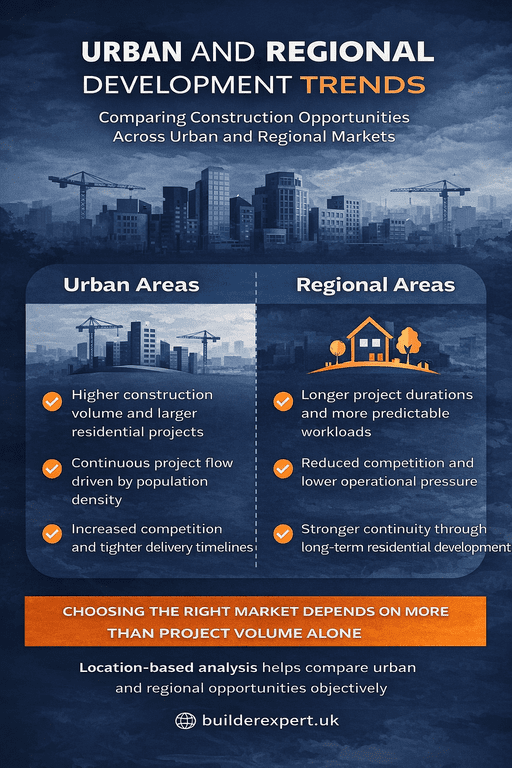
Both urban and regional areas present distinct construction opportunities, each shaped by different economic, demographic, and planning conditions. Urban centres often support higher volumes of work, larger residential schemes, and ongoing regeneration projects driven by population density and housing demand. These environments typically offer a continuous flow of projects, but they also tend to involve higher competition, tighter timelines, and increased pressure on resources.
Regional locations, on the other hand, may offer fewer projects in absolute terms, yet they often provide longer project durations, reduced competition, and more predictable workloads. Residential developments in regional areas are frequently planned with extended timelines, allowing construction companies to secure stable work over longer periods. Additionally, lower operational costs and stronger relationships with local authorities can further enhance project continuity in these regions.
Choosing between urban and regional markets requires more than surface-level observation. Factors such as project scale, workforce availability, supply chain access, and long-term development plans must all be considered. This is where structured analysis becomes essential. By using construction leads by location, companies can objectively compare regional and urban opportunities based on verified planning activity rather than assumptions or market perceptions.
When analysed consistently, construction leads by location highlight where development pipelines are strongest and where future opportunities are likely to emerge. Construction Leads by Location: Where Construction Is Growing Fast provides clarity on which environments align best with specific business models, operational capacities, and growth objectives. This informed approach supports strategic positioning, enabling construction businesses to operate efficiently while minimising risk and maximising long-term potential.
Strategic Use of Construction Leads by Location
Established construction professionals rarely rely on reactive methods to secure work. Instead, they monitor planning data, development approvals, and regional demand indicators to understand where construction activity is building before it becomes widely visible. This forward-looking approach allows them to anticipate market movements rather than respond after competition has intensified. Construction leads by location support this strategy by highlighting where new work is entering the pipeline, offering early insight into emerging opportunities across different regions.
By consistently analysing location-based construction data, companies can identify patterns that signal sustainable growth rather than short-lived activity. These insights enable businesses to prioritise regions with strong development momentum, adjust bidding strategies, and allocate resources more effectively. As a result, decisions related to workforce planning, equipment deployment, and regional expansion are based on measurable indicators instead of assumptions.
This proactive approach enables companies to prepare resources in advance, build a local presence, and establish relationships with developers, consultants, and local authorities ahead of increased competition. Early positioning often translates into stronger market credibility and improved access to future projects. Over time, this method reduces operational uncertainty and strengthens long-term business resilience.
When applied systematically, construction leads by location become a central component of strategic planning within the construction sector. Construction Leads by Location: Where Construction Is Growing Fast reflects a structured, data-informed way of operating, helping professionals align their business decisions with real market dynamics. This approach supports sustainable growth by ensuring that companies remain positioned in regions where demand is consistent, visible, and supported by ongoing development activity.
Location-Based Planning for Workforce and Resources
Decisions related to workforce deployment, equipment investment, and regional expansion carry significant cost implications for construction businesses. When these decisions are made without reliable insight, companies are exposed to unnecessary operational and financial risk. Overestimating demand in the wrong area can result in underutilised resources, while underestimating growth in key regions may lead to missed opportunities. Construction leads by location reduce this risk by providing evidence-based guidance that supports informed and strategic planning.
Access to accurate location-based data allows construction companies to evaluate where demand is genuinely accelerating and where development activity is likely to be sustained. Rather than relying on historical performance or general market assumptions, businesses can base decisions on current planning approvals, development pipelines, and regional growth indicators. This approach strengthens forecasting accuracy and improves confidence when committing labour, equipment, and capital.
By understanding where construction activity is accelerating, companies can plan staffing levels, procurement schedules, and logistics more effectively. Aligning workforce availability with verified demand helps reduce downtime and improves project continuity. Similarly, equipment investments can be prioritised in regions where utilisation is more likely to remain consistent over time. Construction Leads by Location: Where Construction Is Growing Fast supports operational efficiency by ensuring that resources are deployed in response to real market demand rather than speculative trends.
This structured approach to planning is closely aligned with modern construction management principles and data-driven decision-making. For example, integrating location-based insights with cost estimation and project planning tools, such as those discussed in construction estimating resources
https://builderexpert.uk/construction-estimating/
can further enhance accuracy and control across projects.
At the same time, broader industry guidance highlights the importance of evidence-based planning in construction. External bodies such as the Construction Leadership Council emphasise the role of data and regional insight in supporting sustainable industry growth:
https://www.constructionleadershipcouncil.co.uk/
By combining internal operational data with construction leads by location, construction companies can reduce uncertainty, improve efficiency, and position themselves more effectively within competitive regional markets.
Common Challenges Without Location-Based Insight
Companies that overlook geographic trends often encounter avoidable challenges. These include reduced project continuity, increased competition in saturated areas, and delayed responses to market shifts.
Failing to analyse construction leads by location can result in missed opportunities and inefficient allocation of time and capital. Construction Leads by Location: Where Construction Is Growing Fast exists to address these challenges through informed decision-making.
Evaluating the Quality of Construction Leads by Location
Not all leads offer equal value. Reliable construction leads by location are based on verified planning data, consistent development activity, and credible sources that reflect genuine market demand. Areas showing a single large project or a short burst of activity rarely indicate long-term growth. Without broader context, such spikes can be misleading and may result in strategic decisions that lack sustainability.
Effective evaluation therefore focuses on patterns rather than isolated data points. By analysing multiple projects over time, professionals can identify whether an area demonstrates continuous development, repeat investment, and long-term planning commitment. This approach helps distinguish between temporary construction surges and regions that are structurally positioned for ongoing growth.
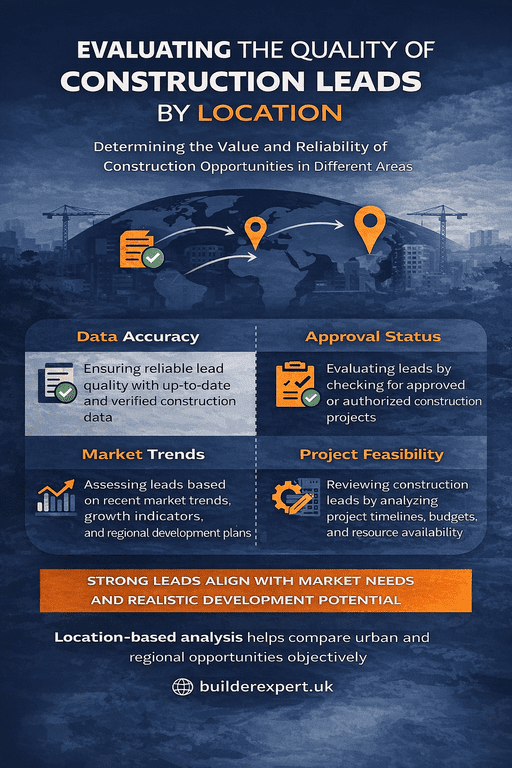
When reviewing construction leads by location, volume alone is not sufficient. The continuity of development activity, diversity of project types, and visibility of future planning stages are equally important indicators. Regions that consistently progress from planning approval to active construction and onward to subsequent phases typically offer stronger long-term prospects.
Construction Leads by Location: Where Construction Is Growing Fast emphasises the importance of assessing not only current activity but also future potential when analysing construction regions. By applying this structured evaluation, construction professionals can reduce risk, prioritise high-quality opportunities, and align their strategies with areas that support sustainable operations and long-term business growth.
Long-Term Value of Location-Based Construction Intelligence
The construction industry is increasingly influenced by economic change, regulatory adjustments, and shifting housing needs. Fluctuations in material costs, updates to planning frameworks, and evolving residential demand continue to reshape where and how construction activity develops. In this environment, companies that adapt quickly are better positioned to maintain a competitive advantage. Monitoring construction leads by location enables that adaptability by providing early insight into where demand is emerging and where market conditions are changing.
Rather than reacting to disruptions after they occur, construction businesses that rely on location-based intelligence can anticipate change and respond strategically. This allows organisations to reassess regional priorities, adjust operational focus, and strengthen their presence in markets that demonstrate long-term stability. When combined with structured planning and cost control practices, such as those outlined in construction estimating methodologies
https://builderexpert.uk/about-building-estimating/
location-based insights become a core component of resilient business strategy.
Construction Leads by Location: Where Construction Is Growing Fast is not about short-term gains or chasing isolated opportunities. It is about building resilience and positioning businesses in regions where demand supports sustainable growth over time. Companies that align regional decision-making with verified planning activity and development trends are better equipped to navigate regulatory change and economic uncertainty.
By integrating construction leads by location into broader project planning and forecasting processes, construction firms can strengthen long-term performance. This approach supports informed investment decisions, improves operational stability, and ensures that growth is driven by real market demand rather than short-lived cycles or speculation.
Conclusion
Construction success depends on more than capability alone. It depends on positioning, timing, and access to opportunity. Even highly skilled construction professionals can face limitations if they operate in regions where demand is inconsistent or declining. By understanding construction leads by location, professionals gain clarity on where construction activity is accelerating, where development pipelines are strongest, and where long-term potential genuinely exists.
In an increasingly competitive and data-driven industry, informed positioning has become a critical success factor. Location-based intelligence allows companies to align their operational focus with areas supported by sustained planning activity and ongoing investment. Rather than reacting to market shifts after they occur, businesses can proactively adjust their strategies to remain aligned with regions that offer continuity and stability. This structured approach strengthens decision-making across all levels of operation, from project selection to regional expansion.
Construction Leads by Location: Where Construction Is Growing Fast provides a framework for informed decision-making within an evolving construction landscape. By combining location-based insight with robust estimating and planning practices, such as those outlined in professional construction estimating guidance
https://builderexpert.uk/construction-estimating-software/
companies can enhance forecasting accuracy and improve control over project costs and timelines.
For organisations seeking stability, growth, and strategic advantage, location-based construction intelligence has become an essential consideration. Integrating regional demand analysis into broader workflows, including project scheduling and resource planning
https://builderexpert.uk/construction-project-workflow-builder-expert/
supports more resilient operations and better long-term outcomes.
Ultimately, businesses that understand where construction demand is forming — and why — are better positioned to build sustainable pipelines, manage risk effectively, and maintain competitiveness in a constantly changing market.
FAQ – Common Questions About Construction Leads by Location
- What are construction leads by location?
Construction leads by location are verified details about upcoming or active construction projects, organised by geographic area. They help professionals understand where construction activity is increasing and where demand is likely to remain stable. - Why are construction leads by location important for construction companies?
Construction leads by location are important because they allow companies to identify regions with consistent development rather than short-term or isolated projects, supporting better planning and reduced business risk. - How do construction leads by location help with long-term planning?
By analysing construction leads by location, companies can focus on areas with ongoing planning approvals and development pipelines, making it easier to plan resources, staffing, and regional expansion with greater confidence. - Are construction leads by location useful for both urban and regional areas?
Yes, construction leads by location are useful for both urban and regional areas, as they provide insight into demand levels, competition, and development trends across different types of construction environments. - How often should construction leads by location be reviewed?
Construction leads by location should be reviewed regularly, as planning activity and market conditions change over time. Frequent review helps companies stay aligned with emerging opportunities and shifting regional demand.
📌https://www.gov.uk/government/publications/the-construction-playbook
📌https://www.constructionleadershipcouncil.co.uk/
📌https://www.planningportal.co.uk/
📈Contact our construction specialistshttps://builderexpert.uk/contact-builder-expert/