
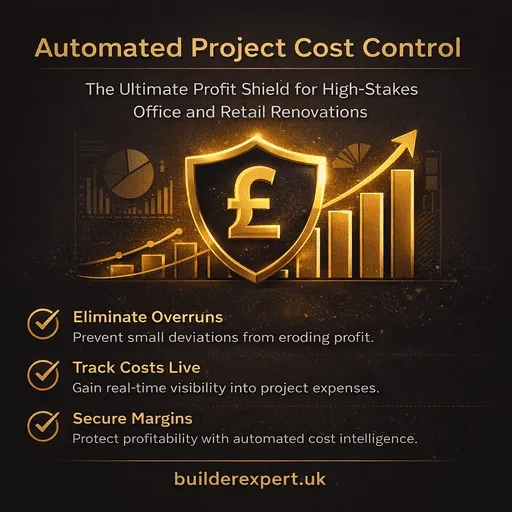
Automated Project Cost Control begins where traditional cost monitoring fails — at the exact moment when small percentages start to erode serious money. A 3% cost overrun on a £1 million office renovation eliminates £30,000 of margin instantly. In competitive commercial refurbishments, that figure is not a rounding error; it represents retained earnings, working capital, and reinvestment potential. When margins on office and retail renovations commonly sit between 8–15%, even modest financial drift can remove a substantial proportion of projected profit. The risk is rarely dramatic at first. It accumulates quietly through minor labour inefficiencies, incremental supplier increases, scope refinements, and delayed reporting cycles that conceal early warning signs.
Office and retail renovation projects are structurally exposed to volatility. Compressed programmes tied to lease agreements, phased occupation requirements, fluctuating material markets, and client-driven design adjustments create constant financial movement.
Unlike new-build environments with predictable sequencing, refurbishment projects must adapt to hidden services, legacy infrastructure, and operational constraints. Without disciplined oversight, these variables interact in ways that steadily undermine margin. This is precisely why Automated Project Cost Control is not simply a digital upgrade to spreadsheet tracking; it is a strategic financial safeguard.
By integrating estimating data, procurement commitments, subcontract valuations, and live labour reporting into a single framework, Automated Project Cost Control replaces delayed, fragmented cost reviews with continuous financial intelligence. Instead of discovering overspend during end-of-month reconciliation, project leaders gain real-time clarity on committed costs versus allowances, forecast shifts, and contingency exposure. The system creates visibility at the point of decision-making — when corrective action is still possible. In high-stakes office and retail renovations, that timing difference determines whether margin compression becomes permanent loss or controlled adjustment.
More importantly, Automated Project Cost Control reshapes behaviour across the project team. Commercial managers, project managers, and directors operate from aligned financial data rather than isolated reports. Variations are captured immediately. Labour productivity deviations are visible early. Supplier price movements adjust forecasts dynamically. This level of integration turns cost management from reactive correction into proactive protection. In an environment where a few percentage points define success or failure, Automated Project Cost Control functions not merely as a management tool, but as a structured defence system designed to preserve profitability under pressure.
The Financial Reality of Office and Retail Renovations
Commercial refurbishments operate in an environment where financial tolerance is minimal and operational pressure is constant. Offices must reopen on predetermined dates aligned with lease agreements, workforce return schedules, or corporate relocation plans. Retail spaces are tied to trading cycles, promotional launches, and seasonal demand peaks. A delayed handover is not simply a programme issue — it directly affects tenant revenue, brand reputation, and in some cases contractual penalties. The financial consequences of even short delays can extend far beyond the construction contract itself.
Industry analysis consistently indicates that refurbishment projects carry a higher statistical risk of cost overruns compared to new-build developments. The reasons are structural. Existing buildings conceal unknown conditions. Mechanical and electrical systems may require redesign once exposed. Structural adjustments often reveal additional reinforcement requirements. Phased occupation introduces sequencing inefficiencies. Scope evolution becomes more likely as stakeholders respond to real-time discoveries. In this context, a 2–5% cost drift is not unusual when oversight systems are reactive rather than predictive.
To illustrate the magnitude of exposure, consider a £2 million retail renovation tendered with a 10% margin, generating £200,000 in projected profit. A 4% cost variance — equivalent to £80,000 — removes 40% of that anticipated return. If additional programme acceleration costs or material price adjustments occur simultaneously, profitability can contract even further. These shifts rarely originate from one catastrophic error; they emerge from incremental deviations that remain unnoticed until financial reconciliation occurs too late for meaningful correction.
This is precisely where Automated Project Cost Control becomes commercially decisive. By ensuring that every cost commitment, labour allocation, subcontract valuation, and procurement adjustment is benchmarked against the original estimate in real time, Automated Project Cost Control converts financial monitoring from retrospective reporting into continuous oversight. Commitments are logged at the point of approval. Forecasts update dynamically as costs change. Variations are integrated into live margin projections rather than tracked separately in isolated documents.
Beyond simple tracking, Automated Project Cost Control establishes a structured feedback loop across the commercial lifecycle of the project. When labour productivity shifts, the financial impact becomes immediately visible. When supplier pricing increases, the projected final account adjusts automatically. When scope evolves, margin sensitivity can be assessed before commitments are finalised. This proactive visibility allows leadership teams to intervene strategically — renegotiating packages, reallocating contingency, or adjusting sequencing before minor deviations compound into significant losses.
In refurbishment environments where complexity and unpredictability are inherent, financial resilience depends on speed of insight. Automated Project Cost Control provides that speed without sacrificing accuracy. Instead of relying on end-of-month summaries or manual spreadsheet consolidation, project stakeholders operate with aligned, real-time data that reflects the true commercial position of the renovation at any given moment. Under these conditions, variance is not eliminated — but it is managed before it becomes destructive.
Ultimately, the distinction lies in timing. Traditional methods identify overspend after impact. Automated Project Cost Control identifies pressure at inception. In high-value office and retail refurbishments, that difference determines whether margin erosion becomes an unavoidable outcome or a controlled adjustment within a protected financial framework.
From Tender Precision to Live Cost Intelligence
Winning a refurbishment contract depends on precise estimating. However, the estimate alone does not protect margin. The vulnerability begins the moment the project transitions from pricing to delivery — when assumptions meet operational reality. At tender stage, figures are controlled, structured, and carefully calculated. Once on site, those figures are exposed to labour performance, sequencing adjustments, supplier pricing shifts, and real-time design decisions. Without a system that connects estimate to execution, margin protection weakens rapidly.

In traditional project environments, the estimate becomes a static reference point rather than an active control mechanism. Cost reporting is compiled weekly or monthly. Variations are tracked in separate documents. Procurement commitments may not immediately reflect in forecast summaries. By the time the commercial team identifies a deviation, the project may already have absorbed several compounding impacts. Corrective flexibility becomes limited, and mitigation strategies shift from prevention to damage control.
This is precisely the gap that Automated Project Cost Control closes. Instead of treating the tender as a historical document, Automated Project Cost Control transforms it into a live financial model that evolves alongside project delivery. Labour hours feed directly into predefined cost codes, providing continuous visibility over productivity and spend. Supplier commitments automatically update cost forecasts as purchase orders are issued. Subcontract valuations are reconciled against budget allowances in real time, highlighting early-stage variance before it escalates.
The practical impact of this integration is significant. Forecasting lag is reduced because financial data is captured at source rather than consolidated retrospectively. Variance identification becomes immediate rather than reactive. Commercial teams no longer wait for month-end reconciliation to assess exposure. Instead, they operate with rolling forecasts that reflect the true financial position of the renovation at any given moment.
The result is measurable and strategically valuable:
- Reduced forecasting lag through real-time data integration
- Immediate variance identification at cost-code level
- Continuous margin tracking against original tender assumptions
- Faster, evidence-based commercial decision-making
When financial data moves at the same speed as site activity, leadership gains clarity rather than approximation. Decisions regarding acceleration, scope refinement, or supplier negotiation can be evaluated against updated projections instantly.
In high-stakes office and retail renovations, speed without visibility equals risk. Rapid delivery without financial transparency increases the probability of margin erosion. Automated Project Cost Control delivers both speed and control by aligning estimating, procurement, labour tracking, and valuation processes within a single structured framework. Instead of relying on periodic summaries, the project team operates with live cost intelligence.
Ultimately, this shift is not technological for its own sake. It is commercial in its impact. By embedding Automated Project Cost Control into the transition from tender to execution, contractors ensure that the precision achieved at pricing stage remains protected throughout delivery. In competitive refurbishment markets, that continuity between estimate and execution defines sustainable profitability.
Scenario 1: The Hidden Labour Drift
Consider a £1.4 million office fit-out with a 22-week programme. The project includes mechanical upgrades, partition reconfiguration, acoustic treatments, and bespoke joinery. Labour allowances were estimated at £420,000.
If labour productivity drops by just 5% due to sequencing inefficiencies and untracked overtime, that equals a £21,000 overspend. Spread across multiple packages, this drift may not be visible until month four.
Without Automated Project Cost Control, the commercial team identifies the issue after accumulated invoices exceed forecast. Recovery options become limited.
With Automated Project Cost Control, labour hours are mapped daily against cost codes. Variances trigger early alerts. By week six, productivity deviation is visible. The team restructures sequencing and reallocates resources.
The intervention reduces projected overspend from £21,000 to under £5,000.
The difference is not theoretical. It is structural.
Scenario 2: Material Price Volatility in Retail Refurbishment
Retail renovations are particularly exposed to material price shifts — flooring systems, glazing packages, lighting installations, and bespoke fixtures are often sourced under fluctuating market conditions.
Imagine a £900,000 store refurbishment with £300,000 allocated to finishes and specialist packages. A 6% supplier price increase, unaccounted for, results in an £18,000 impact.
Without integrated forecasting, that cost is absorbed late in the project cycle.
With Automated Project Cost Control, procurement updates automatically adjust the projected final account. The commercial team sees margin compression immediately. Contingency is reassessed. Alternative suppliers or specification adjustments are explored proactively.
Instead of absorbing an unexpected £18,000 hit, the project absorbs £7,000 after strategic rebalancing.
That £11,000 difference directly protects margin.
Eliminating the “End-of-Project Shock”
One of the most damaging patterns in commercial renovations is the end-of-project reconciliation shock — the point at which months of minor, seemingly manageable deviations accumulate into a material financial shortfall. By the time final accounts are reviewed and cost reports consolidated, the opportunity to correct course has largely disappeared. What appeared controllable in isolation — small labour overruns, incremental supplier increases, modest scope adjustments — reveals itself as a compounded erosion of margin.
This pattern typically occurs because traditional cost monitoring relies on fragmented tools and disconnected workflows. Estimating software often operates independently from live reporting systems. Variations may be tracked in manual spreadsheets maintained separately from core cost plans. Subcontractor valuations can be processed with delay, reducing forecast accuracy. Financial projections are frequently updated monthly rather than continuously. The result is structural latency in decision-making: cost visibility trails behind site reality.
Automated Project Cost Control eliminates this fragmentation by integrating commitments, actual expenditure, labour inputs, procurement updates, forecasts, and approved variations into a unified financial ecosystem. Instead of operating across isolated documents and retrospective summaries, project teams work from a continuously aligned data environment. Every commitment is reflected immediately. Every approved change adjusts the live forecast. Margin is not estimated after the fact — it is monitored dynamically.
With Automated Project Cost Control, margin protection becomes an active discipline rather than a post-project calculation. Instead of discovering profit compression at practical completion, the commercial team reviews variance weekly — and in many cases daily. Early signals trigger corrective conversations. Contingency usage is evaluated in context. Forecast final accounts evolve alongside operational activity, not behind it.
For renovation contractors operating across multiple office and retail projects, this structured clarity has implications beyond a single contract. Portfolio-level visibility improves cash flow forecasting, capital allocation, and strategic planning. By embedding Automated Project Cost Control into routine project governance, businesses reduce the likelihood of end-stage financial surprises and strengthen overall commercial resilience. In high-stakes refurbishment environments, that difference is not incremental — it is foundational.
Real-Time Dashboards for Complex Workspaces
Office and retail renovations often involve phased delivery, where sections of a building remain fully operational while construction progresses around occupants. Tenants expect minimal disruption, uninterrupted services, and strict adherence to reopening schedules. At the same time, programmes compress to accommodate commercial deadlines, lease agreements, and trading commitments. Under these conditions, sequencing adjustments, access restrictions, and accelerated works introduce layers of financial complexity that are not always visible in traditional reporting cycles.
When delivery overlaps with live operations, even minor coordination changes can carry cost implications — additional labour hours, revised logistics, temporary services, or out-of-hours work. Financial exposure increases not necessarily because of large scope changes, but because multiple small adjustments accumulate across phases. Without disciplined oversight, this complexity multiplies quietly.
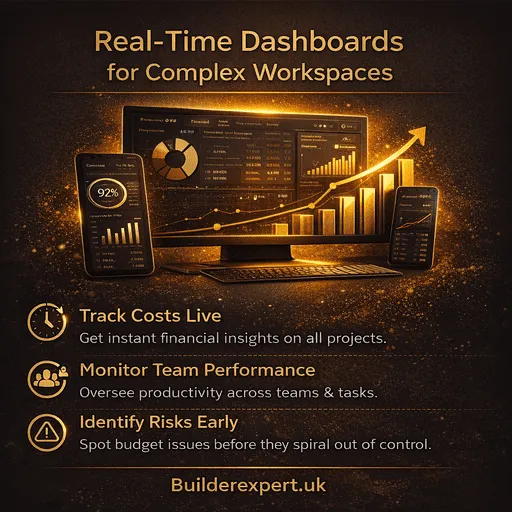
Automated Project Cost Control addresses this challenge by providing real-time dashboards that translate operational activity into immediate financial visibility. Instead of waiting for consolidated reports, project leaders see live indicators such as:
- Committed versus budgeted cost
- Actual versus forecasted expenditure
- Contingency drawdown
- Variation impact
- Projected final margin
This level of transparency aligns project managers, commercial leads, and directors around a single financial narrative. Decisions made on site are reflected instantly in cost forecasts. Risk exposure is visible before it becomes embedded in the final account. In design-and-build refurbishment contracts especially, this clarity strengthens client confidence because financial control is demonstrable, not assumed.
In competitive commercial markets, credibility is currency — and Automated Project Cost Control reinforces that credibility by ensuring that financial control evolves at the same pace as construction delivery.
Strengthening Leadership Through Financial Clarity
High-performing renovation businesses do not rely on instinct alone. They rely on structured insight, disciplined processes, and measurable performance indicators. In competitive office and retail refurbishment markets, experience remains valuable — but experience unsupported by live data cannot consistently protect margin under pressure.
By embedding Automated Project Cost Control into daily operations, leadership shifts from reactive awareness to predictive visibility. Instead of reviewing historical summaries, directors and commercial managers operate with forward-looking financial intelligence. Scope adjustments are evaluated against updated margin projections. Acceleration strategies are assessed in terms of labour cost impact and contingency exposure. Subcontractor negotiations are informed by real-time performance data rather than assumptions.
This elevates cost management from administrative reporting to strategic control. Financial discussions move from “What happened?” to “What will happen if we proceed?” That distinction is critical in high-stakes renovations where sequencing changes, supply fluctuations, and programme compression can alter profitability within weeks.
When margins tighten due to market volatility or competitive tendering, businesses equipped with Automated Project Cost Control respond faster and with greater precision. They identify pressure points early, rebalance resources proactively, and protect projected returns before erosion becomes permanent. In this environment, agility is not accidental — it is engineered through structured financial oversight.
Competitive Differentiation in High-Stakes Renovations
Clients commissioning office and retail refurbishments increasingly expect transparency, predictability, and measurable control. Developers, landlords, and asset managers are no longer satisfied with high-level assurances — they want evidence. They want to see how budgets are tracked, how variations are managed, and how projected final accounts evolve throughout delivery. Financial governance has become part of contractor selection criteria, not merely a back-office function.
Contractors operating without structured automation risk appearing operationally reactive rather than strategically controlled. In competitive commercial markets, perception matters. A business that relies on manual spreadsheets and delayed reporting may still deliver quality workmanship, but it struggles to demonstrate financial precision in real time. That gap can influence repeat work, investor confidence, and long-term positioning.
Automated Project Cost Control signals professionalism, accountability, and operational maturity. It demonstrates that cost management is embedded within project execution rather than reviewed after the fact. Forecasts are dynamic. Commitments are traceable. Margin protection is measurable. By adopting Automated Project Cost Control, renovation specialists show that financial oversight is engineered into their delivery model — not dependent on periodic reconciliation.
In high-stakes office and retail renovations, where financial exposure is immediate and visible to stakeholders, the distinction between reactive tracking and structured automation defines competitiveness. Businesses equipped with Automated Project Cost Control do more than manage cost; they demonstrate control with clarity. Over time, that clarity strengthens client trust, supports premium positioning, and reinforces sustainable commercial performance.
Conclusion
A small percentage deviation can dismantle a significant portion of expected profit in office and retail renovations. Labour inefficiencies, material volatility, scope adjustments, and reporting delays rarely announce themselves dramatically — they accumulate quietly until margin compression becomes unavoidable.
Traditional monitoring methods struggle to keep pace with the speed, coordination demands, and financial exposure inherent in commercial refurbishments. Static reports and delayed reconciliations simply move too slowly for environments where cost decisions are made daily.
Automated Project Cost Control replaces fragmented oversight with integrated, real-time financial intelligence. It transforms tender assumptions into live performance benchmarks. It exposes risk while it is still manageable. It protects margin not occasionally, but continuously.
In high-stakes office and retail renovations, profitability is not protected by effort alone. It is protected by structure, visibility, and disciplined execution. Automated Project Cost Control is the framework that converts financial uncertainty into controlled performance — and controlled performance into sustained competitive advantage.
🔗 https://www.gov.uk/government/publications/the-construction-playbook
🔗 https://www.constructionleadershipcouncil.co.uk/
🔗 https://www.ons.gov.uk/businessindustryandtrade/constructionindustry
🚀 Ready to protect your project profit? Contact our team today.