
Construction job management software is transforming the way residential builders across the UK plan, manage, and deliver projects.
Rising material costs, increasing client expectations, labour shortages, and tighter profit margins have made traditional management methods less effective than ever before.
Many builders still rely on spreadsheets, handwritten notes, disconnected apps, and manual communication, creating unnecessary delays, mistakes, and financial risks.

Modern construction job management software provides a single platform where builders can organise estimates, schedules, project costs, resources, documentation, and customer communication. Instead of spending valuable hours searching for information or correcting avoidable errors, construction companies can focus on delivering quality workmanship, improving customer satisfaction, and increasing profitability.
Whether your business specialises in home extensions, loft conversions, house renovations, or new-build residential developments, investing in the right construction job management software can dramatically improve operational efficiency while giving you greater visibility over every stage of a project.
Table of Contents
- What Is Construction Job Management Software?
- Why Traditional Project Management Creates Problems
- The Biggest Benefits of Construction Job Management Software
- Essential Features Every UK Builder Should Look For
- How Better Job Management Improves Business Growth
- Case Study
- Frequently Asked Questions
- Conclusion
What Is Construction Job Management Software?
Construction job management software is a digital platform designed to help builders manage every stage of a residential construction project from one central location. Instead of using multiple disconnected systems, contractors can organise quotations, estimating, scheduling, labour allocation, material tracking, project documentation, customer information, invoices, and progress updates through a single integrated solution.
For many small and medium-sized UK building companies, administration has become one of the biggest hidden costs. Site managers often spend hours each week searching for documents, updating spreadsheets, responding to client enquiries, or coordinating subcontractors. These activities reduce productivity and increase the likelihood of costly mistakes.
Modern construction job management software simplifies these daily processes by creating a structured workflow that everyone in the business can follow. Office staff, project managers, surveyors, estimators, and site supervisors all have access to the same project information, reducing confusion and improving communication.
The software also provides greater transparency. Builders can quickly monitor project progress, identify delays before they become serious problems, compare estimated costs with actual expenditure, and maintain stronger financial control throughout every project.
As residential construction projects continue to become more complex, digital project management is no longer considered a luxury. It has become an important competitive advantage for companies that want to grow sustainably while maintaining high standards of customer service.
Why Traditional Project Management Creates Problems
Many residential builders still manage projects using manual systems that were designed years ago.
While these methods may appear familiar, they often create hidden inefficiencies that become increasingly expensive as a business grows.

Information is frequently stored across emails, spreadsheets, paper files, messaging applications, and handwritten site notes.
When project information is scattered across multiple locations, finding the latest version of a document becomes difficult. Small mistakes quickly develop into expensive problems.
For example, a revised quotation may never reach the site manager. A delivery date could be recorded incorrectly. Labour schedules may overlap between projects. Material orders may be duplicated or forgotten entirely. Each issue creates unnecessary delays and additional costs.
Without construction job management software, project visibility is also limited. Company owners often struggle to answer important questions such as:
- Which projects are ahead of schedule?
- Which sites are falling behind?
- How much labour has been allocated?
- What is the current project profitability?
- Which quotations are still awaiting approval?
- Which clients require follow-up?
When answers to these questions are difficult to obtain, decision-making becomes reactive rather than proactive.
The financial consequences are significant. Small administrative errors repeated across multiple projects can reduce annual profitability far more than many builders realise. Improving operational efficiency therefore becomes just as important as winning new work.
The Biggest Benefits of Construction Job Management Software
One of the greatest advantages of construction job management software is that it connects every department within the business. Estimating, project planning, scheduling, cost control, documentation, and communication become part of one streamlined workflow rather than separate processes.
Builders immediately benefit from improved organisation. Every project has a central location where drawings, specifications, quotations, client conversations, invoices, schedules, and progress reports are stored securely.
Another major benefit is faster decision-making. Managers no longer need to contact multiple people simply to confirm project status. Real-time information allows problems to be identified and resolved much earlier.
Construction job management software also improves collaboration between office teams and site personnel. Everyone works from the same information, reducing misunderstandings and ensuring project updates are shared quickly.
Additional benefits include:
- Faster project planning
- Improved quotation management
- Better document organisation
- Reduced administrative workload
- Stronger communication with clients
- Improved subcontractor coordination
- Better scheduling accuracy
- Greater financial visibility
- Reduced project delays
- Improved customer satisfaction
Perhaps the most valuable benefit is consistency. Successful building companies rely on repeatable systems rather than individual memory. Standardised digital workflows help maintain quality across every residential project regardless of its size or complexity.
As competition within the UK construction sector continues to increase, businesses that operate efficiently are far better positioned to protect profit margins while delivering a superior customer experience.
Essential Features Every UK Builder Should Look For
Not every software platform offers the same capabilities. Choosing the right construction job management software requires careful consideration of both your current business requirements and future growth plans.
A high-quality platform should allow builders to manage every stage of the project lifecycle without constantly switching between different applications.
Some of the most valuable features include:
- Project dashboard
- Construction estimating integration
- Quotation management
- Scheduling calendar
- Task management
- Labour allocation
- Material tracking
- Document management
- Customer database
- Progress reporting
- Budget monitoring
- Variation management
- Invoice tracking
- Mobile accessibility
- Cloud storage
- Secure user permissions
Ease of use is equally important. Software should simplify daily operations rather than introduce unnecessary complexity. Builders, office staff, and site teams should be able to learn the platform quickly with minimal training.
Cloud-based systems also provide significant advantages. Information can be accessed securely from the office, construction site, or home, allowing managers to make informed decisions wherever they are.
Scalability should also be considered. As your company grows, your construction job management software should continue supporting additional staff, larger projects, and increasing workloads without requiring a complete change of systems.
Selecting the right software is not simply an IT decision—it is a long-term business investment that can influence productivity, profitability, and customer satisfaction for many years to come.
How Construction Job Management Software Improves Planning and Scheduling
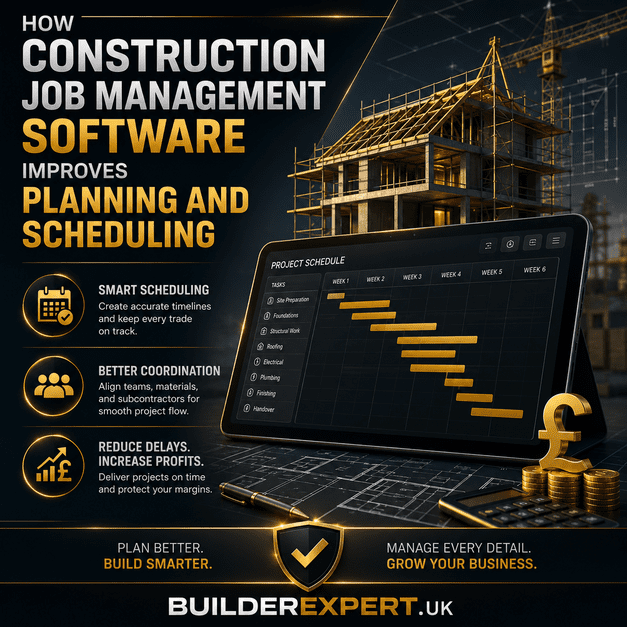
Successful residential construction projects begin long before work starts on site. Careful planning, realistic scheduling, and effective resource allocation determine whether a project is completed on time and within budget. This is where construction job management software delivers significant value.
Many builders still create schedules manually using spreadsheets or separate calendar applications. While this may work for smaller businesses, it becomes increasingly difficult as project numbers grow. Managing several house extensions, loft conversions, and renovation projects simultaneously requires constant updates, making manual scheduling both time-consuming and prone to errors.
Construction job management software centralises project planning into a single system. Managers can create schedules, assign tasks, monitor milestones, and instantly update every team member whenever changes occur.
Instead of reacting to problems after they happen, builders gain the ability to identify potential delays before they affect project delivery. This proactive approach reduces disruption and improves customer confidence throughout the construction process.
The software also helps coordinate multiple resources more effectively, including:
- Site teams
- Project managers
- Estimators
- Subcontractors
- Suppliers
- Plant and equipment
- Material deliveries
When every resource is planned within one platform, businesses experience fewer scheduling conflicts and improved productivity across all active projects.
Another important advantage is workload visibility. Managers can immediately identify whether teams are overbooked or underutilised, allowing them to redistribute resources before delays occur. This balanced approach helps maximise productivity while reducing unnecessary labour costs.
As workloads increase, efficient planning becomes one of the biggest competitive advantages a residential builder can have.
Better Cost Control and Higher Profit Margins
Profitability depends on much more than winning projects. The most successful builders consistently monitor costs throughout construction rather than waiting until completion to review financial performance.
Construction job management software gives businesses greater control over budgets by connecting estimating, project management, labour allocation, procurement, and financial monitoring.
Every decision made during construction has a financial impact. Additional labour, delayed deliveries, design variations, or material price increases can quickly reduce profit margins if they are not identified early.
Using construction job management software allows builders to compare estimated costs with actual project expenditure in real time.
This provides valuable visibility into:
- Labour costs
- Material spending
- Equipment usage
- Subcontractor costs
- Variations
- Purchase orders
- Outstanding invoices
- Overall project profitability
Instead of relying on monthly financial reviews, company owners receive continuous project performance information that supports faster decision-making.
Financial reporting also becomes significantly more accurate. Managers can identify trends across multiple projects and determine where efficiencies can be improved.
Over time, these insights help businesses produce more competitive quotations while maintaining healthy profit margins.
For residential builders operating in today’s challenging economic environment, improved financial control can make the difference between sustainable growth and declining profitability.
Improving Communication Across Every Construction Project
Communication failures remain one of the leading causes of delays, disputes, and unexpected costs within residential construction.
Drawings change.
Specifications are updated.
Clients request variations.
Delivery dates move.
Subcontractors become unavailable.
Without a central communication system, important information can easily be missed.
Construction job management software provides one reliable source of project information that everyone can access.
Rather than searching through emails, text messages, notebooks, or multiple software platforms, project teams work from the same up-to-date information.
This significantly improves collaboration between:
- Office administrators
- Estimators
- Contracts managers
- Site supervisors
- Tradespeople
- Suppliers
- Clients
Document management also becomes far more organised.
Planning documents, quotations, contracts, invoices, photographs, health and safety records, and project notes remain securely stored within each project file.
Every update is easier to track, reducing confusion and improving accountability throughout the project lifecycle.
Clients also benefit from better communication. Faster responses, clearer progress updates, and more organised documentation contribute to a professional experience that encourages repeat business and referrals.
For growing residential construction companies, improving communication is often one of the quickest ways to enhance both efficiency and customer satisfaction.
Why Digital Builders Consistently Outperform Their Competitors
The UK residential construction industry has changed dramatically over the past decade.
Clients expect faster quotations.
Projects are becoming more complex.
Material prices fluctuate regularly.
Labour availability changes quickly.
Builders who continue relying on manual administration are finding it increasingly difficult to compete against businesses that have embraced digital systems.
Construction job management software enables companies to operate with greater consistency, accuracy, and confidence.
Rather than depending on individual experience or memory, businesses develop repeatable processes that can be followed across every project.
This consistency reduces risk while making future growth much easier to manage.
Digital builders typically benefit from:
- Faster quotation turnaround
- Improved project visibility
- Better labour planning
- Reduced administration
- More accurate reporting
- Stronger customer communication
- Higher operational efficiency
- Better cost control
- Improved profitability
- Greater scalability
Technology also supports business resilience.
If key employees are unavailable, project information remains securely stored and accessible to authorised team members. Business operations continue with minimal disruption.
As residential construction becomes increasingly competitive, adopting construction job management software is no longer simply about improving productivity.
It is about creating a business capable of delivering consistently high-quality projects while protecting margins, improving customer satisfaction, and building a strong reputation that generates long-term sustainable growth.
UK Residential Case Study: How Construction Job Management Software Increased Profitability
A residential building company based in Surrey was managing multiple home extensions, loft conversions, and full property renovations at the same time. Although the business was winning a steady stream of new projects, the directors found that administration was becoming increasingly difficult. Project information was spread across spreadsheets, emails, handwritten notes, and multiple software applications, making it hard to maintain complete control over every job.
To improve efficiency, the company introduced construction job management software that combined estimating, scheduling, document management, project tracking, labour allocation, and cost monitoring into one central platform.
Within only a few weeks, the business noticed significant improvements. Project managers could instantly view project progress, office staff had immediate access to customer information, and site teams received updated schedules without unnecessary phone calls or duplicated paperwork.
The company completed a £248,000 residential renovation project over a 25-week programme while maintaining excellent visibility over labour costs, material purchases, subcontractor activities, and client variations. Improved coordination helped increase the final project profit from an expected 15% to just over 18%.
Key factors behind the successful implementation included:
- Centralised project management
- Faster communication between office and site
- Improved labour scheduling
- Better document control
- Real-time budget monitoring
- More accurate project reporting
“Since implementing construction job management software, we spend far less time chasing information and far more time delivering quality projects. Every member of the team works from the same data, and our projects are far easier to control from start to finish.” — James
🏗️ If you would like to discuss your project with our Builder Expert, click here
Conclusion
The residential construction industry is becoming more competitive every year, and builders who continue relying on manual systems are placing unnecessary pressure on their time, resources, and profitability. Investing in construction job management software allows businesses to streamline daily operations, improve communication, strengthen financial control, and deliver projects with greater confidence.
Whether your company specialises in extensions, renovations, refurbishments, or new-build homes, construction job management software provides the structure needed to organise every stage of the project lifecycle. From estimating and scheduling to cost tracking and customer communication, a single integrated platform helps reduce risk while increasing efficiency.
As your business grows, the importance of having reliable systems becomes even greater. Modern construction job management software enables builders to manage more projects without sacrificing quality, customer service, or profitability. Companies that embrace digital project management today will be far better positioned to meet future industry demands and outperform competitors.
If you are looking for a smarter way to manage residential construction projects across the UK, Builder Expert provides professional digital solutions designed specifically for modern builders. Our platform helps simplify estimating, organise project workflows, improve scheduling, monitor costs, and support sustainable business growth through powerful construction job management software that keeps every project under control from start to finish.
📎 BCIS (Building Cost Information Service): https://www.bcis.co.uk/
📎 UK Government – The Construction Playbook: https://www.gov.uk/government/publications/the-construction-playbook
📎 Construction Leadership Council: https://www.constructionleadershipcouncil.co.uk/
📎 Planning Portal: https://www.planningportal.co.uk/
📎 Health and Safety Executive (Construction): https://www.hse.gov.uk/construction/
Frequently Asked Questions About Construction Job Management Software
What is construction job management software?
Construction job management software is a digital platform that helps residential builders manage estimating, planning, scheduling, budgeting, labour, documentation, communication, and project progress from one central system.
Is construction job management software suitable for small building companies?
Yes. Construction job management software is suitable for businesses of all sizes. Small builders often benefit the most because it reduces administration, improves organisation, and allows them to manage more projects without increasing office overheads.
Can construction job management software improve profitability?
Absolutely. Construction job management software improves cost visibility, reduces delays, minimises administrative errors, and helps builders make better decisions throughout every stage of a residential construction project, leading to stronger profit margins.
Does construction job management software help with scheduling?
Yes. One of the major strengths of construction job management software is its ability to organise labour, subcontractors, suppliers, equipment, and project milestones within a single scheduling system, making resource planning far more efficient.
How do I choose the best construction job management software?
The best construction job management software should include estimating, project scheduling, quotation management, document storage, cost tracking, reporting, cloud accessibility, mobile compatibility, and an intuitive interface that supports future business growth.