
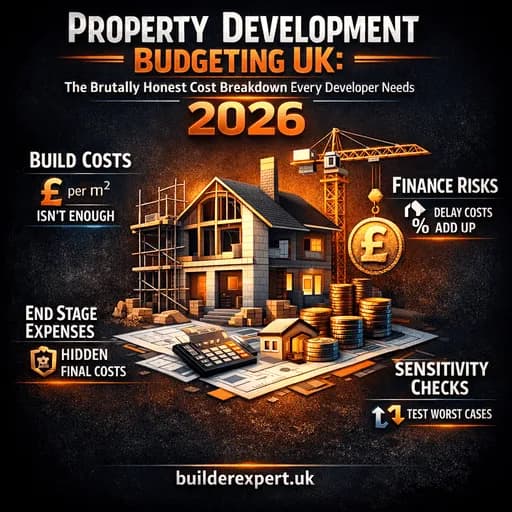
UK residential property development has entered a far less forgiving era. Construction inflation, planning delays, labour volatility, and tighter development finance mean that budgeting errors now have immediate and often irreversible consequences. Where margins were once able to absorb inefficiency, today even modest miscalculations can erode profitability or stall projects entirely. Yet many developers still approach budgets as a formality rather than a strategic control tool. This disconnect is where profit quietly disappears.
The reality is that Property Development Budgeting UK now operates in an environment defined by uncertainty. Material prices fluctuate, contractor availability shifts rapidly, and planning timelines remain unpredictable across local authorities. These pressures demand a far more disciplined and forward-looking approach to budgeting than in previous cycles. Relying on historic benchmarks or optimistic assumptions is no longer sufficient; budgets must actively anticipate risk rather than react to it.
This article addresses Property Development Budgeting UK as it actually operates in practice, not as it appears in theoretical models. It focuses on the real cost drivers, structural risks, and financial pressure points that define residential development in the UK today. Developers who understand these dynamics early retain control. Those who do not are forced to react once options are already limited.
A key issue is that many budgets are still built in isolation, without fully connecting land cost, planning exposure, construction pricing, and finance structure into a single, coherent financial model. In effective Property Development Budgeting UK, each of these elements must inform the others. A delay in planning approval, for example, is not simply a programme issue; it directly increases holding costs, interest exposure, and risk to projected returns.
Equally important is recognising that budgeting is not a one-off exercise completed at feasibility stage. Property Development Budgeting UK should be treated as a living process that evolves as information improves and risks crystallise. Early-stage assumptions must be challenged, stress-tested, and refined as the project moves closer to construction and delivery. Developers who embed this discipline are better positioned to protect capital, maintain lender confidence, and make rational decisions under pressure.
Ultimately, strong Property Development Budgeting UK is less about predicting outcomes perfectly and more about preparing for deviation from plan. In a market where volatility is the norm rather than the exception, budgeting becomes a strategic advantage. Developers who master it are not immune to risk, but they are far better equipped to manage it on their own terms.
What Property Development Budgeting UK Really Involves
At a professional level, Property Development Budgeting UK is not about estimating costs in isolation. It is about modelling risk across the entire lifecycle of a residential project. Every budget is effectively a forecast of uncertainty, and weak assumptions compound quickly as a scheme progresses. What appears manageable at feasibility stage can escalate rapidly once planning, construction, and finance pressures converge.
In the UK residential sector, Property Development Budgeting UK must account for far more than headline build costs. Land value assumptions influence finance structure, planning risk affects programme and interest exposure, and construction pricing determines not only cost but also delivery certainty. Each component interacts with the others, and failure to model these relationships accurately leads to fragile budgets that collapse under pressure.
A robust budgeting approach integrates land value, planning risk, construction pricing, finance exposure, and exit assumptions into a single decision framework. This integration allows developers to understand not only whether a project is viable, but how sensitive it is to change. In effective Property Development Budgeting UK, sensitivity analysis is not optional; it is essential for identifying which variables pose the greatest threat to profit.
Developers who treat budgeting as a static document inevitably underestimate how fast conditions can change once capital is committed. Contractor pricing can shift between tender and appointment, planning conditions can introduce additional scope, and finance costs can increase due to delays. Without an adaptable budget structure, these changes are often absorbed reactively rather than managed strategically.
Property Development Budgeting UK also requires clarity around exit assumptions. Sales values, absorption rates, and disposal costs must be stress-tested against realistic market scenarios rather than best-case projections. Overconfidence at exit stage frequently masks underlying risk earlier in the budget, giving a false sense of security during decision-making.
Ultimately, professional Property Development Budgeting UK is a control mechanism, not a compliance exercise. It enables developers to challenge deals before commitment, protect capital during delivery, and respond rationally when conditions deviate from plan. In a market defined by volatility, the ability to model and manage uncertainty is what separates sustainable developers from speculative participants.
Land Acquisition and Pre-Development Costs
Land acquisition is where budget discipline is either established or abandoned. Purchase price negotiations, legal fees, surveys, planning consultants, architects, and early design work form the foundation of the financial model. These costs define the true entry price of a project, yet they are often treated as secondary compared to construction spend. Underestimating them does not improve viability; it only delays reality until capital is already committed.
In practice, early-stage assumptions around land value and professional fees frequently determine whether a project remains controllable. Overpaying for land on the basis of optimistic build costs or sales values leaves little room to absorb risk later. In professional Property Development Budgeting UK, land acquisition is analysed not in isolation, but in direct relation to achievable planning outcomes, build complexity, and finance constraints.
Pre-development expenditure also extends beyond visible professional fees. Time itself carries a cost. Holding periods must reflect realistic planning timelines rather than best-case scenarios. Delays of several months are common across UK local authorities, and each additional month increases interest exposure, consultant fees, and opportunity cost. Conservative assumptions at this stage protect liquidity and reduce pressure later in the project when flexibility is limited.
Accurate modelling of these early costs requires structured estimating rather than informal allowances. Many developers now rely on dedicated estimating frameworks to test feasibility before acquisition, using tools and methodologies designed specifically for residential development. Resources such as https://builderexpert.uk/construction-estimating/ help ensure that land-related assumptions are supported by realistic cost planning rather than intuition.
In Property Development Budgeting UK, disciplined land acquisition is not about eliminating risk, but about pricing it correctly. Developers who understand the full financial impact of acquisition decisions are better positioned to negotiate land values, structure finance sensibly, and walk away from deals that only work on paper. Those who do not often discover that the project’s margin was lost before planning approval was ever secured.
Planning Risk and Regulatory Exposure
Planning is not a binary event; it is a variable risk factor that evolves throughout the early life of a residential project. Delays, redesigns, additional reports, and planning conditions directly affect both cost and programme, often in ways that are difficult to reverse once momentum is lost. Developers who budget on best-case approval timelines expose themselves to avoidable finance erosion and unnecessary pressure on cash flow.
In reality, planning uncertainty is one of the most influential variables in Property Development Budgeting UK. Local authority capacity, policy interpretation, consultation feedback, and political context can all extend timelines well beyond initial expectations. Each additional month impacts holding costs, interest accrual, and professional fees, compounding financial exposure long before construction begins.

Property Development Budgeting UK requires explicit allowances for planning uncertainty rather than optimistic assumptions. This includes modelling extended holding periods, incorporating additional consultant input, and allowing for potential design revisions driven by planning feedback. Ignoring these factors does not make them disappear; it simply pushes their impact later into the project when flexibility is reduced and costs are harder to control.
Experienced developers treat planning risk as something to be managed, not predicted. They stress-test budgets against delayed approvals and adverse outcomes, ensuring that schemes remain viable even when timelines extend. This disciplined approach is closely linked to structured project workflows that integrate estimating, planning, and cost control from the outset. Guidance such as highlights how aligning planning stages with cost monitoring improves financial resilience.
Treating planning risk as predictable rather than controllable is a defining trait of experienced developers. In Property Development Budgeting UK, the goal is not to eliminate uncertainty but to ensure that it is priced, timed, and absorbed without destabilising the wider project. Developers who embed this mindset protect both liquidity and decision-making authority throughout the development cycle.
Construction Costs and Specification Control
Construction costs dominate residential development budgets, yet they are often the least precisely understood element of the financial model. Cost-per-square-metre benchmarks are useful indicators for early comparison, but they are not substitutes for detailed, project-specific analysis. Site conditions, access constraints, build complexity, and procurement strategy all influence final cost in ways that generic averages cannot capture.
In the context of Property Development Budgeting UK, over-reliance on headline benchmarks is a common source of error. Developers who anchor budgets to optimistic £/m² figures often discover later that specification requirements, regulatory standards, or construction sequencing drive costs significantly higher. These adjustments rarely occur in isolation; they compound across multiple trades, amplifying their impact on the overall budget.
Effective Property Development Budgeting UK depends on early specification clarity and disciplined scope control. Decisions around structure, finishes, building services, and compliance requirements must be resolved as early as possible to avoid uncertainty filtering into contractor pricing. Where specifications remain vague, contractors price risk rather than certainty, leading to inflated tenders or aggressive re-pricing during delivery.
Late-stage design changes, even when minor in isolation, frequently produce disproportionate cost increases. Small alterations can disrupt sequencing, require redesign of interconnected elements, or trigger additional approvals. In residential development, these changes often coincide with peak expenditure periods, increasing cash flow pressure and reducing the ability to absorb cost overruns.
Developers who maintain tight specification governance protect margins and reduce contractor disputes. Clear documentation, disciplined change control, and early alignment between design intent and budget constraints create stability throughout the build phase. In Property Development Budgeting UK, this discipline separates controlled projects from those that drift beyond their original financial parameters.
Ultimately, construction cost control is not achieved through optimism or aggressive negotiation alone. It is the result of clarity, preparation, and consistent decision-making. Developers who understand this approach are better equipped to manage risk, maintain programme certainty, and protect profitability in a challenging residential market.
Labour, Materials, and Market Volatility
UK residential construction continues to face persistent labour constraints and ongoing supply chain instability. Skilled trades remain in short supply across many regions, while subcontractor pricing, material lead times, and availability fluctuate far more than traditional budgeting models allow for. These conditions introduce uncertainty that cannot be eliminated, only managed.

In practice, labour volatility affects more than headline pricing. Availability issues can disrupt sequencing, extend programme durations, and increase reliance on alternative subcontractors at short notice. Each of these factors carries cost implications that ripple through the project. In Property Development Budgeting UK, failing to reflect this reality often leads to compressed programmes, increased preliminaries, and higher finance exposure.
Material supply presents similar challenges. Extended lead times, minimum order quantities, and price validity periods mean that procurement decisions now carry greater financial weight than in previous cycles. Developers who assume stable pricing throughout the build phase expose themselves to sudden cost escalation, particularly on materials with volatile global supply chains.
In Property Development Budgeting UK, volatility is not ignored or over-hedged; it is priced realistically. Experienced developers build structured allowances that absorb market movement without eroding the credibility of the overall budget. This approach relies on understanding which cost categories are most exposed to fluctuation and applying targeted buffers rather than blanket contingency.
Effective management of labour and material risk is closely linked to how projects are structured and monitored. Clear task sequencing, realistic programmes, and disciplined cost tracking improve visibility and reduce reactive decision-making. Guidance such as illustrates how breaking projects into clearly defined estimating components supports more resilient budgeting under volatile conditions.
External data also reinforces the scale of this challenge. Industry-wide analysis from organisations such as the Construction Leadership Council highlights ongoing pressure on skills, productivity, and supply chains across the UK construction sector. Incorporating this broader context into Property Development Budgeting UK ensures that assumptions are aligned with market reality rather than historical norms.
Ultimately, developers who acknowledge volatility early retain control over outcomes. By pricing uncertainty deliberately and structuring budgets to accommodate movement, Property Development Budgeting UK becomes a tool for stability rather than a source of surprise. In a market defined by constraint, realism is the most effective form of risk management.
Finance Costs and Cash Flow Pressure
Finance is often the most underestimated risk within residential development budgets, despite being one of the most unforgiving. Interest accrues daily, not at project completion, and even modest delays can significantly erode projected profit. Where programmes slip, finance costs rise automatically, often without the same visibility as construction overruns. Weak cash flow modelling creates stress even where headline profit margins appear acceptable on paper.
In the context of Property Development Budgeting UK, finance risk is closely tied to timing rather than total cost. A project may remain within its overall budget yet still experience severe pressure if expenditure and funding are misaligned. Drawdowns are staged, valuations are conditional, and lenders release funds only when specific milestones are achieved. If cost timing does not match funding availability, developers are forced to inject additional capital or renegotiate terms under pressure.
Property Development Budgeting UK must therefore account for realistic programme durations, not aspirational ones. Delays in planning approval, procurement, or construction sequencing extend borrowing periods and increase interest exposure. These effects compound quickly, particularly on leveraged projects where finance costs represent a significant proportion of total expenditure.
Budgets that fail lender scrutiny increase finance costs and restrict funding flexibility, directly reducing developer control. Lenders assess not only headline profitability but also the credibility of assumptions, contingency levels, and cash flow resilience. Overly optimistic budgets often trigger reduced loan-to-cost ratios, higher interest margins, or additional conditions that limit operational freedom.
Experienced developers use Property Development Budgeting UK as a tool to anticipate lender behaviour rather than react to it. By modelling conservative scenarios and stress-testing cash flow, they maintain negotiating leverage and avoid emergency funding decisions. In an environment of tighter credit and heightened scrutiny, disciplined financial modelling is no longer optional. It is a prerequisite for maintaining control over both capital and outcomes throughout the development lifecycle.
Contingency and Risk Discipline
Contingency is not an admission of uncertainty; it is a recognition of reality. Its purpose is to protect the project from genuine risk events, not to compensate for incomplete planning or optimistic estimating.
In Property Development Budgeting UK, contingency levels must reflect project complexity, stage, and exposure. Developers who treat contingency as negotiable often discover too late that risk does not negotiate.
Hidden and End-Stage Costs
Profit erosion frequently occurs at the final stages of residential projects, often when developers expect financial pressure to ease. Compliance certification, utilities connections, landscaping, sales costs, marketing expenses, and professional close-out fees are routinely underestimated or excluded altogether. Because these costs arise near completion, they tend to attract less attention during feasibility and early-stage budgeting, despite their material impact on final returns.
In many cases, these end-stage costs emerge when cash flow is already constrained. Construction expenditure may have peaked, finance drawdowns are nearing completion, and sales income may not yet be realised. Without adequate allowances, developers are forced to absorb these expenses at precisely the point where liquidity is weakest. This dynamic is a common source of stress in residential delivery.
Property Development Budgeting UK must incorporate these costs from the outset rather than treating them as secondary or optional. Certification requirements, statutory approvals, and utility connections are non-negotiable and must be completed before occupation or sale. Similarly, external works such as landscaping and access improvements are often conditions of planning or saleability rather than discretionary enhancements.
Late recognition of end-stage expenditure compresses cash flow and reduces exit flexibility, even on otherwise successful schemes. Developers may be forced to delay completion, reduce marketing effectiveness, or accept less favourable sales terms in order to preserve liquidity. These compromises directly affect realised profit, not just projected returns.
In professional Property Development Budgeting UK, end-stage costs are planned with the same rigour as construction spend. They are scheduled accurately, costed conservatively, and aligned with anticipated sales or refinancing timelines. This approach ensures that final delivery supports a controlled exit rather than triggering last-minute financial pressure.
Ultimately, strong Property Development Budgeting UK recognises that profit is not secured when construction finishes, but when the project exits cleanly. Developers who plan for end-stage costs early maintain control through completion and protect the value created throughout the development lifecycle.
Profit, Sensitivity, and Strategic Decision-Making
A professional development budget exists to support decisions, not to justify optimism. Its primary function is to test whether a project remains viable when reality deviates from plan. Sensitivity testing is therefore essential. It reveals how a scheme responds to delays, cost increases, finance pressure, or market softening. If relatively small deviations eliminate profit, the project is structurally weak, regardless of how attractive the headline numbers may appear.
In Property Development Budgeting UK, sensitivity analysis should be applied across multiple variables rather than a single worst-case scenario. Changes to build costs, planning timelines, interest rates, or sales values rarely occur in isolation. The interaction between these factors often determines whether a project absorbs pressure or fails under it. Developers who ignore this interdependence tend to overestimate resilience and underestimate downside risk.
Strong Property Development Budgeting UK enables developers to assess not just whether a project works, but how it fails. Understanding the breakpoints within a financial model provides clarity around acceptable risk and informs negotiation strategy at acquisition stage. This insight allows developers to adjust land value assumptions, restructure finance, or refine specification before committing capital.
Crucially, disciplined budgeting empowers developers to walk away from marginal deals without hesitation. In competitive markets, the pressure to proceed can be intense, particularly when time and professional fees have already been invested. However, capital preservation is a strategic decision. Projects that only succeed under ideal conditions rarely deliver sustainable returns.
By contrast, schemes built on resilient fundamentals maintain viability across a range of outcomes. Property Development Budgeting UK, when applied correctly, directs capital towards these opportunities. It prioritises robustness over optimism and clarity over speculation. Developers who adopt this mindset concentrate resources on projects that can absorb volatility and still perform.
Ultimately, the strength of a budget is measured not by how attractive it looks at feasibility, but by how well it guides decisions under uncertainty. In Property Development Budgeting UK, this discipline is what separates confident decision-makers from reactive participants, and long-term operators from short-term risk-takers.
Conclusion
Property Development Budgeting UK is not an administrative exercise; it is a strategic discipline. Developers who approach budgeting with realism, structure, and risk awareness retain control throughout the development cycle. Those who rely on assumptions are controlled by events.
Property Development Budgeting UK rewards discipline over optimism and preparation over prediction. In a market defined by volatility and constraint, mastery of budgeting is no longer optional. It is the skill that separates sustainable developers from temporary participants.
▶ https://www.gov.uk/government/publications/the-construction-playbook
▶ https://www.constructionleadershipcouncil.co.uk/
▶ Discuss Your Project https://builderexpert.uk/contact-builder-expert/