

Residential construction estimating software has become an essential tool for modern builders, contractors, and residential project managers who want greater accuracy, faster quoting, and better financial control. In an industry where margins can quickly disappear due to poor budgeting or inaccurate estimates, software-driven estimating offers a practical way to reduce risk and improve project planning.
Residential construction projects involve countless variables. Labour rates, materials, subcontractor pricing, scheduling, site conditions, and client expectations all influence the final cost. Without a structured estimating process, builders often rely on spreadsheets, manual calculations, or outdated pricing methods that leave room for error.
As the construction sector becomes increasingly competitive, residential builders need systems that help them produce accurate quotations while maintaining profitability. Residential construction estimating software simplifies the estimating process by creating a repeatable workflow that supports consistency and better decision-making.
Whether managing home extensions, renovations, loft conversions, or full new-build projects, using the right estimating platform allows contractors to improve planning and avoid costly mistakes before construction begins.
Why Residential Builders Need Better Estimating Systems
Many residential construction businesses still rely on traditional estimating methods. Manual spreadsheets, handwritten calculations, and rough assumptions may work on small jobs, but they often create problems when projects become more complex.
A lack of estimating accuracy can result in underpricing, budget overruns, or delayed construction timelines. Builders who underestimate labour, material quantities, or subcontractor costs may struggle to maintain profit margins.
Residential construction estimating software creates a structured approach to budgeting by reducing guesswork. Instead of manually calculating every element, contractors can work with organised templates, standard pricing categories, and automated cost calculations.
This matters because residential construction projects often contain hidden variables. Small pricing errors can quickly multiply across multiple trades and construction stages.
Builders using software-based estimating typically benefit from:
- Faster quotation preparation
- Improved pricing accuracy
- Better client communication
- Reduced manual errors
- More consistent project budgeting
- Improved profitability tracking
Residential builders who adopt digital estimating tools often gain a competitive advantage because they can respond to enquiries faster while producing more reliable pricing.
What Is Residential Construction Estimating Software?
Residential construction estimating software is a digital system designed to calculate project costs for residential building work. It helps builders create realistic estimates by organising pricing information into a structured workflow.
Unlike traditional estimating methods, software platforms automate many repetitive tasks. Contractors can build quotes using labour rates, material databases, subcontractor pricing, and project-specific variables.
Most estimating platforms include tools for:
- Cost forecasting
- Labour calculations
- Material quantity tracking
- Quote generation
- Budget planning
- Project cost comparison
- Pricing templates
- Scope-of-work organisation
The purpose of residential construction estimating software is not only to save time but also to improve pricing confidence.
Builders often face pressure to provide quick quotations to potential clients. Without software, preparing a professional estimate may take hours or even days.
With a structured estimating system, contractors can produce faster, more accurate pricing while maintaining consistency across projects.
This creates a more professional customer experience and reduces uncertainty during early planning.
How Residential Construction Estimating Software Works
Residential construction estimating software works by combining project information with real construction cost data to produce structured, accurate pricing estimates. Instead of relying on manual spreadsheets or time-consuming calculations, builders can enter project details into a central system that automatically organises costs into clear categories.
Traditional estimating often depends on experience, handwritten notes, or outdated pricing references. While experience remains valuable, manual processes leave room for inconsistencies and human error.
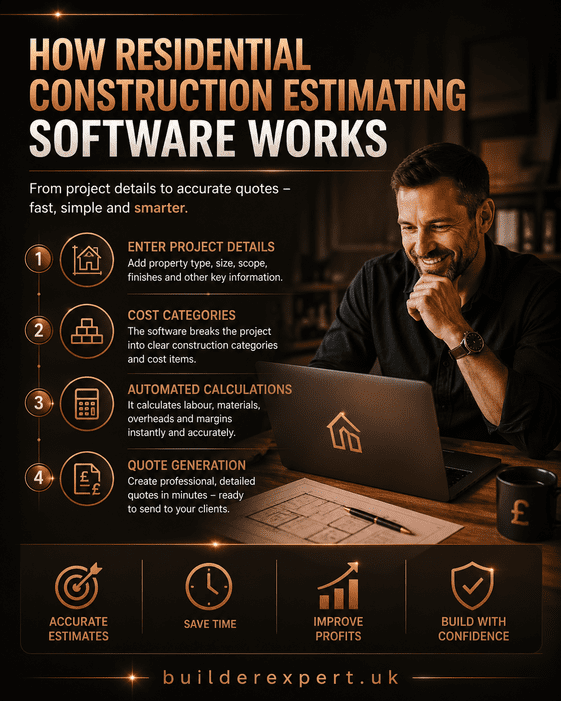
Modern estimating software creates a repeatable workflow that improves accuracy, speeds up quoting, and provides greater financial visibility from the earliest planning stages.
The software follows a logical process that mirrors how residential construction projects are priced in real-world scenarios.
By breaking a project into individual components, contractors gain a more realistic understanding of total build costs before work begins.
Project Information Entry
The first step involves entering project-specific information. This stage creates the foundation for the estimate because the accuracy of the output depends on the quality of the initial inputs.
Builders typically enter details such as:
- Property type
- Build size
- Extension or renovation scope
- Construction complexity
- Labour requirements
- Finish quality
- Timeline expectations
This information helps the software understand the scale and complexity of the project. For example, a small kitchen extension will require a very different cost structure compared to a full residential new-build.
Property size influences material quantities and labour hours, while finish quality affects product selection and installation costs. Timeline expectations may also impact labour scheduling and subcontractor availability.
By collecting this data early, residential construction estimating software creates a reliable framework for cost forecasting.
Cost Category Allocation
Once project information is entered, the software separates costs into structured pricing categories. This stage improves organisation and prevents important cost items from being overlooked.
Instead of producing one broad figure, the estimate becomes divided into specific construction areas.
Typical categories include:
- Foundations
- Structural work
- Roofing
- Electrical installation
- Plumbing
- Flooring
- Decoration
- External works
Breaking pricing into categories allows contractors to understand exactly where money is being allocated. Builders can quickly identify which phases carry the highest costs and which areas may require adjustments.
For residential construction, category-based estimating is extremely valuable because projects often involve multiple trades working across different timelines. Clear cost separation improves visibility and helps contractors explain pricing more effectively to clients.
Automated Calculations
After categories are created, the software performs automated calculations based on stored pricing logic. This is where estimating platforms deliver significant time savings.
Rather than manually calculating labour totals, material quantities, markups, and contingencies, the software applies predefined cost rules automatically.
For example, the system may calculate:
- Labour hours required for each construction stage
- Material quantities based on project dimensions
- Subcontractor allowances
- Waste percentages
- Contingency allocations
- Overhead and profit margins
Residential construction estimating software reduces the risk of forgetting key pricing elements. Manual calculations often miss small but important details that affect profitability.
Automation also improves consistency. Builders can apply the same pricing logic across multiple projects, creating a more reliable estimating system over time.
This becomes especially important for growing construction businesses where multiple staff members prepare quotations.
Quote Generation
Once calculations are complete, the software generates a professional quotation. Many platforms automatically convert estimating data into client-ready documents that present costs in a clear and organised format.
Builders no longer need to manually prepare proposals or transfer numbers between spreadsheets and documents.
Modern quote generation may include:
- Detailed cost breakdowns
- Scope of work summaries
- Labour and material sections
- Optional upgrades or variations
- Branded presentation layouts
- VAT calculations
- Terms and conditions
Professional presentation helps improve client trust. Homeowners are more likely to feel confident when quotations are detailed, structured, and visually clear.
For contractors, this stage also reduces administration time. Instead of formatting estimates manually, builders can focus on communication, planning, and project delivery.
Why Workflow Automation Matters
One of the biggest advantages of residential construction estimating software is workflow automation. Construction estimating often becomes repetitive, especially for contractors handling multiple enquiries each week.
Automation reduces manual repetition by creating a predictable estimating structure.
Benefits include:
- Faster quotation turnaround
- Reduced human error
- Improved pricing consistency
- Better project forecasting
- Stronger financial control
- Easier client communication
By automating estimating stages, builders spend less time on calculations and more time managing projects, improving profitability, and delivering quality residential construction work.
A well-structured estimating workflow creates a stronger connection between pricing, planning, and execution. This makes residential construction estimating software a valuable tool for contractors who want to improve efficiency and maintain greater control over project costs.
Key Benefits of Residential Construction Estimating Software
Builders increasingly adopt digital estimating because it solves several common construction challenges.
Improved Accuracy
One of the largest benefits of residential construction estimating software is improved pricing precision.
Manual calculations increase the likelihood of missing materials, underestimating labour, or forgetting specialist costs.
Software creates repeatable estimating logic.
Faster Quotation Turnaround
Speed matters when competing for residential projects.
Builders who respond quickly often secure more enquiries.
Residential construction estimating software allows contractors to create quotes in less time.
Better Budget Visibility
A structured estimating system provides clearer insight into where money is allocated.
Builders can track:
- Labour percentages
- Material cost breakdowns
- Profit margins
- Subcontractor allowances
- Contingency costs
Professional Presentation
Clients often trust builders who provide organised, detailed quotations.
Residential construction estimating software creates cleaner and more professional documentation.
Reduced Financial Risk
Poor estimating increases the likelihood of project losses.
Software reduces pricing inconsistencies and supports smarter planning.
Common Problems Builders Face Without Estimating Software
Many construction businesses underestimate how much time and money is lost through inefficient estimating.
Builders who rely on spreadsheets often face challenges such as:
- Inconsistent pricing
- Forgotten cost items
- Slow quote preparation
- Duplicate calculations
- Poor cost tracking
- Incorrect labour assumptions
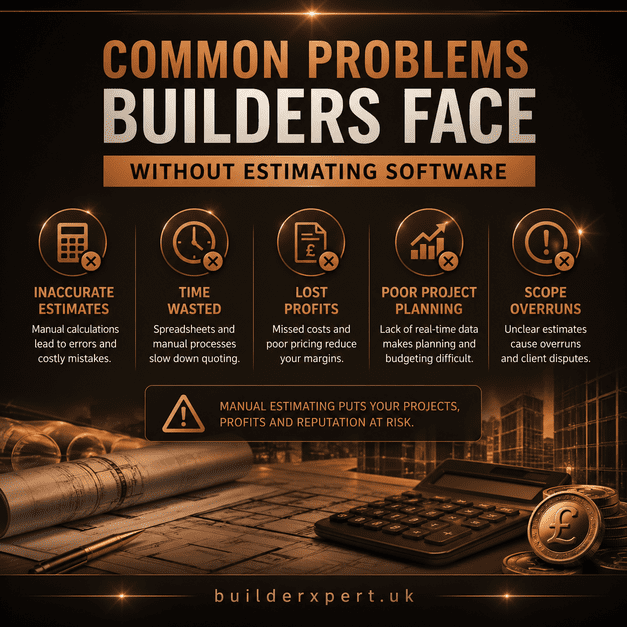
Without residential construction estimating software, contractors may struggle to maintain pricing consistency across projects.
This becomes particularly difficult when multiple team members prepare quotations.
Manual estimating also creates scalability problems.
As project volume increases, builders require systems that reduce admin workload while improving financial visibility.
Another issue involves version control.
Spreadsheets are often updated manually, which increases the risk of outdated pricing.
Residential construction estimating software solves this by centralising pricing information.
Builders gain access to one structured system rather than relying on multiple disconnected files.
Residential Projects That Benefit Most From Estimating Software
Residential construction estimating software works across multiple project types.
Residential contractors often handle different categories of work, each requiring a unique pricing structure.
Home Extensions
Extensions require careful budgeting because structural work, steel installation, roofing, and internal finishes all affect pricing.
Loft Conversions
Loft conversions often involve structural adjustments, insulation, staircase installation, and roof modifications.
Full Property Renovations
Renovation projects frequently uncover hidden conditions.
Software helps builders anticipate variable costs.
New Build Homes
New-build projects require detailed forecasting.
Residential construction estimating software helps organise pricing across multiple phases.
Kitchen and Living Space Upgrades
Internal remodels involve cabinetry, plumbing, flooring, lighting, and finishing work.
Builders benefit from structured cost planning.
By applying estimating software to these project categories, contractors gain greater consistency and stronger financial control.
How Estimating Software Improves Project Planning
Project planning begins long before construction starts.
Builders who understand cost allocation early can make better decisions throughout the build process.
Residential construction estimating software supports project planning by connecting pricing with workflow organisation.
Contractors can use software to:
- Identify cost-sensitive areas
- Compare material options
- Forecast labour requirements
- Plan construction stages
- Allocate contingency budgets
- Improve scheduling decisions
Better estimating leads to better planning.
When builders know where costs sit, they can reduce waste and improve project efficiency.
Residential construction projects benefit significantly from early planning because delays and changes become more expensive later.
Residential construction estimating software allows builders to identify realistic pricing before work begins.
This improves confidence during both quoting and delivery.
Choosing the Right Residential Construction Estimating Software
Not all estimating tools offer the same functionality.
Builders should evaluate software based on their specific residential workflow.
Important features include:
Ease of Use
A complex platform may slow productivity.
Builders need software that feels intuitive.
Residential-Specific Templates
Some platforms focus on commercial construction.
Residential construction estimating software should support extensions, renovations, and home builds.
Customisable Pricing
Builders need flexibility to adjust labour rates and material allowances.
Quote Presentation Tools
Professional client quotations improve trust.
Cloud Access
Cloud-based estimating systems improve accessibility.
Builders can work across devices and update estimates remotely.
Choosing the right software depends on business size, estimating volume, and project type.
The goal is to find a system that supports efficiency while maintaining accuracy.
Residential Case Study: Using Software to Improve Builder Accuracy
A small residential contractor in Manchester specialised in home extensions and loft conversions.
The business struggled with inconsistent pricing because quotations were created manually using spreadsheets.
Project profitability varied, and quote preparation often took several hours.
The company implemented residential construction estimating software to improve consistency.
After introducing software-based estimating, the contractor achieved:
- Faster quote turnaround
- Improved pricing confidence
- Better labour forecasting
- Reduced missed cost items
- Stronger client communication
Within six months, quotation time decreased by approximately 45%.
The builder also reduced underpricing errors that previously affected profitability.
Software helped standardise estimating across multiple residential project types.
The contractor reported greater confidence when discussing budgets with clients.
This case study highlights how residential construction estimating software improves both operational efficiency and financial visibility.
Why Residential Construction Estimating Software Matters in 2026
Residential construction continues to evolve.
Builders face rising labour costs, changing material prices, increased competition, and higher client expectations.
Traditional estimating methods no longer provide the speed or accuracy required in a modern market.
Residential construction estimating software helps contractors adapt by providing better budgeting systems and stronger planning workflows.
In 2026, digital construction tools are becoming standard practice.
Residential builders increasingly require:
- Faster quoting systems
- More accurate forecasting
- Better margin control
- Improved client transparency
- Greater pricing consistency
Builders who invest in structured estimating systems often gain long-term advantages.
Residential construction estimating software supports profitability, professionalism, and scalability.
As competition increases, estimating accuracy becomes more important than ever.
Conclusion
Accurate estimating is one of the most important foundations of successful residential construction.
Builders who rely on manual calculations often experience inconsistencies, slow quoting, and reduced financial control.
Residential construction estimating software provides a smarter solution by organising project pricing into a clear and repeatable process.
From home extensions to full new-build projects, software-based estimating improves speed, accuracy, and profitability.
Contractors gain better insight into labour, materials, budgeting, and project planning.
Residential construction estimating software also improves communication with clients by providing clearer cost expectations.
As residential construction becomes more competitive, builders need tools that help them work faster and plan more effectively.
Using residential construction estimating software creates stronger financial confidence, better workflows, and more professional project delivery.
For residential builders looking to improve estimating quality, adopting a structured software solution is no longer optional. It is becoming an essential part of smarter project planning.
.
🔗 https://www.bcis.co.uk/
🔗 https://www.constructionleadershipcouncil.co.uk/
🔗 https://www.rics.org/uk/
🔗 https://www.theaccessgroup.com/en-gb/construction/software/estimating/
🔗 https://www.buildxact.com/uk/features/construction-estimating-software/
🔗 https://www.estimatorxpress.co.uk/
🔗 https://www.eque2-estimating.co.uk/
🔗 https://estimate.co.uk/
FAQ
- What is residential construction estimating software?
Residential construction estimating software is a digital tool designed to help builders, contractors, and residential construction professionals calculate project costs more accurately. It organises labour rates, material pricing, subcontractor expenses, and project variables into a structured estimating process. Instead of relying on spreadsheets or manual calculations, builders can create faster, more consistent quotes while improving budget accuracy. - Why is residential construction estimating software important for builders?
Residential construction estimating software helps builders reduce errors, improve pricing consistency, and save time during the quotation process. Construction projects involve many cost variables, and small estimating mistakes can significantly affect profitability. Software creates a repeatable system that supports better financial planning and stronger project preparation. - Can residential construction estimating software improve project profitability?
Yes, residential construction estimating software can improve profitability by helping contractors avoid underpricing and overlooked costs. Accurate estimating allows builders to understand labour, materials, overheads, and contingencies more clearly. When pricing is realistic from the beginning, projects are more likely to remain financially stable throughout construction. - How does residential construction estimating software work?
Residential construction estimating software works by combining project details with cost data to generate estimated pricing. Builders enter information such as project size, build type, labour requirements, materials, and finish level. The system then calculates likely costs and organises them into a structured estimate or quotation. Many platforms also include templates, cost databases, and automated calculations. - Who should use residential construction estimating software?
Residential construction estimating software is useful for builders, contractors, renovation specialists, project managers, and residential developers. It is especially valuable for businesses handling extensions, loft conversions, refurbishments, and new-build homes. Both small construction firms and larger residential contractors benefit from improved estimating accuracy. - Does residential construction estimating software replace manual quoting?
Yes, residential construction estimating software is designed to replace or significantly reduce manual quoting methods. While builders may still review and customise estimates, software automates many repetitive calculations. This reduces admin time and improves consistency across projects, especially when multiple team members create quotations. - Can residential construction estimating software help reduce estimating mistakes?
Yes, one of the main benefits of residential construction estimating software is reducing human error. Manual spreadsheets often miss cost categories or contain outdated pricing. Software creates a centralised estimating process that helps builders track labour, materials, and allowances more accurately. - What features should builders look for in residential construction estimating software?
Builders should look for features such as labour tracking, material pricing databases, quote generation, custom templates, cloud access, project budgeting, and reporting tools. Residential-specific functionality is also important because housing projects require different estimating workflows compared to commercial construction. - Is residential construction estimating software suitable for small builders?
Yes, residential construction estimating software is highly beneficial for small builders because it improves efficiency and reduces the time required to prepare quotes. Small businesses often have limited administrative resources, so automation helps streamline operations while maintaining pricing accuracy. - Why is estimating software becoming more important in residential construction?
Estimating software is becoming more important because residential construction costs continue to fluctuate due to labour rates, supply chain issues, and material pricing changes. Builders need faster access to accurate information to remain competitive. Residential construction estimating software provides greater financial visibility and helps contractors make smarter project decisions.
📞 Want to speak with our team? Contact Builder Expert here