
Across the UK, developers and homeowners are increasingly transforming unused industrial buildings into modern residential properties. Converting an old warehouse into a home can create striking living spaces with open layouts, high ceilings, and distinctive architectural character that many traditional houses cannot offer.
These conversions are particularly popular in urban areas where former industrial zones are being redeveloped into residential communities. With the right design approach, an old warehouse can become a contemporary home that combines industrial aesthetics with modern comfort.
However, warehouse conversion projects also come with significant financial and structural challenges. Many of these buildings were originally designed for storage or manufacturing rather than residential living. As a result, builders often need to address issues such as structural reinforcement, insulation upgrades, plumbing installations, electrical systems, and compliance with modern UK building regulations. Without careful planning and accurate budgeting, renovation costs can quickly escalate beyond the original expectations of both developers and homeowners.
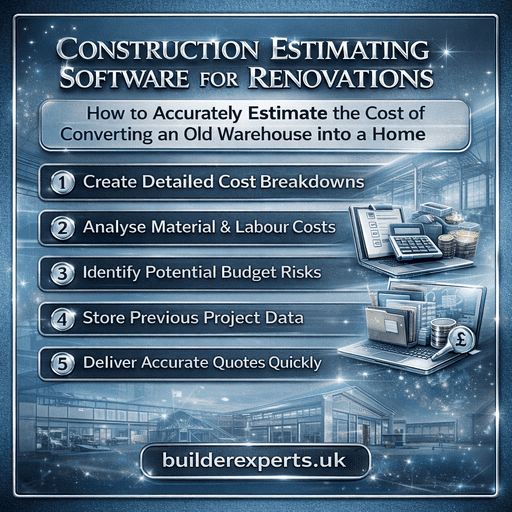
This is where Construction Estimating Software for Renovations becomes essential. Instead of relying on guesswork, spreadsheets, or outdated pricing methods, builders can use digital estimating tools to calculate material costs, labour requirements, and project timelines with far greater accuracy. Construction Estimating Software for Renovations allows contractors to create structured cost breakdowns, ensuring that every stage of a complex renovation project is properly budgeted before work begins.
Digital estimating tools also make it easier for builders to respond quickly to client requests. Detailed estimates can be produced in a shorter time frame, allowing contractors to present professional proposals while maintaining full control over their pricing strategy. By using Construction Estimating Software for Renovations, contractors can produce reliable project estimates, reduce costly calculation errors, and protect their profit margins when tackling demanding renovation projects such as warehouse-to-home conversions.
Why Warehouse Conversions Are Growing in the UK
Warehouse conversions have become increasingly popular across many UK cities as developers look for creative ways to address the growing demand for residential housing. Former industrial districts that once housed factories, storage facilities, and distribution centres are now being transformed into attractive residential neighbourhoods. Cities such as Manchester, Birmingham, and London have seen a steady rise in warehouse-to-home conversions, where large industrial buildings are redesigned into stylish loft apartments or spacious family homes.
One of the main reasons for this trend is the structural potential that many older warehouses offer. Unlike traditional houses, warehouses typically feature wide open floor plans, high ceilings, and strong structural frameworks. These characteristics give architects and builders the flexibility to create unique living environments that appeal to modern homeowners. Elements such as exposed brickwork, steel beams, and large industrial windows can also be incorporated into contemporary interior designs, creating distinctive spaces that blend historical character with modern comfort.
Despite these advantages, converting an old warehouse into a residential property is rarely a simple renovation project. Many industrial buildings require extensive upgrades before they can meet residential building standards. Builders may need to install new insulation systems, reinforce structural elements, improve damp-proofing, and upgrade roofing structures to ensure the building performs efficiently as a home. Plumbing networks, electrical systems, ventilation, and fire safety measures must also be installed or significantly upgraded to comply with UK building regulations.
These technical requirements can have a major impact on project budgets if they are not accurately planned from the beginning. Hidden structural issues, outdated materials, and regulatory requirements can quickly increase the scope of work during the renovation process. For this reason, careful planning and accurate cost estimation are essential before construction begins.
This is where Construction Estimating Software for Renovations plays a crucial role in the early stages of project planning. By using Construction Estimating Software for Renovations, builders can evaluate every stage of a warehouse conversion and calculate the likely costs of structural upgrades, materials, labour, and compliance requirements. The software allows contractors to generate detailed cost breakdowns, helping both builders and property developers understand the financial scope of the project before construction begins. With the support of Construction Estimating Software for Renovations, contractors can approach complex warehouse conversions with greater confidence, ensuring budgets remain realistic and projects remain financially viable.
The Key Cost Factors When Converting a Warehouse into a Home
Converting an old warehouse into a residential property involves several cost categories that must be carefully evaluated during the estimating process. Unlike standard home renovations, warehouse conversions often require a combination of structural, mechanical, and regulatory upgrades. Each stage of the project introduces different cost variables, and if these are not accurately calculated from the beginning, the final project budget can increase significantly.
One of the most significant cost factors is structural modification. Many warehouses were originally designed to support storage or industrial operations rather than residential living spaces. As a result, builders may need to reinforce floors, introduce additional load-bearing elements, or modify roof structures to meet residential safety standards. In some cases, internal walls must also be added to create functional living areas, bedrooms, and service spaces. These structural adjustments can represent a substantial portion of the overall renovation budget.
Another major cost factor is compliance with modern building regulations. Residential buildings in the UK must meet strict standards related to insulation, fire protection, ventilation, and overall energy efficiency. Older warehouses were rarely constructed with these requirements in mind, meaning that significant upgrades are often necessary. Installing modern insulation systems, upgrading fire safety features, and improving thermal performance are essential steps in transforming an industrial building into a safe and comfortable home.
In addition to structural and regulatory upgrades, several other cost elements must be included in the renovation estimate. These components form the core of most warehouse conversion budgets and should always be evaluated carefully during the planning stage.
Typical renovation cost components include:
• Structural reinforcement and steelwork
• Installation of plumbing and drainage systems
• Electrical wiring, lighting, and distribution boards
• Thermal insulation and energy efficiency improvements
• Interior finishes such as flooring, kitchens, bathrooms, and wall treatments
Each of these elements can vary depending on the condition of the existing building and the complexity of the design. For this reason, accurate cost planning is essential before construction work begins.
By using Construction Estimating Software for Renovations, builders can break down these categories into detailed cost components and create structured project estimates. Construction Estimating Software for Renovations allows contractors to analyse labour costs, material quantities, and installation requirements with greater precision. This level of detail helps builders present transparent budgets to their clients while ensuring that no critical cost factors are overlooked.
Ultimately, Construction Estimating Software for Renovations enables contractors to manage complex renovation projects more effectively. By organising every construction element into a clear estimating framework, builders can provide reliable cost projections and maintain stronger financial control throughout the warehouse conversion process.
How Construction Estimating Software Improves Renovation Cost Accuracy
Traditional estimating methods often rely on manual calculations, handwritten notes, or static spreadsheets. While these tools may still be useful for very small renovation jobs, they often struggle to handle the complexity of larger projects such as warehouse conversions. Industrial buildings typically involve multiple construction stages, structural modifications, and regulatory upgrades, all of which require detailed financial planning. When builders rely solely on manual calculations, it becomes much easier to overlook important cost elements or underestimate the true scope of the project.
This is where Construction Estimating Software for Renovations provides a clear advantage. Instead of estimating costs through fragmented spreadsheets or rough calculations, builders can use a structured digital platform designed specifically for construction budgeting. With Construction Estimating Software for Renovations, contractors can input precise quantities for materials, labour rates, supplier pricing, and installation costs into one integrated estimating system. This allows every part of the project to be analysed systematically, ensuring that all cost categories are properly accounted for.
One of the key benefits of Construction Estimating Software for Renovations is the ability to update estimates quickly as project conditions change. Material prices in the construction industry can fluctuate, and renovation projects often uncover unexpected issues once work begins. Digital estimating tools allow builders to adjust quantities, update supplier prices, and recalculate total costs in real time. This flexibility helps contractors maintain accurate project budgets even when circumstances evolve during the planning stage.
Another important advantage is transparency. Detailed estimates generated through Construction Estimating Software for Renovations provide property owners with a clear understanding of how construction budgets are structured. Instead of presenting a single lump-sum figure, builders can show clients exactly how costs are distributed across structural work, materials, labour, and finishing elements. This level of clarity helps build trust between contractors and clients while reducing the likelihood of disputes during construction.
Most importantly, accurate estimating directly affects profitability. Builders who underestimate renovation projects risk absorbing unexpected costs that reduce their margins. By using Construction Estimating Software for Renovations, contractors can produce reliable estimates that reflect the real scope of the project. This allows builders to plan their resources more effectively, maintain healthy profit margins, and deliver complex renovation projects such as warehouse conversions within the planned budget.
Step-by-Step Cost Estimation for Warehouse Conversion Projects
When estimating the cost of converting a warehouse into a home, builders should follow a structured estimating process to ensure accuracy and financial control. Renovation projects involving industrial buildings often contain hidden complexities that are not immediately visible during the early planning stages. Without a clear and organised estimating approach, contractors risk overlooking key cost elements that can significantly affect the final project budget.
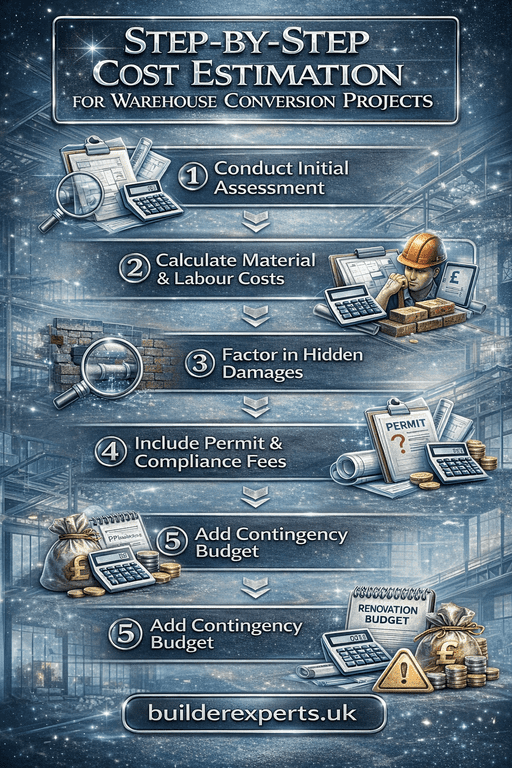
The first step in this process is a detailed building assessment. Contractors must carry out a thorough inspection of the property to evaluate the overall structural integrity of the warehouse. This includes identifying potential structural weaknesses, water damage, outdated materials, and any areas that may require reinforcement or replacement. Understanding the current condition of the building allows builders to determine the scale of structural modifications required before any construction work begins.
Once the structural condition of the warehouse has been assessed, the next stage involves quantity take-offs. This step focuses on calculating the quantities of materials required throughout the renovation process. Builders must carefully measure the materials needed for structural work, insulation systems, internal walls, flooring, roofing adjustments, and interior finishes. Accurate quantity measurements are essential because even small calculation errors can lead to significant cost variations in larger renovation projects.
The estimating process typically includes several key steps that help builders organise project costs in a logical and reliable way:
• Structural assessment of the warehouse building
• Calculation of material quantities and labour requirements
• Pricing of materials based on supplier quotations
• Estimation of labour costs for each stage of construction
• Addition of contingency budgets to cover unforeseen issues
Each of these stages plays an important role in developing a realistic renovation budget. When these steps are performed carefully, builders gain a much clearer understanding of the full financial scope of the project before construction begins.
By using Construction Estimating Software for Renovations, contractors can automate many parts of this estimating process and reduce the risk of calculation errors. Construction Estimating Software for Renovations allows builders to organise quantities, material prices, and labour rates within a single structured system. This not only speeds up the estimating workflow but also improves the overall accuracy of project budgets.
Ultimately, Construction Estimating Software for Renovations enables contractors to produce professional, well-structured estimates that support better decision-making during the planning phase. For complex renovation projects such as warehouse-to-home conversions, this level of precision is essential for maintaining budget control and delivering successful results.
Example Cost Breakdown for a Warehouse Conversion
To understand how cost estimation works in practice, consider a hypothetical warehouse conversion project in Manchester. Industrial buildings in cities like Manchester are often repurposed into modern residential properties, making accurate budgeting particularly important for both developers and contractors.
In this example, a developer purchases an old 180-square-metre warehouse with the intention of converting it into a two-bedroom residential loft. The building offers strong structural potential but requires several key upgrades before it can function as a comfortable living space. Structural reinforcement is needed to meet residential standards, while new insulation systems must be installed to improve energy efficiency. In addition, the project requires new plumbing networks, electrical installations, and modern interior finishes to transform the industrial space into a high-quality residential property.
To evaluate the financial feasibility of the project, the builder prepares a preliminary estimate using Construction Estimating Software for Renovations. Rather than relying on rough approximations, the contractor uses Construction Estimating Software for Renovations to organise material quantities, labour costs, and supplier pricing within a structured estimating system. This allows the builder to produce a clear and realistic breakdown of the expected renovation costs.
An example cost breakdown for this warehouse conversion might include:
• Structural reinforcement: £45,000
• Insulation and roofing upgrades: £22,000
• Plumbing and drainage installation: £14,000
• Electrical systems and lighting: £11,000
• Interior construction and finishes: £38,000
• Kitchen and bathroom installation: £20,000
Estimated project total: £150,000
Because the builder used Construction Estimating Software for Renovations, the estimate provides a transparent breakdown of all major construction costs. Construction Estimating Software for Renovations allows both the contractor and the client to clearly understand how the renovation budget is structured and which construction elements require the largest investment. This level of financial clarity is particularly valuable for complex renovation projects such as warehouse conversions, where multiple construction stages must be carefully coordinated to keep the project within budget.
Common Mistakes When Estimating Renovation Costs
Even experienced builders can underestimate renovation costs if they rely on incomplete data or outdated estimating methods.
One of the most common mistakes is overlooking structural repairs. Older warehouses may contain hidden structural issues that only become visible once renovation work begins.
Another frequent issue is underestimating regulatory requirements. Residential conversions must comply with strict UK building standards, which can increase both construction time and project costs.
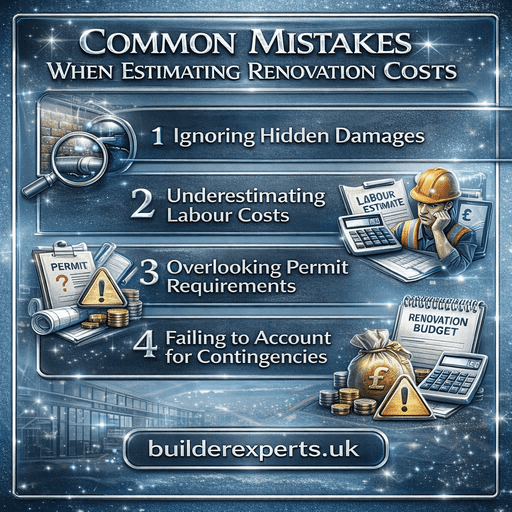
Other common estimating mistakes include:
- Failing to include contingency budgets
- Underestimating labour requirements
- Ignoring site access or logistics challenges
- Using outdated material pricing data
Builders who rely on Construction Estimating Software for Renovations can reduce these risks by generating structured, data-driven estimates.
Why Digital Estimating Tools Are Becoming Essential for Builders
The UK construction industry is increasingly adopting digital tools to improve project planning, cost management, and overall efficiency. Builders who continue to rely solely on manual estimating methods or basic spreadsheets may find it increasingly difficult to remain competitive in a market that is rapidly moving toward more data-driven construction processes. Accurate budgeting has become a critical factor in delivering successful renovation projects, particularly when dealing with complex structural conversions.
Construction Estimating Software for Renovations enables contractors to produce faster and more accurate project quotations while maintaining full control over construction budgets. Instead of manually calculating costs for materials, labour, and installation tasks, builders can organise all project data within a structured digital estimating system. Construction Estimating Software for Renovations also allows contractors to store information from previous projects, creating a valuable database that can improve the accuracy of future estimates and support better long-term planning.
For renovation projects involving complex structures such as warehouse conversions, digital estimating tools provide a clear operational advantage. Builders can analyse project costs in greater detail, evaluate different construction scenarios, and identify potential financial risks before work begins. By using Construction Estimating Software for Renovations, contractors are able to present more reliable proposals to their clients, strengthening trust and improving decision-making during the early stages of project development.
As renovation demand continues to grow across the UK housing market, builders who adopt Construction Estimating Software for Renovations will be better positioned to manage complex projects, control costs more effectively, and maintain strong profit margins. In an increasingly competitive construction industry, Construction Estimating Software for Renovations is becoming a key tool for contractors who want to deliver high-quality renovation work while operating with greater precision and financial confidence.
Conclusion
Converting an old warehouse into a residential property can be a highly rewarding project, offering the opportunity to transform underused industrial space into a unique and modern home. However, these types of renovations require careful planning and precise financial control. Structural upgrades, compliance with UK building regulations, energy efficiency improvements, and high-quality interior finishes all contribute to the overall renovation budget. Without accurate cost estimation from the beginning, even well-designed warehouse conversions can face unexpected financial challenges.
This is why Construction Estimating Software for Renovations has become an essential tool for modern builders and property developers. By using Construction Estimating Software for Renovations, contractors can produce detailed cost breakdowns, analyse labour and material requirements, and identify potential budget risks before construction begins. These digital tools help reduce uncertainty while providing clients with clear and transparent project estimates that support better decision-making.
Ultimately, Construction Estimating Software for Renovations allows builders to approach complex renovation projects with greater confidence and efficiency. For contractors planning warehouse conversions or other large residential renovation projects, Construction Estimating Software for Renovations is increasingly becoming one of the most valuable resources for delivering projects successfully, maintaining strong profit margins, and ensuring that every stage of the construction process remains financially well planned.
Frequently Asked Questions (FAQ)
1. What is Construction Estimating Software for Renovations?
Construction Estimating Software for Renovations is a digital tool that helps builders calculate renovation costs accurately. It allows contractors to estimate materials, labour, and project expenses quickly, reducing errors and improving budgeting.
2. Why is Construction Estimating Software for Renovations important for warehouse conversions?
Warehouse conversions often involve structural upgrades, insulation improvements, and regulatory compliance. Construction Estimating Software for Renovations helps builders calculate these costs precisely and avoid unexpected budget increases.
3. How does Construction Estimating Software for Renovations improve cost accuracy?
The software automates calculations for materials, labour, and construction tasks. This reduces manual mistakes and ensures estimates are based on real project data and current market prices.
4. Can Construction Estimating Software for Renovations help small builders?
Yes. Small builders and renovation contractors can use Construction Estimating Software for Renovations to create professional quotes, plan budgets, and compete more effectively for residential renovation projects.
5. What types of renovation projects benefit from Construction Estimating Software for Renovations?
Many residential renovation projects benefit from accurate digital estimating, including home extensions, apartment refurbishments, loft conversions, and warehouse-to-home redevelopment projects.
🔗 https://www.bcis.co.uk/
🔗 https://www.gov.uk/government/publications/the-construction-playbook
🔗 https://www.constructionleadershipcouncil.co.uk/
🔗 https://www.rics.org/
🔗 https://www.planningportal.co.uk/
👷 If you want to talk to our Builder Expert, click here