
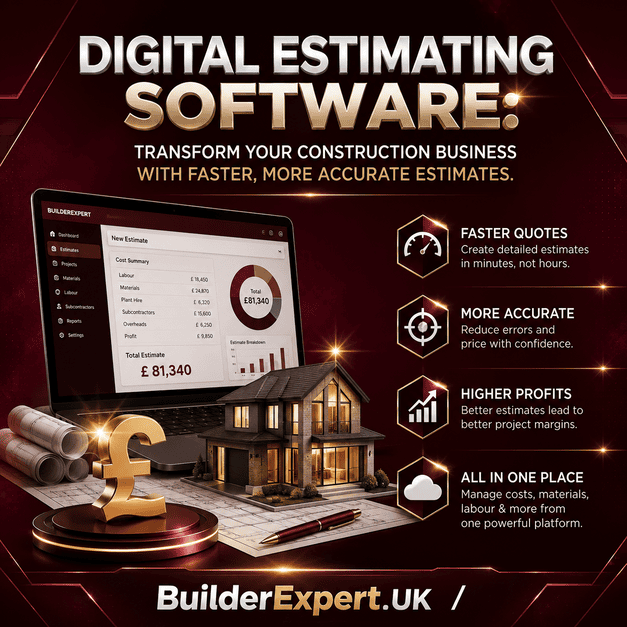
Construction businesses across the UK are under increasing pressure to produce accurate quotations quickly while maintaining healthy profit margins.
As material prices continue to fluctuate, labour costs rise, and clients expect faster responses, traditional estimating methods are becoming less effective.
This is where digital estimating software is transforming the way modern builders prepare project costs and manage their businesses.
Whether you specialise in home extensions, loft conversions, renovations, new-build homes, or general residential construction, the ability to produce professional estimates efficiently can make the difference between winning or losing a project. Clients often compare several quotations before making a decision, and builders who respond first with clear, detailed, and accurate pricing frequently gain a significant competitive advantage.
Unlike spreadsheets or handwritten calculations, digital estimating software centralises every aspect of the estimating process. Labour rates, material prices, plant hire, subcontractor costs, overheads, contingencies, and profit margins can all be managed from one intelligent platform. This reduces human error, improves pricing consistency, and gives builders greater confidence when submitting quotations.
The construction industry is becoming increasingly digital. Companies that embrace technology are improving efficiency, reducing administrative work, and delivering a more professional experience to their clients. Estimating is no longer just about calculating numbers—it has become a strategic business function that directly influences profitability, customer satisfaction, and long-term growth.
In this guide, we’ll explore how digital estimating software helps UK builders create faster and more accurate estimates, improve financial control, increase profitability, and build a more scalable construction business.
Table of Contents
- Why Accurate Estimating Matters More Than Ever
- What Is Digital Estimating Software?
- Why Traditional Estimating Methods Are Holding Builders Back
- The Biggest Benefits of Digital Estimating Software
- Key Features Every Builder Should Look For
- How Digital Estimating Improves Business Profitability
- A Real-World Example from a UK Construction Company
- Frequently Asked Questions
- Final Thoughts
Why Accurate Estimating Matters More Than Ever
Every successful construction project begins long before work starts on site. It begins with a well-prepared estimate that accurately reflects the true cost of delivering the project.
Unfortunately, estimating has become increasingly challenging. Material prices fluctuate regularly, supplier costs change without warning, labour shortages affect wage rates, and clients expect detailed quotations within days rather than weeks.
Small pricing errors that once had little impact can now significantly reduce project profitability.
Many builders underestimate labour requirements.
Others forget to include waste allowances.
Some overlook subcontractor costs.
Others simply rely on outdated price lists.
Individually these mistakes may appear small.
Collectively they can remove thousands of pounds from a project’s expected profit.
This is why digital estimating software has become such an important investment for forward-thinking construction companies.
Instead of manually calculating every figure, builders can work with structured cost libraries, reusable templates, automated calculations, and consistent pricing rules. This creates far greater accuracy while dramatically reducing the amount of time required to prepare professional quotations.
Accurate estimating also creates confidence.
Clients appreciate receiving quotations that clearly explain how costs have been calculated. Transparent pricing helps reduce disputes, builds trust, and positions contractors as organised professionals rather than simply another builder providing a rough figure.
As competition within the UK residential construction market continues to increase, accurate estimating is becoming one of the strongest competitive advantages available.
What Is Digital Estimating Software?
At its core, digital estimating software is a specialised platform designed to help construction companies calculate project costs quickly, consistently, and accurately.
Instead of relying on multiple spreadsheets, notebooks, calculators, or disconnected documents, everything required to produce an estimate is stored within one central system.
A typical estimate may include:
- Labour costs
- Material pricing
- Plant hire
- Subcontractor costs
- Waste allowances
- Overheads
- Profit margins
- Contingencies
- Optional extras
- VAT calculations
Rather than calculating every figure manually, builders simply select the required project components while the software performs the calculations automatically.
This significantly reduces administration while ensuring pricing remains consistent across every quotation.
Modern digital estimating software also allows builders to create reusable estimate templates.
For example, if your company regularly builds rear extensions, loft conversions, garage conversions, kitchens, bathrooms, or complete property renovations, previously created estimates can be duplicated and adjusted instead of being recreated from scratch.
Over time this creates enormous efficiency gains.
Many construction companies discover they can produce professional quotations in a fraction of the time previously required while maintaining far greater pricing accuracy.
The result is a faster sales process, improved client communication, and greater confidence when pricing projects.
Why Traditional Estimating Methods Are Holding Builders Back
Many experienced builders still prepare estimates using spreadsheets or even handwritten calculations.
Although these methods have worked for years, today’s construction industry demands greater speed, accuracy, and consistency.
Manual estimating creates several challenges that become increasingly difficult as businesses grow.
Inconsistent Pricing
Without a central pricing system, different employees may calculate similar projects differently.
One estimator may include contingency allowances.
Another may forget.
One may apply updated labour rates.
Another may use figures from six months ago.
This inconsistency creates confusion and unpredictable profitability.
Increased Human Error
Manual calculations naturally introduce mistakes.
Simple typing errors.
Incorrect formulas.
Missed material quantities.
Forgotten subcontractor costs.
Duplicated items.
These small issues can have major financial consequences on larger projects.
Slow Quotation Production
Modern homeowners expect fast responses.
If one builder takes two weeks to produce an estimate while another delivers a professional quotation within 24 hours, the faster company immediately creates a stronger first impression.
Speed has become a competitive advantage.
Builders using digital estimating software can often prepare accurate quotations significantly faster than companies relying on traditional methods.
Limited Business Visibility
Spreadsheets rarely provide useful business insights.
Construction companies often struggle to answer questions such as:
- Which project types generate the highest margins?
- Where are labour costs increasing?
- Which suppliers are becoming more expensive?
- Which estimates convert into signed contracts most frequently?
- How profitable are different types of residential work?
Modern digital estimating software provides much greater visibility into business performance, helping owners make informed commercial decisions instead of relying on assumptions.
Difficult Collaboration
Construction estimating often involves office staff, directors, quantity surveyors, site managers, and external subcontractors.
Managing multiple spreadsheet versions shared through emails frequently creates confusion.
Different team members may unknowingly edit outdated files, causing inconsistent pricing and duplicated work.
A digital platform ensures everyone works from the same information, reducing mistakes and improving collaboration across the business.
The construction industry is evolving rapidly.
Builders who continue relying solely on manual estimating methods often find themselves spending more time on administration while competitors using digital estimating software respond faster, price more consistently, and deliver a more professional customer experience.
As client expectations continue to rise, digital estimating is no longer simply a technological upgrade—it is becoming an essential part of running a successful and profitable construction business.
The Biggest Benefits of Digital Estimating Software
Investing in digital estimating software is about far more than replacing spreadsheets with a modern application. It is about creating a structured estimating process that improves accuracy, saves time, strengthens financial control, and supports long-term business growth.
As construction projects become more demanding, builders need systems that allow them to work efficiently without compromising quality. Digital estimating software provides exactly that by automating repetitive tasks while giving estimators complete control over project pricing.
Below are some of the biggest advantages that UK construction companies experience after adopting digital estimating software.
Faster Quotation Production
One of the most immediate benefits of digital estimating software is the speed at which quotations can be produced.
Instead of manually calculating every labour hour, material quantity, and subcontractor cost, estimators can build professional quotations using predefined cost libraries and reusable templates.
For companies pricing multiple projects every week, this can save many hours of administrative work.
Faster quotations also improve customer experience.
Many homeowners contact several builders before making a decision. Companies using digital estimating software can often respond significantly faster, increasing the likelihood of securing the project before competitors submit their estimates.
Speed is no longer just convenient—it has become a genuine commercial advantage.
Greater Accuracy Across Every Estimate
Accuracy remains one of the most valuable features of digital estimating software.
Manual calculations increase the likelihood of errors, especially on larger residential projects involving hundreds of individual cost items.
With digital estimating software, labour rates, material prices, supplier information, plant hire costs, subcontractor pricing, overheads, and profit margins can all be standardised.
This ensures every quotation follows the same pricing structure.
Consistent pricing reduces costly mistakes while giving business owners greater confidence that every project has been priced correctly.
It also protects profit margins by reducing the risk of accidental underpricing.
Better Consistency Throughout the Business
As construction businesses expand, several people may become involved in the estimating process.
Without clear systems, every estimator develops slightly different pricing habits.
One may include waste allowances.
Another may use different labour rates.
Someone else may forget contingency costs altogether.
Digital estimating software removes much of this inconsistency.
Every estimator works from the same database, the same templates, and the same pricing structure.
This creates consistent quotations regardless of who prepares them.
For growing businesses, consistency improves professionalism while making financial forecasting much more reliable.
Essential Features Every Builder Should Look For
Not all estimating platforms offer the same functionality.
Choosing the right digital estimating software requires understanding which features provide genuine value rather than simply adding unnecessary complexity.
Builders should focus on software that improves efficiency without making the estimating process more difficult.

Some of the most valuable features include:
- Centralised labour cost libraries
- Material price databases
- Supplier pricing management
- Subcontractor cost tracking
- Reusable estimate templates
- Automatic calculations
- Profit margin controls
- Overhead allocation
- VAT calculations
- Professional PDF quotation generation
- Cloud access
- Estimate revision history
- Project duplication
- Client quotation management
The best digital estimating software should simplify estimating rather than creating additional administration.
Ease of use is just as important as functionality.
If estimators cannot use the software efficiently, productivity gains will quickly disappear.
Cloud-Based Accessibility
Modern construction companies rarely operate from a single office.
Directors visit clients.
Estimators work remotely.
Site managers require access to project information.
This is where cloud-based digital estimating software offers significant advantages.
Cloud technology allows authorised users to access estimates from almost anywhere while ensuring everyone works with the latest project information.
Changes made by one team member become immediately available to others.
This eliminates confusion caused by multiple spreadsheet versions being emailed between staff members.
Cloud access also improves business continuity by protecting valuable estimating data through secure online storage.
Professional Client Presentations
First impressions matter.
Homeowners often judge builders long before construction begins.
Well-presented quotations demonstrate professionalism and attention to detail.
Digital estimating software enables construction companies to generate clean, organised, and professional quotations that are easy for clients to understand.
Rather than receiving confusing spreadsheets or handwritten figures, customers receive structured cost breakdowns that inspire confidence.
Professional presentation helps strengthen trust while improving the overall customer experience.
How Digital Estimating Software Improves Profitability
Many builders initially invest in digital estimating software because they want to save time.
While this is certainly an important benefit, the long-term financial impact is often even greater.
Profitability improves because better estimates create better decisions.
Accurate project pricing reduces the likelihood of unexpected losses while ensuring labour, materials, subcontractors, and overheads have all been properly considered.
When estimates become more reliable, businesses gain stronger financial control.
Margins become predictable.
Cash flow improves.
Project performance becomes easier to monitor.
Business owners can identify profitable project types and focus future marketing efforts accordingly.
Another important benefit of digital estimating software is pricing consistency.
Rather than adjusting figures differently for every quotation, builders follow standard pricing principles across all projects.
This consistency protects profitability while making commercial performance easier to analyse over time.
Better Resource Planning
Construction estimating does not end once a quotation has been accepted.
Accurate estimates provide valuable information throughout project delivery.
Using digital estimating software, project managers can compare estimated costs with actual expenditure during construction.
This allows businesses to identify cost overruns earlier and take corrective action before problems become serious.
Potential advantages include:
- Better labour allocation
- Improved procurement planning
- More accurate scheduling
- Stronger cost monitoring
- Reduced material waste
- Improved supplier management
- Better forecasting
- Increased operational efficiency
Accurate estimating becomes the foundation for better project management.
Why Digital Estimating Software Supports Business Growth
Growth creates complexity.
As construction companies win more work, estimating volumes increase rapidly.
Preparing every quotation manually eventually becomes unsustainable.
Digital estimating software provides the scalability required for long-term expansion.
Instead of increasing administrative staff every time project enquiries rise, businesses can streamline their estimating process using automation and standardisation.
This allows estimators to prepare more quotations without sacrificing quality.
It also enables directors to focus on business development rather than checking calculations.
Companies that embrace digital estimating software often discover they can respond to more enquiries, improve quotation quality, maintain pricing consistency, and increase conversion rates simultaneously.
These improvements compound over time.
More enquiries lead to more quotations.
Better quotations generate higher conversion rates.
Higher conversion rates produce increased revenue.
Increased revenue creates opportunities for further growth.
For ambitious builders, digital estimating software becomes an investment that supports every stage of business development rather than simply another piece of software.
Preparing Your Business for the Future
The UK construction industry continues to evolve.
Clients expect faster communication.
Costs fluctuate more frequently.
Competition is increasing.
Builders who continue relying on outdated estimating methods may find it increasingly difficult to compete with businesses using modern digital systems.
Digital estimating software allows construction companies to adapt to these changes with greater confidence.
By improving estimating accuracy, reducing administration, increasing consistency, and supporting better financial management, builders place themselves in a much stronger position for future success.
Forward-thinking companies recognise that estimating is no longer just a pricing exercise.
It is one of the most important commercial processes within the entire business.
For this reason, adopting digital estimating software is becoming less of a competitive advantage and more of an operational necessity for construction companies that want to remain profitable in an increasingly demanding market.
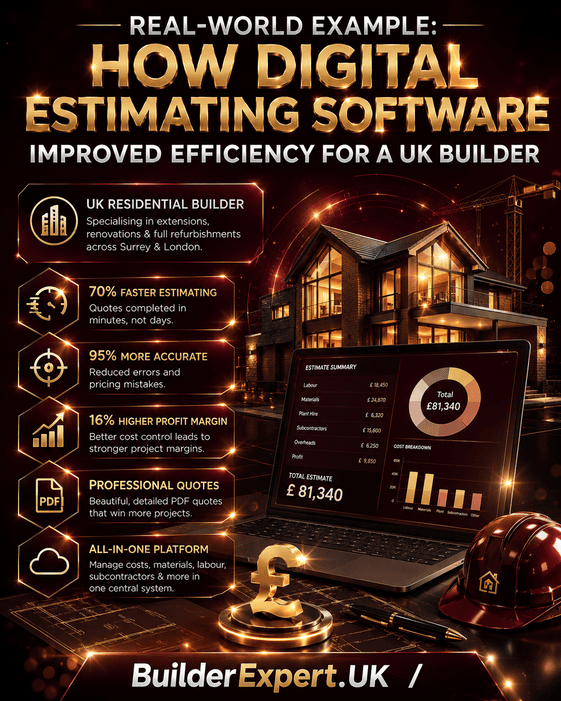
Real-World Example: How Digital Estimating Software Improved Efficiency for a UK Builder
To understand the real value of digital estimating software, consider the example of a medium-sized residential construction company operating across Surrey, Kent, and South London.
The business specialised in house extensions, loft conversions, complete property renovations, and kitchen refurbishment projects. Although demand for its services continued to grow, the estimating process was creating significant operational challenges.
Every quotation was prepared using multiple spreadsheets.
Labour calculations were completed manually.
Material prices were copied from supplier lists.
Previous estimates were duplicated and edited individually.
As project enquiries increased, the estimating team struggled to keep pace.
Producing a detailed quotation regularly took several hours, while reviewing calculations before sending estimates to clients added even more administrative work.
The company decided to introduce digital estimating software to standardise its estimating process and improve pricing consistency.
Within the first few months, several measurable improvements became clear.
Quotation preparation became significantly faster because estimators could reuse project templates rather than starting every estimate from the beginning.
Labour rates, supplier prices, overheads, and profit margins were managed from one central database.
The number of pricing inconsistencies reduced dramatically because every estimator worked with the same information.
Management also gained much greater visibility over project profitability.
By comparing estimated costs against completed projects, the company identified pricing trends that had previously gone unnoticed.
Several labour activities had consistently been underpriced.
Once these rates were updated within the digital estimating software, overall project profitability improved without increasing administrative workload.
Perhaps the biggest benefit was confidence.
Directors no longer worried that quotations contained forgotten costs or outdated pricing.
Instead, they knew every estimate followed the same structured process.
This allowed the business to respond to more enquiries, improve client satisfaction, and continue growing without significantly increasing office administration.
The example demonstrates that digital estimating software is not simply about producing estimates more quickly.
It creates a reliable commercial foundation that supports sustainable business growth.
Why BuilderExpert Digital Estimating Software Stands Out
Every estimating platform promises to improve efficiency.
However, successful builders need more than basic calculation tools.
They require software that reflects the way construction companies actually operate.
BuilderExpert has been developed specifically for builders who need a practical, easy-to-use solution for producing professional estimates while maintaining complete control over project costs.
The platform brings together every stage of the estimating process within one central system.
Instead of switching between spreadsheets, calculators, documents, and emails, users can prepare accurate estimates from a single workspace.
BuilderExpert digital estimating software helps construction companies:
- Produce professional quotations faster.
- Standardise labour and material pricing.
- Reduce manual calculations.
- Improve estimating accuracy.
- Maintain consistent profit margins.
- Create reusable estimate templates.
- Monitor project costs more effectively.
- Improve collaboration between office and site teams.
- Present professional PDF quotations to clients.
- Support long-term business growth.
Unlike generic estimating tools, BuilderExpert has been designed around the day-to-day requirements of UK residential builders.
Whether the project involves a house extension, loft conversion, garage conversion, renovation, or complete new-build property, the software simplifies estimating while helping businesses maintain commercial control.
As enquiry volumes increase, BuilderExpert digital estimating software enables companies to scale their estimating process without sacrificing quality or consistency.
Frequently Asked Questions
What is digital estimating software?
Digital estimating software is a construction estimating solution that helps builders calculate labour, material, subcontractor, overhead, and profit costs quickly and accurately while producing professional client quotations.
Who should use digital estimating software?
It is suitable for builders, contractors, construction companies, estimators, quantity surveyors, renovation specialists, and residential developers looking to improve estimating accuracy and efficiency.
Can digital estimating software reduce estimating mistakes?
Yes.
Because calculations are automated and pricing is standardised, digital estimating software significantly reduces manual errors and helps ensure every quotation follows consistent pricing rules.
Is digital estimating software suitable for small construction companies?
Absolutely.
Small businesses often benefit the most because digital estimating software saves valuable administration time while helping maintain healthy profit margins as the business grows.
Does digital estimating software improve profitability?
Yes.
More accurate estimates reduce underpricing, improve financial planning, protect profit margins, and provide greater visibility over project performance.
Can estimates be updated easily?
Yes.
Most modern digital estimating software allows builders to edit labour rates, material prices, supplier costs, contingencies, and profit margins without recreating the entire estimate.
Does digital estimating software work for renovation projects?
Yes.
It is widely used for home renovations, extensions, loft conversions, garage conversions, refurbishments, and many other residential construction projects.
Why are more UK builders moving to digital estimating software?
Builders increasingly recognise that digital estimating software helps them respond faster, improve professionalism, reduce administration, increase pricing accuracy, and remain competitive in a rapidly changing construction market.
- BCIS – Building Cost Information Service
- The Construction Playbook (UK Government)
- Construction Price and Cost Indices (BCIS Insight)
- BIS Construction Price and Cost Indices (GOV.UK)
Final Thoughts
The construction industry is becoming increasingly competitive, and clients expect faster responses, transparent pricing, and professional quotations from the very first interaction.
Traditional estimating methods can no longer provide the speed, consistency, or financial control that modern construction businesses require.
Digital estimating software offers a smarter approach.
By bringing labour costs, material pricing, subcontractor expenses, overheads, contingencies, and profit margins into one structured platform, builders gain greater confidence in every quotation they produce.
Beyond improving estimating accuracy, digital estimating software strengthens the entire business.
It helps companies reduce administration, improve collaboration, increase profitability, and make better commercial decisions based on reliable project data.
Whether your business prepares a handful of quotations each month or manages hundreds of estimates every year, investing in digital estimating software provides a long-term competitive advantage that supports sustainable growth.
As technology continues to reshape the construction industry, builders who embrace digital estimating today will be better positioned to win more projects, deliver greater value to clients, and build stronger, more profitable businesses in the years ahead.
Ready to Transform Your Estimating Process?
If you’re looking for an easier way to produce professional quotations, improve estimating accuracy, and gain greater control over your construction projects, BuilderExpert can help.
Our digital estimating software has been developed specifically for UK builders, providing the tools needed to estimate faster, reduce costly mistakes, and improve business profitability.
👉 If you would like to speak with one of our BuilderExpert specialists and see how our digital estimating software can support your construction business, please contact us today and discover a smarter way to estimate construction projects.