
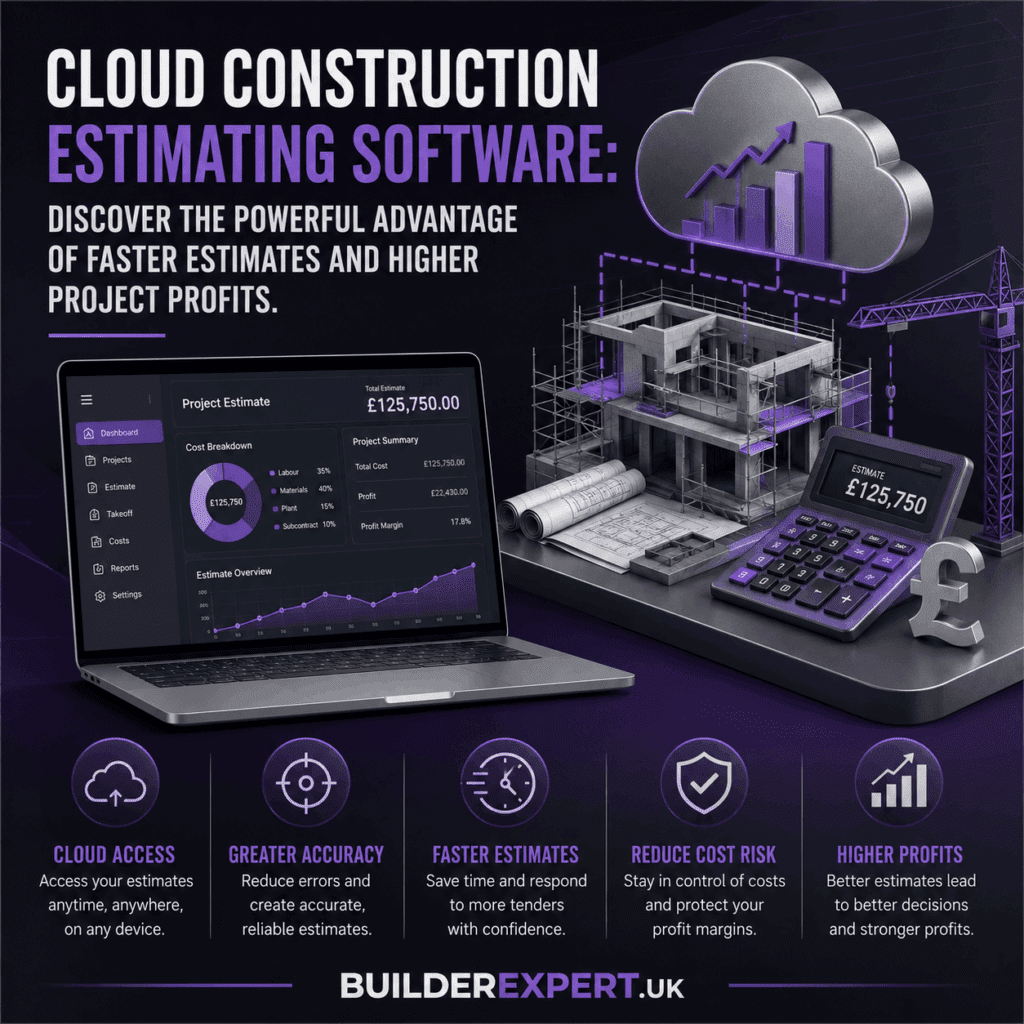
Cloud construction estimating software has transformed the way modern builders manage project costs, prepare quotations, and improve profitability.
As construction projects become increasingly complex, contractors need faster, more accurate methods for calculating costs, managing budgets, and responding to client enquiries.
Traditional spreadsheets and manual estimating processes often struggle to meet these demands, leading to delays, errors, and missed opportunities.
For residential builders across the UK, speed and accuracy can significantly influence business performance. Clients expect prompt quotations, transparent pricing, and confidence that projects will remain within budget. Cloud-based estimating platforms help construction companies streamline their workflows, improve collaboration, and maintain greater control over project finances. As competition continues to grow, many builders are discovering that adopting modern estimating technology provides a significant advantage over relying solely on traditional methods.
Table of Contents
- What Is Cloud Construction Estimating Software?
- Why Traditional Estimating Methods Are Holding Builders Back
- Key Features of Modern Cloud Construction Estimating Software
- How Cloud-Based Estimating Improves Accuracy
- Faster Quotation Preparation for Residential Builders
- Improving Team Collaboration Through Cloud Technology
- Reducing Cost Overruns and Financial Risk
- Real-World Case Study
- Conclusion
What Is Cloud Construction Estimating Software?
Cloud construction estimating software is a digital solution that enables builders, contractors, and estimators to create project cost estimates using internet-based platforms rather than locally stored spreadsheets or desktop applications.
Unlike traditional estimating systems that require files to be saved on individual computers, cloud-based solutions allow project data to be accessed securely from virtually any location. This flexibility is particularly valuable for builders who regularly move between offices, construction sites, and client meetings.
Modern estimating platforms typically combine multiple functions into a single environment. These may include:
- Cost estimating
- Labour calculations
- Material pricing
- Profit margin analysis
- Quotation generation
- Project forecasting
- Budget monitoring
By centralising these activities, builders can significantly improve efficiency while reducing the risk of data duplication and version-control issues.
One of the biggest advantages of cloud technology is real-time access to information. Team members can work from the same dataset, ensuring everyone is using the latest project information. This reduces confusion and supports better decision-making throughout the construction process.
As residential construction projects become more demanding, the ability to generate accurate estimates quickly has become a critical business requirement rather than a luxury.
Why Traditional Estimating Methods Are Holding Builders Back
Many construction businesses still rely heavily on spreadsheets for estimating.
While spreadsheets remain useful tools for certain tasks, they often create challenges when managing multiple projects or producing complex cost calculations.
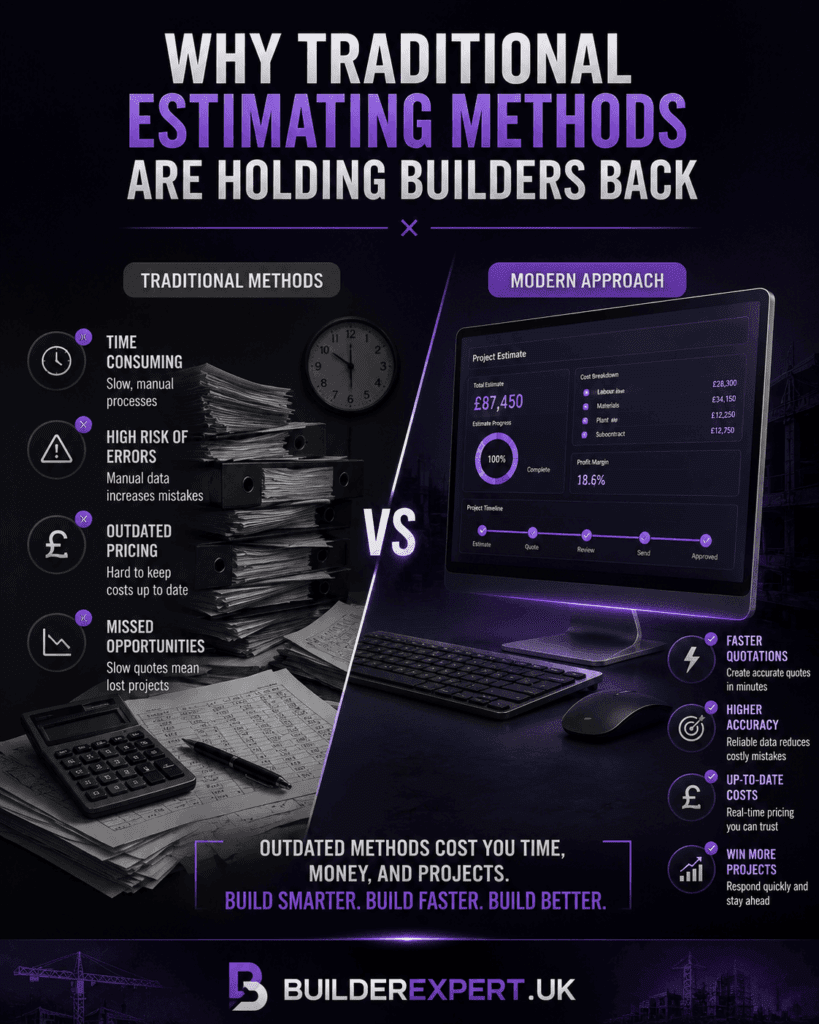
Manual estimating processes typically involve entering large volumes of data, checking formulas, updating material prices, and reviewing labour assumptions. Every manual step introduces opportunities for mistakes.
Common problems associated with traditional estimating methods include:
- Formula errors
- Incorrect quantities
- Outdated material prices
- Duplicate data entry
- Slow quotation production
- Limited collaboration
- Difficult version control
These issues can directly affect profitability.
For example, a simple pricing mistake within a residential extension estimate may reduce profit margins substantially. In competitive markets, builders often operate with relatively tight margins, making accuracy extremely important.
Traditional spreadsheets can also make it difficult to scale operations. As the number of projects increases, managing dozens of separate estimating files becomes increasingly time-consuming.
Another challenge is accessibility. If estimating data is stored on a single computer, team members may struggle to access important information while working remotely or visiting construction sites.
Builders who continue relying solely on manual estimating methods often spend unnecessary time managing administrative tasks instead of focusing on business growth and project delivery.
Key Features of Modern Cloud Construction Estimating Software
The capabilities of cloud construction estimating software extend far beyond basic cost calculations. Modern platforms are designed to support the entire estimating workflow while improving efficiency and accuracy.
One of the most valuable features is centralised cost data management. Builders can maintain up-to-date labour rates, supplier pricing, and material costs within a single system.
This provides several benefits:
- Greater pricing consistency
- Faster estimate creation
- Reduced manual updates
- Improved financial visibility
Another major advantage is template-based estimating.
Many cloud platforms allow users to create standardised templates for common residential projects such as:
- Home extensions
- Loft conversions
- Kitchen renovations
- Garage conversions
- New-build homes
Templates reduce repetitive work and help estimators maintain consistency across multiple projects.
Automated calculations are equally important.
Instead of manually updating formulas, the software performs calculations automatically, reducing the likelihood of human error and improving estimate reliability.
Reporting tools also play a significant role. Builders can quickly generate professional quotations, cost breakdowns, and budget summaries for clients and project stakeholders.
Cloud-based systems often integrate with wider construction management tools, creating a more connected workflow that supports project planning, procurement, and financial management.
The result is a more efficient estimating process that supports both operational performance and long-term business growth.
How Cloud-Based Estimating Improves Accuracy
Accuracy is one of the most important factors in successful construction estimating.
An estimate that is too high may reduce competitiveness and discourage potential clients. An estimate that is too low can significantly damage profitability once construction begins.
Cloud construction estimating software helps minimise these risks by creating a more structured and controlled estimating environment.
Centralised cost databases ensure that estimators use consistent labour rates and material prices throughout the organisation. This reduces discrepancies between different projects and team members.
Automated calculations further improve reliability by eliminating many of the mathematical errors that commonly occur within spreadsheets.
Additional accuracy benefits include:
- Standardised estimating procedures
- Improved cost visibility
- Consistent pricing assumptions
- Reduced data duplication
- Faster estimate reviews
- Better financial forecasting
Another important advantage is historical project analysis.
Many platforms allow builders to review previous estimates and compare projected costs against actual project outcomes. This feedback loop helps continuously improve future estimates.
Over time, construction companies can develop increasingly accurate pricing models that support stronger decision-making and better financial performance.
For residential builders seeking sustainable growth, accurate estimating is one of the most effective ways to protect profit margins while maintaining competitive pricing.
Faster Quotation Preparation for Residential Builders
Speed has become a major competitive advantage within the UK residential construction sector.
Homeowners often request quotations from multiple builders before making a decision. Contractors who respond quickly frequently create stronger first impressions and improve their chances of securing projects.
Traditional estimating methods can slow this process considerably.

Gathering supplier prices, reviewing spreadsheets, checking formulas, and preparing professional quotations may require several days for larger projects.
With cloud construction estimating software, many of these tasks can be completed significantly faster.
Pre-built templates, automated calculations, and centralised pricing databases allow estimators to generate quotations more efficiently without sacrificing accuracy.
Potential benefits include:
- Faster response times
- Increased estimating capacity
- Improved client satisfaction
- More opportunities to tender
- Better business scalability
Rapid quotation delivery also helps builders maintain momentum during sales discussions.
When homeowners receive clear and professional cost information quickly, they are often more confident in the builder’s professionalism and organisational capabilities.
In increasingly competitive residential markets, the ability to deliver accurate quotations faster than competitors can become a powerful differentiator.
Improving Team Collaboration Through Cloud Technology
One of the most overlooked benefits of cloud construction estimating software is its ability to improve collaboration across the entire construction business.
Estimating is rarely an isolated activity. Accurate project pricing often depends on input from directors, project managers, site supervisors, procurement teams, and external suppliers. When information is stored across multiple spreadsheets, emails, and paper documents, communication can quickly become fragmented.
Cloud-based systems provide a centralised environment where authorised team members can access the same project information in real time.
This creates a single source of truth for estimating data.
Instead of sending multiple spreadsheet versions between team members, everyone works from the same platform. Changes made by one user can be viewed immediately by others, reducing confusion and improving transparency.
For residential construction businesses managing multiple projects simultaneously, this level of visibility can significantly improve operational efficiency.
Key collaboration benefits include:
- Shared access to project estimates
- Improved communication between departments
- Reduced version-control issues
- Faster approval processes
- Better project coordination
- Greater accountability
Site managers can review estimated labour allowances while procurement teams can verify material budgets before purchasing decisions are made.
Directors and business owners can also gain clearer visibility into project profitability before construction begins.
As construction businesses grow, strong collaboration becomes increasingly important. Cloud technology allows builders to maintain consistency and control even when multiple projects are running at the same time.
Reducing Cost Overruns and Financial Risk
Every construction business faces financial risk.
Unexpected material price increases, labour shortages, design modifications, and estimating errors can all contribute to cost overruns that reduce profitability and place unnecessary pressure on project budgets.
One of the primary reasons builders invest in cloud construction estimating software is to gain greater control over project finances from the earliest planning stages. By using cloud construction estimating software, contractors can develop more accurate budgets, improve forecasting, and reduce the likelihood of unexpected financial surprises during project delivery.
Accurate estimates create realistic budgets.
When budgets are based on reliable data generated through cloud construction estimating software, project teams can make more informed decisions regarding labour allocation, procurement scheduling, supplier management, and resource planning. This level of visibility helps reduce waste while improving overall financial performance.
Modern cloud construction estimating software helps reduce financial risk by providing:
- Consistent cost calculations
- Up-to-date pricing information
- Improved budget visibility
- Better project forecasting
- Historical cost analysis
- Stronger financial reporting
Another major advantage of cloud construction estimating software is the ability to monitor estimating assumptions more effectively.
For example, if labour rates increase or supplier costs change, estimators can update central cost databases and instantly apply those changes across future estimates. This flexibility ensures that cloud construction estimating software continues to produce estimates that reflect current market conditions rather than outdated pricing information.
The construction industry continues to experience significant fluctuations in labour and material costs. Builders who rely on spreadsheets or outdated pricing systems often expose themselves to unnecessary financial risk. In contrast, cloud construction estimating software helps businesses remain agile, responsive, and financially aware throughout the entire estimating process.
Perhaps most importantly, cloud construction estimating software supports long-term profitability by helping builders identify potential cost issues before construction begins. Better visibility, stronger forecasting, and more accurate pricing all contribute to improved financial control.
Ultimately, reducing cost overruns is not simply about controlling expenses.
It is about using cloud construction estimating software to create a predictable financial framework that supports sustainable business growth, protects profit margins, and improves confidence in every project estimate.
Supporting Better Construction Cost Planning
Estimating and cost planning are closely connected.
While estimating focuses on predicting project costs before construction begins, cost planning helps manage those costs throughout the project lifecycle.
Cloud construction estimating software strengthens this relationship by providing greater visibility into financial data from the earliest planning stages.
A detailed estimate creates a foundation for effective project management.
Project teams can use estimating data to:
- Forecast cash flow requirements
- Plan procurement schedules
- Allocate labour resources
- Monitor project expenditure
- Evaluate financial performance
When estimates are structured correctly, cost planning becomes significantly easier.
Builders can compare actual costs against projected budgets and identify potential issues before they become serious problems.
This proactive approach allows construction businesses to maintain tighter financial control throughout the project.
Another advantage is consistency.
Using the same estimating framework across multiple projects creates standardised financial processes that improve reporting accuracy and business oversight.
For growing residential construction companies, strong cost planning practices can be the difference between sustainable profitability and ongoing financial uncertainty.
Cloud technology provides the tools needed to make cost planning more accurate, more transparent, and easier to manage.
How Cloud Construction Estimating Software Improves Tender Success
Winning construction projects often depends on the quality and accuracy of the tender submission.
Clients expect competitive pricing, detailed cost breakdowns, and confidence that the builder understands the project requirements.
Preparing high-quality tenders manually can be time-consuming.
Estimators may spend hours gathering information, reviewing costs, and formatting documentation before a proposal is ready for submission.
Cloud construction estimating software helps streamline this process by automating many of the tasks traditionally associated with tender preparation.
Builders can produce:
- Detailed cost breakdowns
- Professional quotations
- Consistent pricing structures
- Accurate labour calculations
- Material cost summaries
- Financial forecasts
The ability to prepare tenders faster can significantly increase bidding capacity.
Instead of spending excessive time on administrative tasks, estimators can focus on reviewing project risks, refining pricing strategies, and improving submission quality.
Speed also plays an important role.
Many clients appreciate prompt responses and organised documentation. Builders who deliver professional quotations quickly often create a stronger first impression.
Over time, these advantages can contribute to higher tender success rates and a more predictable project pipeline.
Real-World Case Study: Surrey Home Extension Project
A residential construction company based in Surrey specialised in home extensions and renovation projects valued between £80,000 and £250,000.
The business relied primarily on spreadsheets for estimating and frequently encountered challenges with pricing consistency and quotation preparation times.
Before implementing cloud construction estimating software, estimators often spent several days producing detailed quotations.
Project information was stored across multiple files, making collaboration difficult and increasing the risk of pricing errors.
The company adopted a cloud-based estimating platform and standardised its estimating process.
Project Details
- Project Type: Rear Home Extension
- Project Value: £120,000
- Construction Duration: 15 Weeks
- Team Size: 8 Personnel
Results Achieved
- Estimating time reduced by approximately 45%
- Improved pricing consistency across projects
- Faster quotation turnaround
- Better visibility of labour and material costs
- Increased confidence in project profitability
The company also reported stronger financial control during project delivery because budgets established during estimating were more accurate and easier to monitor.
According to the managing director:
“Moving to a cloud-based estimating system significantly improved both efficiency and confidence in our pricing process. We spend less time producing estimates and more time winning projects.”
This example demonstrates how digital estimating tools can deliver practical benefits for residential builders seeking greater operational efficiency and profitability.
Why More UK Builders Are Adopting Cloud-Based Estimating Solutions
The construction industry is becoming increasingly digital.
Builders who once relied entirely on spreadsheets are now embracing technology to improve accuracy, efficiency, and financial performance.
Several factors are driving the adoption of cloud construction estimating software across the UK residential construction sector.
These include:
- Growing project complexity
- Increased client expectations
- Labour shortages
- Material cost volatility
- Greater competition
- Demand for faster quotations
Cloud platforms help address these challenges by providing builders with modern tools that support better decision-making.
As construction businesses continue to seek efficiency gains, cloud-based estimating is becoming less of a competitive advantage and more of a business necessity.
Companies that adopt modern estimating technology are often better positioned to scale operations, improve profitability, and maintain consistent project delivery standards.
For many builders, the question is no longer whether to invest in cloud estimating software.
The real question is how quickly they can implement it to remain competitive in an evolving construction market.
Future Trends in Cloud Construction Estimating Software
The capabilities of cloud construction estimating software continue to evolve rapidly as technology becomes more integrated within the construction industry.
While today’s platforms already deliver significant benefits through automation, collaboration, and financial visibility, future developments are expected to provide even greater levels of efficiency and accuracy.
Artificial intelligence is likely to play an increasingly important role in estimating workflows.
Advanced systems may soon be capable of analysing historical project data, identifying cost trends, and recommending pricing adjustments based on previous project performance.
This could help builders create more accurate estimates while reducing the amount of manual input required.
Other emerging trends include:
- AI-assisted estimating
- Automated risk analysis
- Real-time supplier price integration
- Predictive project forecasting
- Enhanced reporting dashboards
- Improved mobile functionality
- Greater integration with project management software
Another area of growth is data-driven decision-making.
As construction companies collect more project information, cloud platforms will become increasingly valuable for identifying patterns and improving business performance.
Builders who embrace these technologies early may gain a significant competitive advantage through better forecasting, stronger cost control, and more efficient project delivery.
The future of construction estimating is not simply about creating quotations faster.
It is about using technology to make smarter business decisions across the entire project lifecycle.
Conclusion
Cloud construction estimating software has become one of the most valuable tools available to modern residential builders. By replacing manual spreadsheets and disconnected estimating processes, cloud-based platforms help construction companies improve accuracy, accelerate quotation preparation, strengthen collaboration, and gain greater control over project finances.
The benefits extend far beyond estimating alone. Faster quotations can improve client responsiveness, better cost planning can reduce financial risk, and enhanced visibility can support more informed decision-making throughout every stage of construction. As projects become increasingly complex and competition continues to grow, builders need systems that allow them to operate efficiently while protecting profit margins.
For UK residential contractors, adopting cloud-based estimating technology is no longer simply a way to improve productivity. It is becoming an essential strategy for maintaining competitiveness, increasing profitability, and delivering projects with greater confidence.
Builders who invest in modern estimating solutions today will be better positioned to manage future challenges, scale their operations, and achieve long-term business growth.
📞If you want to speak with our builder expert, click here
Frequently Asked Questions
What is cloud construction estimating software?
Cloud construction estimating software is an online platform that helps builders create accurate project cost estimates, manage pricing information, and prepare quotations using cloud-based technology.
How does cloud construction estimating software differ from spreadsheets?
Cloud-based systems provide centralised data management, automated calculations, real-time collaboration, and improved version control, while spreadsheets often require manual updates and are more prone to errors.
Is cloud construction estimating software suitable for small builders?
Yes. Many small and medium-sized construction companies use cloud-based estimating tools to improve efficiency, reduce administrative work, and create more accurate quotations.
Can cloud estimating software improve project profitability?
Yes. More accurate estimates help builders avoid underpricing projects, control costs more effectively, and protect profit margins.
Does cloud construction estimating software help with tendering?
Absolutely. These platforms can generate professional quotations, detailed cost breakdowns, and accurate pricing information that support stronger tender submissions.
Can multiple team members access the same estimate?
Yes. One of the major benefits of cloud technology is that authorised users can access and update project information from different locations.
How does cloud estimating software improve accuracy?
It uses standardised pricing databases, automated calculations, and structured estimating processes that reduce the risk of manual errors.
Can cloud construction estimating software support residential projects?
Yes. It is widely used for home extensions, loft conversions, renovations, refurbishments, and new-build residential developments.
Does cloud estimating software help manage material price changes?
Yes. Many systems allow builders to update supplier costs and material prices centrally, ensuring future estimates reflect current market conditions.
Is cloud construction estimating software secure?
Most reputable platforms use secure cloud infrastructure, data encryption, user permissions, and backup systems to protect project information.
Can cloud estimating software integrate with other construction tools?
Many platforms integrate with project management, accounting, procurement, and scheduling systems to create a more connected workflow.
How long does implementation typically take?
Implementation varies depending on company size and complexity, but many builders can begin using cloud estimating software within a relatively short period after setup and training.
Will cloud construction estimating software replace estimators?
No. The software supports estimators by automating repetitive tasks and improving accuracy, allowing professionals to focus on decision-making and project strategy.
Why are more UK builders adopting cloud-based estimating solutions?
Builders are seeking faster quotation preparation, improved financial control, better collaboration, and stronger profitability in an increasingly competitive construction market.
What should builders look for when choosing cloud construction estimating software?
Important considerations include ease of use, reporting capabilities, cost database management, collaboration features, scalability, customer support, and integration options.
External References
📎 https://www.gov.uk/government/publications/the-construction-playbook
📎 https://www.constructionleadershipcouncil.co.uk/
📎 https://www.planningportal.co.uk/