

Construction forecasting software is rapidly becoming one of the most valuable tools available to modern builders, contractors, and construction companies across the UK.
In an industry where profitability depends on accurate planning, resource allocation, and financial control, relying on assumptions or outdated spreadsheets can expose businesses to unnecessary risks.
From labour shortages and material price fluctuations to project delays and cash flow challenges, construction companies face constant uncertainty that can significantly impact project outcomes.
This is where construction forecasting software provides a competitive advantage. By transforming historical project data, current workloads, resource availability, and financial information into actionable forecasts, builders can make informed decisions before problems arise. Instead of reacting to issues after they occur, contractors can proactively identify potential bottlenecks, manage resources more effectively, and protect project profitability throughout every stage of construction.
Whether you manage residential renovations, house extensions, new-build developments, or multiple concurrent projects, accurate forecasting has become essential for sustainable growth. As competition increases and margins remain under pressure, companies that embrace data-driven forecasting are positioning themselves for long-term success.
Table of Contents
- What Is Construction Forecasting Software?
- Why Forecasting Has Become Essential for Modern Builders
- The Hidden Costs of Poor Construction Forecasting
- Key Features Found in Modern Construction Forecasting Software
- How Construction Forecasting Software Improves Resource Planning
- Financial Forecasting and Cash Flow Management
- Improving Project Delivery Through Predictive Insights
- Real-World UK Case Study
- Future Trends in Construction Forecasting Technology
- Conclusion
What Is Construction Forecasting Software?
Construction forecasting software is a specialised digital solution designed to help construction businesses predict future project performance, resource requirements, financial outcomes, and operational risks. Rather than relying solely on historical experience or manual calculations, forecasting software uses real-time project data to generate accurate projections that support better decision-making.
At its core, forecasting involves analysing available information and identifying likely future outcomes. For construction companies, this can include forecasting project costs, labour demand, material requirements, equipment utilisation, cash flow, project timelines, and business growth opportunities.
Traditionally, many contractors managed forecasts using spreadsheets. While spreadsheets remain useful for simple calculations, they often struggle to provide the visibility required to manage multiple projects simultaneously. Manual data entry, version control issues, and limited reporting capabilities can create significant challenges, particularly as businesses grow.
Modern construction forecasting software solves these limitations by centralising project information within a single platform. Project managers, estimators, directors, and operational teams can access the same data in real time, ensuring everyone works from accurate and up-to-date information.
The software continuously analyses project performance and highlights trends that may affect future outcomes. For example, if labour productivity begins to decline on a project, the system can identify potential scheduling risks before delays become critical. Similarly, if material costs increase unexpectedly, forecasts can be adjusted immediately to reflect changing budgets.
Common forecasting areas include:
- Project cost forecasting
- Labour forecasting
- Material demand forecasting
- Revenue forecasting
- Cash flow forecasting
- Project completion forecasting
- Resource allocation forecasting
- Business pipeline forecasting
The ability to predict future performance provides construction businesses with greater control over operations. Instead of relying on instinct alone, decision-makers can use data-driven insights to guide project planning and business strategy.
As the construction sector continues to adopt digital technologies, forecasting software is becoming a core component of modern construction management. Businesses that implement effective forecasting systems often achieve stronger project outcomes, improved financial performance, and greater operational efficiency.
Why Forecasting Has Become Essential for Modern Builders
The UK construction industry has become increasingly complex over the past decade.
Rising material costs, changing regulations, labour shortages, supply chain disruptions, and increasing client expectations have created an environment where accurate forecasting is more important than ever.

Many builders still operate using reactive management practices.
They respond to issues after they occur rather than identifying risks before they develop. While this approach may have worked when projects were smaller and market conditions were more stable, today’s environment requires a far more proactive strategy.
Construction forecasting software allows builders to move from reactive decision-making to predictive management. Instead of guessing future outcomes, businesses can evaluate likely scenarios using real project data.
One of the biggest challenges contractors face is resource planning. A company may secure several projects simultaneously but struggle to allocate labour effectively. Without accurate forecasting, this can lead to understaffed projects, missed deadlines, and dissatisfied clients.
Forecasting software provides visibility into future labour requirements by analysing project schedules, workload forecasts, and available resources. This enables businesses to recruit, subcontract, or reassign staff before shortages affect project performance.
Financial management is another area where forecasting delivers significant value. Construction projects often involve complex payment schedules, supplier commitments, and fluctuating costs. Unexpected cash flow issues can create serious operational challenges, even for profitable businesses.
By forecasting future income and expenditure, construction companies can identify potential cash flow gaps early and take corrective action. This improves financial stability and reduces the likelihood of project disruption.
Forecasting also supports strategic growth planning. As companies expand, leadership teams need accurate information to determine whether they can safely take on additional projects. Without forecasting, growth decisions may be based on assumptions rather than reliable data.
Modern construction forecasting software provides visibility into future workloads, resource availability, and financial capacity. This allows businesses to pursue growth opportunities with greater confidence while maintaining operational control.
Perhaps most importantly, forecasting helps protect profitability. Small issues that go unnoticed early in a project can develop into major financial problems later. Accurate forecasting enables project teams to identify deviations from planned performance and implement corrective measures before margins are affected.
In a competitive industry where profit margins are often tight, the ability to anticipate challenges and make informed decisions can become a major differentiator. Builders that invest in forecasting capabilities are increasingly finding themselves better equipped to manage risk, improve project outcomes, and maintain long-term profitability.
The Hidden Costs of Poor Construction Forecasting
Many construction companies underestimate the financial impact of poor forecasting. While the consequences are not always immediately visible, inaccurate forecasts can affect nearly every aspect of project performance and business operations.
One of the most common problems is resource inefficiency. When labour requirements are not accurately forecasted, businesses often experience periods of overstaffing or understaffing. Both scenarios create financial consequences.
Overstaffing increases labour costs without generating additional productivity. Understaffing, on the other hand, can lead to delays, reduced quality, overtime expenses, and client dissatisfaction.
Material procurement presents another significant challenge. Without accurate forecasting, contractors may order materials too early, increasing storage costs and tying up working capital. Alternatively, materials may arrive too late, causing project delays and disruption.
Cash flow issues frequently stem from inadequate forecasting as well. Construction projects often involve substantial upfront expenses that must be carefully balanced against future payment schedules. Poor forecasting can result in liquidity shortages that place pressure on business operations.
Project scheduling is also heavily influenced by forecasting accuracy. Delays in one phase of construction often create a domino effect that impacts multiple trades, subcontractors, suppliers, and project milestones. Without predictive visibility, project managers may not recognise developing risks until significant delays have already occurred.
Another hidden cost involves missed business opportunities. Companies that lack reliable forecasting often struggle to evaluate whether they have sufficient capacity to accept new projects. As a result, they may either reject profitable opportunities unnecessarily or commit to projects they cannot adequately resource.
The long-term consequences extend beyond individual projects. Repeated forecasting inaccuracies can damage client relationships, reduce profitability, weaken operational efficiency, and limit business growth potential.
This is precisely why many forward-thinking contractors are investing in construction forecasting software as part of their broader digital transformation strategy.
Key Features Found in Modern Construction Forecasting Software
The capabilities of construction forecasting software have evolved significantly in recent years. Modern solutions do far more than generate basic projections. They provide construction companies with a centralised platform that combines operational, financial, and project data to support smarter decision-making across the business.
As projects become increasingly complex, contractors require forecasting tools that deliver both visibility and flexibility. The most effective software solutions enable users to analyse current performance, model future scenarios, and identify potential risks before they impact profitability.
One of the most valuable features is real-time data integration. Instead of relying on static spreadsheets that quickly become outdated, modern forecasting systems continuously update projections using live project information. This ensures forecasts remain accurate as project conditions change.
Project managers can immediately see how schedule changes, cost increases, labour shortages, or material delays may affect overall project performance. This visibility allows teams to take corrective action early rather than reacting after problems occur.
Another important feature is scenario planning. Construction businesses frequently encounter uncertainty, whether related to market conditions, supplier availability, labour resources, or client requirements.
Advanced construction forecasting software allows decision-makers to evaluate multiple scenarios and understand the potential impact of different outcomes. For example, managers can assess how a material price increase or subcontractor delay could affect project margins and delivery schedules.
Popular forecasting features often include:
- Labour forecasting dashboards
- Resource allocation planning
- Cost forecasting tools
- Cash flow forecasting reports
- Revenue projection modelling
- Project pipeline forecasting
- Material demand forecasting
- Risk management alerts
- Productivity tracking
- Performance analytics
Many platforms also include visual dashboards that transform complex data into easy-to-understand reports. Executives and project managers can quickly identify trends, monitor key performance indicators, and evaluate business performance without manually analysing large datasets.
Automation is another major advantage. Forecasts that once required hours of manual work can now be generated automatically, reducing administrative burden while improving consistency and accuracy.
As construction companies continue to adopt digital technologies, these advanced forecasting capabilities are becoming essential rather than optional. Businesses that embrace forecasting technology gain greater control over operations while improving both project delivery and financial performance.
How Construction Forecasting Software Improves Resource Planning
Resource planning remains one of the most challenging aspects of construction management. Every project depends on the successful coordination of labour, materials, equipment, subcontractors, and time.
When resources are not properly aligned with project requirements, productivity suffers and profitability declines.
This is where construction forecasting software delivers significant value.
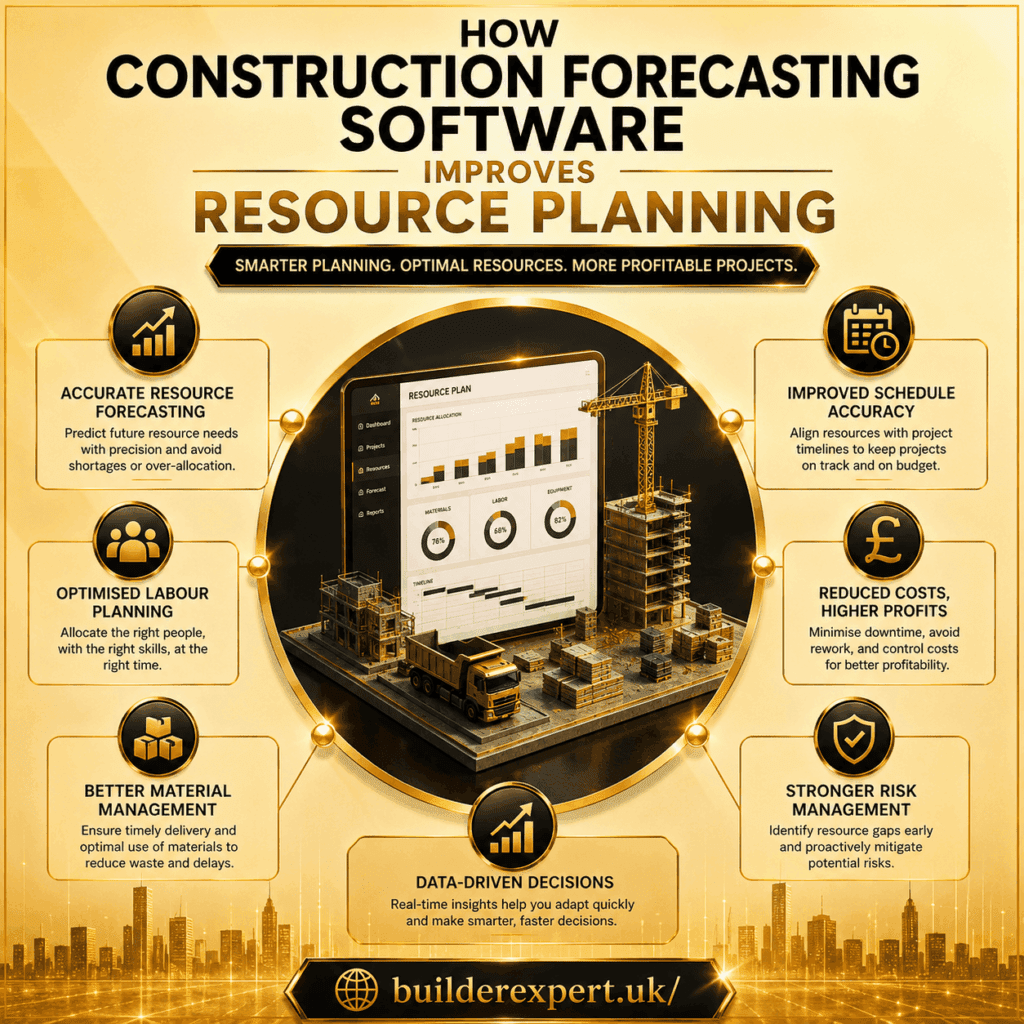
Accurate forecasting allows construction companies to anticipate future resource needs well before shortages become operational problems. Instead of making decisions based on assumptions, managers can rely on data-driven forecasts that reflect actual project workloads and business capacity.
Labour forecasting is particularly important. Skilled labour shortages continue to affect many sectors of the UK construction industry, making workforce planning increasingly difficult. Contractors often struggle to determine how many operatives, supervisors, or specialist trades will be required over the coming months.
Forecasting software analyses project schedules, current workloads, and upcoming commitments to provide clear visibility into future labour requirements.
This allows businesses to:
- Recruit proactively
- Schedule subcontractors more effectively
- Avoid labour shortages
- Reduce overtime costs
- Improve workforce utilisation
- Increase project productivity
Equipment planning also benefits significantly from forecasting.
Construction businesses frequently manage expensive assets such as excavators, access equipment, lifting machinery, and specialist tools. Poor forecasting can result in equipment sitting idle on one project while being urgently needed elsewhere.
Using construction forecasting software, managers can forecast equipment demand across multiple projects and optimise utilisation rates. This reduces unnecessary hire costs while ensuring critical resources remain available when needed.
Material forecasting is equally important.
Material price volatility continues to affect construction profitability. Ordering materials too early can create storage challenges and increase working capital requirements. Ordering too late can cause project delays and disrupt schedules.
Forecasting software helps contractors determine:
- What materials will be needed
- When they will be needed
- Estimated quantities
- Projected costs
- Supplier demand trends
This improves procurement planning and reduces the risk of both shortages and waste.
For growing businesses managing multiple projects simultaneously, forecasting provides a strategic overview of organisational capacity. Leadership teams can assess whether future workloads align with available resources before committing to additional contracts.
This level of visibility enables sustainable growth while maintaining operational control.
Ultimately, effective resource planning improves project efficiency, reduces operational risk, and strengthens profitability across the entire business.
Financial Forecasting and Cash Flow Management
For many construction companies, profitability challenges are not caused by a lack of work but by inadequate financial visibility.
Projects may appear profitable on paper, yet cash flow pressures, cost overruns, delayed payments, and unexpected expenses can create serious financial difficulties. This is why financial forecasting has become one of the most valuable applications of construction forecasting software.
Construction projects often involve complex financial structures. Businesses must balance labour costs, supplier payments, equipment expenses, subcontractor invoices, retention payments, and client payment schedules simultaneously.
Without accurate forecasting, financial risks can remain hidden until they become critical.
Modern forecasting software provides visibility into future financial performance by analysing both historical data and current project information. Contractors can see how ongoing activities are likely to impact future revenue, expenditure, profitability, and cash flow.
Cash flow forecasting is particularly important.
Even profitable businesses can experience cash flow problems when outgoing costs exceed incoming payments. Forecasting software helps identify these periods in advance, giving management teams time to secure financing, adjust payment schedules, or implement corrective measures.
Key financial forecasting capabilities often include:
- Revenue forecasting
- Cost forecasting
- Margin forecasting
- Cash flow projections
- Budget variance analysis
- Forecast versus actual reporting
- Profitability tracking
- Pipeline revenue forecasting
One major benefit is improved project cost control.
As projects progress, actual costs rarely align perfectly with original estimates. Labour productivity may fluctuate, material prices may increase, or unforeseen site conditions may create additional expenses.
Construction forecasting software continuously updates financial forecasts using real-time project performance data. This enables project teams to identify emerging cost risks before they significantly impact margins.
Forecasting also supports more informed business decisions.
Directors can evaluate future financial performance across multiple projects and determine whether the business has sufficient capacity to invest in growth, hire additional staff, purchase equipment, or pursue larger contracts.
For residential builders, extension specialists, and renovation contractors, forecasting provides a clearer understanding of how individual projects contribute to overall business performance.
Rather than waiting until project completion to assess profitability, management teams can monitor financial outcomes throughout the project lifecycle and make adjustments as needed.
The result is greater financial stability, stronger cash flow management, and improved long-term profitability.
Improving Project Delivery Through Predictive Insights
One of the most powerful advantages of construction forecasting software is its ability to provide predictive insights that improve project delivery.
Traditional project management often focuses on reporting what has already happened. Forecasting shifts attention toward what is likely to happen next.
This distinction is critical.
By analysing trends, performance data, and project variables, forecasting software helps construction teams identify potential issues before they escalate into major problems.
For example, a project may currently appear on schedule. However, forecasting algorithms may detect declining productivity levels, increasing labour requirements, or procurement delays that indicate future schedule risks.
Without predictive insights, project managers may not recognise these issues until deadlines are already under threat.
Forecasting software allows teams to:
- Identify schedule risks early
- Monitor productivity trends
- Predict resource shortages
- Anticipate budget overruns
- Evaluate project health
- Improve decision-making speed
- Reduce operational uncertainty
These predictive capabilities are becoming increasingly important as construction projects grow in complexity and clients demand greater certainty regarding cost, quality, and delivery timelines.
Companies that leverage forecasting effectively are often able to deliver projects more consistently, maintain stronger client relationships, and achieve higher levels of profitability.
By transforming raw project data into actionable intelligence, construction forecasting software enables construction businesses to move beyond reactive management and embrace a more proactive, strategic approach to project delivery.
Real-World UK Case Study: How Construction Forecasting Software Improved Profitability
To understand the practical impact of construction forecasting software, consider the example of a residential contractor operating across Surrey and South London.
The company specialised in house extensions, loft conversions, and full property renovations. While the business had a strong reputation and a healthy pipeline of projects, management faced recurring challenges related to labour allocation, material procurement, and cash flow visibility.
Project managers relied heavily on spreadsheets and manual reporting. Although this approach had worked when the company managed only a few projects at a time, growth exposed significant weaknesses in the planning process.
Several projects experienced resource conflicts because labour requirements had not been accurately forecasted. Teams were occasionally overallocated on one project while shortages emerged elsewhere. Material orders were often placed reactively, resulting in delivery delays and scheduling disruptions.
Management decided to implement construction forecasting software to improve visibility across all active and upcoming projects.
Within the first six months, the company achieved measurable improvements.
Project Overview
- Project Type: Residential extension and renovation portfolio
- Total Project Value: £240,000
- Project Duration: 24 weeks
- Initial Target Margin: 14%
- Final Achieved Margin: 18%
Key Results
- Improved labour utilisation across multiple projects
- Earlier identification of scheduling conflicts
- More accurate material procurement planning
- Reduced project delays
- Improved cash flow forecasting
- Increased overall project profitability
The forecasting platform provided real-time visibility into future workloads, labour demand, and financial performance. Management teams could identify capacity issues weeks before they affected project delivery.
By proactively adjusting resource allocation and procurement schedules, the company reduced operational inefficiencies and protected project margins.
According to the company director:
“The biggest difference was visibility. We stopped making decisions based on assumptions and started planning based on reliable forecasts. That changed how we managed projects and significantly improved profitability.”
This example demonstrates why many successful contractors are investing in construction forecasting software as part of their broader digital transformation strategy.
Future Trends in Construction Forecasting Technology
The role of construction forecasting software is expected to expand significantly over the coming years.
As digital adoption accelerates throughout the construction sector, forecasting solutions are becoming increasingly sophisticated. Emerging technologies are enabling software platforms to generate more accurate predictions, deliver deeper insights, and support faster decision-making.
One of the most significant developments is the integration of Artificial Intelligence (AI).
AI-powered forecasting systems can analyse vast quantities of project data and identify patterns that may be difficult for humans to detect. These systems continuously learn from project performance and improve forecasting accuracy over time.
Machine learning capabilities are already being used to forecast:
- Labour productivity
- Cost trends
- Material demand
- Project completion dates
- Resource utilisation
- Cash flow performance
- Risk exposure
Another major trend involves greater integration across construction technology ecosystems.
Modern contractors increasingly use estimating software, project management systems, procurement platforms, accounting solutions, and customer relationship management tools. Future forecasting systems will connect these technologies seamlessly, creating a unified source of operational intelligence.
Cloud technology will continue to play a critical role as well.
Cloud-based forecasting platforms allow stakeholders to access real-time project data from any location. Whether working from site, the office, or remotely, decision-makers can access the latest forecasts instantly.
Predictive analytics is also expected to become more advanced.
Rather than simply forecasting likely outcomes, future software platforms may recommend specific actions designed to improve project performance. This will help project teams move from forecasting problems to actively preventing them.
As competition within the construction sector continues to increase, businesses that embrace these technologies will likely gain a significant competitive advantage.
The ability to predict future outcomes with greater accuracy will become increasingly important for maintaining profitability, managing risk, and supporting sustainable business growth.
Why Construction Forecasting Software Is Becoming a Competitive Advantage
Construction companies are under increasing pressure to deliver projects faster, control costs more effectively, and maintain healthy profit margins.
At the same time, market conditions continue to evolve.
Material costs fluctuate, labour shortages persist, and client expectations are rising. Contractors that continue relying solely on traditional planning methods may find it increasingly difficult to compete.
This is one of the primary reasons why construction forecasting software is emerging as a strategic advantage rather than simply another operational tool.
Businesses that forecast effectively gain greater visibility into future performance.
They can:
- Plan resources more accurately
- Protect project margins
- Improve project delivery
- Manage risk proactively
- Strengthen cash flow control
- Support sustainable growth
- Make faster business decisions
Perhaps most importantly, forecasting creates confidence.
When decision-makers have access to reliable data and accurate projections, they can pursue growth opportunities with greater certainty while maintaining operational stability.
For builders seeking long-term success, forecasting is no longer a luxury—it is becoming a fundamental business capability.
📎 https://www.planningportal.co.uk/
📎 https://www.rics.org/uk/products/data-products/bcis/
📎 https://www.gov.uk/government/publications/the-construction-playbook
📎 https://www.constructionleadershipcouncil.co.uk/
📎 https://www.ons.gov.uk/businessindustryandtrade/constructionindustry
Conclusion
Construction forecasting software has become one of the most valuable technologies available to modern construction businesses. By providing accurate predictions regarding costs, resources, cash flow, project performance, and future workloads, forecasting software enables contractors to make smarter decisions and achieve stronger project outcomes.
As the UK construction industry becomes increasingly competitive, the ability to anticipate challenges before they arise is becoming a critical advantage. Builders that rely on reactive management practices often struggle with inefficiencies, unexpected costs, and reduced profitability.
In contrast, businesses that adopt construction forecasting software gain the visibility required to plan effectively, manage risk, optimise resources, and protect margins.
Whether you operate a residential construction company, renovation business, extension specialist firm, or growing contracting organisation, forecasting technology can help transform how projects are planned and delivered.
The companies that embrace data-driven forecasting today are positioning themselves to become the industry leaders of tomorrow.
📞 If you want to get in touch with our team, click here
Frequently Asked Questions (FAQs)
What is construction forecasting software?
Construction forecasting software is a digital solution that helps contractors predict future project outcomes, including costs, resources, timelines, cash flow, and profitability.
Why is construction forecasting important?
Forecasting allows construction businesses to identify potential risks early, improve planning accuracy, and make informed decisions that protect project profitability.
Can construction forecasting software improve cash flow management?
Yes. Forecasting software provides visibility into future income and expenditure, helping businesses identify potential cash flow gaps before they become critical.
Who should use construction forecasting software?
Residential builders, renovation contractors, extension specialists, project managers, estimators, and construction business owners can all benefit from forecasting technology.
How does construction forecasting software support resource planning?
It forecasts future labour, equipment, and material requirements, enabling businesses to allocate resources more efficiently and avoid shortages.
Can forecasting software reduce project delays?
Yes. By identifying risks and potential bottlenecks early, forecasting software helps project teams take corrective action before delays occur.
Is construction forecasting software suitable for small construction companies?
Absolutely. Smaller businesses often benefit significantly because forecasting improves visibility and supports better growth planning.
What data does construction forecasting software use?
Most systems use project schedules, cost information, labour data, procurement records, financial performance data, and historical project information.
How does forecasting software improve profitability?
By helping businesses control costs, optimise resources, improve productivity, and avoid costly mistakes throughout project delivery.
What is the future of construction forecasting software?
Future platforms will increasingly incorporate artificial intelligence, machine learning, predictive analytics, and deeper integration with other construction management technologies.