
Targeted construction leads have become one of the most valuable assets for builders, contractors, and construction companies looking to achieve sustainable growth in today’s competitive UK market.
While many businesses continue to spend significant time and money chasing generic enquiries, the most successful contractors are focusing on a smarter approach—connecting with highly relevant prospects who are actively planning construction projects.

The difference between average lead generation and targeted construction leads can have a major impact on profitability, conversion rates, project quality, and long-term business growth. Instead of sorting through unqualified enquiries, builders can focus their efforts on homeowners, developers, and property owners who are genuinely seeking construction services. This not only improves efficiency but also increases the likelihood of securing higher-value projects.
As competition continues to intensify across residential construction, extensions, renovations, and new-build developments, having access to accurate and relevant project opportunities is becoming a significant competitive advantage. Construction companies that consistently secure quality leads often enjoy stronger project pipelines, healthier profit margins, and greater confidence when planning future growth.
In this guide, we will explore why targeted construction leads are transforming business development across the construction industry, how they differ from traditional lead generation methods, and how builders can use them to win more profitable projects.
Table of Contents
- What Are Targeted Construction Leads?
- Why Traditional Lead Generation Often Fails
- The Benefits of Using Targeted Construction Leads
- How Builders Identify High-Value Opportunities
- The Role of Planning Data in Lead Generation
- How Targeted Construction Leads Improve Conversion Rates
- Building a Predictable Project Pipeline
- Real-World UK Case Study
- Future Trends in Construction Lead Generation
- Conclusion
What Are Targeted Construction Leads?
Targeted construction leads are project opportunities that closely match a contractor’s ideal customer profile, service offering, geographic coverage, and business objectives. Unlike generic enquiries that may have little relevance to a builder’s expertise, targeted leads are specifically selected because they align with the company’s preferred project types and growth strategy.
Many builders waste considerable resources pursuing enquiries that ultimately fail to convert into profitable projects. Some prospects may be outside the contractor’s service area, others may have unrealistic budgets, and some may simply be exploring options without any immediate intention to proceed.
Targeted leads eliminate much of this inefficiency.
Rather than generating a large volume of random enquiries, the focus shifts toward securing opportunities that have a higher probability of becoming profitable projects.
Examples of targeted construction leads may include:
- Homeowners planning house extensions
- Property renovation projects
- Loft conversion opportunities
- New-build residential developments
- Planning-approved construction projects
- High-value refurbishment projects
- Residential improvement schemes
- Property development opportunities
The key advantage is relevance.
A contractor specialising in residential extensions will achieve far better results targeting homeowners actively planning extensions than pursuing general construction enquiries with uncertain requirements.
This targeted approach improves both marketing efficiency and sales performance. Teams spend less time filtering unsuitable enquiries and more time engaging with genuine opportunities.
For growing construction businesses, targeted leads provide a more reliable foundation for sustainable growth. Rather than depending on unpredictable referral networks or broad advertising campaigns, builders can establish a consistent flow of opportunities that match their preferred project profile.
As digital lead generation continues to evolve, targeted construction leads are increasingly becoming the preferred solution for contractors seeking higher conversion rates and stronger long-term profitability.
Why Traditional Lead Generation Often Fails
Many construction companies continue to rely on traditional lead generation methods that were effective years ago but deliver increasingly inconsistent results today.
Word-of-mouth referrals remain valuable, but they can be difficult to scale. Online directories may generate enquiries, but lead quality often varies significantly. Generic advertising campaigns frequently produce large numbers of enquiries without guaranteeing relevance.
As a result, builders often face several common challenges.
First, many enquiries lack intent.
Prospective clients may be gathering information, comparing prices, or researching future possibilities rather than actively seeking a contractor. While these contacts may eventually become projects, they often consume valuable time without generating immediate revenue.
Second, traditional lead sources frequently lack targeting.
A contractor specialising in high-end residential renovations may receive enquiries relating to commercial projects, maintenance work, or services outside their expertise. Every unsuitable enquiry requires additional administration, communication, and qualification.
Third, competition is often intense.
Many generic lead platforms distribute the same enquiry to multiple contractors simultaneously. This creates pricing pressure and reduces the likelihood of securing profitable work.
The consequences can include:
- Lower conversion rates
- Increased marketing costs
- Reduced productivity
- Longer sales cycles
- Greater administrative workload
- Lower project profitability
Targeted construction leads address these issues by focusing on quality rather than quantity.
Instead of competing for every available enquiry, builders can concentrate on opportunities that closely align with their business objectives. This creates a more efficient sales process and improves overall business performance.
For contractors seeking predictable growth, moving beyond traditional lead generation methods is often an essential step toward building a stronger and more sustainable project pipeline.
The Benefits of Using Targeted Construction Leads

The growing popularity of targeted construction leads is driven by the measurable benefits they deliver across multiple areas of business performance.
One of the most significant advantages is improved lead quality.
Because opportunities are selected based on specific criteria, contractors spend less time filtering unsuitable enquiries and more time engaging with genuine prospects.
Higher-quality leads often result in:
- Better conversion rates
- Higher project values
- Faster sales processes
- Improved customer relationships
- Greater profitability
- More predictable workloads
Another major benefit involves resource efficiency.
Sales teams, estimators, and project managers all have limited time available. When businesses focus on highly relevant opportunities, internal resources can be allocated more effectively.
Targeted leads also support stronger business planning.
When a company has access to a consistent stream of relevant opportunities, it becomes easier to forecast future workloads, manage staffing requirements, and plan business growth.
Perhaps most importantly, targeted construction leads often generate better project outcomes.
Projects that align closely with a contractor’s expertise are typically delivered more efficiently and profitably than work outside their core specialisation.
This creates a positive cycle where improved project delivery leads to stronger client satisfaction, more referrals, and additional growth opportunities.
How Builders Identify High-Value Opportunities
Not all construction projects offer the same level of profitability, stability, or long-term business value. One of the biggest advantages of using targeted construction leads is the ability to focus on opportunities that align with a contractor’s expertise, capacity, and growth objectives.
Successful builders understand that winning more work is not always the goal. Winning the right work is far more important.
High-value opportunities often share several characteristics. They typically involve realistic budgets, clearly defined project requirements, committed decision-makers, and a genuine intention to proceed. These projects also tend to match the contractor’s preferred project type, whether that involves house extensions, renovations, loft conversions, or new-build developments.
Builders who consistently secure profitable projects usually evaluate opportunities based on factors such as:
- Project value
- Location
- Planning status
- Client readiness
- Expected timeline
- Resource requirements
- Potential profit margin
Rather than pursuing every enquiry that arrives, companies using targeted construction leads can prioritise prospects that offer the highest likelihood of conversion and profitability.
This approach improves efficiency throughout the sales process. Estimators spend less time preparing quotations for unsuitable projects, while business owners can focus their attention on opportunities that support long-term growth objectives.
In a competitive market, identifying high-value opportunities early can significantly improve both project success rates and overall business performance.
The Role of Planning Data in Lead Generation
One of the most effective sources of targeted construction leads comes from planning application data.
Across the UK, thousands of homeowners and property developers submit planning applications every month for extensions, renovations, conversions, and new-build projects. These applications often provide valuable insight into future construction activity before contractors are actively being approached.
For builders, this creates a powerful opportunity.
Instead of waiting for homeowners to begin searching for contractors, businesses can identify upcoming projects at an earlier stage of the decision-making process.
Planning data typically includes information such as:
- Project location
- Development type
- Proposed construction works
- Applicant details
- Planning status
- Project scope
This information allows contractors to focus on projects that match their preferred services and geographic coverage areas.
For example, a company specialising in residential extensions can target approved extension projects rather than investing marketing resources into broader, less predictable advertising campaigns.
The use of planning-based targeted construction leads also provides a more proactive approach to business development. Builders gain visibility into future opportunities and can engage with prospects before competitors become involved.
As lead generation strategies continue to evolve, planning intelligence is becoming an increasingly important resource for contractors seeking consistent project pipelines and higher-quality opportunities.
How Targeted Construction Leads Improve Conversion Rates
Lead generation success is not measured solely by the number of enquiries received. The true measure of success is conversion.
Many contractors generate a high volume of enquiries but struggle to convert them into paying projects. This often occurs because the leads themselves are poorly qualified or lack genuine intent.
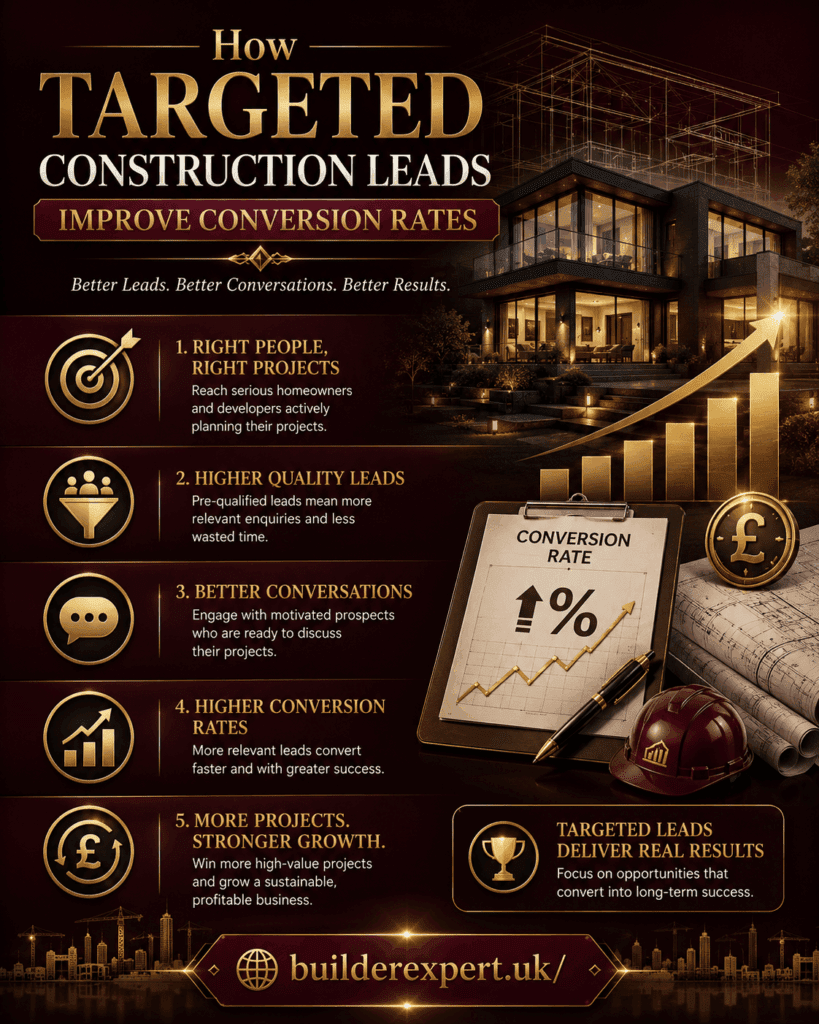
Targeted construction leads improve conversion rates by ensuring that opportunities are closely aligned with the contractor’s services, expertise, and target market.
When prospects already match the builder’s ideal customer profile, several advantages emerge.
Communication becomes easier because the contractor has relevant experience. Proposals become stronger because they address specific project requirements. Clients gain greater confidence because they are speaking with specialists rather than generalists.
Higher conversion rates are often driven by factors such as:
- Better project alignment
- More relevant expertise
- Improved trust
- Faster response times
- Stronger project understanding
- Reduced competition
Another important benefit involves the quality of conversations taking place during the sales process.
Builders engaging with targeted construction leads are typically discussing active projects rather than speculative enquiries. This means less time spent qualifying prospects and more time focused on delivering solutions.
Over time, improved conversion rates reduce customer acquisition costs and increase return on investment across all lead generation activities.
For construction businesses seeking sustainable growth, conversion efficiency often matters more than lead volume alone.
Building a Predictable Project Pipeline
One of the biggest challenges facing construction businesses is maintaining a consistent flow of future work.
Many contractors experience periods of intense activity followed by quieter periods where new projects become difficult to secure. This inconsistency can create staffing challenges, cash flow pressures, and uncertainty when planning future growth.
Targeted construction leads help solve this problem by creating a more predictable and manageable project pipeline.
Instead of relying entirely on referrals or unpredictable marketing activity, builders can establish a structured process for identifying and pursuing relevant opportunities throughout the year.
A predictable pipeline provides several important benefits.
It enables businesses to forecast workloads more accurately, recruit staff with greater confidence, plan resource allocation more effectively, and maintain healthier cash flow.
Project pipeline visibility also supports strategic decision-making. Contractors can assess future capacity and determine whether they are in a position to accept additional work without compromising quality or profitability.
Key advantages of a predictable pipeline include:
- Greater business stability
- Improved workforce planning
- Better cash flow forecasting
- Reduced downtime between projects
- Increased confidence when pursuing growth
- Stronger long-term profitability
Perhaps most importantly, a consistent pipeline reduces the pressure associated with constantly searching for the next project.
When businesses have ongoing access to targeted construction leads, they can focus on delivering exceptional results while maintaining a steady flow of future opportunities.
For modern builders seeking sustainable expansion, building a predictable project pipeline is no longer optional—it is a critical component of long-term success.
Real-World UK Case Study: How Targeted Construction Leads Increased Project Quality and Profitability
To understand the true value of targeted construction leads, consider the example of a residential construction company operating across Greater London and the South East.
The business specialised in house extensions, loft conversions, and property renovations. Like many contractors, the company generated enquiries through referrals, online directories, and general advertising campaigns. While lead volume appeared healthy, conversion rates remained inconsistent and estimating teams spent considerable time preparing quotations for projects that never progressed.
Management decided to focus on a more strategic lead generation approach centred around targeted construction leads.
Rather than pursuing every enquiry, the company concentrated on opportunities that matched its preferred project types, geographic coverage areas, and profitability targets.
Over a six-month period, the results were significant.
Project Overview
- Sector: Residential Construction
- Average Project Value: £120,000
- Service Area: Greater London & South East
- Lead Source: Targeted Construction Leads
- Review Period: 6 Months
Results Achieved
- Improved lead quality
- Higher enquiry-to-quote conversion rates
- Reduced time spent on unsuitable enquiries
- Stronger project pipeline visibility
- Increased average project value
- Improved profitability
The company reported that sales teams spent less time qualifying prospects and more time engaging with genuine opportunities. Estimators focused on projects that closely matched the business’s expertise, resulting in a more efficient sales process and stronger margins.
According to the director:
“The biggest change wasn’t the number of enquiries we received. It was the quality of the opportunities. We were spending more time speaking with serious homeowners and less time chasing unsuitable projects.”
This case study demonstrates how targeted construction leads can support both operational efficiency and long-term business growth.
Future Trends in Construction Lead Generation
The construction industry continues to evolve, and lead generation strategies are evolving alongside it.
As competition increases and digital adoption accelerates, builders are becoming more selective about where they invest their marketing resources. Simply generating large numbers of enquiries is no longer enough. The focus is shifting toward quality, relevance, and predictability.
One of the biggest trends is the growing use of data-driven lead generation.
Construction companies increasingly rely on planning intelligence, market data, geographic targeting, and project-specific information to identify future opportunities before competitors become aware of them.
Artificial Intelligence is also beginning to influence lead generation strategies.
AI-powered tools can analyse large volumes of data and identify patterns that help contractors prioritise opportunities more effectively. This can improve lead qualification, increase efficiency, and support better decision-making.
Key trends likely to shape the future include:
- Greater use of planning application data
- AI-assisted lead qualification
- Predictive project identification
- Geographic lead targeting
- Automated business development processes
- Improved lead verification methods
- Enhanced project opportunity intelligence
As these technologies continue to mature, businesses that embrace modern lead generation methods will be better positioned to secure profitable projects and maintain a competitive advantage.
For many contractors, targeted construction leads are already becoming a core component of sustainable growth strategies.
📎 https://www.planningportal.co.uk/
📎 https://www.gov.uk/government/publications/the-construction-playbook
📎 https://www.constructionleadershipcouncil.co.uk/
📎 https://www.ons.gov.uk/businessindustryandtrade/constructionindustry
📎 https://www.gov.uk/government/collections/national-planning-policy-framework
Why Targeted Construction Leads Deliver a Competitive Advantage
Many builders still rely heavily on referrals and word-of-mouth recommendations. While referrals remain valuable, they rarely provide the consistency required to support long-term growth.
Modern construction businesses require greater visibility and control over future opportunities.
This is where targeted construction leads create a significant competitive advantage.
Contractors that consistently access relevant opportunities can:
- Build stronger project pipelines
- Improve forecasting accuracy
- Increase conversion rates
- Reduce marketing waste
- Strengthen profitability
- Support controlled business growth
Perhaps most importantly, targeted leads provide predictability.
Rather than waiting for enquiries to arrive, businesses can actively identify and pursue opportunities that match their preferred customer profile.
This proactive approach enables builders to grow with greater confidence while maintaining high standards of project delivery.
In a competitive market where margins matter, predictability often becomes one of the most valuable business advantages available.
Conclusion
Targeted construction leads are transforming how modern builders identify opportunities, win projects, and grow their businesses. Instead of relying on broad marketing campaigns or unpredictable referral networks, contractors can focus on opportunities that align closely with their expertise, service areas, and profitability objectives.
By improving lead quality, increasing conversion rates, supporting stronger project pipelines, and reducing wasted effort, targeted leads create measurable benefits throughout the business development process.
As the UK construction sector becomes increasingly competitive, companies that prioritise quality opportunities over sheer enquiry volume are positioning themselves for sustainable long-term success.
Whether you specialise in house extensions, renovations, loft conversions, or residential construction projects, investing in a targeted lead generation strategy can help create a more predictable and profitable future.
📞 If you want to get in touch with our team, click here:
https://builderexpert.uk/contact-builder-expert/
Frequently Asked Questions (FAQs)
What are targeted construction leads?
Targeted construction leads are project opportunities that closely match a contractor’s preferred services, locations, project values, and customer profile.
Why are targeted construction leads better than generic leads?
Because they are more relevant, they typically generate higher conversion rates, better project quality, and improved profitability.
How do builders find targeted construction leads?
Many contractors use planning application data, specialist lead providers, digital marketing campaigns, and project intelligence platforms.
Do targeted construction leads improve conversion rates?
Yes. Because the opportunities are highly relevant, contractors often experience stronger engagement and improved conversion performance.
Are targeted construction leads suitable for small builders?
Absolutely. Small and growing construction businesses often benefit significantly because they can focus resources on the most promising opportunities.
What types of projects can targeted construction leads include?
House extensions, loft conversions, renovations, new-build developments, refurbishment projects, and other residential construction opportunities.
How can targeted construction leads reduce marketing costs?
By reducing the number of unsuitable enquiries and improving conversion rates, businesses achieve a higher return on their marketing investment.
Can targeted construction leads help forecast future workloads?
Yes. Consistent access to relevant opportunities makes it easier to predict future project pipelines and resource requirements.
What role does planning data play in lead generation?
Planning data helps contractors identify upcoming construction projects before homeowners begin actively searching for builders.
Why are targeted construction leads becoming more important in 2026?
Increasing competition, rising customer expectations, and advances in data-driven marketing are encouraging builders to focus on quality opportunities rather than enquiry volume alone.
How do targeted construction leads support business growth?
They provide a consistent source of relevant opportunities, helping contractors secure more profitable projects and build stronger pipelines.
Are targeted construction leads only useful for residential builders?
No. While they are particularly valuable for residential construction, they can also support commercial contractors and specialist construction firms.