
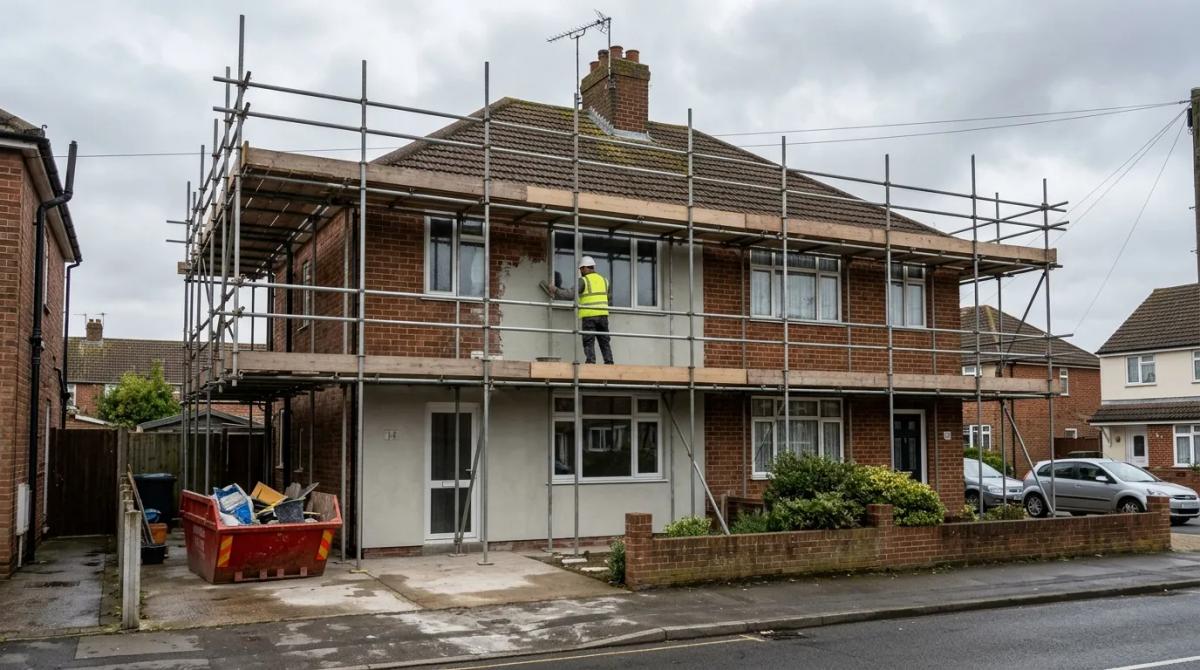
Rendering a house in the UK costs roughly £3,000 to £6,500 for a two bed terrace and £9,500 to £19,500 for a four bed detached, with scaffolding included, at London and South East prices. Through colour render runs about £45 to £95 per m² supplied and fitted (monocouche at the lower end, silicone higher), with scaffolding on top.
This guide gives the price per m² by system, how to measure your own wall area, worked totals for three common house types and a calculator. It is written for builders and surveyors pricing a job, and for anyone checking a render quote against real numbers.
House rendering cost UK: prices at a glance
| Standard | System | Per m², supplied and fitted | 3 bed semi, render and scaffold |
|---|---|---|---|
| Budget | Sand and cement, two coat, painted | £40 to £75 | £5,200 to £10,000 |
| Mid-range | Monocouche through colour render | £45 to £80 | £5,700 to £10,500 |
| Premium | Silicone or K Rend through colour render | £60 to £95 | £7,200 to £12,000 |
| Insulated | External wall insulation with a render finish | £100 to £180 | £11,200 to £20,500 |
The semi is about 100 m² of wall after openings, with £1,200 to £2,500 of scaffolding. All prices on this page are typical current UK prices at London and South East levels, including VAT, and supplied and fitted unless a line says otherwise. Outside London and the South East the same job usually costs less. They are indicative and current as at November 2026, not a quotation.
Render systems and price per m²
"Render" covers several systems, and they are not priced the same way.
Traditional sand and cement render goes on in two coats, a scratch coat and a finish coat, and is then painted with masonry paint. It is the cheapest system to buy and the only one that carries a repainting cycle.
Monocouche and silicone through colour renders are a thin coat system applied in one or two passes over a basecoat and mesh. The colour is in the render, so there is no paint finish, and they resist cracking and algae far better than sand and cement. K Rend is a brand of silicone through colour render, not a different way of pricing the job.
External wall insulation (EWI) adds insulation board, mechanical fixings and a reinforcing mesh under the render coat, and is the only system that improves the wall's U value.
| System | Supplied and fitted, per m² | Good to know |
|---|---|---|
| Monocouche through colour render | £45 to £80 | colour is in the render, no painting |
| Silicone through colour render | £60 to £95 | the most crack and algae resistant of the thin coats |
| K Rend silicone render | £60 to £95 | a brand of silicone through colour render |
| Sand and cement, two coat | £30 to £50, plus £10 to £25 for painting | repainted every 5 to 10 years |
| External wall insulation with render finish | £100 to £180 | the only system that improves the wall's U value |
Scaffolding, stripping old render, repointing and the roofline are extra on all of them, and are covered below. Sand and cement looks the cheapest per m² until the painting is counted: with it, the gap to monocouche almost closes, and the paint comes back every 5 to 10 years.
How to measure the render area
Render is measured by the square metre of wall, not by the size of the house, so the measurement is where a quote is won or lost.
Measure each elevation as width times height. Storey height is 3 metres for pricing, so a two storey elevation is 6 metres high; add half the gable width times its height for a gable end (width x height ÷ 2 is close enough). Deduct window and door openings: on an average house this takes 15 to 20% off the gross area, and on a heavily glazed rear elevation more.
A mid terrace has two elevations to render, a semi has three (front, rear and the one exposed flank), and a detached has four. Beading around every opening, at corners and at the bellcast is part of the rate above, but the number of openings still moves the labour, which is covered under cost drivers below.
Scaffolding cost
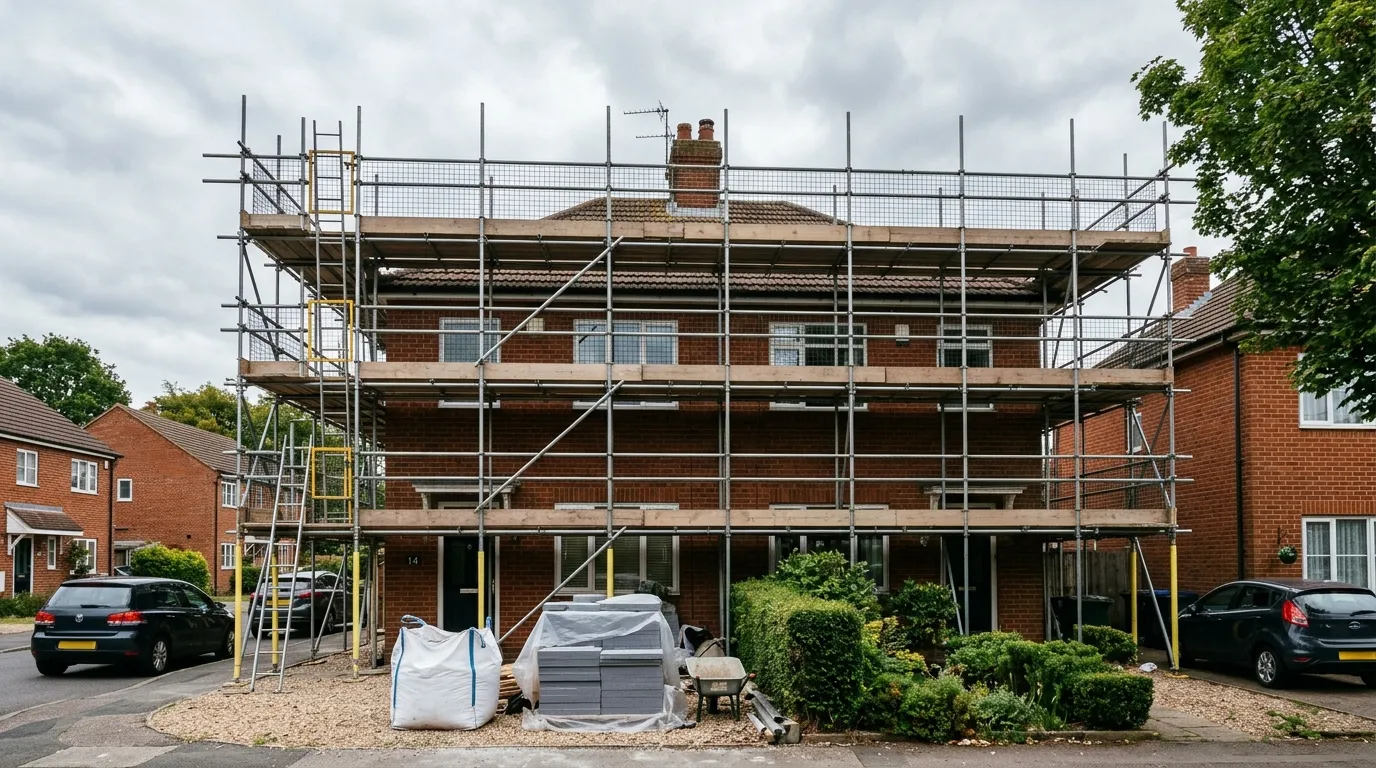
Scaffolding is a separate cost from the render rate, and on a full wrap it is one of the biggest lines on the job. For the elevations being rendered, supplied, erected, inspected and struck over the length of a render job, it typically runs:
| House | Scaffold for the render job |
|---|---|
| 2 bed mid terrace, front and rear | £800 to £1,800 |
| 3 bed semi, front, rear and one flank | £1,200 to £2,500 |
| 4 bed detached, all four elevations | £1,800 to £3,500 |
Scaffold is priced by the length of wall and the number of storeys, because every extra lift carries its own boards, ties and inspection, and by how long it stays up. A scaffold tower for chimney or gable access, where the main scaffold does not reach, adds about £300 to £700.
A bungalow, a single elevation or a low rear wall can sometimes be worked off a mobile tower instead of a full scaffold, which takes the scaffold line down to a few hundred pounds. Anything above single storey height needs a proper scaffold: a rendering gang cannot keep a wet edge across a wall from a tower, and the joins show.
Preparing the walls and re-rendering an existing house
Rendering fresh blockwork on a new extension is the cheap version of this job. Re-rendering a house that already has render on it costs more per m², because the old coat has to come off first and whatever is behind it has to be made sound.
Hacking off blown or loose render and getting rid of it runs about £12 to £25 per m², including disposal. Once the wall is bare, the substrate decides the rest. Repointing where the joints have gone is about £40 to £80 per m², raked out and repointed, and on a Victorian house it is often needed over a good part of the wall rather than in patches.
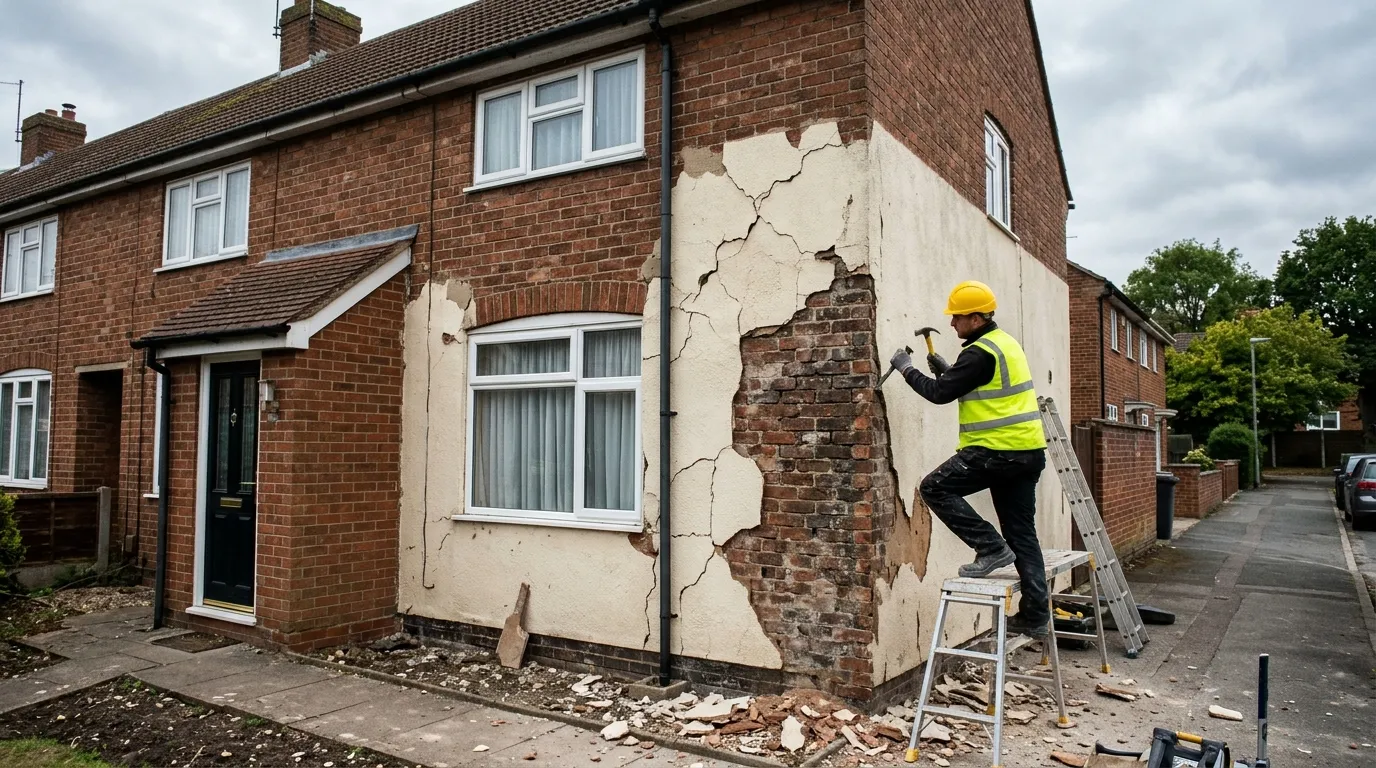
Sound, well keyed existing render can sometimes be overclad rather than removed, which saves the hack off and the disposal, but only where the substrate has been tapped over and confirmed sound. Guessing at this stage is where most early render failures start.
This is the single biggest source of argument on render jobs. "Render the house" can mean a basecoat and a thin coat over the render that is already there, or a strip back to brick with repointing and new beads first. Those two jobs can be 40% apart in price and they look identical on a quote. The line that says where the work stops is what decides the price, and it belongs in writing before anyone starts.
Fascias, soffits, gutters and downpipes
On almost every render job the rainwater goods come off and go back on, because render has to run up behind them. While the scaffold is up, an older house usually gets them replaced instead: the scaffold is the expensive part, and doing it two years later means paying for it twice.
New uPVC fascia and soffit boards run about £60 to £100 per metre, and plastic guttering and downpipes about £30 to £60 per metre, supplied and fitted. On a three bed semi with around 20 metres of eaves that is roughly £1,800 to £3,200 added to the job, and it is not in the worked totals below.
Painting and maintenance
Through colour, monocouche and silicone renders do not get painted: the colour is in the material. Sand and cement does, and the paint comes back round every 5 to 10 years.
Painting external walls in masonry paint runs about £10 to £25 per m², supplied and applied; the upper end includes filling and repairing the surface first, not paint alone. Windows, sills and doors decorated while the scaffold is up add a few hundred pounds each.
Worked totals by house type
Three common houses, priced with monocouche or silicone through colour render (the lower end monocouche, the upper end silicone), including scaffolding, excluding hack off, fascias and gutters, and excluding anything the client chooses to replace while the scaffold is up. Rounded ranges, London and South East.
| House | Wall area assumed | Elevations and scaffold | Indicative total, render and scaffold |
|---|---|---|---|
| 2 bed mid terrace | about 50 m² after openings | front and rear, 10 LM over 2 storeys | £3,000 to £6,500 |
| 3 bed semi | about 100 m² after openings | front, rear and one flank, 23 LM over 2 storeys | £5,700 to £12,000 |
| 4 bed detached | about 170 m² after openings | all four, 38 LM over 2 storeys | £9,500 to £19,500 |
Add the hack off where there is existing render to remove: roughly £600 to £1,250 on the terrace, £1,200 to £2,500 on the semi and £2,000 to £4,250 on the detached. Add repointing where the wall needs it, and fascias and gutters where they are being replaced.
The same work outside London and the South East usually comes in lower. Sand and cement with painting comes in a little below monocouche, but the paint comes back every 5 to 10 years, which the thin coat systems do not.
Rendering cost calculator
House Rendering Cost Calculator
- Render system cost
- £5,500
- Scaffolding cost
- £1,840
- Hack off and disposal
- £0
- Estimated total cost
- £7,340
Typical current UK prices at London and South East levels, supplied and fitted, including VAT. Indicative only, not a quotation; repointing, fascias, gutters and windows are not included. Outside London and the South East the same job usually costs less.
External wall insulation compared with render only
EWI costs roughly £100 to £180 per m² supplied and fitted against £45 to £95 per m² for render alone, so the system choice moves the price more than anything else on this page. The extra buys 50 to 100 mm of insulation board, mechanical fixings, a reinforcing mesh coat and all the detailing that goes with thickening a wall: window and door reveals re-formed, sills extended or replaced, verges and eaves deepened, downpipes packed out and the meter boxes moved.
It is worth it on a solid brick wall with no cavity, where internal insulation would cost floor area and the plaster, cornices and skirtings, and on any house already due a full re-render, because the scaffold and the render coat are being paid for either way. Installing insulation in a residential property currently carries 0% VAT until 31 March 2027 under the energy saving materials relief, which render on its own does not. The Energy Saving Trust is the place to check current grant eligibility before pricing.
Windows and doors while the scaffold is up
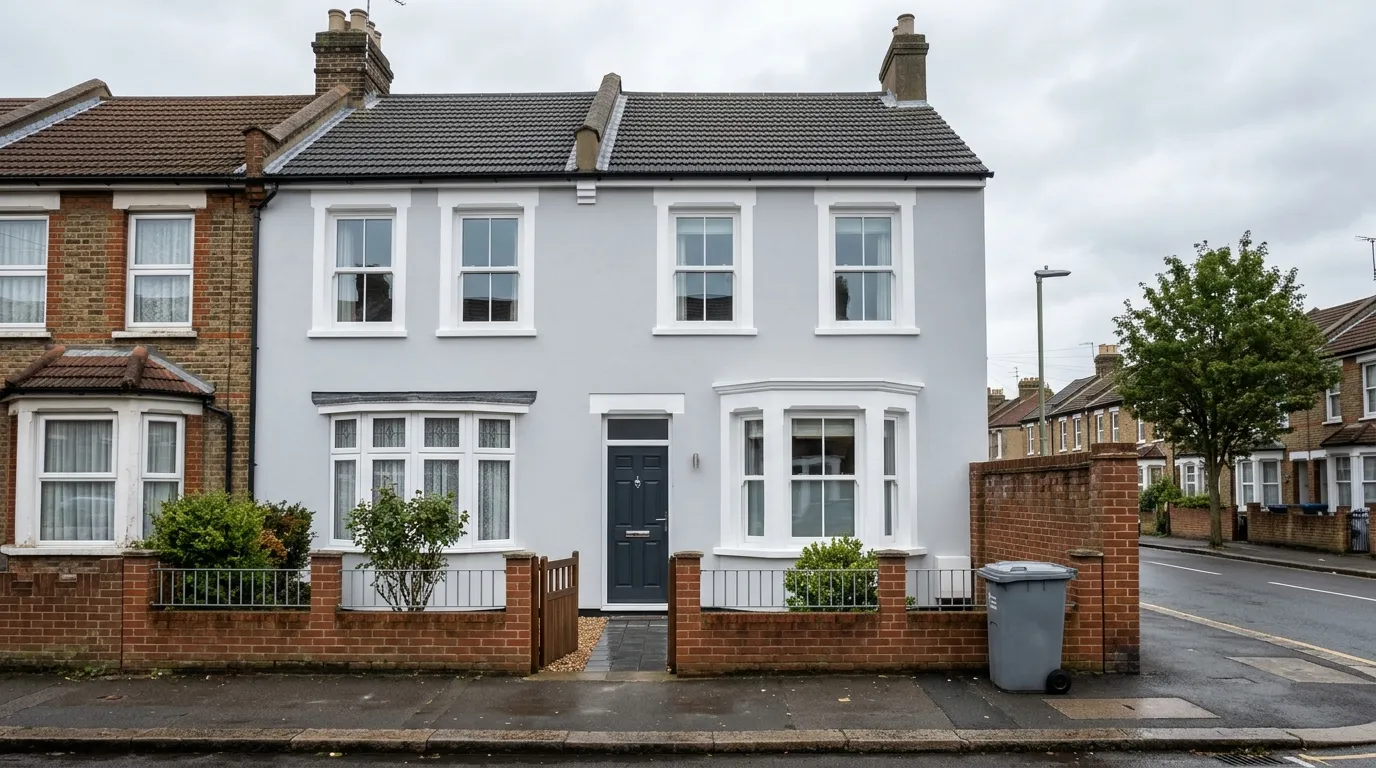
Windows and doors are the client's choice, so they are a budget rather than part of the render price. A standard white uPVC casement runs about £450 to £700 per window supplied and fitted, and a three bed semi about £4,500 to £7,000 for the full set. If windows are being changed, change them before the render goes on, not after: new reveals and beads are part of the render job, and cutting them in afterwards means patching a finish that never quite matches.
What moves the quote
- Height and storeys: each extra storey adds a full scaffold lift, before any render is mixed.
- Access: a flank with no side gate, a shared drive or a scaffold licence for the footway pushes the preliminaries up. Chimney and gable access adds a tower at about £300 to £700.
- Substrate condition: sound blockwork is the cheap end; hack off at £12 to £25 per m² and repointing at £40 to £80 per m² are the expensive end.
- Number of openings: every window and door is beading, reveals, a sill detail and a stop. Deducting the area makes the quote look smaller while the labour goes up.
- Mesh and basecoat on an uneven wall: a wall out of true needs a thicker basecoat and full mesh, which is material and a day or two of labour, not a line anyone shows separately.
- Colour and texture: deep colours and fine textures carry a material premium and are less forgiving of a patchy application.
- Listed building or conservation area: render is normally permitted development, but not on a listed building or where an article 4 direction applies, and a lime system rather than cement may be required.
- Region: the prices here are London and South East. Elsewhere the same job usually costs less, mostly on labour.
How long rendering takes
A three bed semi in monocouche or silicone takes about two to three weeks: two days for the scaffold, two to four days of preparation and beading, a day or two for the basecoat and mesh, then the top coat, with the scaffold struck at the end. Sand and cement with painting is three to four weeks, because the scratch coat and the finish coat each need drying time and the paint needs a dry window of its own.
Render is not applied in frost, in driving rain or in strong direct sun, so a winter job carries lost days. Every lost day is another day of scaffold hire, which is why a longer programme costs more even when the wall area has not changed.
What a low render quote leaves out
The low end of every range on this page is the bare minimum. When one quote is thousands below the others, it is usually one or more of these:
- no scaffold, or a tower priced where a scaffold is needed
- no hack off and no disposal of the old render
- no beads, no corner beads and no mesh in the basecoat
- one coat instead of two, or a thin coat over a basecoat that was never applied
- no repointing or substrate repair behind the render
- fascias, gutters and downpipes not taken off and refitted
- no making good to sills, reveals and the drive or path below
- no painting on a sand and cement system
- no allowance for drying time between coats, which shows up later as a programme that overruns
None of that is dishonesty. It is a price for a narrower job than the one the client thinks they are buying, and the gap comes back as extras, as a rushed application, or as a wall that looks fine for two years.
How to compare three render quotes
Line them up and check that each one names: the system and the manufacturer type, the number of coats, beads and mesh, the scaffold (and how long it is on hire), hack off and disposal, substrate preparation and repointing, rainwater goods off and back on, making good, painting where the system needs it, and the guarantee length. A quote that names all of those can be compared. One that says "render the house, £8,000" cannot be compared with anything, and the difference between it and the next quote is usually scope, not price. Our guide to comparing builder quotes sets out the same test for a whole project.
Frequently asked questions
How much does it cost to render a three bedroom house?
On a three bed semi with around 100 m² of wall over two storeys, monocouche or silicone render including scaffolding comes to about £5,700 to £12,000 in London and the South East, and less elsewhere. Add £1,200 to £2,500 if there is existing render to strip off, and £1,800 to £3,200 if the fascias and gutters are being replaced while the scaffold is up.
Is rendering a house worth it?
It is worth it for appearance, for weatherproofing a wall that is porous or badly patched, and as the finish on top of external wall insulation. It does not fix rising damp, it does not fix a failed cavity tray or a leaking gutter, and sealing a damp solid wall behind a cement render usually makes the damp worse rather than better. Fix what is causing the water first, then render.
How often does render need redoing?
Sand and cement needs repainting every 5 to 10 years and full replacement at 20 to 40 years. Monocouche and silicone through colour systems generally run 25 to 30 years or more with no repainting, assuming the substrate was sound and the application was right. All of them need the gutters kept clear, which is what kills more render than weather does.
What are the disadvantages of rendering?
Cement render cracks as the building moves, and a crack in a thin coat system is hard to repair invisibly, because the patch rarely matches the surrounding colour and texture. On a solid wall, a dense cement render can trap moisture in the wall. It is a maintenance item as well: painted systems need a repaint cycle, and all renders need washing down where they face north and go green.
Does rendering always need scaffolding?
Above single storey height, yes. A single storey wall or a low rear elevation can be done from a mobile tower, which is a few hundred pounds instead of one to three thousand.
Render almost always sits inside a wider external refurbishment: scaffold, roofline, repointing, decorating and the rainwater goods all come off the same programme. If you are pricing a job like that rather than render on its own, a detailed construction estimate prices it task by task, in build order, so nothing falls down the gap between trades.