
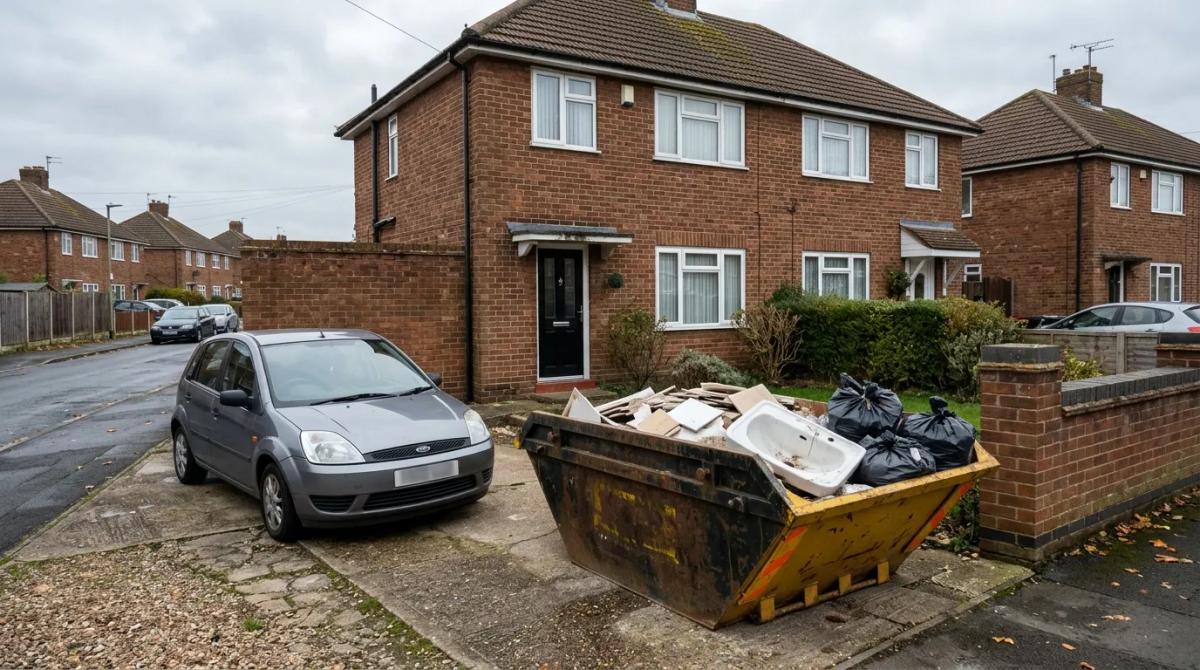
A 4 yard skip is around 1.8 m long, 1.3 m wide and 1.0 m high (roughly 6 ft by 4 ft 3 in by 3 ft 2 in), holds about 3 cubic metres of waste and is usually limited to 2 to 3 tonnes. That is 40 to 50 standard bin bags, or about 35 to 40 builder's barrow loads. It is the midi skip, the size most builders put on a driveway for a bathroom strip out, a small kitchen rip out or a single room taken back to brick. This page is for the builder deciding which skip to book and what it will cost on the job.
4 yard skip dimensions
Every supplier's skip is slightly different, because skips are made by several manufacturers and the same yardage comes in a few shapes. Book on the range, not on one exact figure, and check the supplier's own spec if the space is tight.
| Dimension | Typical range | In feet |
|---|---|---|
| Length | 1.8 to 2.2 m | 6 ft to 7 ft 3 in |
| Width | 1.2 to 1.4 m | 4 ft to 4 ft 7 in |
| Height | 0.9 to 1.2 m | 3 ft to 4 ft |
| Volume | 4 cubic yards | about 3.05 m³ |
In plain terms it is about the footprint of a small family car and lower than one. On most single driveways a 4 yard sits with room to walk past it, which is exactly why it gets booked on jobs where a 6 or 8 yard would block the only way in.
Comparing 2, 4, 6 and 8 yard skips
The 4 yard sits in the middle of the range most builders actually book. Here is how it compares with the sizes either side of it.
| Size | Typical dimensions (L x W x H) | Holds (bin bags) | Weight limit | Best suited to |
|---|---|---|---|---|
| 2 yard | 1.8 m x 1.2 m x 0.6 m | 20 to 30 | 1.5 to 2 tonnes | A small garden clearance, a single room declutter, a bit of soil from a small dig |
| 4 yard | 1.8 to 2.2 m x 1.2 to 1.4 m x 0.9 to 1.2 m | 40 to 50 | 2 to 3 tonnes | A bathroom strip out, a small kitchen rip out, one room back to brick |
| 6 yard | 2.4 to 3.0 m x 1.5 to 1.7 m x 1.1 to 1.3 m | 60 to 70 | 3 to 4.5 tonnes | A full kitchen rip out, a small extension, a garage clearance |
| 8 yard | 3.5 to 3.7 m x 1.5 to 1.7 m x 1.2 to 1.5 m | 80 to 90 | 4.5 to 6 tonnes | A loft conversion, a chimney breast removal, a full house strip out |
As the skip gets bigger the weight limit grows faster than the volume, because the lorry can carry more before it is at its own limit. That is why a 4 yard is often the right choice for a job that is bulky but light, while a 6 or 8 yard earns its price on a job that is both bulky and heavy.
How much a 4 yard skip holds
Stated three ways, a 4 yard skip takes:
- 40 to 50 standard black bin bags of loose waste
- roughly 3 cubic metres by volume
- about 35 to 40 builder's barrow loads

Those three only agree for light, loose waste. Bulky items (a bath, kitchen carcasses, a sheet of worktop) waste space unless they are broken down, and anything dense stops being a volume question and becomes a weight question, which is the next section.
Skips are collected level, not heaped. Anything above the rim has to come off before the lorry will take it, so plan on the skip being full when the waste reaches the top edge.
Weight limit
A 4 yard skip is typically limited to around 2 to 3 tonnes, with some suppliers allowing a little more on a mixed load and less on a heavy one. The limit is the lorry's, not the skip's, so it is not negotiable on the day.

On soil, rubble, concrete, tiles or plaster you hit the weight long before the volume. Hardcore runs around 1.5 to 2 tonnes per cubic metre, so a 4 yard skip filled with broken concrete or bathroom tiles can be at its limit when it looks half empty. Fill it to the top with rubble and it simply will not be lifted: the driver leaves it, you take material out, and the job loses half a day waiting. Light, bulky waste (timber, carpet, packaging, green waste, old furniture) fills the skip to the rim with no weight problem at all.
The practical rule on site: heavy waste goes in the bottom half and nothing dense goes in above it.
What jobs fit one 4 yard skip
| Job | Rough waste produced | One 4 yard skip? |
|---|---|---|
| Full bathroom strip out (suite, tiles, floor, old boxing) | 2 to 3 m³, 1 to 1.5 tonnes with tiles | Yes, if tiles go in first and flat |
| One room stripped back to brick (plaster, skirting, carpet) | 2.5 to 3.5 m³ | Usually yes on a small room, tight on a large one |
| Small kitchen rip out (units, worktop, flooring, no walls removed) | 3 to 4 m³ | Only if the carcasses are broken down |
| Shed removal or a small garden clearance | 2 to 3 m³, light | Yes, comfortably |
| Soil from a small dig (footings for a porch or a shed base) | 1.5 to 2 m³ of spoil | Yes by volume, but it is at the weight limit |
| Chimney breast removal, a loft conversion, a full house strip out | 6 m³ and up, heavy | No, go to 8 yard or multiple loads |
Dug soil bulks up by roughly 20 to 30% once it is loose, so 1.5 m³ out of the ground fills nearer 2 m³ in the skip and weighs about 1.5 tonnes a cubic metre. That is the job where a 4 yard runs out of weight first.
What a 4 yard skip costs
Prices below are what a customer pays in the UK, including VAT, for a standard one to two week hire with delivery, collection and disposal of mixed non-hazardous waste.
| Region | Typical 4 yard skip hire (1 to 2 weeks, inc VAT) |
|---|---|
| London and the South East | £240 to £380 |
| Midlands, South West and Wales | £200 to £300 |
| North of England and Scotland | £150 to £260 |
| UK typical | £180 to £300 |
The low end of that range is the bare minimum, and it is worth knowing what it leaves out before comparing two quotes. A cheap headline price usually means a short hire period (7 days, not 14), a strict weight allowance, standard mixed waste only, and no permit. What gets added afterwards is where the gap closes: an overweight charge if the lorry has to leave the skip, extended hire by the week, a wait and load premium if the driver has to stand while you fill it, and a charge for banned items found in the load. A complete price with a fortnight's hire and a realistic weight allowance costs more on paper and nothing extra later.
For the full picture across every size, our skip hire cost guide sets out 2 to 20 yard skips with prices, permits and weight allowances.
Skip permits
A skip on your own driveway or garden needs no permit and nothing to pay. A skip standing on the public highway, including the road, verge or pavement, needs a permit from the local council, issued under the Highways Act 1980. You can find the right council through the gov.uk skip permit service.
Typical council permit fees run £30 to £110, and a few city boroughs charge considerably more. Fees and the length of the permit vary by council: some issue for 7 days, some for 14 or 28, and renewal is another fee. In busy boroughs allow a couple of weeks' notice, because a permit is not issued the same day and a suspended parking bay takes longer again. The skip firm usually applies on your behalf and shows it as a separate line.
Lights and markings on a highway skip are the hirer's responsibility in practice, and the skip firm supplies them with the permit.
Access and placement
Check this before you book, not when the lorry arrives:
- A 4 yard fits on most single driveways where a 6 or 8 yard will not, with room to walk round it
- The lorry needs roughly 3 m of clear width to get alongside the drop point, and clear overhead space to tip the skip off the back: low branches, telephone lines and carport roofs stop the job
- The ground takes the load: a full 4 yard skip is 3 tonnes of waste plus the skip, so block paving and new tarmac mark unless boards go under it
- A drop door is not standard on a 4 yard, so everything goes over the side. On a rubble job that is a lot of lifting, and some builders pay for a 6 yard with a door instead
Skip lorries themselves are about 2.3 to 2.5 m wide over the mirrors, so a narrow lane, a tight bend or parked cars both sides are a real problem well before the driveway is.
When a 4 yard is the wrong choice
Two 4 yard loads always cost more than one 8 yard, so if there is any chance the waste runs over, book up. Mixed strip out waste from anything larger than one room almost always needs more than one 4 yard, and the second collection is what stalls the trades: the skip is full by Wednesday, the exchange comes Friday, and nobody can clear a floor in between.
Where the waste is heavy soil or hardcore rather than mixed strip out waste, a skip is the wrong tool. A grab lorry takes 12 to 16 tonnes in one go and loads itself from the kerb, and muck away priced per tonne is cheaper per load than filling skips at 2 tonnes a time. Keep the skip for the mixed stuff and send the spoil away by grab.
What cannot go in a skip
- Plasterboard. This is the one that catches builders on bathroom and renovation jobs: gypsum cannot go to landfill with mixed waste, so it is either kept out and taken away separately or put in its own skip. Suppliers charge for picking it out of a mixed load
- Asbestos in any form, including garage roof sheets and old artex removed in large pieces
- Fridges, freezers and air conditioning units
- Mattresses, which several suppliers now refuse or surcharge
- Tyres, paint and solvents, batteries, gas bottles, fluorescent tubes and oils
Declare the waste type when you book. The skip is weighed and sorted at the transfer station, so banned items come back as a charge on the invoice.
The skip is part of the preliminaries
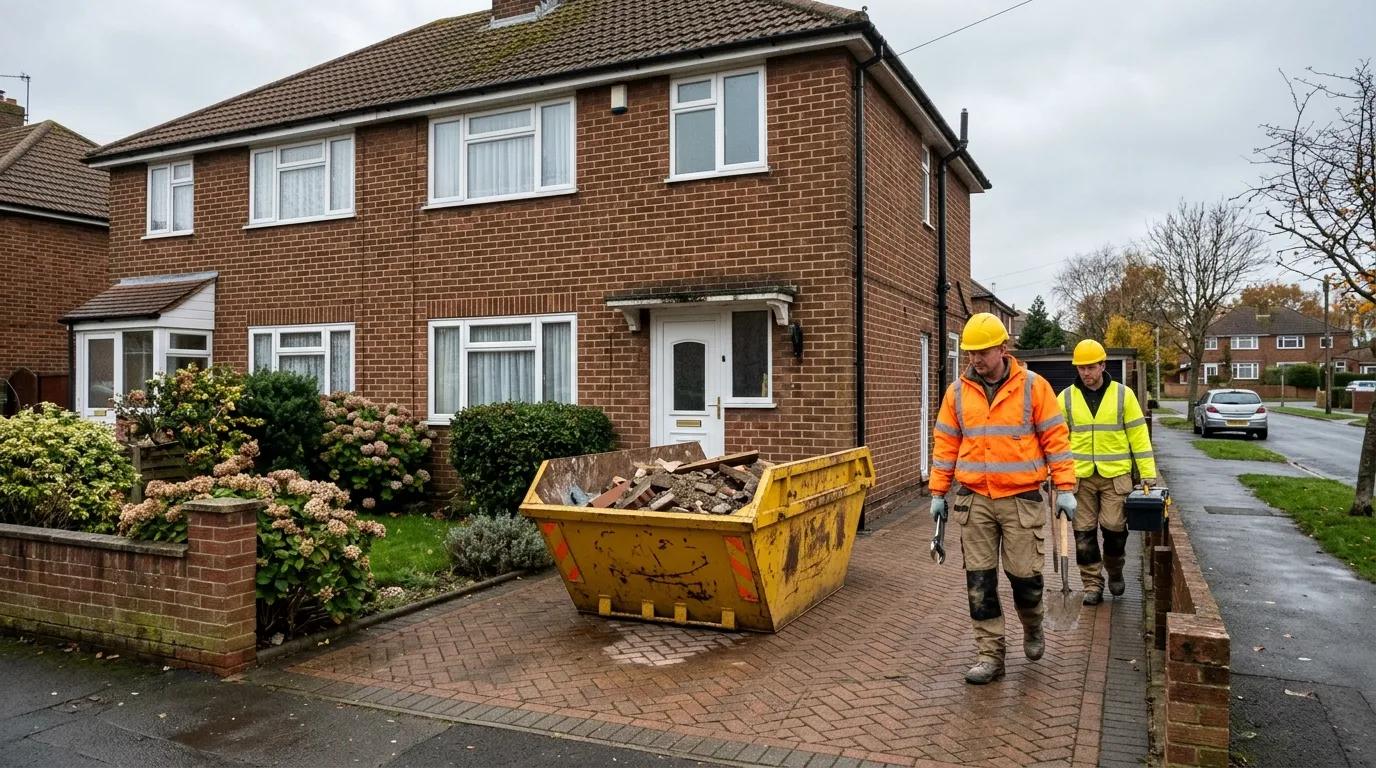
On a priced job the skip is not a separate purchase, it sits in the preliminaries alongside scaffold, protection, welfare and parking, and that whole group typically runs 10 to 15% of the total. Price it there, with the number of exchanges the programme actually needs, rather than remembering it when the first one fills up. Our guide to preliminaries on building work covers how the rest of that group is priced.
Pricing the job the skip belongs to
Skip size is a small decision that trips up the programme when it is wrong: a second collection part way through a strip out stops the trades, and a skip too big is money spent on air. If you are pricing a bathroom, kitchen or extension where the waste matters, our detailed estimating service prices the whole job with waste and disposal as its own line, and our estimating software gives you the same breakdown yourself in minutes.
Which skip size do I need?
- Recommended skip size
- 4
A rough guide only, based on roughly 12 bin bags per cubic yard of skip space. Heavy waste such as rubble or soil reaches the weight limit well before the skip looks full.
Common questions
What skip sizes can be hired? Standard road going skips run 2, 4, 6, 8, 12, 14 and 16 yards, with 20 to 40 yard roll on roll off skips for bulk waste on larger sites. Mini (2 yard) and midi (4 yard) are the driveway sizes, 6 and 8 yard are the builder's sizes.
Are skips charged per day or per hire period? Per hire period, normally 7 or 14 days included in the price, with extensions charged by the week. Nobody charges by the day, but a skip left beyond the agreed period picks up an extended hire charge, and a highway permit that expires has to be renewed.
How wide does a skip lorry need to be? The lorry is around 2.3 to 2.5 m wide and needs roughly 3 m of clear running width plus overhead clearance to tip the skip. If the access is narrower than that, the skip cannot be delivered however small it is.
Can I put a 4 yard skip on the road? Yes, with a council permit, lights and markings. On your own driveway none of that applies.