

A party wall agreement is the written settlement reached under the Party Wall etc. Act 1996 before work starts on a shared wall, a boundary wall or an excavation close to a neighbour's building. In law it is called a party wall award, and it is drawn up by a surveyor once notice has been served and the neighbour has dissented or stayed silent. If the neighbour consents to the notice in writing, there is no award, no surveyor and no fee: that written consent is the agreement.
This page is for builders, contractors and anyone pricing a job that falls under the Act: what counts as notifiable work, which notice to serve and when, how long the process takes, what the award contains, who pays and how the fees sit inside a job estimate.
What a party wall is
The Act applies in England and Wales and recognises more than one kind of party structure:
- A wall standing astride the boundary between two owners' land, whether it is part of a building or a free standing garden wall (a party fence wall; a timber fence is not covered).
- A wall standing wholly on one owner's land but separating two buildings, so only the part doing the separating is the party wall.
- A party structure, which includes floors and partitions between flats in the same building, not just vertical walls.
The government's explanatory booklet on the Party Wall etc. Act 1996 sets out the types with diagrams and carries the example notice letters, which are free to use.
When you need a party wall agreement
The Act bites in three situations:
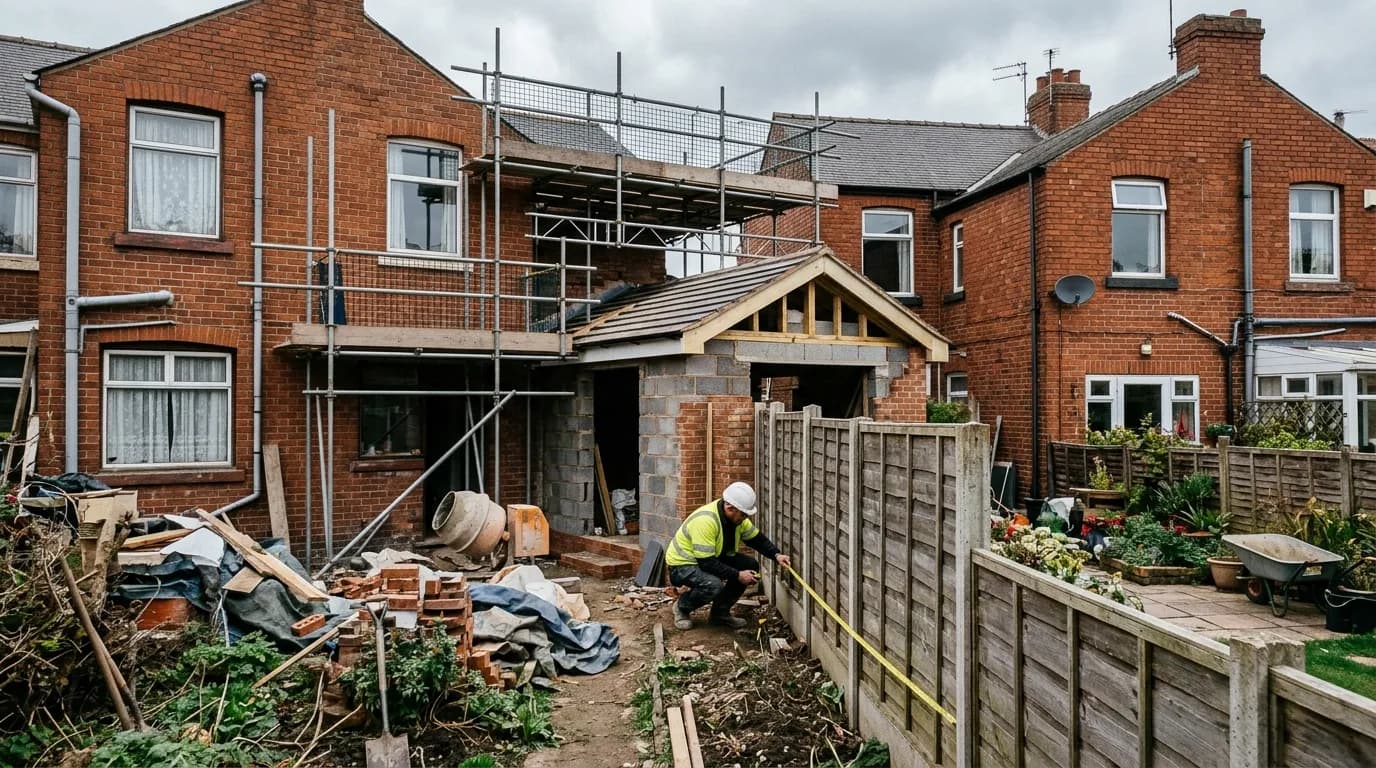
- Work directly to a shared wall or structure (cutting in, raising, underpinning, rebuilding, inserting a damp proof course, cutting a beam into it).
- Building a new wall on or up to the line of junction with a neighbour.
- Excavating close to a neighbour's building, under the 3 metre and 6 metre rules below.
Jobs that are normally notifiable: cutting a steel beam and padstones into a party wall, removing a chimney breast off a party wall, underpinning, loft conversions where steels bear on the party wall, raising or rebuilding a party wall, and extension or basement foundations dug near the boundary.
Jobs that are normally not notifiable: replastering a party wall, chasing in for sockets or a rewire, fixing shelves, kitchen units or a boiler to it, and extensions far enough from the boundary that no excavation test is met. Minor work of this kind is usually left alone, but anything that cuts into the structure or takes load off it should be checked before the programme is fixed.
The 3 metre and 6 metre excavation rules
Both rules are about depth, not just distance:
- 3 metre rule. Excavation within 3 metres of a neighbour's building or structure, where the new foundation goes deeper than the bottom of theirs. Most extension trench fill foundations next to an older shallow footing fall straight into this.
- 6 metre rule. Excavation within 6 metres, where any part of the excavation would cut a line drawn downwards at 45 degrees from the bottom of the neighbour's foundation. This catches deep pads, piles and basements.
Measure from the neighbour's building, not the boundary, and work off the engineer's foundation depth rather than an assumption. We cover the 3 metre rule and how to apply it on site in more detail on its own page.
Types of notice and when to serve them
There are three notices, and one job can need more than one. An extension with foundations near the boundary and a steel into the party wall usually needs two.
| Notice | Section of the Act | Work it covers | Minimum notice period |
|---|---|---|---|
| Line of Junction Notice | Section 1 | A new wall built on, astride or up to the boundary | 1 month before work starts |
| Party Structure Notice | Section 3, for works under Section 2 | Work to an existing party wall or party structure | 2 months before work starts |
| Notice of Adjacent Excavation | Section 6 | Excavation within 3m or 6m of a neighbour's building | 1 month before work starts |
A notice is valid for 12 months: if the work has not started within a year of the notice being served, it lapses and has to be served again. That is worth knowing when a client serves early and then waits on planning or funding.
Serving notice correctly
Notice is served by the building owner, or by a surveyor or architect on their behalf, on every adjoining owner. "Owner" is wider than the person living there: it covers freeholders, long leaseholders and anyone holding a lease with more than a year to run, so a let flat can mean two or three notices for the same property. Serve on all of them. Where ownership is unknown, the notice can be addressed to "the owner" of the property and delivered there, with a copy fixed to a conspicuous part of the premises.
The notice must name the building owner, describe the proposed work with enough detail for the neighbour to understand it (drawings and sections for excavation work), and give the date work will start. Get the design far enough on to describe the work properly before serving, because a vague notice invites a dissent.
The process, step by step
- Identify the notifiable work from the drawings: party structure, line of junction, excavation, or a combination.
- Prepare the drawings and sections you need, including foundation depths, so the notice describes the work accurately.
- Serve the correct notice on every adjoining owner, allowing 1 or 2 months as above.
- Wait for the response period: the adjoining owner has 14 days to reply.
- Consent in writing ends the matter. Dissent, or silence after 14 days, puts the matter into dispute under the Act.
- Appoint surveyors: either one agreed surveyor acting impartially for both owners, or one surveyor each, who then select a third surveyor to settle any deadlock between them.
- The surveyor takes a schedule of condition of the neighbouring property, usually photographs and notes of existing cracks and finishes.
- The award is drawn up and served on both owners.
- Either owner has 14 days from service to appeal the award to the county court.
- Work starts in accordance with the award.
What happens after notice is served

- Written consent. No award, no surveyor fee, and work can start once the notice period has run. This is the usual outcome on small domestic jobs where the neighbour is told what is happening early.
- No response within 14 days. The neighbour is deemed to have dissented, and the dispute procedure runs even though nothing was actually in dispute.
- Dissent or a counter notice. The neighbour disagrees, or wants extra work for their own benefit, such as strengthening their own foundations while the ground is open.
On domestic work an agreed surveyor is the common and cheaper route. The third surveyor exists as a referee and is rarely called on.
The party wall award
The award is the document most people mean when they say party wall agreement. It records:
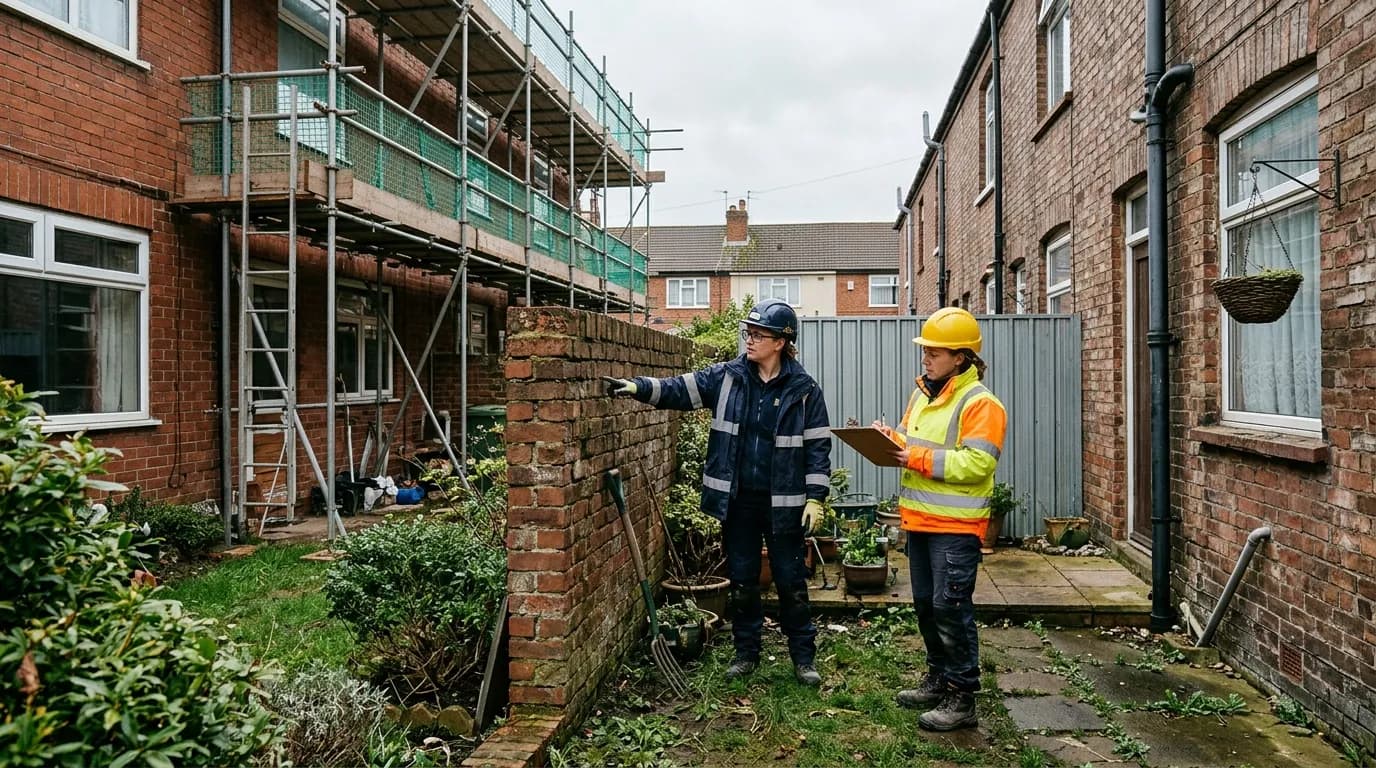
- The work that is authorised and the method of carrying it out, including any temporary support or protection.
- The hours work may take place, and sometimes restrictions on noisy operations.
- A schedule of condition of the neighbouring property, used to settle any damage claim afterwards.
- Rights of access to the neighbour's land where the work needs it, and the notice to be given before each visit.
- The surveyors' fees and who pays them.
- How anything arising during the work, including alleged damage, is dealt with by the surveyors rather than by the owners arguing on site.
Work covered by the award can begin as soon as the award is in force, even if the original notice period has not fully run.
Who pays
The default under the Act is that the building owner, the one doing the work, pays the cost of the works and all reasonable surveyor fees, including the adjoining owner's surveyor, because the work is for the building owner's benefit. The exceptions:
- Work carried out for the adjoining owner's benefit, or extra work they ask for, is paid by them.
- Repairs to a shared wall can be shared between the owners in proportion to their use of it.
- Costs run up by unreasonable requests or obstruction by either owner can be awarded against that owner.
Typical UK party wall surveyor fees, as an example only and not a quote from us:
| Scenario | Typical fee |
|---|---|
| Agreed surveyor, single notice, straightforward domestic job | £900 to £1,800 |
| Two surveyors, one each side, single notice | £1,800 to £3,500 combined |
| Two surveyors, excavation plus party structure notices, basement or larger job | £2,500 to £5,000+ combined |
| Third surveyor called in | Added on top, billed separately |
Fees are higher in London and rise with every extra adjoining owner: a mid-terrace job with notices both sides costs more than a semi with one neighbour. Our separate page on party wall surveyor cost goes into the fee structures in detail.
Party wall surveyor fee allowance
- Estimated allowance
- £1,300
Typical UK market fees used as a planning allowance, not a Builder Expert price and not a quote. Where the neighbour consents in writing there is no surveyor fee at all.
If notice is never served
Skipping notice does not make the work illegal in itself, but it strips the job of the protection the Act gives. The adjoining owner can apply for an injunction to stop the work, and courts do grant them. The building owner then carries ordinary common law liability for any damage, with no schedule of condition to prove what was already cracked before the job started.
For the builder the damage is commercial: a site shut down mid-build, labour stood down, hired plant sitting idle and a completion date that slips by months. If a client tells you to press on without notice, get the instruction in writing and price the risk, or walk away from it.
Can owners write their own agreement
Yes, up to a point. An adjoining owner can simply consent to the notice in writing, and that consent is the agreement: no surveyor, no award, no fee. The free example letters in the gov.uk booklet cover both the notice and the reply. Once there is a dissent, or 14 days of silence, the Act takes over: only appointed surveyors can make the award, and the two owners cannot draft it between themselves.
Two things the Act does not say
There is no "1 metre rule." The tests in the Act are the line of junction and the 3 metre and 6 metre excavation rules, all tied to depth and distance from the neighbour's building. A boundary distance of one metre on its own means nothing under the Act.
The "12 year rule" is not part of the Act. That phrase comes from adverse possession and limitation periods in property law, a separate matter entirely. It does not create or remove any party wall right.
Party wall, planning and building regulations
These are three separate consents and one job can need all three. Planning permission deals with what you are allowed to build, building regulations deal with how it is built and are signed off by building control, and the Party Wall Act deals with your neighbour's rights. None of them replaces another: an approved planning application is no defence to a missing party wall notice.
Allowing for party wall costs in your estimate and programme
Party wall surveyor fees are a professional fee, like the structural engineer and the building control charge. They belong on their own fee line in the estimate, or as a provisional sum where the neighbour's response is unknown, and they are paid by the client. They are never buried inside the rate for the wall or the excavation they relate to.
Three things to build into the job:
- The fee line. List it with the engineer and building control fees so the client can see what is a professional fee and what is construction work.
- The programme. One or two months of notice period, plus two to six weeks for surveyors to agree an award, sit in front of the start date. A start date promised before the award exists is a date you will miss.
- The preliminaries. Working hours in the award, often weekdays only with no early starts and no noisy work at weekends, cut productive hours on site. That lands in preliminaries and in the programme, not in trade rates.
If you are pricing a loft conversion, rear extension or basement that needs a party wall agreement, our detailed estimate sets out the build cost and the professional fees as separate lines, so the client sees exactly what they are paying for and what is still an allowance. Builders who price these jobs week in, week out can run the same numbers themselves in minutes with our estimating software, keeping party wall, engineer and building control fees consistent from one job to the next.