
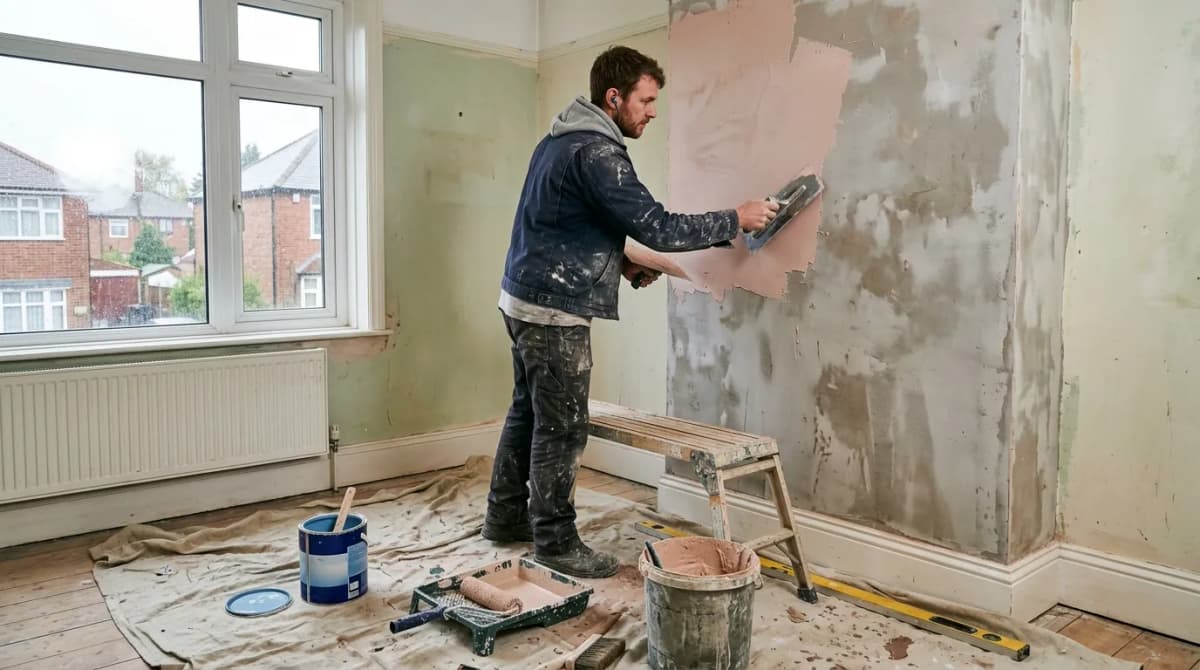
A self employed painter and decorator hourly rate in the UK runs from about £18 to £30 an hour outside London, and £25 to £40 an hour in London and the South East, labour only. That works out at roughly £150 to £220 a day in most of the country and £200 to £320 a day in and around London, for one tradesman working direct for the client on an eight hour day.
This page is written for builders, main contractors and finishing trades pricing work: decorating, plastering and tiling rates side by side, with the labour outputs behind them, so you can build a real number instead of guessing. Figures are indicative and current as at November 2026, not a quotation.
Rates compared: painter, plasterer and tiler
| Trade | Hourly rate, labour only | Day rate, labour only | Typical output or measured rate |
|---|---|---|---|
| Painter and decorator | £18 to £40 | £150 to £320 | 40 to 70 m² of wall a day, two coats of emulsion; usually priced by the room |
| Plasterer | £20 to £40 | £180 to £300 | 10 to 15 m² a day skimming; 20 to 30 m² a day boarding and skimming with a labourer |
| Tiler | £20 to £40 | £180 to £300 | 8 to 15 m² a day floors, 6 to 12 m² a day walls; usually priced at £25 to £45 per m², fitting only |
The top of each range is London and the South East. All four columns above are labour only: the client or the main contractor supplies paint, plaster, boards, tiles and adhesive. Supplied and fitted rates, where the trade brings the materials, sit higher, and every figure later on this page says which of the two it is.
The table also shows why comparing trades on one hourly figure rarely works. A plasterer's day includes drying time built into the sequence of coats, a tiler's per m² price includes setting out and grouting that never appears as hours, and a painter's day on a fiddly staircase buys far less coverage than the same day on a flat, freshly plastered wall.
Self employed painter and decorator hourly rate
The self employed painter and decorator hourly rate above is the specialist's own price for a standalone job booked direct with a private client, not a line inside a bigger project. A decorator who comes to a finished house for two days of touching up and painting a bedroom prices what he can see: the walls are sound, the floor is covered, he is in and out.
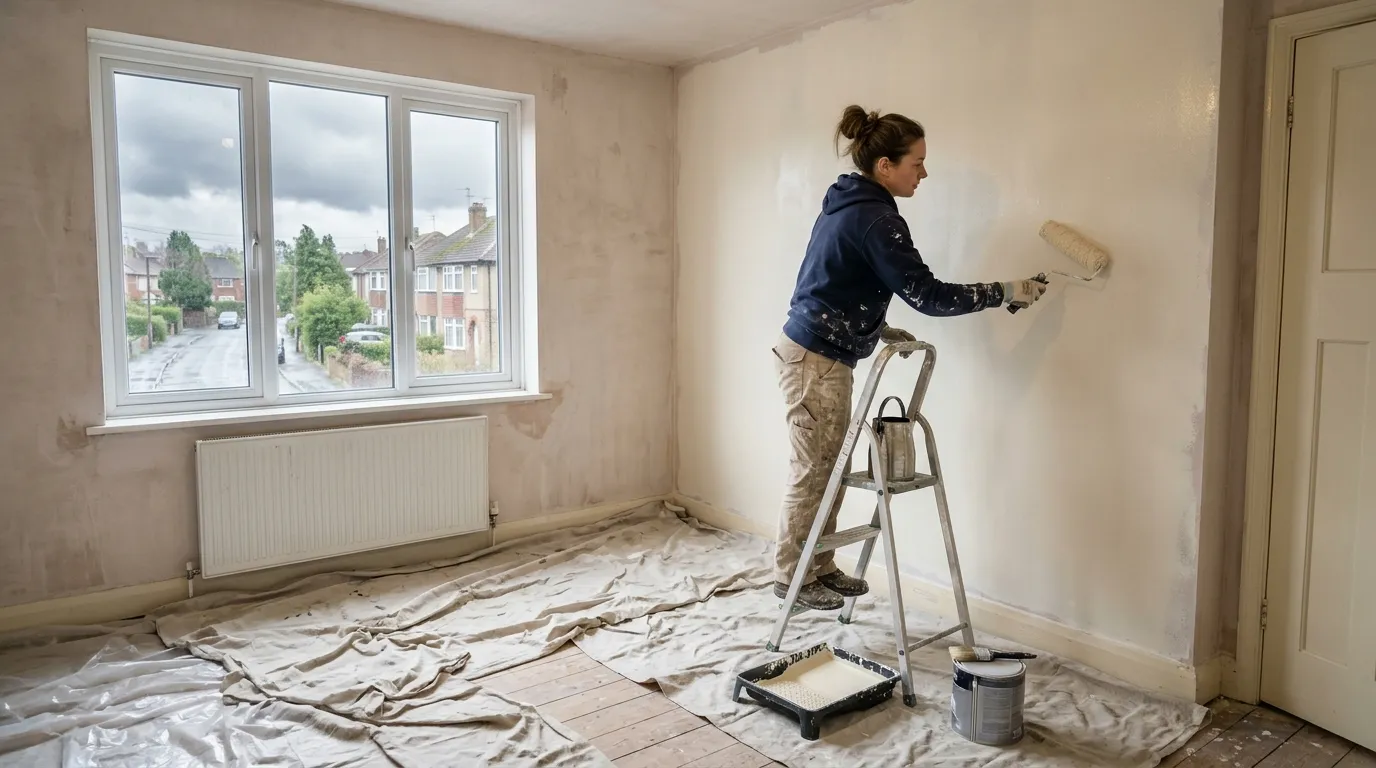
A day rate is not a fixed number of square metres, because output depends entirely on the surface. On freshly skimmed or previously painted walls that need a sand and a wipe down, a decorator will cover 15 to 20 m² an hour in emulsion, so 40 to 70 m² of wall across a working day once cutting in, moving furniture and setting up are taken off. On old, uneven plaster that needs filling, sanding and a mist coat first, the same wall takes three or four times as long before a drop of top coat goes on. Woodwork is slower again: a day on skirting, architraves and doors is mostly preparation.
What the hourly rate does and doesn't include
A self employed decorator's hourly or day rate covers his own labour. It does not automatically include paint and materials (many quote supplied and fitted, but plenty work labour only against materials you provide), access beyond a basic set of ladders, or making good the plaster before he starts.
If a wall needs cracks filled, a patch skimmed or boarding first, that is either agreed as part of the job or it is someone else's work, usually a plasterer's, done before the painter arrives. Get that line wrong on a quote and the preparation ends up unpriced on somebody's job, normally the main contractor's.
How a self employed tradesman sets his hourly rate
The charge-out rate is not take-home pay, and the gap between the two is where a lot of one man businesses go wrong. Work it out from the bottom up. Replace every figure below with your own.
Say you want £35,000 a year in your pocket. The year has 260 working days; take off 25 days holiday, 8 bank holidays, a few days sick, and roughly a day a week lost to quoting, buying materials, travel and chasing money, and you are realistically billing 190 to 200 days.
Then the business costs that come out before you pay yourself: van finance or depreciation and fuel at £5,000 to £7,000, public liability and van insurance around £600 to £1,000, tools, consumables and PPE around £1,500, phone, accountant and bookkeeping around £1,200, pension and training whatever you put in. Call it £10,000 a year on a modest set-up.
So you need £45,000 across 195 billable days, which is £231 a day, or about £29 an hour on an eight hour day. That is why a decorator charging £20 an hour and working flat out ends up with less than an employed painter on a site rate: the rate was set against wages, not against the cost of running a business.
VAT and CIS are not your costs
Two numbers frighten new tradesmen and neither is a cost to the business. VAT a registered trader charges is collected for HMRC and handed over, and the VAT on paint, boards and tiles is reclaimed against it, so the money passes through. Registration is compulsory once taxable turnover passes the £90,000 threshold. Watch the domestic reverse charge too: on most CIS work between VAT registered businesses you do not charge VAT on the invoice at all, the contractor accounts for it, which hits your cash flow rather than your profit.
CIS is the same idea. Working for a contractor, 20% is deducted from the labour element of your invoice if you are registered with HMRC for the Construction Industry Scheme, and 30% if you are not. That deduction is an advance payment against your own tax bill, not a tax in itself, and with normal expenses most subcontractors get some of it back at the end of the year. Materials invoiced separately are outside the deduction, which is one reason labour and materials are always split on a CIS invoice. Register before your first job: the full rules are on the GOV.UK guide for CIS subcontractors, and we cover the paperwork in our CIS guide for builders.
When to price by the hour, by the day and by the m²
Hourly suits small call-outs and snagging: an hour touching up a hallway, half a day on a snag list after another trade. Day rate suits work where the preparation is unknown, which is most redecoration of an occupied house, because nobody can measure how long filling and sanding will take until they start.
Per m² or per room suits measurable, repeating work: boarding and skimming, tiling, a full house of emulsion after a refurbishment. The quicker you get, the more a measured price is worth: an hourly rate punishes speed, a price for the job rewards it. The one rule either way is to write down what the price includes and where the job stops.
Decorating costs per room
Pricing a whole room gives a more realistic figure than an hourly rate, because it carries the real time a room takes: moving furniture, protecting floors, filling, sanding, two coats on walls and ceiling, and the woodwork. These are Builder Expert's own current rates from real estimates, supplied and fitted in white emulsion and eggshell, and they are customer prices: labour, materials, our margin and 20% VAT are already in them, so nothing is added on top. They are London and South East prices, not a UK average.
| Room, decorated complete | Typical price, supplied and fitted |
|---|---|
| WC | £650 |
| Storage cupboard | £295 |
| Utility room | £1,000 |
| Bathroom | £1,000 |
| Study | £1,075 |
| Bedroom | £1,305 |
| Kitchen | £1,350 |
| Living room | £1,650 |
| Dining room | £1,650 |
| Hallway, including the balustrade | £1,865 |
These assume a normal sized room in reasonable condition, needing the usual preparation rather than a plaster repair. A big room, heavy wallpaper to strip, or dark colours needing extra coats push the price above them.
What a room price means as a day rate
Take the bedroom. A 4 m by 3.5 m room with a 2.4 m ceiling has roughly 36 m² of wall and 14 m² of ceiling, plus a door, a window, skirting and architrave. Our figure of about £1,305 covers preparation, two coats of emulsion to walls and ceiling and the woodwork in eggshell, supplied and fitted.
One decorator does that properly in about three days. £1,305 over three days is roughly £435 a day as a customer price. That sits above the £200 to £320 a self employed decorator charges direct, and the difference is not profiteering: our figure carries the paint, filler, dust sheets and tape, the margin and the VAT, where his day rate is labour only before any of that.
Priced by the day instead, our own rates for the separate parts of a decorating job are about £430 a day for two coats of emulsion to ceilings, £444 a day for walls, and £452 a day for preparing and finishing woodwork and doors in eggshell, all supplied and fitted. Hanging wallpaper runs at about £27 per m², fitting only, with the paper supplied by the client. External decorating is priced differently again: making good and painting external walls at about £43 per m², an external door at around £585 and a window including its sill at around £560, each supplied and fitted, because access and weather add time indoor work never carries.
Plastering rates
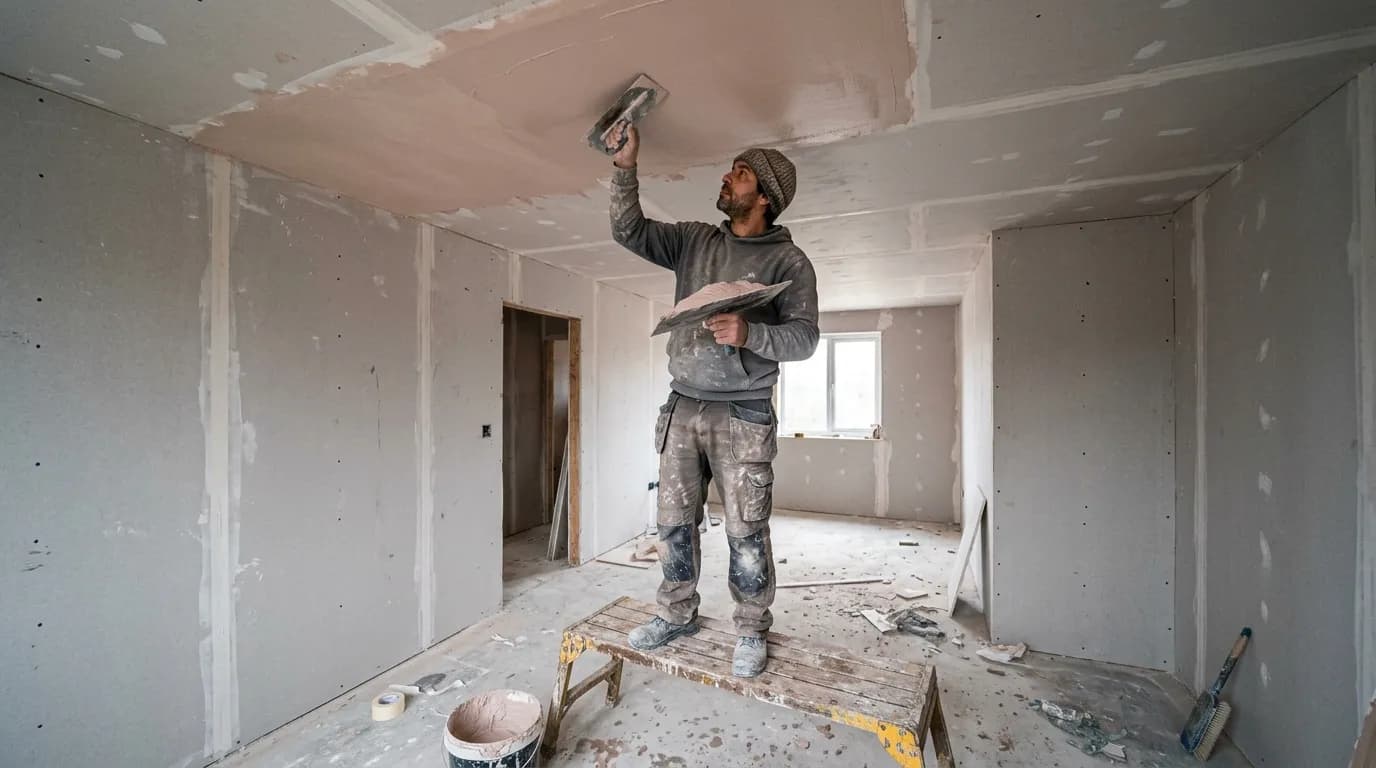
Plastering is priced by the m², and the rate changes with what goes on the wall or ceiling, not just the skim on top. The figures below are Builder Expert's own, supplied and fitted, covering the board where one is needed and the finishing skim, with labour, materials, margin and VAT included. Again, London and South East.
Worked through on a real room, the 4 m by 3.5 m bedroom above has about 36 m² of wall and 14 m² of ceiling. Overboarding and skimming the lot in standard 12.5mm board comes out around £2,950, supplied and fitted (36 m² at £57 plus 14 m² at £63). Skim coat only, over existing walls and ceiling that are sound and flat, is around £1,250 for the same room (50 m² at £25). Walls alone, boarded and skimmed, are about £2,050 (36 m² at £57).
| Plasterboard and finish, supplied and fitted | Walls, per m² | Ceilings, per m² |
|---|---|---|
| Skim coat only, no boarding | £25 | £25 |
| Standard 12.5mm board and skim | £57 | £63 |
| Sound block 12.5mm board and skim | £60 | £65 |
| Fireproof 12.5mm board and skim | £60 | £66 |
| Moisture resistant 12.5mm board and skim | £62 | £68 |
| Insulated 62.5mm board and skim | £84 | £89 |
Ceilings cost more than walls for the same board, because everything happens overhead off a board or trestle. The jump from standard to insulated board is the insulation and the extra weight to fix safely, not the plastering labour, so specify the lighter board unless the job genuinely needs the thermal upgrade, for example a cold external wall in a basement conversion.
A plasterer booked direct for a standalone job typically charges £180 to £250 a day across most of the UK and £220 to £300 in London, labour only, for a two coat skim. A competent plasterer skims 10 to 15 m² a day of straightforward wall or ceiling once it is boarded, less in a fiddly room with reveals, corners and a ceiling rose to work around, and 20 to 30 m² a day boarding and skimming with a labourer to hand.
Where a job needs a metal stud partition built in a basement conversion, with insulation behind moisture resistant board, our own rate for that drylining work is around £89 per m² supplied and fitted, separate from the plaster finish above.
Tiling rates
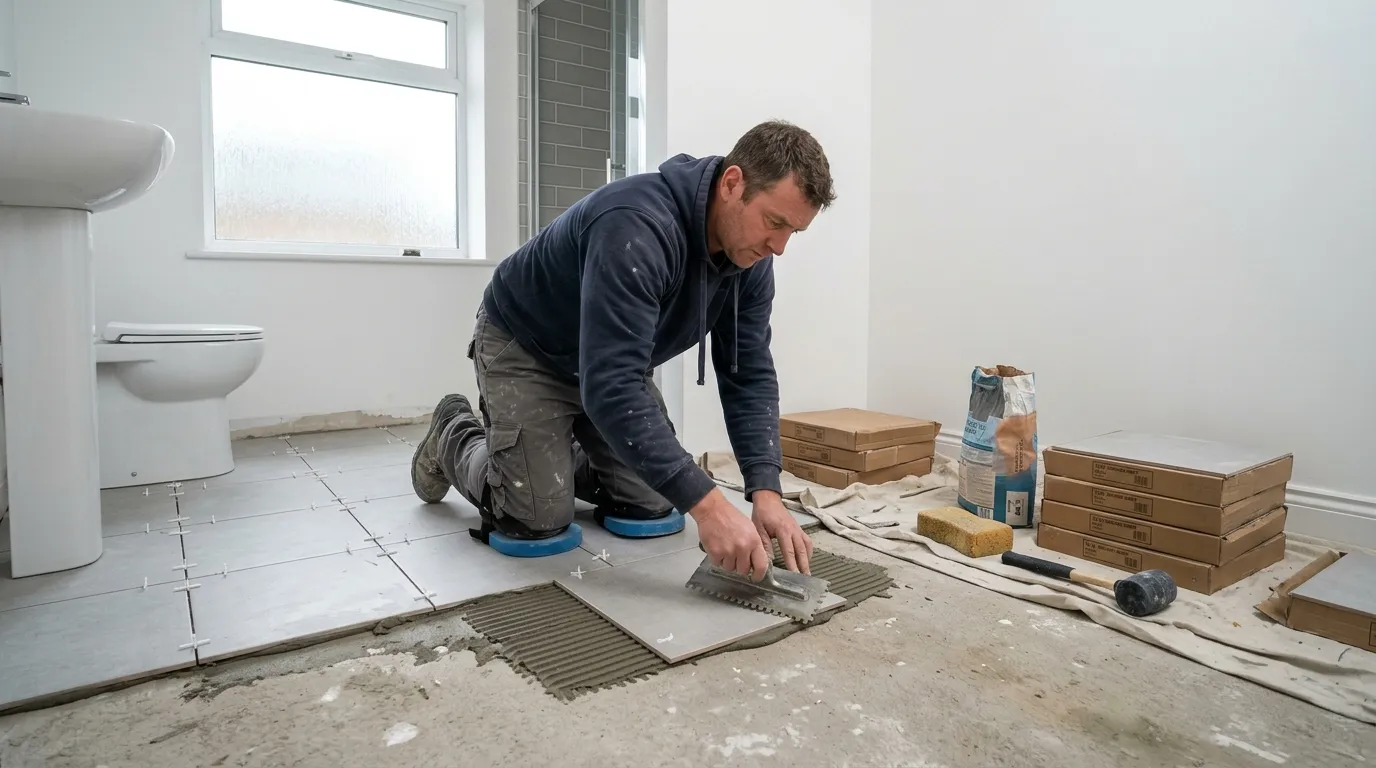
Tiling is priced per m², and the market range is wide because so much depends on the floor or wall underneath and on the tile. For ceramic floor tiling, supplied and fitted, the current UK market runs from around £30 to £70 per m². The low end assumes a large, flat, well screeded floor with few cuts, which a specialist pricing the exact job in front of him can do quickly and still make good money.
The top end assumes a smaller area, more cuts around fittings, and a floor needing levelling first. Natural stone and large format porcelain cost more to fit, typically £55 to £100 per m² supplied and fitted, being heavier, needing careful setting out and less forgiving of an uneven base. Bathroom wall tiling typically runs £35 to £65 per m² supplied and fitted, depending on tile size and the cutting the layout needs around sanitaryware and windows.
Fitting only, with the client supplying the tiles, usually runs £25 to £45 per m² for floors and £25 to £40 per m² for walls, because the tiler still prepares the surface, sets out, cuts and grouts. A tiler lays 8 to 15 m² of floor or 6 to 12 m² of wall in a day, at the lower end in small bathrooms with heavy cutting.
Tiles themselves are the client's budget
On our estimates the tiles are a provisional sum: a budget the client sets, not a price we quote, because the choice swings the figure more than the fitting does. The current UK market average for ceramic wall and floor tiles is roughly £15 to £35 per m², porcelain roughly £25 to £60 per m², and large format or natural stone from £50 per m² upwards, with trims, matting and upgraded adhesives on top. Treat those as market averages, separate from our fitting rates, and remember the builder's margin and VAT still apply to a client's allowance when he buys it for them: a £2,000 tile budget costs roughly £2,880 by the time it is bought and fitted through a contractor.
Why a project rate sits above a specialist's price
A specialist pricing direct stands in the room and prices tight. Inside a project the main contractor has no such comfort: he pays a mid range subcontract price and carries everything around the work, because the subcontractor does only his own part. Preparing the surface, making good after other trades, moving the client's furniture again, and putting right whatever turns up all fall on the contractor's own labour, and that is worth roughly 20% on the same task.
That is why our per m² figures sit between the middle and the top of the market range rather than at the bottom. Priced from drawings, nobody knows that the floor is flat or the walls are plumb, and nine times out of ten there is more preparation than the drawing shows, rarely less.
What a low price leaves out
A low quote on paper is usually the bare minimum. "Paint the woodwork" can be three hours of splashing paint on, or three days of sanding, filling, priming, undercoating and two top coats with a sand between each: the same line on the quote, a completely different result.
A cheap tiling price has no allowance for levelling an uneven floor, so either the tiles follow the dip or somebody pays for a latex screed later. A cheap skim goes on over walls that are out of true, which is smooth but not level, and the client only finds out when the kitchen units go on. None of that is dishonest, it is just a different job, and the gap comes back as extras, a rushed finish, or work done to the letter and not to the standard expected.
Regional variation
| Region | Decorator day rate, labour only | Plasterer day rate, labour only |
|---|---|---|
| London and the South East | £200 to £320 | £220 to £300 |
| Midlands, South West, East | £160 to £230 | £180 to £250 |
| North of England | £150 to £200 | £170 to £230 |
| Scotland, Wales, Northern Ireland | £140 to £200 | £160 to £230 |
Builder Expert's own rates throughout this page are London and South East prices. Outside that, the same job generally comes in lower, mostly on labour rather than materials, so adjust before you use them on a job in Newcastle or Swansea. For context on what employed finishing trades cost a firm, see our guide to JIB and CIJC wage rates, and for how these tasks sit inside a full priced job, our estimate tasks breakdown.
Pricing finishing work across a whole job
Working these numbers out by hand for every room takes time, and it is easy to miss a line: making good around a radiator, an extra coat on a dark colour, the hallway ceiling nobody measured. Builder Expert's estimating software builds the full decorating, plastering and tiling cost for a project from the same rates behind this page, room by room, in minutes, which suits a builder pricing his own jobs week in, week out.
If you would rather hand it over, our detailed estimating service prices the work from your drawings and returns a document you can put in front of a client. Last reviewed November 2026.