
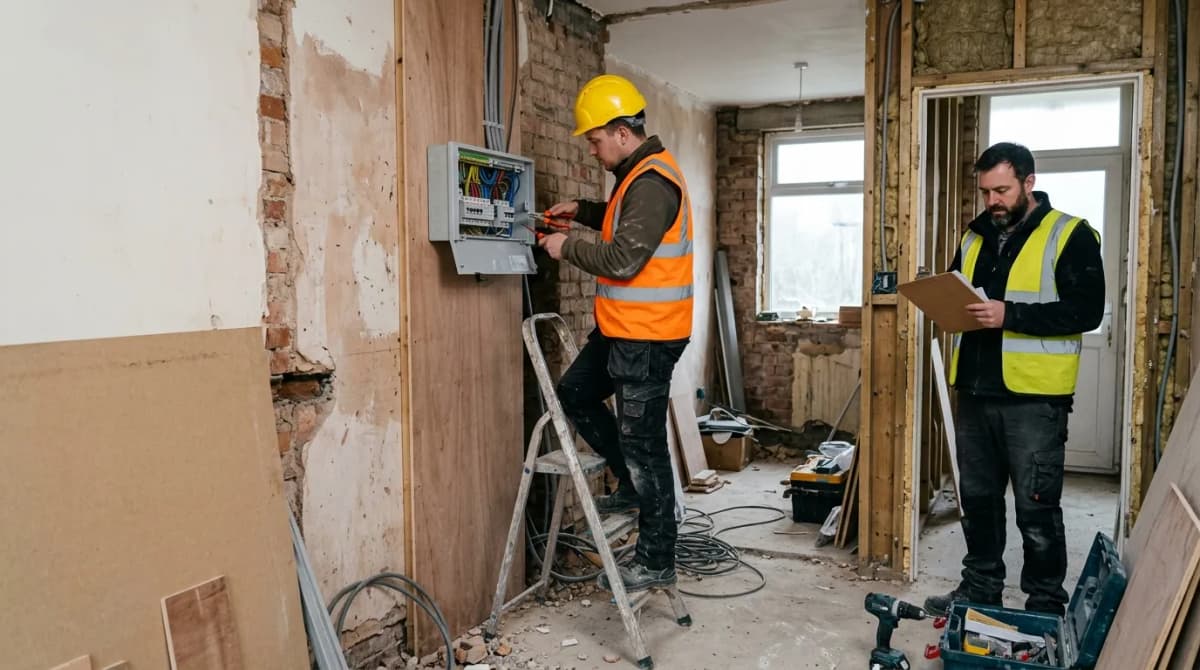
JIB rates are the hourly wage grades set by the Joint Industry Board for the electrical contracting industry, and CIJC rates are the equivalent grades set by the Construction Industry Joint Council for building and civil engineering operatives. From 5 January 2026 the JIB national standard rate is £18.38 an hour for an Electrician, £20.08 for an Approved Electrician and £22.70 for a Technician; from 20 July 2026 the CIJC craft rate is £16.40 an hour and the general operative rate £13.18.
This page is for the builder, electrical contractor or quantity surveyor pricing work. It sets out both grade structures, the allowances that sit on top, and how a published wage turns into the labour rate you actually charge once holiday, National Insurance, pension and overheads are in.
What JIB and CIJC rates are, and who they bind
The JIB is the national agreement for the electrical contracting industry in England, Wales and Northern Ireland, made between the Electrical Contractors' Association and Unite the Union. The CIJC Working Rule Agreement is the building side's equivalent, agreed between the main contractor federations and Unite and GMB, and it covers bricklayers, carpenters, groundworkers, plant operators and general labourers.
Neither is law. They bind member companies and signatories: a JIB member firm, or an employer whose contracts of employment or collective agreement apply the CIJC Working Rule Agreement. A small non-member builder is bound only by the National Living Wage and ordinary employment law. In practice both agreements still matter to every estimator, because main contractors often require them on site, and because they are the recognised national benchmark for checking whether a wage or a subcontract price is realistic.
JIB graded operative rates from 5 January 2026
The figures below are the JIB National Standard rates for graded operatives, effective Monday 5 January 2026, under the JIB Industrial Determination 2026 to 2028 published in the JIB handbook. They are the Transport Provided column; where the operative uses their own vehicle, the Own Transport rate applies and runs roughly £1.10 an hour higher.
| Grade | Transport provided | Own transport |
|---|---|---|
| Site or Installation Technician | £22.70 | £23.96 |
| Approved Electrician | £20.08 | £21.25 |
| Electrician | £18.38 | £19.49 |
| Adult Trainee | £15.69 | £16.61 |
The graded rates rose 3.95% in January 2026 and the same determination sets 4.6% from 4 January 2027 and 4.85% from 3 January 2028, so a pricing spreadsheet can be updated in advance.
JIB apprentice rates by stage
Apprentices are paid by stage, not by year. A stage is reached on college and NVQ progress, so an apprentice who has not completed the required units stays on the lower stage even after twelve months.
| Apprentice stage | National hourly rate from 5 January 2026 |
|---|---|
| Stage 4 | £14.03 |
| Stage 3 | £13.05 |
| Stage 2 | £10.60 |
| Stage 1 | £8.16 |
Apprentice rates were frozen at the January 2026 settlement and rise by 2% in 2027 and 3% in 2028. Check which transport column applies before you use one of these in a price.
The JIB working week and overtime
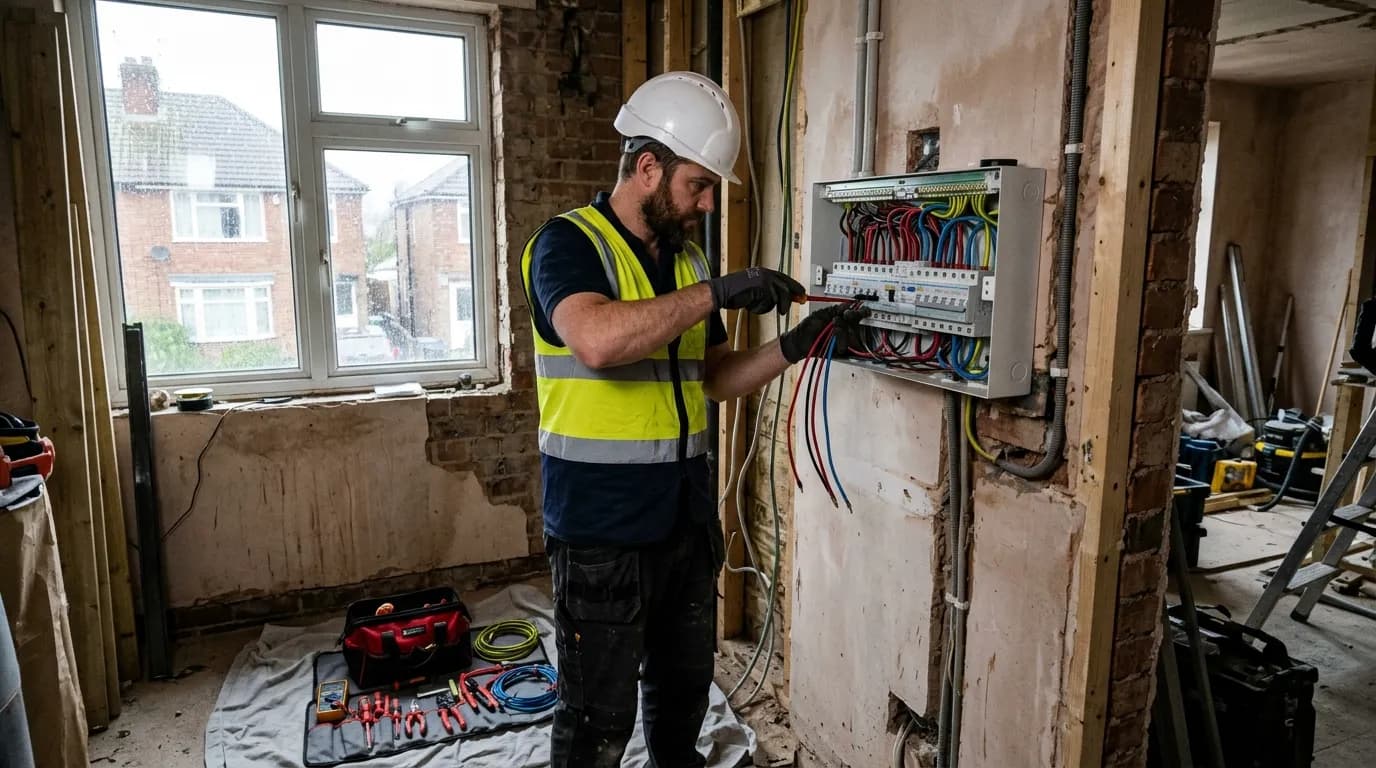
The JIB standard working week is 37.5 hours. Hours worked beyond the normal daily hours Monday to Friday, and on Saturdays, are paid at time and a half; Sundays, bank holidays and hours worked after midnight attract double time. Overtime multiplies the base grade rate only: travel allowances and lodging are paid at their flat value, not enhanced. On a job with Saturday working built into the programme, an Approved Electrician's £20.08 becomes £30.12 an hour for those hours, which is why an overtime assumption should be written into the estimate rather than discovered on site.
CIJC building operative rates from 20 July 2026
The CIJC standard working week is 39 hours: eight hours Monday to Thursday and seven on Friday. These are the basic minimum rates agreed in the 2026 settlement, effective Monday 20 July 2026.
| Grade | Hourly rate | 39-hour week |
|---|---|---|
| Craft Operative (bricklayer, carpenter, plasterer) | £16.40 | £639.60 |
| Skill Rate 1 | £15.61 | £608.79 |
| Skill Rate 2 | £15.04 | £586.56 |
| Skill Rate 3 | £14.07 | £548.73 |
| Skill Rate 4 | £13.30 | £518.70 |
| General Operative | £13.18 | £514.02 |
Apprentice rates under the agreement start at £8.29 an hour in year one and £8.80 in year two. An apprentice who has achieved NVQ Level 2 moves to £13.13 an hour, and on completion with NVQ Level 3 to the full craft rate of £16.40. Where a rate would fall below the statutory floor, the National Living Wage of £12.71 an hour for workers aged 21 and over applies instead; the National Minimum Wage rates on gov.uk are the check.
Allowances on top of the hourly rate
Neither agreement stops at the basic rate. The allowances below are paid on top, and all of them move with each settlement, so take the current figures from the determination or promulgation before you price:
- Travel time: paid where the daily journey to site exceeds the threshold in the rules, calculated in bands by distance from the shop or from home.
- Daily travel allowance or fares: a flat daily payment by distance band, paid whether or not the operative claims mileage.
- Transport and mileage: the JIB Own Transport rate covers an operative using their own vehicle; CIJC pays a mileage band instead.
- Lodging or subsistence: a nightly allowance where the operative stays away from home, plus a weekend retention payment on long jobs.
- Responsibility and supervisory supplements: an hourly addition for an operative running a gang or holding specific responsibility on site.
London and regional weighting
Both agreements carry higher rates inside London. On the JIB, the London Zone runs about 12% above the national standard: from 5 January 2026 that is £22.48 an hour for an Approved Electrician, £20.58 for an Electrician and £25.47 for a Technician. Apply the published London figure rather than adding a percentage of your own, and remember the weighting applies to the basic rate, so overtime and the allowances move with it.
From wage rate to the rate you charge
A JIB or CIJC hourly wage is what the worker receives. It is never the rate you put on an estimate, because it carries none of the cost of employing that person and none of the hours you pay for but do not sell.

Productive hours in a year
Start with contracted hours and take out everything you pay for but cannot sell. On the JIB week: 37.5 hours over 52 weeks is 1,950 paid hours. Take off 22 days annual holiday and 8 public holidays (30 days at 7.5 hours, 225 hours), 5 days of training and card renewals (37.5 hours), 5 days of average sickness (37.5 hours), and around 150 hours of non-productive time (travel inside the working day, toolbox talks, waiting, snagging that was never priced). That leaves about 1,500 productive hours a year. Divide fixed employment costs by that figure, not by 1,950, or every rate you build is roughly a fifth too low.
Worked example: one Approved Electrician
This is an example, not a quotation. It uses the January 2026 national rate and typical 2026/27 employer costs.
| Line | Annual figure |
|---|---|
| Wage, 1,950 paid hours at £20.08 (holiday and public holidays are inside this) | £39,156 |
| Employer's National Insurance, 15% above the £5,000 secondary threshold | £5,123 |
| Pension, 3% of qualifying earnings | £987 |
| JIB benefits and welfare contributions (combined benefits scheme) | £600 |
| Training: CITB or industry levy, card renewals, courses | £500 |
| Total cost of employment | £46,366 |
| Divided by 1,500 productive hours | £30.91 per hour |
Note what has happened: the £20.08 headline is already £30.91 before a single penny of overhead or profit, and the biggest single cause is the productive-hours divisor rather than the taxes.
Step two: overheads and margin
Add site and company overheads: van, fuel, tools, PPE, insurance, supervision and the office behind the job. On a typical small electrical firm that lands at around £4.50 an hour per operative, giving £35.41. The margin on top is your own commercial decision, not an industry figure; at 20% the arithmetic is £35.41 × 1.20 = £42.49, so you would charge around £42.50 an hour for that Approved Electrician. At 15% it is £40.72, at 25% it is £44.26.
Wage grade to charge-out rate
- Cost per productive hour
- £35.30
- Rate to charge
- £42.36
Defaults follow the worked example above using published JIB rates and 2026/27 employer costs. These are industry figures for building your own labour rate, not Builder Expert prices.
What does not belong in the build-up
VAT charged on labour is not a cost to a VAT-registered firm: it is collected and paid over, or reclaimed, and on most business-to-business construction work it is handled by the domestic reverse charge, where the customer accounts for the VAT instead of you. CIS deducted from a subcontractor's labour is not a cost either: it is a payment on account of that subcontractor's own tax, which he reclaims through his return. Neither figure belongs in a labour rate. How the deductions are made and reported sits in our guide to the Construction Industry Scheme.
Employed grade rate against a subcontractor's day rate
The two numbers are not comparable as they stand. A JIB or CIJC grade rate buys an employee whose holiday, sick pay, employer NI, pension, training and idle hours you carry. A self-employed electrician quoting £250 to £350 a day on domestic work, or £300 to £500 on commercial, carries all of that himself and prices it in, which is why his day rate looks high next to £20.08 an hour.
Use the grade rate when you employ directly, when you price a long contract where the gang is on your books, or when you are checking a subcontract price against the national minimum for the grade. Use the day rate or price-work rate when you are buying the work in, and price it as quoted rather than converting it back to an hourly wage. More on building rates for your own gang sits in our guide to labour costs and how builders underestimate them.
When the rates change
JIB rates are settled annually and normally take effect on the first Monday in January; the current three-year determination was published well in advance, so the 2027 and 2028 figures are already known. CIJC rates are settled annually too, with recent uplifts landing in the summer (20 July in 2026) and an occasional April revision where the National Living Wage overtakes the lowest grade. Always state the effective date of the rate set you have used on the estimate itself, because a figure from the previous settlement will understate this year's cost by around 4%.
Putting these rates into a priced job
A labour rate is one line in an estimate. The rest is hours by task, materials, plant, preliminaries and the on-costs above, which is what our estimate tasks breakdown covers task by task.
One thing to watch on electrical work in particular: labour-only and supply-and-fix are different prices, and the difference is not just cable and accessories. When a rewire or a consumer unit change is priced as a job in its own right rather than as part of a larger build, the estimate has to carry preliminaries and protection, chasing and making good, plastering, decorating and a final clean, not only the electrician's hours. Our page on rewire and EICR costs prices that work as the whole mini project it actually is.
If you would rather hand the pricing over, our detailed construction estimate prices the whole job by trade and phase with labour rates built this way. If you price job after job yourself, the building work estimator applies labour rates across every task automatically and lets you set your own on-costs and margin.
Frequently asked questions
Are JIB rates legally binding?
Only on JIB member companies and employers who have written the agreement into contracts of employment. Everyone else is bound by the National Living Wage, though most electrical contractors still use the JIB grades as their benchmark.
Do CIJC rates apply to self-employed subcontractors?
No. JIB and CIJC rates are wage agreements for employed operatives. A self-employed subcontractor's day rate or price-work rate is agreed separately, with the grade rate used only as a reference point.
What is the JIB rate for an electrician in 2026?
£18.38 an hour nationally from 5 January 2026 where transport is provided, £19.49 on own transport, and £20.58 in the London Zone.
Why is the rate I pay higher than the published figure?
Because the published figure is basic wage only. Add employer's National Insurance, pension, benefits, training and the hours you pay for but cannot sell, and the real cost of a productive hour is routinely 50% above the headline rate before any overhead or margin.