
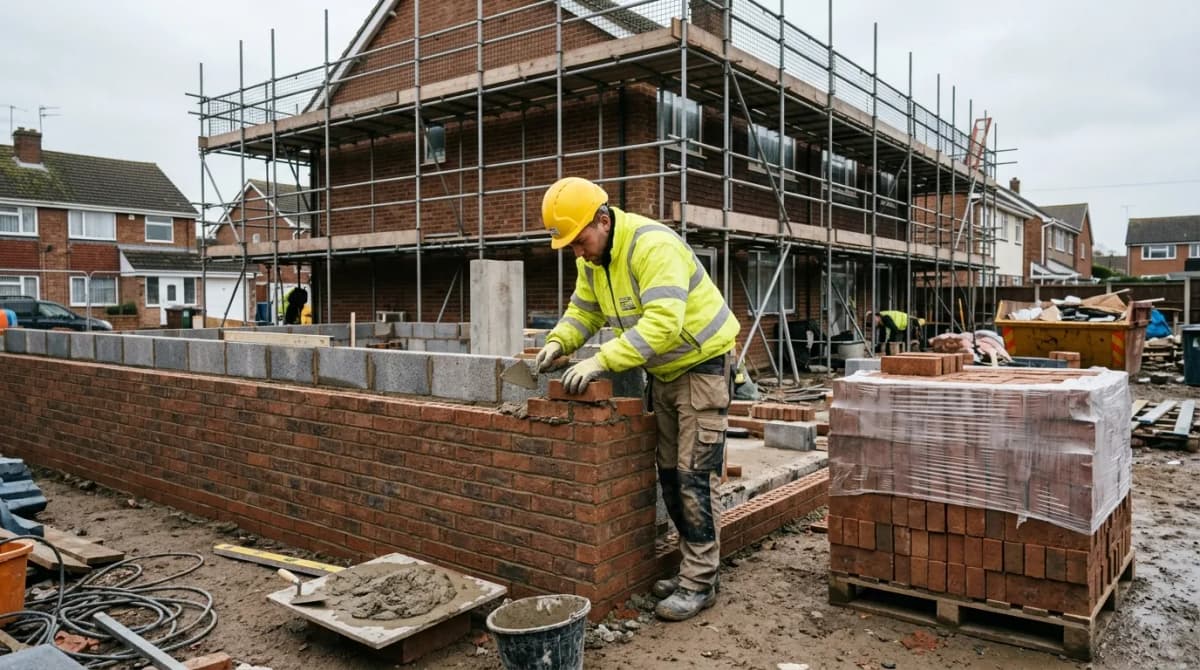
A single skin of standard UK bricks takes 60 bricks per m². A one-brick wall, or the two leaves of a cavity wall counted together, takes 120 per m². Those figures are for the standard metric brick (215 x 102.5 x 65mm) laid with a 10mm mortar joint, and they are the numbers every takeoff starts from. This guide is for builders, bricklayers and contractors pricing brickwork: the arithmetic behind the count, the figures for other brick formats and bonds, blocks, mortar, wall ties, packs and pallets, and what the finished wall costs.
How many bricks per m²
The count comes from the coordinating size: the brick face plus one mortar joint. A standard metric brick face is 215mm long and 65mm high, so with a 10mm joint it occupies 225mm x 75mm on the wall.
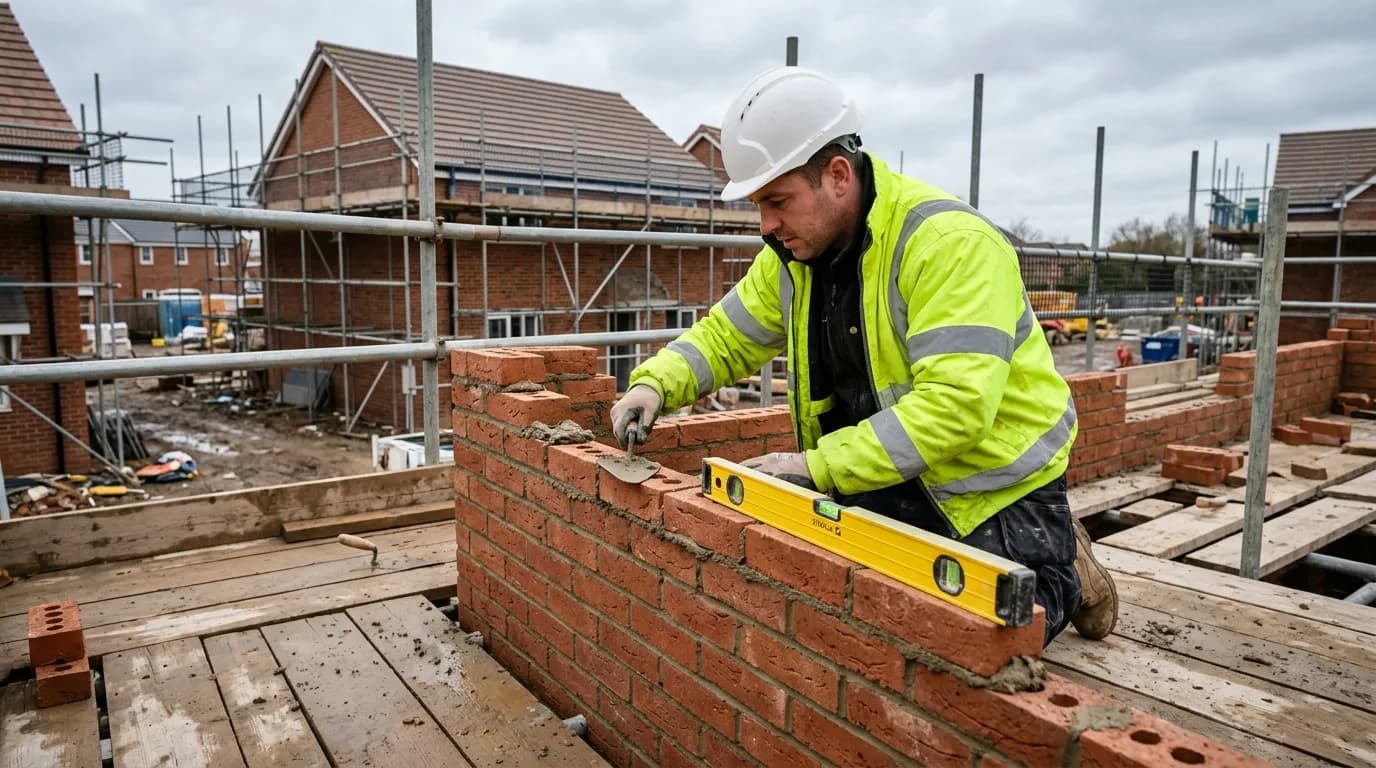
0.225 x 0.075 = 0.016875 m² per brick, and 1 ÷ 0.016875 = 59.26, which is rounded up to 60 bricks per m² of wall face.
That is the half-brick (102.5mm) skin. Double it for anything a full brick thick:
| Wall type | Thickness | Bricks per m² |
|---|---|---|
| Single skin, half brick | 102.5mm | 60 |
| Solid wall, one brick thick | 215mm | 120 |
| Cavity wall, both leaves in brick | 102.5mm + 102.5mm | 120 |
| Cavity wall, brick outer and block inner | 102.5mm + 100mm | 60 bricks + 10 blocks |
The standard gauge that goes with this is four courses to 300mm (four bricks at 65mm plus four joints at 10mm = 300mm). Every nominal figure on this page assumes a 10mm joint. If the gang is working to a wider gauge to pick up an existing building, the count drops, and on a big elevation that difference is worth checking before the order goes in.
Bricks per m² by brick format
Not every brick on a UK job is 65mm high. Imperial-format and maxi bricks course differently, so the per m² figure changes:
| Brick format | Face size | Coursing height (incl. joint) | Bricks per m², half brick |
|---|---|---|---|
| Standard metric | 215 x 65mm | 75mm | 60 |
| Metric imperial / handmade | 215 x 73mm | 83mm | 54 |
| Maxi | 215 x 80mm | 90mm | 50 |
| Engineering (Class A and B) | 215 x 65mm | 75mm | 60 |
| Thin brick / slip | 215 x 50mm | 60mm | 74 |
Double each figure for a one-brick wall. Imperial bricks are the usual trap on an extension to an older house: order at 60 per m² for a 73mm brick and you are roughly 10% over, which is a wasted part pack you cannot send back.
Bricks per m² by bond
Bond does not change how many bricks fill a square metre of wall face, it changes how thick the wall has to be. Stretcher bond works in a half-brick skin; the traditional bonds show headers, so they need the full one-brick thickness and twice the bricks:
| Bond | Wall thickness | Bricks per m² |
|---|---|---|
| Stretcher | Half brick (102.5mm) | 60 |
| Flemish | One brick (215mm) | 120 |
| English | One brick (215mm) | 120 |
| English garden wall | One brick (215mm) | 120 |
| Header | One brick (215mm) | 120 |
Feature bonds also cost more to lay: more cuts, more setting out, and a slower gang. Price the labour by the day on anything other than straight stretcher bond.
How many blocks per m²
A standard concrete block face is 440 x 215mm. With a 10mm joint the coordinating face is 450 x 225mm, so 0.45 x 0.225 = 0.10125 m², and 1 ÷ 0.10125 = 9.88, rounded to 10 blocks per m².
| Block | Face size | Blocks per m² |
|---|---|---|
| 100mm dense concrete | 440 x 215mm | 10 |
| 140mm dense concrete | 440 x 215mm | 10 |
| 215mm dense concrete | 440 x 215mm | 10 |
| 100mm aircrete | 440 x 215mm | 10 |
| 100mm aircrete, thin joint (2 to 3mm) | 440 x 215mm | 10.3 (use 10.5) |
| 440 x 100mm solid dense | 440 x 215mm | 10 |
Thickness does not change the count, only the weight, the price per block and how many fit on a pack. Thin-joint aircrete is the one exception: with a 2 to 3mm glued joint the coordinating face shrinks, so allow about 10.5 blocks per m² and order thin-joint mortar by the bag, not sand and cement.
Brick and block calculator
Enter the wall's length and height to get bricks, blocks, mortar bags and an indicative material cost.
Brick and block quantity calculator
- Net wall area
- 12.0 m²
- Bricks to order
- 793
- Blocks to order
- 132
- Wall ties (field, at 2.5/m²)
- 30
- Brick packs (500 per pack)
- 2
- Ready-mixed mortar bags (25kg)
- 36
- Indicative material cost
- £1,119
Quantities use 60 bricks and 10 blocks per m² at a 10mm joint. Costs use typical current UK merchant prices including VAT (£0.80 a facing brick, £1.90 a 100mm block, £6.50 a 25kg bag of mortar); check your own supplier quotes. Add ties, insulation, dpc, lintels, labour and scaffold separately.
Cavity wall takeoff from one wall area
A cavity wall is four quantities off the same square metre of elevation. For every net m²:
- 60 facing bricks for the outer leaf.
- 10 blocks for the inner leaf (100mm, dense or aircrete depending on the structural and U-value spec).
- 2.5 wall ties, the standard density for low-rise masonry where both leaves are at least 90mm thick, set out at 900mm horizontally by 450mm vertically and staggered. The guidance sits in Approved Document A and the masonry codes it refers to. Around openings, movement joints and verges the spacing tightens to a maximum of 300mm vertically, within 225mm of the edge, so add one tie per 300mm of jamb height on top of the field count.
- 1 m² of cavity insulation, full fill or partial fill to the spec, plus 5% for cutting.
On a 100m² elevation that is 6,000 bricks, 1,000 blocks, 250 field ties before the jamb ties, and 100m² of insulation. Take the ties off the jambs separately: they are easy to forget and they run out halfway up a window.
Mortar quantities per m²
Mortar for a half-brick skin works out at roughly 0.022 m³ per m² once waste is allowed for, and blockwork at roughly 0.008 m³ per m². In practical terms:
| Work | Mortar per m² | Sand | Cement at 1:5 |
|---|---|---|---|
| 60 bricks (half brick skin) | approx. 0.022 m³ | approx. 35kg | approx. 6kg (quarter of a 25kg bag) |
| 10 blocks (100mm) | approx. 0.008 m³ | approx. 13kg | approx. 2kg |
Scaled up, 1,000 bricks laid takes roughly 0.55 tonne of building sand and four to five 25kg bags of cement at a 1:5 mix, or about six bags at 1:6 for internal and lower-strength work. In ready-mixed bags, one 25kg bag lays roughly 30 bricks or 14 blocks, so a 20m² cavity wall (1,200 bricks, 200 blocks) needs around 55 bags. Above about 30m² of brickwork, loose sand and bagged cement with a mixer is far cheaper than ready-mixed bags, and a plasticiser is normal in site mortar.
Wastage allowance
Add waste as a planning allowance, not a fixed rule, and tell the client it is in there:
- 5% on a simple straight wall in one brick type with few cuts.
- 10% on a typical house or extension elevation with openings, returns and reveals.
- 12 to 15% on feature bonds, curves, soldier courses, plinths or heavily cut brickwork, and on reclaimed or handmade bricks where breakage in the pack is higher.
Blocks take the same treatment, usually 5 to 10%, more where closers and cut pieces are needed at reveals and under lintels.
Packs, pallets and rounding up
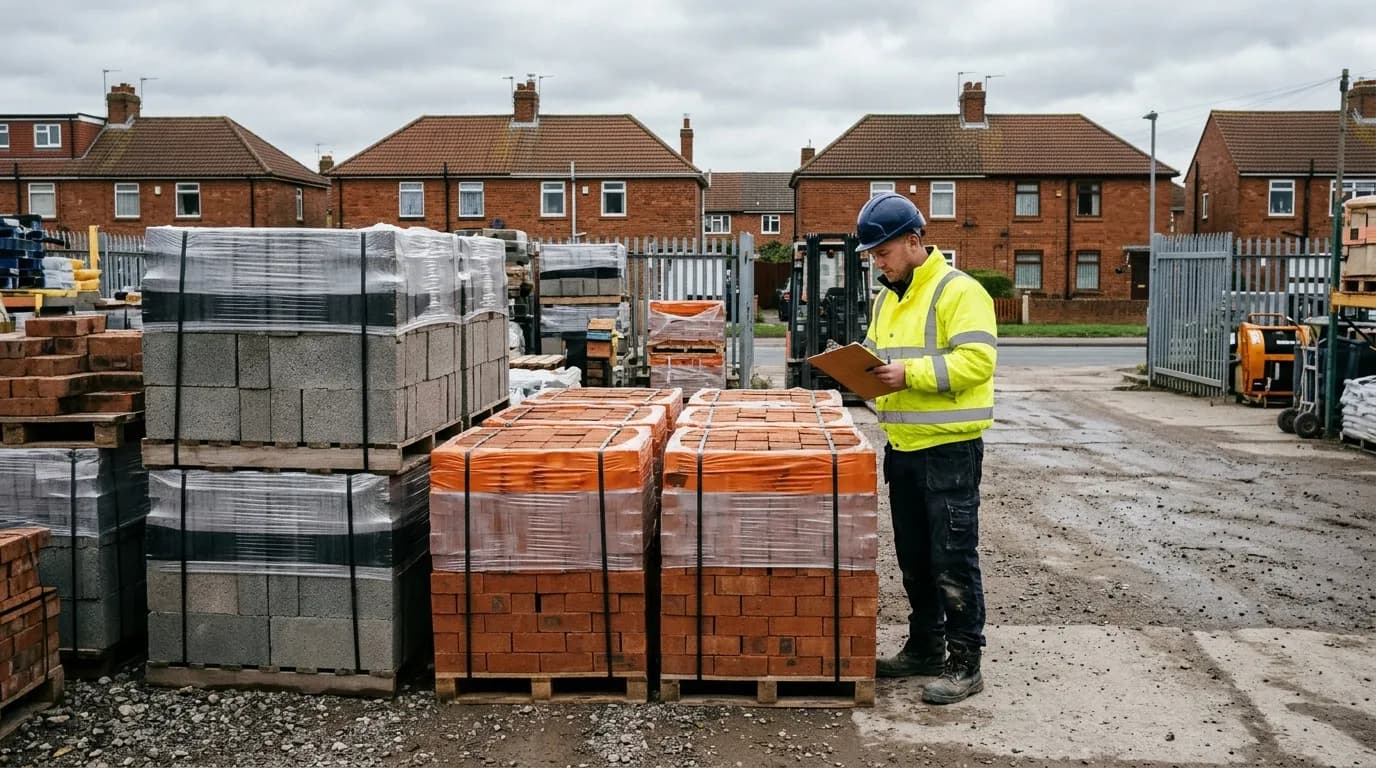
Bricks and blocks come in strapped packs, and merchants quote by the pack, not loose:
| Material | Typical pack or pallet quantity | Wall area covered |
|---|---|---|
| Facing bricks, wirecut | 500 per pack (400, 420, 480 and 504 also common) | approx. 8.3m² at 60/m² |
| Stock and handmade bricks | 400 to 500 per pack | approx. 6.7 to 8.3m² |
| Engineering bricks | 300 to 400 per pack | approx. 5 to 6.7m² |
| 100mm dense concrete blocks | 72 per pack | approx. 7.2m² |
| 140mm dense concrete blocks | 48 per pack | approx. 4.8m² |
| 100mm aircrete blocks | 48 to 60 per pack | approx. 4.8 to 6m² |
Pack counts vary by manufacturer and range, so confirm the figure on the quote before you convert. The rule is simple: divide the brick quantity (waste included) by the pack size and round up to the next whole pack. Merchants rarely split a pack, part packs are almost never credited back, and a short delivery stops a gang for a day, which costs more than the spare bricks. If 1,080 bricks are needed and packs are 500, that is three packs, not two and a bit. On a facing brick, order the whole job in one delivery so the colour blends from the same batch.
Two worked examples
Garden wall, 10m long x 1.8m high, single skin. Area 10 x 1.8 = 18m². Bricks 18 x 60 = 1,080, plus 10% waste = 1,188, so order 1,200. At 500 per pack that is three packs. Mortar 18 x 0.022 = 0.40 m³, which is about 0.55 tonne of sand and four to five 25kg bags of cement at 1:5, or around 40 ready-mixed bags. On top of the brickwork, count the trench and concrete footing, the dpc, the coping or capping and the piers.
Cavity wall elevation, 8m x 2.6m, with openings. Gross area 8 x 2.6 = 20.8m². Deduct a door at 0.9 x 2.1 = 1.89m² and two windows at 1.2 x 1.2 = 1.44m² each (2.88m²), a total deduction of 4.77m², leaving 16.03m² net. Bricks 16 x 60 = 960 plus 10% = 1,056, so two packs of 500 will not cover it: order three. Blocks 16 x 10 = 160 plus 10% = 176, which is three packs of 72. Field ties 16 x 2.5 = 40, plus jamb ties: 9m of jamb at 300mm centres adds 30, so order 100 ties. Insulation 16m² plus offcuts, and four lintels with cavity trays and weep vents.
Working in feet
One square metre is 10.76 ft², so 60 bricks per m² is about 5.6 bricks per ft² for a half-brick wall, and 11.2 per ft² for a one-brick wall. A wall measured as 30ft x 6ft is 180 ft², which is 16.7m², or about 1,000 bricks before waste. Remember that imperial-format bricks (68 to 73mm high) course differently from metric: measure the existing gauge on site rather than assuming 75mm.
Brick slips
A brick slip is a thin, cut face only, laid flat against a backing board with adhesive rather than bedded in mortar, so it courses differently from a full brick and the brick count above does not apply. For a 215 x 65mm slip face, allow around 72 slips per m², plus corner slips measured by the linear metre of return where the wall turns a corner. Slips are not brickwork: they are an adhesive, backing board and pointing job, priced closer to tiling than to bricklaying, and they are usually laid by a different gang. Count them separately in the estimate so the labour rate is right.
What else to count once you have the brick quantity
Once the m² figure is settled, the rest of the takeoff follows from it:
- Wall ties, field and jamb, plus insulation retaining clips.
- Dpc to both leaves, and cavity trays over openings.
- Cavity closers at reveals, cills and heads.
- Lintels, with the bearing and the cavity width confirmed.
- Cills, soldier courses or special bricks.
- Weep vents, typically two per lintel and over every cavity tray.
- Movement joints, with compressible filler, sealant and debonded ties.
- Scaffold lifts, the hand-off above 1.5m and the loading on the lift.
- Muck away for the footing spoil and the cleaning down at the end.
For the concrete under the wall, our concrete and sub-base calculator works out the footing and oversite volumes, and where an opening is being formed in existing brickwork the beam and propping are priced in our guide to structural alterations and steel beam costs.
Cost of a brick wall per m²
These are example rates including labour, materials, margin and VAT. They move with region, access, scaffold and the brick chosen, so price your own supplier quotes into the job rather than using them as a quotation:
| Item | Example rate |
|---|---|
| Facing bricks | £0.55 to £1.30 each, higher for handmade and reclaimed |
| 100mm blocks | £1.60 to £2.20 each |
| Mortar materials | £10 to £15 per m² of brickwork |
| Bricklaying labour | £550 to £850 per 1,000 bricks laid |
| Half-brick skin, labour only | £35 to £55 per m² |
| Blockwork, labour only | £18 to £28 per m² |
| Cavity wall, supply and build | £120 to £180 per m² |
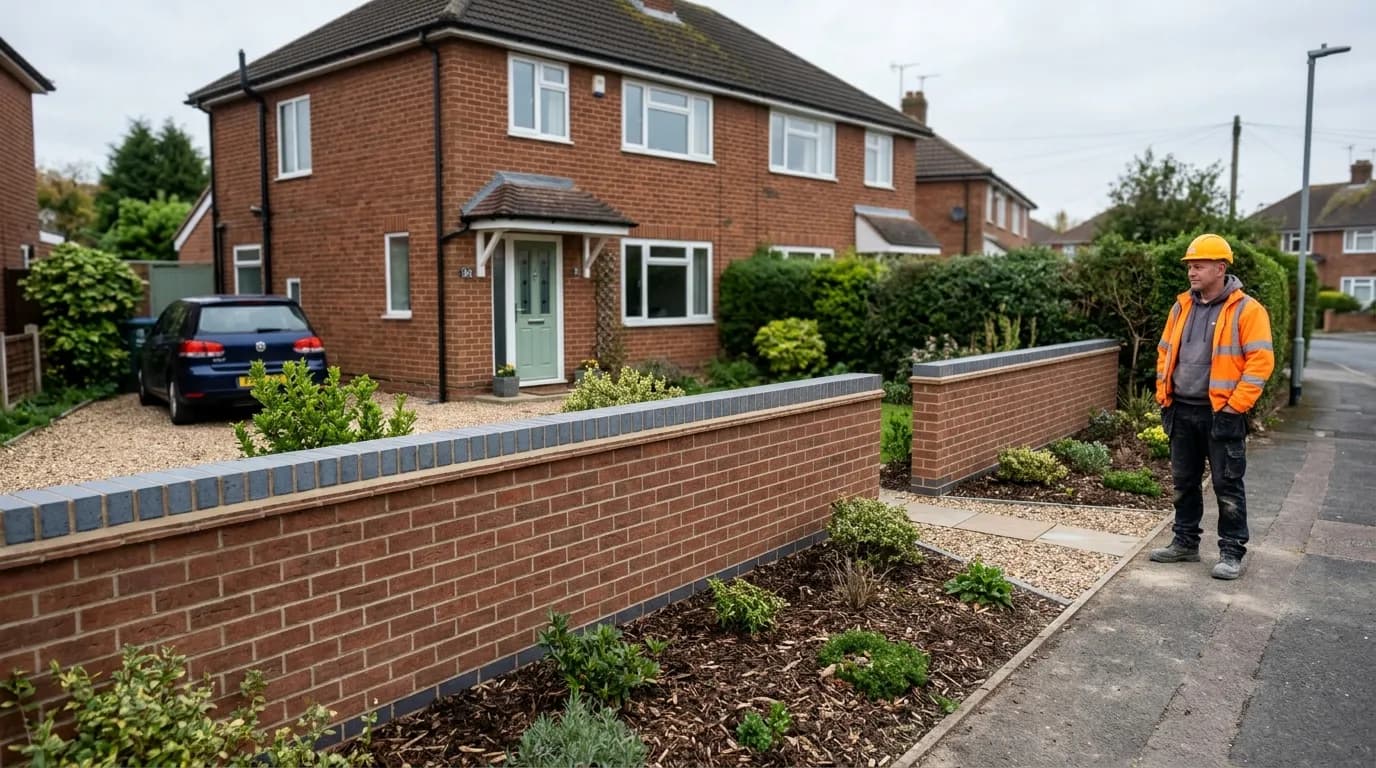
How those figures are used depends on what the wall is. A new garden wall priced on its own is a mini project: setting out, excavation and the concrete footing, dpc, the brickwork, access where needed, pointing, the coping, making good and clearing away, with any skip and muck away in the same price. The same brickwork inside an extension is priced as brickwork tasks only, because the extension's own phases already carry the preliminaries, scaffold, plastering, decoration and clean, and pricing them twice is how an estimate ends up 10% over the competition for no reason.
Common mistakes
- Measuring the elevation gross and forgetting to deduct the door and window openings, which on a typical house front is a pack of bricks too many.
- Counting the outer leaf and forgetting the inner leaf, the ties or the insulation, so the materials budget covers two thirds of the wall.
- Using 60 per m² with a 73mm imperial brick or a wider gauge.
- Ordering to the exact brick count and discovering that part packs are not split and not credited.
- Leaving out the jamb ties, which on an elevation with three openings is more ties than the field count for a whole bay.
- Pricing feature bonds, curves and plinths at the same labour rate as straight stretcher bond.
Price the whole wall, not just the bricks
Quantities are the easy half. The money sits in the labour, the scaffold, the groundwork under the wall and the finishing around it, and that is where most brickwork quotes go wrong. Builder Expert's estimating software turns these quantities into a complete priced estimate in minutes, with labour and materials against every task, or you can send us your drawings and we will price the brickwork, or the whole job, for you.