
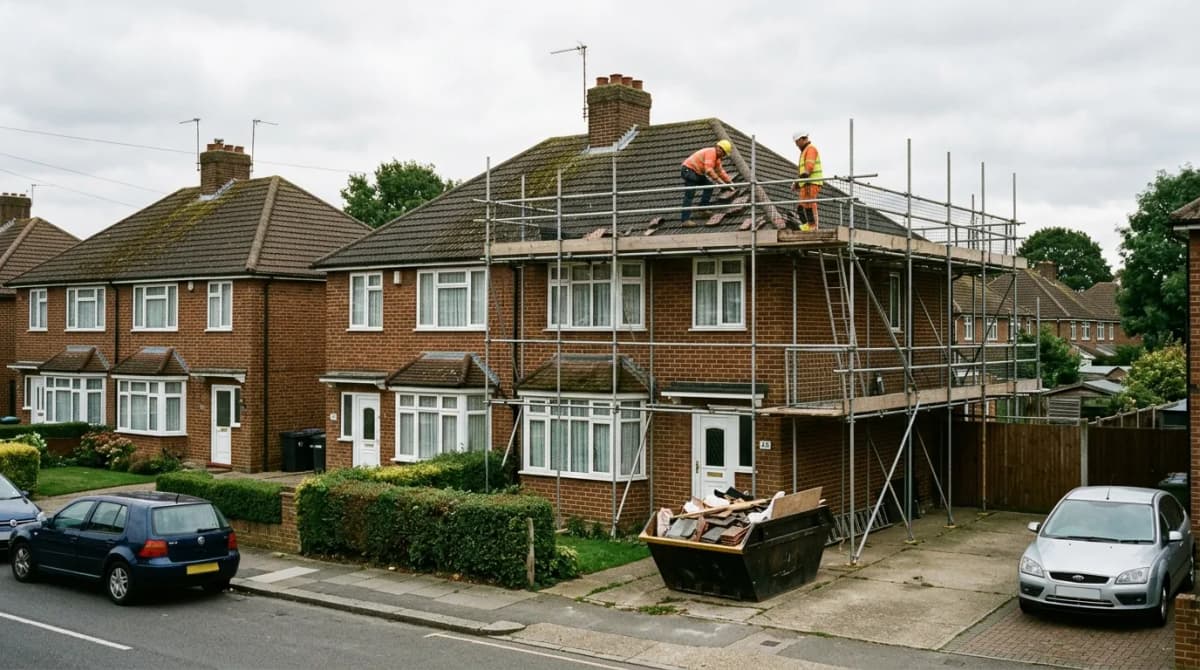
A full reroof of a standard UK house, priced as a job on its own, typically costs between £10,000 and £27,500 depending on house type, covering and access. For a three-bed semi in concrete interlocking tile, budget £13,000 to £18,000. Those are rounded, indicative ranges current at the time of writing, not a quotation: they come from Builder Expert's own estimating data for London and the South East, and most other UK regions come in lower. This page is written for builders, roofers and surveyors who need a figure they can defend in front of a client, with the roof measured properly and every line the job actually carries.
What a new roof costs in the UK: the short answer
Every Builder Expert figure on this page already includes labour, materials, the builder's margin and VAT. Nothing is added on top: no separate labour line, no VAT line, no overhead line. There is no contingency in them either, so allow one of your own on a reroof, because nobody knows the true condition of the rafters and battens until the covering is off.
A new roof is two different jobs, and the gap between them is large. A recover strips the old covering, checks the timbers, and relays membrane, battens and tiles on the existing structure. A full rebuild replaces rafters or trusses and insulation as well, which is the job after fire or storm damage, where the timbers are rotten or undersized, or where a loft conversion changes the roof shape. In our estimating data a recover sits at roughly a third to a half of the cost per m² of a rebuild, so agree which one you are quoting before you put a number on paper.
How a reroof is measured: working your roof area from the footprint
Roof area is not floor area, and quoting from house type alone is guesswork. An estimator works it from the footprint:
- Standard pitch (roughly 30 to 40 degrees): roof area = footprint × 1.1
- Steep pitch (45 degrees and above, or plain tile and slate roofs): roof area = footprint × 1.3
A semi measuring 8.5 m by 8 m has a footprint of 68 m², so the roof area is 68 × 1.1 = 74.8 m², call it 75 m². The same house with a steep plain-tiled roof measures 68 × 1.3 = 88.4 m², nearly 14 m² more to strip, batten and cover. Quantities are always rounded up. A dedicated roof area calculator, a roof pitch chart and a roof tile calculator are covered in our roofing calculators; for whole-job totals, our construction cost calculator does the same arithmetic across a project.
New roof cost by roof covering type
These are rates for the roofing work itself per m² of roof area: strip and dispose, membrane, battens and the covering, before scaffold and site costs. Slate and GRP come from Builder Expert's own price book, rounded around our rate. Concrete tile, clay plain tile and EPDM are not separate lines in our book, because most reroofs are scoped around what the survey finds, so those three are current UK market figures and are labelled as such.
| Covering | £ per m² of roof area | Typical life | What it changes |
|---|---|---|---|
| Concrete interlocking tile (market figure) | £100–£140 | 40–60 years | The default. Large tiles, fast to lay, heavy, so the timbers must take the load |
| Clay plain tile (market figure) | £135–£180 | 60–100 years | Small units, around 60 per m², far more labour and more ridge and verge detail |
| Natural slate (Builder Expert rate, around £202/m²) | £190–£215 | 80–100+ years | Skilled work, often a steeper pitch, higher material cost and more waste |
| GRP flat roof (Builder Expert rate, around £140/m²) | £130–£150 | 20–30 years | Needs a sound new deck and dry weather to lay; seamless finish |
| EPDM or felt flat roof (market figure) | £90–£130 | 15–35 years | Cheaper and quicker; EPDM outlasts torch-on felt by a decade or more |
New roof cost by house type and size
Rounded totals for a standard concrete interlocking tile reroof priced as a standalone job: scaffold, strip and disposal, membrane and battens, covering, ridge, verge, valleys and flashings, skip and site costs all inside the figure. Fascia, soffit and rainwater goods are priced separately below, as they are in most quotes.
| House type | Assumed footprint | Roof area used (× 1.1) | Standalone total |
|---|---|---|---|
| Mid-terrace, two storeys | 55 m² | 60 m² | £10,000–£13,500 |
| Semi-detached, two storeys | 68 m² | 75 m² | £13,000–£18,000 |
| Detached, two storeys | 100 m² | 110 m² | £19,500–£27,500 |
| Bungalow | 85 m² | 95 m² | £15,000–£21,000 |
A bungalow has more roof per house than a semi, which is why its total sits above one despite the single storey. Natural slate on the same roofs adds roughly 60 to 80% to the roofing work; a full rebuild with new structure and insulation is roughly double a tile recover.
Priced inside a bigger build, a loft conversion or a full refurbishment, the same roof costs less per m², because the scaffold, skip, protection, welfare and site supervision are shared with everything else on site rather than carried by the roof alone. A standalone reroof pays for its own set-up and its own minimum visit, and on a job this size that difference is worth several thousand pounds. The way those shared costs are allocated is set out in our estimate task breakdown.
What a full reroof actually involves, in build order
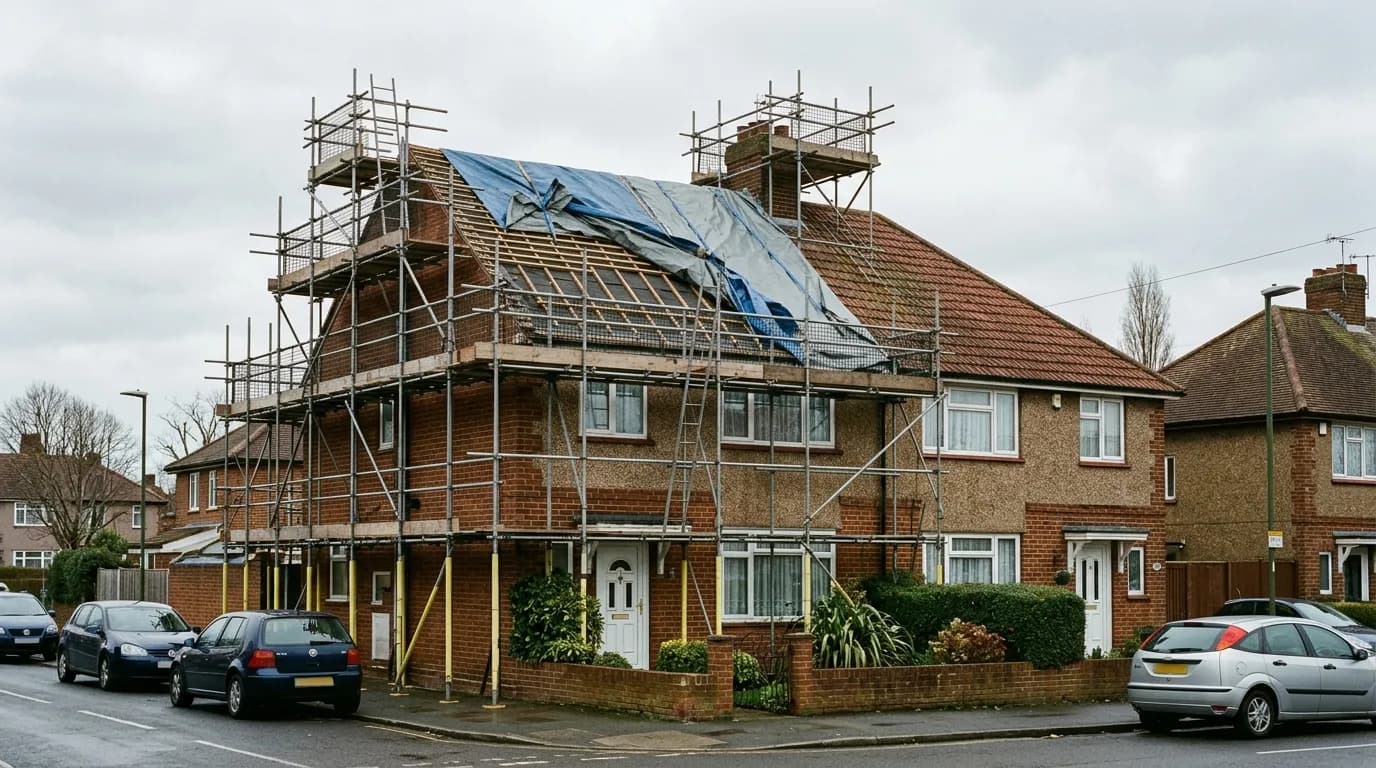
- Preliminaries and scaffold: scaffold to every elevation being worked, edge protection, protection to the driveway and glazing, skip and skip licence, welfare.
- Strip the old covering and dispose of it, with temporary sheeting over the open roof.
- Check the rafters, wall plates and purlins, and repair or replace what the strip exposes.
- Breather membrane and new treated battens, set out to the tile gauge.
- The covering: tiles or slate laid, with ventilation at eaves and ridge.
- Ridge and verge: bedded and pointed, or a dry ridge and dry verge system.
- Valleys, flashings and abutments, including lead to chimneys and parapets.
- Fascia, soffit and rainwater goods, usually renewed while the scaffold is standing.
- Clean down, scaffold away, sign off and hand over.
Worked example: reroofing a three-bed semi
Footprint 8.5 m × 8 m = 68 m². Standard pitch, so roof area = 68 × 1.1 = 75 m². Concrete interlocking tile, two-storey, scaffold to front and rear, one chimney left in place. Priced as a job on its own.
| Part of the job | Rounded cost |
|---|---|
| Scaffold, skip and licence, protection, welfare, final clean | £4,500–£6,000 |
| Strip and dispose of the old covering | £1,000–£1,500 |
| Structural check, repairs, new membrane and battens | £1,500–£2,000 |
| Concrete interlocking tile covering, 75 m² | £5,000–£7,000 |
| Ridge (10 m), verge, valleys and flashings | £1,000–£1,500 |
| Fascia, soffit, gutters and downpipes | £2,500–£3,000 |
| Total | £15,500–£21,000 |
Take the fascia, soffit and rainwater goods out and the figure lands in the £13,000–£18,000 band in the house-type table. Chimney work, roof windows and any rafter replacement beyond a few lengths are separate lines on top.
Scaffolding, skips and site preliminaries
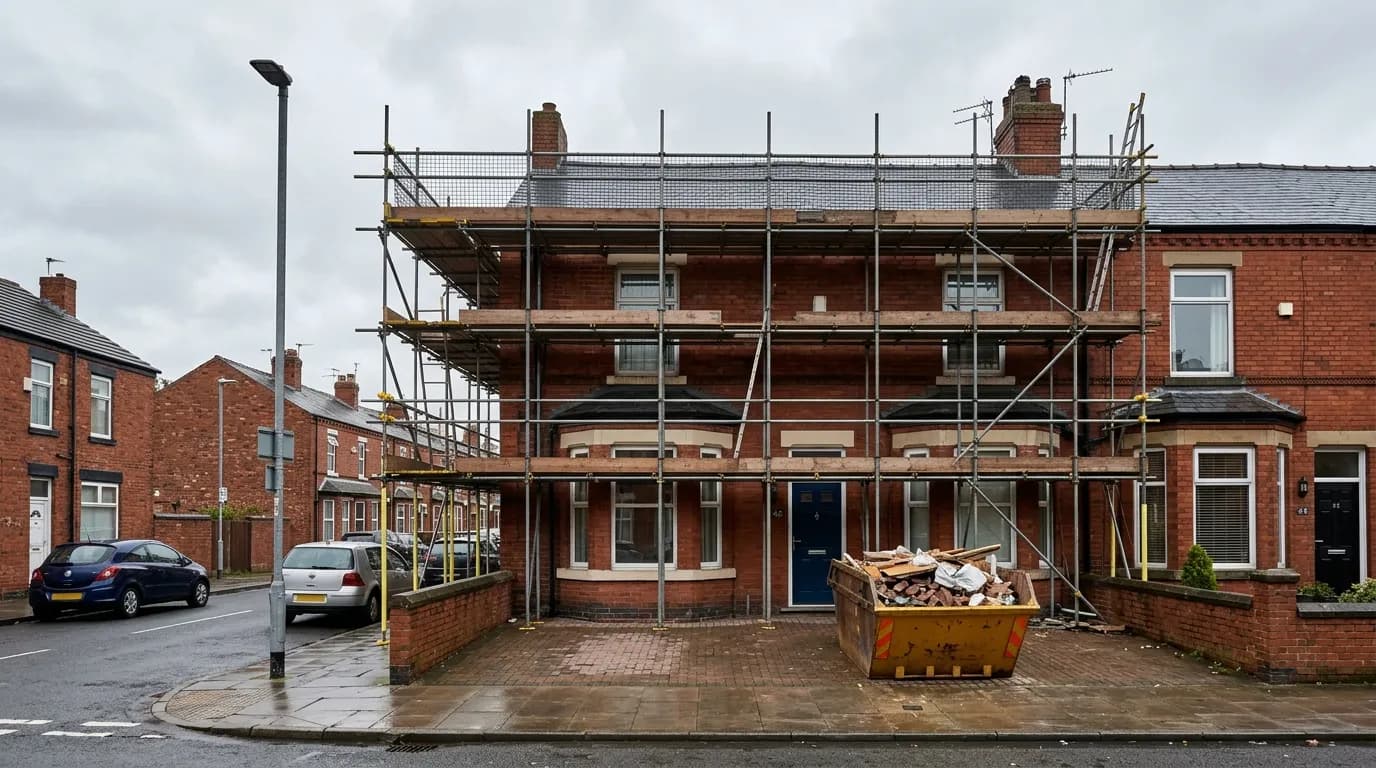
Scaffolding is a separate, unavoidable cost on almost every pitched reroof, and no honest quote hides it inside a tile rate. It is priced per linear metre of elevation per storey at our rate of £136.80 per LM per storey, so a two-storey semi scaffolded front and rear, around 17 m of elevation over two storeys (roughly 34 LM of scaffold run), comes to roughly £4,500 to £5,000 in our data, with a hire period of a few weeks included. A bungalow pays for one storey, a detached house often pays for four elevations. A chimney needs its own tower on top of the main scaffold, around £800 to £850 (our rate is £813.60 each), and scaffold tower hire prices are a separate topic in their own right.
Add the skip and skip licence, parking, protection to driveway and glazing, small-site health and safety and the final clean, and preliminaries typically run at 10 to 15% of a reroof total, the same share they take on a whole project (see preliminaries in construction). That share sits inside the quoted total in the tables above, never added on top of it. Skip dimensions and 8 yard skip prices are covered in our skip hire guide.
Flat roof replacement costs: garages and extensions
Standalone jobs, including stripping the old covering, a new deck where needed, trims, outlets and site costs.
| Flat roof | Area | GRP | EPDM or felt |
|---|---|---|---|
| Single garage | around 15 m² | £2,500–£3,500 | £2,000–£3,000 |
| Double garage | around 30 m² | £4,500–£6,000 | £4,000–£5,000 |
| Extension roof | around 20 m² | £3,500–£4,500 | £3,000–£4,000 |
A cold deck roof insulates between the joists and needs a ventilated void; a warm deck puts rigid insulation above the deck, under the membrane, and performs better. Replacing the waterproof covering counts as renovating a thermal element, so the insulation normally has to be upgraded at the same time, which lifts the deck height and means new trims and, often, a new fascia line. An old asbestos cement garage roof is a different job again and must go to a licensed contractor. Flat roof replacement cost, and asbestos garage roof removal, are each covered in more depth elsewhere on the site.
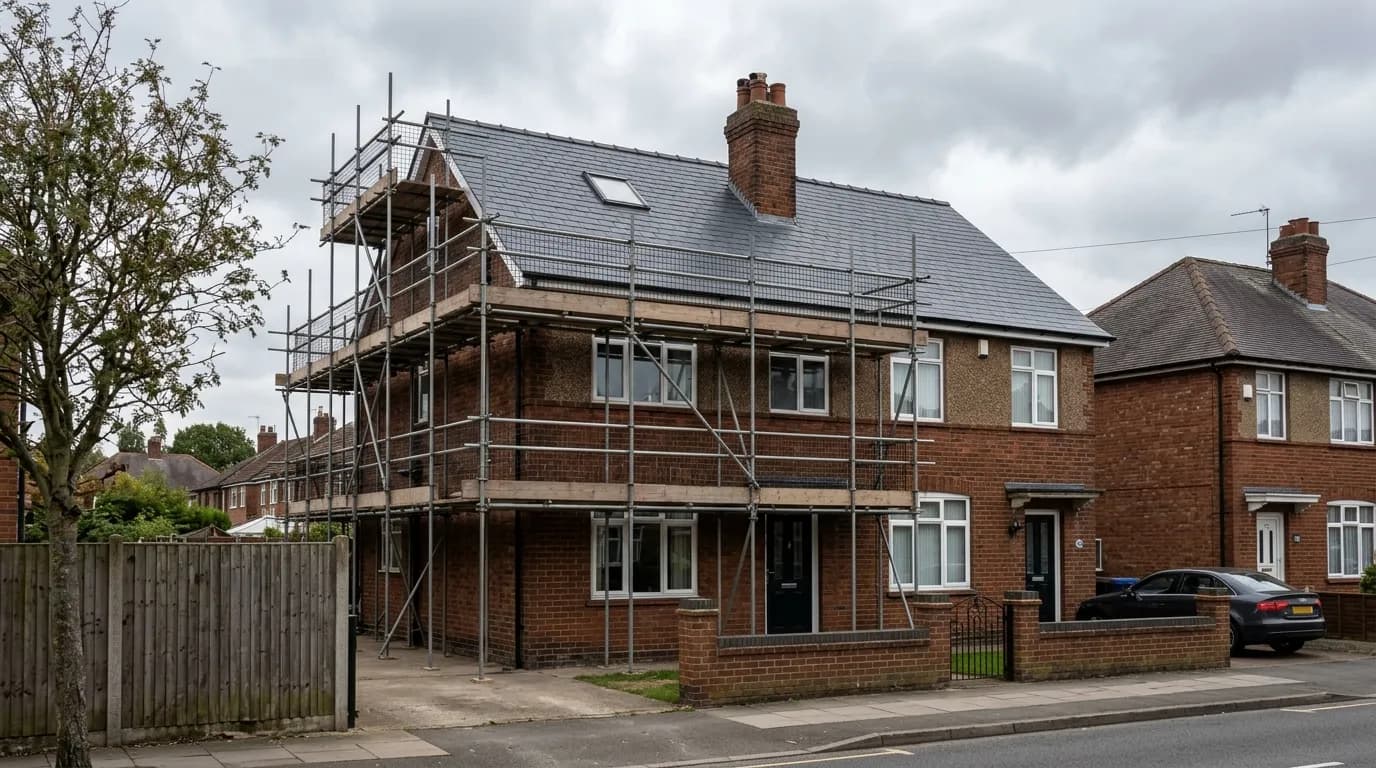
Extras priced while the scaffold is up: chimney, valleys, fascia and gutters
These are the lines most often missing from a thin quote, and the moment to do them is while access is already paid for.
| Extra | Rounded cost |
|---|---|
| Repoint and repair a chimney stack, including flaunching and lead flashings (our rate £983.52 each) | £950–£1,100 per stack |
| Demolish a chimney stack above roof line and make the roof good (our rate £1,912.80 each) | £1,900–£2,100 per stack |
| New roof window: trim the opening, install, flash and make good the tiling (our rates for trimming, installing and making good together total £897.55) | £850–£1,000 each, window not included |
| Emergency escape roof window to Velux escape specification (our rate £1,152.00 each) | £1,100–£1,250 each |
| Valley gutter renewal, assuming a 6–8 m valley at our rate of £76.60 per LM | £450–£650 per valley |
| Fascia and soffit replacement | £1,500–£2,500 per house |
| Gutters and downpipes | £750–£1,500 per house |
Chimney stack removal and rebuild, chimney flashing repair and guttering replacement each have their own cost page; if a dormer is involved, the roof alteration is priced as part of the conversion, as in our loft conversion costs guide.
Roof windows and other provisional sums
The roof window itself is not our price, and it should not be a builder's price either. Items the homeowner chooses (roof windows, rooflights, special tiles, decorative ridge) are handled as provisional sums: the client sets the budget, the builder buys and fits to it, and the builder's margin and VAT still apply on top of the budget. In practice a budget costs the client about 1.44 times its value. As an example, a £500 roof window allowance lands at roughly £720 on the final account for the window itself, which is separate from and on top of the £850 to £1,000 for the opening, installation and making good shown above. Put the allowance in the quote as a stated sum with the words "provisional sum" next to it, and the conversation when the client upgrades is a short one.
Building regulations, the 25% rule and professional fees
A roof is a thermal element, and under Approved Document L renovating a thermal element is building work that has to be notified to building control and has to meet current energy standards. The thresholds are more than 50% of the surface of the element itself, or more than 25% of the whole external envelope. A full strip and recover crosses that line every time. In practice that means insulation at rafter or ceiling level brought up to standard as part of the job, which is why a like-for-like price from an old quote no longer holds. Changing from slate to heavier concrete tiles also needs a structural check of the timbers under Approved Document A. The current Approved Documents are published on gov.uk.
Professional and statutory fees are not in any Builder Expert figure. As current UK market ranges, not our rates: building control for a reroof notification runs roughly £300 to £600, and a structural engineer's visit and calculations for new or strengthened rafters roughly £500 to £1,000. Building control fees and structural engineer fees are covered properly on their own pages.
What moves the price up or down
- Pitch and access. A steep roof, or a terrace with no side access, adds 10 to 20% through slower working and more scaffold.
- Hips, valleys and dormers. Every hip, valley and dormer is cut work and lead: a complex roof adds 15 to 25% over a plain gable-to-gable.
- Two storeys versus a bungalow. A second storey of scaffold on a typical semi adds roughly £1,500 to £2,500.
- Rafter or batten replacement found on strip. Budget 5 to 10% of the roofing figure; a widespread problem turns a recover into a rebuild and roughly doubles it.
- Covering choice. Clay plain tile adds about a third over concrete; natural slate adds 60 to 80%.
- Listed building or conservation area. Matching materials and consent conditions add 20 to 40%, and lead times stretch.
- Region. Our figures are London and South East prices; most of the UK sits 10 to 25% below them for the same scope.
Repair or replace: signs a roof has reached the end
Replace rather than repair when slipped or cracked tiles are no longer isolated, when the battens crumble under a nail, when the felt has perished and daylight shows at the eaves, when the ridge line dips or the rafters spring underfoot, or when the roof has had three or four patch repairs in as many years. A single leak around a flashing or a handful of broken tiles is a repair.
The cheapest way to replace a roof is a concrete interlocking tile recover on the existing structure, with a scaffold shared with any other work and the existing fascia left alone. The trade-offs are real: concrete tiles are the shortest-lived pitched covering, the old fascia and gutters will need doing within a few years while the scaffold is long gone, and leaving a tired verge or valley unrenewed is the usual cause of a leak two winters later.
Expected service life by covering: concrete tile 40 to 60 years, clay plain tile 60 to 100, natural slate 80 to 100 or more, torch-on felt 15 to 20, EPDM 25 to 35, GRP 20 to 30. The most expensive single part of a reroof is the covering and the labour to lay it, usually 45 to 55% of the total; scaffold and site costs are the biggest non-roofing line, and on a tight urban job they can rival the tiles.
How to check a roofing quote, line by line
Roofers price either on a day rate or per m² of roof area. Current UK market day rates run around £220 to £400 a day plus VAT for standard domestic work, with London roughly a third higher, but a day rate is labour only and tells you nothing about materials, waste or access. Builder Expert's own rates already include labour, materials, margin and VAT, which is why they can be compared directly with a fixed quote. Our guide to getting a quote for building work covers the paperwork side, and the difference between an estimate and a quote matters here more than on most jobs.
A quote you can rely on names:
- The roof area in m², and how it was measured
- The covering by manufacturer and model, not just "new tiles"
- Strip and disposal of the old covering, with the skip and licence
- Breather membrane and new battens, stated as new
- Ridge and verge method, bedded or dry fixed
- Valleys, flashings and any lead work, by weight code
- Fascia, soffit, gutters and downpipes, included or excluded
- Scaffold: elevations, storeys and hire period
- The insulation upgrade and the building control notification
- Whether VAT is included, and any provisional sums as stated figures
The items most often missing are scaffold, disposal, battens and membrane, verge and ridge, rainwater goods and VAT. A per-m² rate that does not say which of those it carries is not comparable with anything.
Getting your roof priced properly
If you are pricing a roof for a client, a detailed construction estimate prices it the way the trades actually work: by trade and task, in build order, from the drawings or a measured survey, with the scaffold, prelims and provisional sums shown as their own lines. That is the service most builders use for a reroof, and it sits alongside the rest of our construction estimating services.
If you would rather price it yourself, our construction estimating software holds the same rates behind this page, so you can put in the roof area, pick the covering and have the scaffold and preliminaries priced with it in minutes.
Reroof cost calculator
- Roof area
- 75
- Roofing work: strip, membrane, battens and covering
- £9,000
- Standalone job total, with scaffold, skip and site costs
- £13,000
Builder Expert's own estimating data for London and the South East, including labour, materials, margin and VAT, with market figures for concrete tile, clay tile and EPDM. Excludes fascia, soffit, gutters, chimney work, roof windows and fees. Indicative and current at the time of writing, not a quotation; other UK regions are usually lower.