
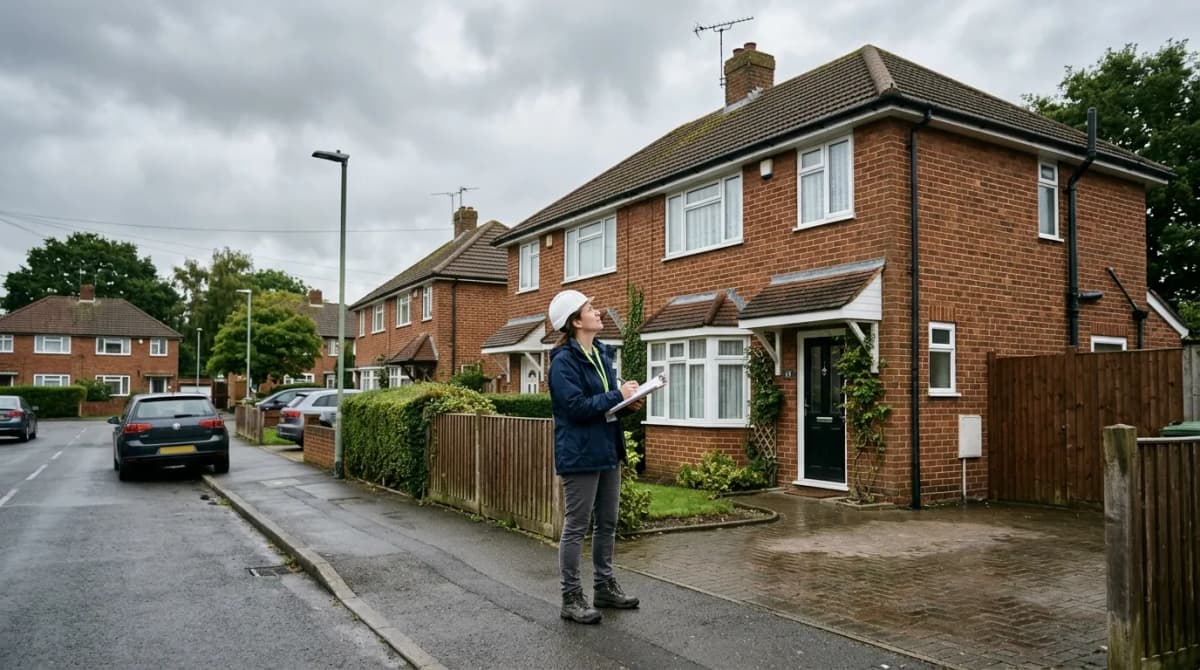
A RICS Level 2 survey costs £400 to £1,000 in the UK, with most buyers paying around £500 to £600 for a standard three bed house. Those figures are for the survey only: adding a market valuation and a reinstatement figure usually puts £50 to £150 on top.
Reallymoving data put the UK average Level 2 survey at £520 in August 2026, which matches what surveyors quote day to day. This page is for builders, surveyors and estimators pricing the repairs a RICS Level 2 survey throws up, and for the clients they advise.
RICS Level 2 survey cost by property value
Fees track the property's value and floor area, because a bigger or more expensive property takes longer to inspect and longer to write up. These are example market fees from across the UK at the time of writing, inclusive of VAT where the surveyor is VAT registered (many sole practitioners sit under the threshold and quote without it, so always ask).
| Property value | Example Level 2 fee (survey only) |
|---|---|
| Up to £100,000 | £380 to £480 |
| £100,000 to £250,000 | £400 to £550 |
| £250,000 to £500,000 | £500 to £700 |
| £500,000 to £1,000,000 | £650 to £950 |
| Over £1,000,000 | £950 upwards, priced individually |
RICS Level 2 survey cost estimator
- Typical fee (low)
- £480
- Typical fee (high)
- £720
Example UK market fees for a RICS Level 2 survey, not Builder Expert's own rates. Get written quotes from two or three RICS registered surveyors local to the property.
Level 2 fees by property size
Size and bedroom count move the fee as much as value does, which is why a modest flat in London and a four bed detached in Yorkshire can be quoted the same money. Example market fees:
| Property | Example Level 2 fee (survey only) |
|---|---|
| 1-2 bed flat | £380 to £500 |
| 2-3 bed terrace | £420 to £600 |
| 3 bed semi detached | £480 to £680 |
| 4-5 bed detached | £600 to £900 |
| Large or period detached, over 250 m² | £850 upwards |
What makes one quote higher than another
Two surveyors looking at the same house can be £200 apart, and the reasons are mundane:
- Property value and floor area, the two biggest drivers of both time and professional indemnity exposure.
- Age and construction, with pre-1900, listed, timber framed, solid wall or concrete properties taking longer and sometimes pushing the surveyor to recommend Level 3.
- Flats with communal areas, where the surveyor has to comment on roofs, stairwells and grounds they may not easily reach.
- Adding a market valuation and an insurance reinstatement figure, typically £50 to £150 more.
- Access, meaning a safe loft hatch, an accessible under-floor void and unlocked outbuildings. No access means caveats in the report rather than answers.
- Turnaround speed, where a next day inspection and a 48 hour report carry a premium.
- Travel, since a rural property an hour from the nearest practice costs more to get to.
Level 2 survey cost by region
Fees follow local property values and local competition more than anything else. The same Reallymoving data showed London averaging £590 against a UK average of £520, with the North East lowest at £463. Example ranges:
| Region | Example Level 2 fee |
|---|---|
| London and the South East | £550 to £1,000 |
| South West and East of England | £500 to £850 |
| Midlands | £450 to £750 |
| North of England | £400 to £650 |
| Wales | £400 to £650 |
| Northern Ireland | £400 to £650 |
| Scotland | Covered by the seller's Home Report |
London and the South East sit at the top on higher values and higher overheads, not because the inspection is different. In thinly covered rural areas the fee can also creep up: fewer local surveyors, longer drives, and a half day gone for one inspection.
Scotland works differently
In Scotland the seller organises a Home Report, which is made available to prospective buyers, so a buyer there rarely commissions a Level 2 of their own. The Single Survey inside the Home Report is the equivalent of a Level 2 survey with valuation. A Scottish buyer who wants more can still commission a Level 3 Building Survey, a specialist damp and timber report, or a structural engineer, all paid for privately.
Level 1, Level 2 and Level 3 compared
| Level 1 (Condition Report) | Level 2 (HomeBuyer Report) | Level 3 (Building Survey) | |
|---|---|---|---|
| Inspection | Visual, headline condition only | Visual and more extensive, including the loft from the hatch and accessible drain covers | Visual but far more thorough, roof space entered, exposed floors inspected |
| Opening up | None | None: no lifting carpets, no moving furniture, no opening up | None, but the surveyor reasons about what is likely behind the finishes |
| Report length | 10 to 15 pages | 20 to 30 pages | 50 pages and up |
| Time on site | 1 hour or so | 1 to 4 hours | 3 to 8 hours, sometimes two visits |
| Example fee | £300 to £500 | £400 to £1,000 | £600 to £1,500, more on large or listed buildings |
| Suits | Newer, standard homes in obvious good order | Conventional homes built since around 1900, in reasonable condition | Older, altered, neglected or non standard properties |
When Level 3 is the right call
Pay the extra few hundred pounds for Level 3 if the property is pre-1900, of non-standard construction (timber frame, thatch, solid wall, no-fines or system built concrete), shows visible structural movement, has stood empty or neglected, has already been heavily altered or extended, or is about to be extended, converted or substantially altered. A Level 2 tells the buyer something is wrong. A Level 3 sets out what is causing it and what the repair options are, which is the part a builder can actually price from.
None of this applies to a new build home. Defects there sit with the developer under the warranty, and the right inspection is a snagging in construction survey, not a RICS Level 2 or Level 3.
What a Level 2 survey covers
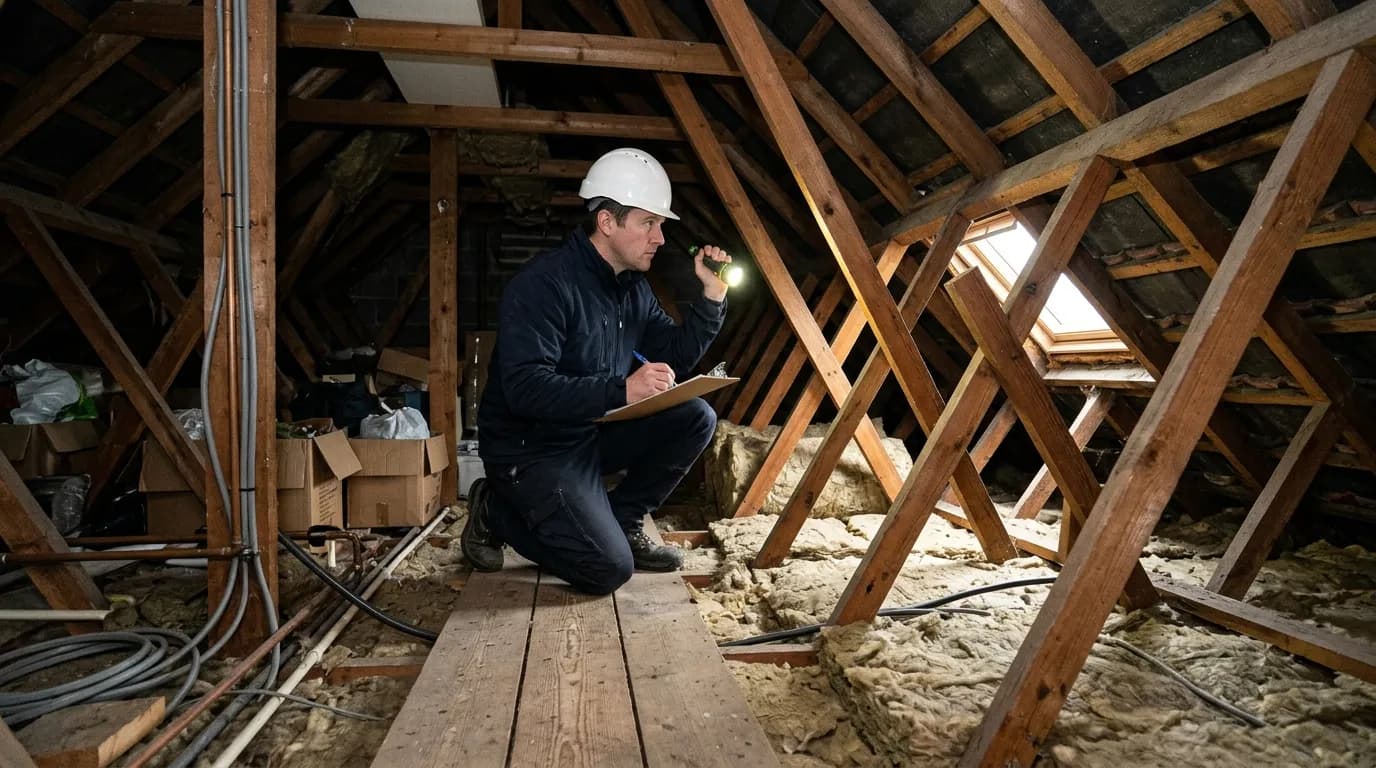
A Level 2 survey is a visual, non-intrusive inspection of the parts of the property that can be seen and safely reached. At Level 2 the surveyor inspects the roof space from the hatch, lifts accessible inspection chamber covers and visually inspects the different elements of the building, but nothing is dismantled and no carpets come up.
Every element gets a traffic light condition rating:
- Rating 1 (green): no repair currently needed. Nothing to do.
- Rating 2 (amber): defects that need repair or replacement, but are not serious or urgent. Price them, budget for them, do them in the first couple of years.
- Rating 3 (red): serious or urgent defects, or something that needs further investigation before exchange. Act on these first. A typical rating 3 is perished pointing and cracked render to a gable with damp showing on the inside face: the surveyor cannot say from the ground whether it is pointing, render or a failed cavity tray, so the report tells the buyer to investigate.
Time on site for a Level 2 is roughly one to four hours depending on size, and the report normally lands within three to five working days. A Level 3 is usually three to eight hours on site and five to ten working days to write up.
Does a Level 2 survey cover damp?
Yes, but only what a non-intrusive inspection can find. The surveyor takes readings with a moisture meter at accessible walls, usually at skirting level and around chimney breasts, bay windows and external corners, and looks for staining, salting and blown plaster. They cannot see behind plaster, under a solid floor or inside a cavity. So a damp finding in a Level 2 almost always comes with a recommendation to get a specialist damp and timber investigation before exchange, and that report, not the survey, is what a builder prices from.
Survey only or survey and valuation
RICS issues Level 2 in two versions: survey only, and survey and valuation. The valuation version adds a market value and an insurance reinstatement figure, typically £50 to £150 more. One thing worth telling any client: a lender's mortgage valuation is not a survey. RICS says plainly that a valuation is not a survey. It exists to protect the lender's security, it can be done from a desk, and it will not tell a buyer the roof is at the end of its life.
What a cheap survey leaves out
A £280 quote next to a £550 quote is not the same job, and the gap shows up in the report. The cheap end typically means a desktop heavy inspection with little time on site, no loft access, no moisture readings taken, a short templated report with generic wording under every heading, no valuation or reinstatement figure, and no phone call with the surveyor afterwards to talk the findings through. That last one is worth real money: twenty minutes with the surveyor often tells the buyer more than the report does. Compare like with like before comparing price.
A survey never prices the work
This is the part buyers get wrong. A RICS report identifies defects, rates them and recommends further investigation. It does not price the repairs, and surveyors are not supposed to: they have not taken off quantities, rung a supplier or booked a scaffold. A condition rating 3 on the roof covering could mean a dozen slipped tiles or a full re-roof, and the difference is tens of thousands of pounds.
The real cost sits in how deep the repair goes. "The walls need attention" can mean repointing one elevation, hacking off and re-rendering, or stripping back to brick and starting again. The first question is always where the job ends, and no survey answers it.
Worked example: a 3 bed semi Level 2 report
Here is a realistic set of findings from a Level 2 on a 1950s three bed semi, each priced as an example. Every line says what basis it is on.
| Finding | Rating | Basis | Example cost |
|---|---|---|---|
| Failed pointing to the rear elevation, about 40 m² | 2 | Standalone mini project, supplied and fitted, including scaffold, protection and clean up | £2,400 to £3,600 |
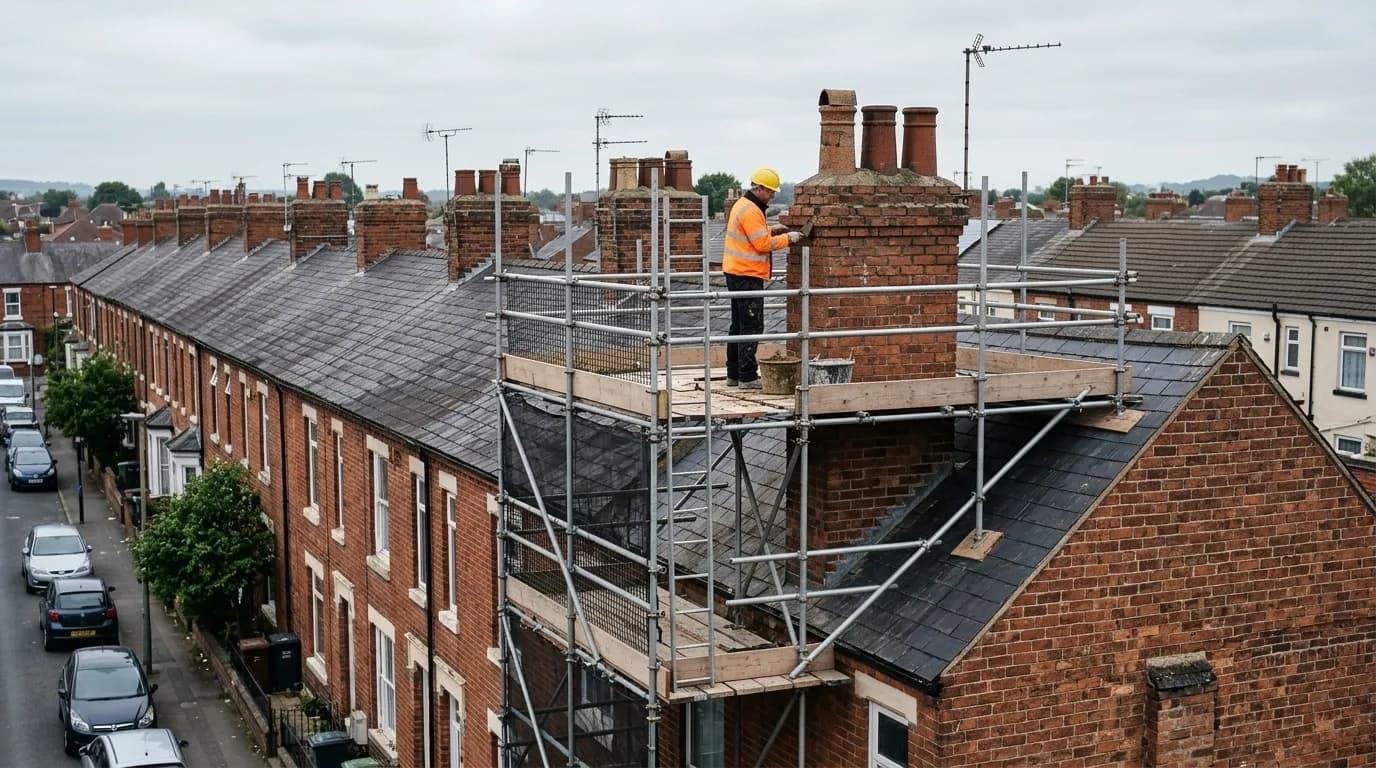
| Slipped tiles and tired flashing to the chimney | 3 | Standalone mini project, supplied and fitted, scaffold or tower included | £900 to £1,800 |
| Chimney stack repointed while the scaffold is up | 2 | Line inside the roof works above, supplied and fitted, no separate access cost | £500 to £900 |
| Old consumer unit, no RCD protection | 3 | Booked direct with an electrician, supplied and fitted, EICR first | £550 to £900, plus £150 to £300 for the EICR |
| Damp staining to the bay, cause unknown | 3 | Investigation first, then priced | £200 to £400 for a damp and timber report |
| Rotten softwood cills to three windows | 2 | Line inside a wider decorating and repair project, supplied and fitted | £900 to £1,500 |
Taken as one visit, those lines come to roughly £5,500 to £9,500 before the damp repair itself, which cannot be priced until the specialist has been. Note the two different bases. The pointing and the roof repair are standalone mini projects, so the figures carry preliminaries, access, protection, making good and cleaning. The cill repairs and the stack repointing are lines inside a bigger piece of work, so they carry only their own labour and materials, with access and finishing already paid for elsewhere. For a closer look at pricing masonry defects by area, see our guide to repointing and stone repair costs.
The consumer unit is a job normally booked direct with an electrician, so the figure above is that trade's direct price. Any consumer unit change must also meet current UK building regulations for electrical safety, which is why the EICR comes first. Our own rate for the same change inside a larger refurbishment sits higher, because it is a main contractor's subcontract line: the contractor pays the sparks a mid range price and then carries the chasing, the making good, the decorating and the risk around it.
That is the same reason our rates generally sit at the middle to upper end of the market range. We price from a report and a set of drawings rather than from standing in the room, so we assume the realistic version of the job rather than the easy one, and we carry the contractor's margin. Nine times out of ten there is more work behind a defect than anyone could see, very rarely less.
What to do once the report lands
- Read the rating 3 items first. Everything else can wait; these decide whether the purchase goes ahead at the agreed price.
- Book the further investigations the surveyor names. A structural engineer's visit and short report is typically £400 to £900, a damp and timber report £200 to £400, a CCTV drain survey £150 to £350, an EICR £150 to £300. These fees are extra and are not in the survey price.
- Get the repairs priced properly, by trade and by task, with the scope written down. Not a round number scribbled during a viewing.
- Then decide: proceed, renegotiate, or walk.
On renegotiation, be honest about what carries weight. A list of rating 3 items on its own rarely moves a seller, because it names problems without sizing them. A priced schedule of repairs, itemised and credible, is a different conversation: it turns "the roof needs work" into a number with a scope behind it. Round numbers get dismissed; a breakdown that a seller's own builder would recognise does not.
Getting the repairs priced
Builder Expert prices exactly this work as part of our construction estimating services. Send us the survey report, photographs of the defects and any drawings you have, and we produce a detailed construction estimate: the repairs broken down by trade and task, with labour, materials and margin, so a buyer, a builder or a surveyor's client knows the real figure before exchange rather than after. Where the report flags something structural, our steel beam and structural alterations guide shows how that work is priced, and our guide to comparing builders' quotes is worth reading before you take three numbers at face value. If you only need a fast first figure, our construction estimating software will give you one in minutes.
FAQ
Is a RICS Level 2 survey worth it? On a conventional house in reasonable condition, yes. A RICS Level 2 survey cost of around £500 against a purchase of £300,000 is small money for finding out the roof has five years left, and the report is the only independent opinion in the whole transaction that is working for the buyer.
How long does a Level 2 survey take? Around one to four hours on site depending on the size of the property, with the report normally back in three to five working days.
Does a Level 2 survey include damp? It includes a visual check and moisture meter readings at accessible walls. It does not include opening up, so a damp finding usually leads to a specialist damp and timber investigation.
Does a Level 2 survey give a valuation? Only if you order the survey and valuation version, which costs roughly £50 to £150 more and adds a market value and an insurance reinstatement figure.
Is a survey legally required? Not in England, Wales or Northern Ireland. In Scotland the seller must provide a Home Report before the property is marketed, and it contains a Level 2 equivalent single survey.
Who arranges and pays for it? In England, Wales and Northern Ireland the buyer instructs and pays for the survey and receives the report. In Scotland the seller pays for the Home Report.
Does a mortgage valuation count as a survey? No. It is a lender's check on its own security, often done remotely, and it carries no duty to tell the buyer about the condition of the building.
Fees quoted on this page are examples of the UK market at the time of writing. They vary by surveyor, region and property, and are not a fixed price list. Our own repair figures come from Builder Expert's rates and are examples, not quotations.