
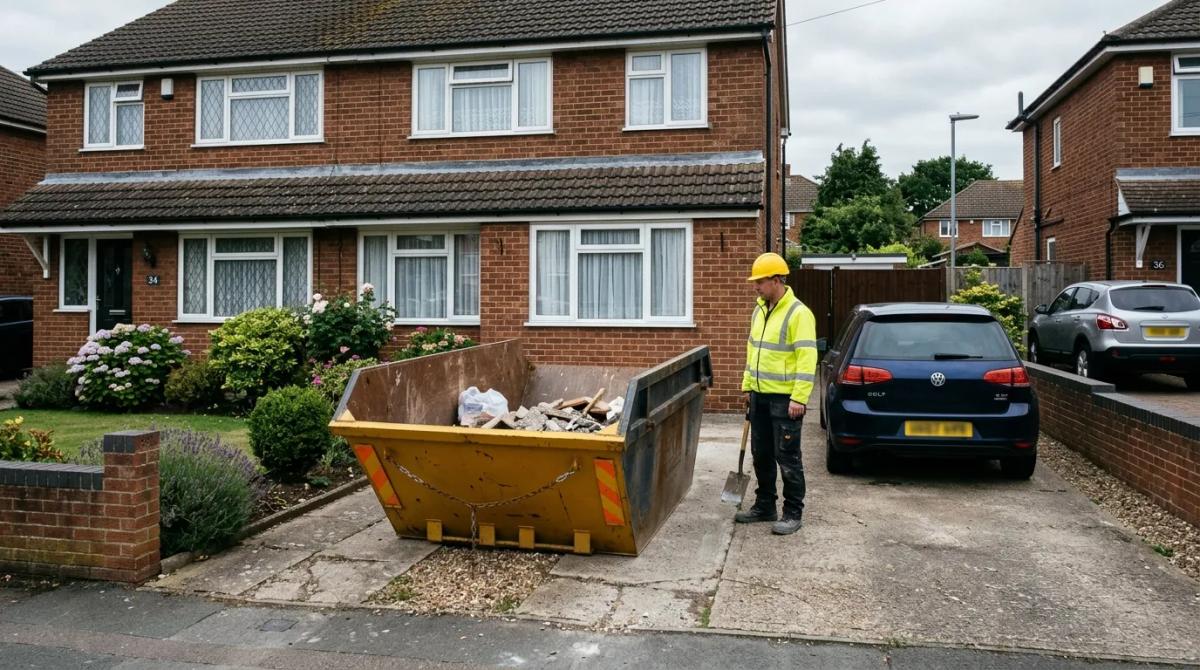
8 Yard Skip Dimensions
Dimensions vary by maker, because skips are built to fit a standard lorry rather than to one national pattern. The figures below are the typical range you will be quoted; always check the exact size with the supplier if space is tight.
| Dimension | Typical UK figure | Range across suppliers |
|---|---|---|
| Length (top rail) | 3.5 m (11 ft 6 in) | 3.4–3.7 m (11 ft 2 in – 12 ft 2 in) |
| Width | 1.7 m (5 ft 7 in) | 1.65–1.8 m (5 ft 5 in – 5 ft 11 in) |
| Height | 1.25 m (4 ft 1 in) | 1.2–1.4 m (4 ft – 4 ft 7 in) |
| Base length | 2.2–2.5 m (7 ft 3 in – 8 ft 2 in) | sloped ends, so the base is shorter than the top |
The skip takes up about the footprint of a small family car, so it sits on most driveways. Allow room beyond the skip itself: the lorry needs to reverse in, drop its arms and lift clear, so clear headroom and no overhanging cables or branches matter as much as the ground space.
Capacity: Yards, Cubic Metres and Bin Bags
The same 8 yard skip is described three ways:
- 8 cubic yards, the trade measure, and where the name comes from
- About 6.1 m³, the metric equivalent
- Roughly 60 to 80 bin bags, the household comparison
Bin bag counts quoted online run from 60 all the way to 160, and both ends are honest enough: bag size, how hard the bags are stuffed and how well the skip is packed all change the answer. For planning a job, work in cubic metres and ignore the bags.
Most 8 yard skips have a drop-down door at one end. That is the real advantage over a 6 yard: a barrow goes straight in, so the skip gets packed tight instead of thrown in over the rail, and a packed skip holds perhaps a third more.
8 Yard Skip Weight Limit
Volume is only half the story. Almost every UK operator rates an 8 yard skip at a maximum of about 8 tonnes, and in practice mixed builders' waste is capped at around 7 to 8 tonnes because the lorry has a gross vehicle weight it cannot exceed on the road. Some firms set a lower allowance in the hire price and charge for anything above it.
The plain warning: an 8 yard skip filled with soil, concrete, rubble or tiles hits the weight limit long before it looks full. Fill one to the rail with wet clay and it cannot be lifted, cannot legally be driven, and will be left on site until it is dug back out by hand.
| Material (loose, as broken out) | Approx tonnes per cubic yard | Yards before 8 tonnes |
|---|---|---|
| Mixed strip-out waste (timber, plasterboard, packaging, carpet) | 0.15–0.3 | the full 8 yards |
| Plasterboard waste only | 0.25–0.35 | the full 8 yards, but it must be segregated |
| Brick rubble, loose | 1.0–1.2 | 6–7 yards |
| Broken concrete | 1.2–1.5 | 5–6 yards |
| Hardcore and MOT type 1 | 1.4–1.6 | 5 yards |
| Topsoil, dry | 1.0–1.2 | 6–7 yards |
| Clay subsoil, wet | 1.2–1.5 | 5–6 yards |
| Ceramic tiles and mortar bed | 1.0–1.3 | 6 yards |
Those are the theoretical limits. Most operators go further and ask for soil, rubble and concrete loads to be kept to around half a skip, or supply a 4 yard heavy waste skip instead, because the lift happens at the roadside with the load off centre. The practical trick on a strip-out is to spread the heavy material evenly across the base and fill the rest with light waste.
What Fits in an 8 Yard Skip
Real jobs, and how many 8 yard skips they usually take:
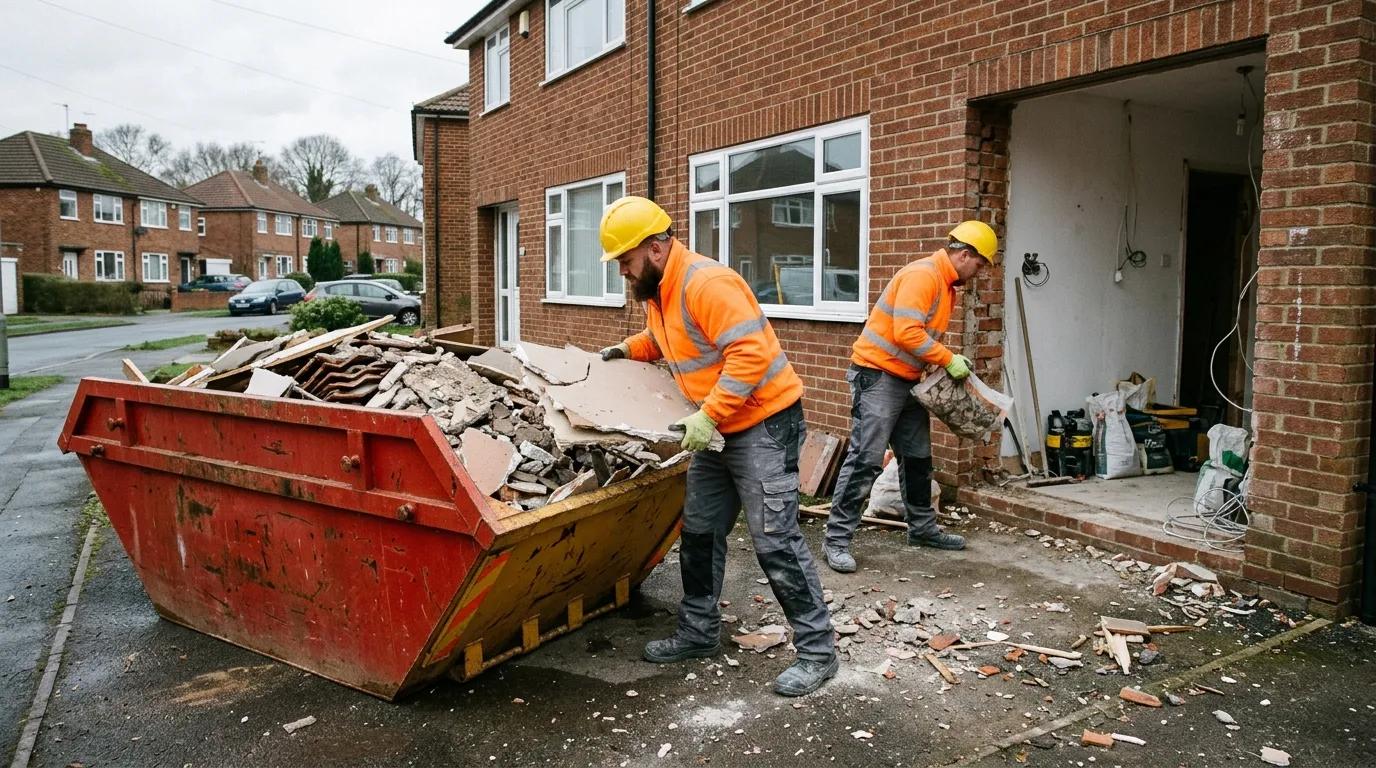
- Full bathroom rip-out (bath, basin, WC, tiles off the walls, floor up, old boxing): about half an 8 yard skip. The tiles and the mortar behind them are the weight.
- Kitchen rip-out (carcasses, worktops, tiles, flooring, old plasterboard): most of one 8 yard skip. Kitchen units are bulky and light, so they eat volume, not tonnage.
- Bathroom and kitchen together in one house: one 8 yard skip if it is packed, two if the floors come up and the walls are hacked back.
- Garage or loft clearance: one 8 yard skip for a typical single garage, but it fills fast with furniture and boards.
- Soft strip of a small single storey room (ceilings, plasterboard, skirting, floor coverings, old pipework): one 8 yard skip, sometimes with a second for the plaster and rubble.
- Patio lift, around 20 m² of slabs on a mortar bed: half to two thirds of an 8 yard skip by volume, and at the weight limit by then. Two part filled skips, not one full one.
Where it does not stretch is a whole house renovation, a loft conversion strip-out or a large extension's demolition phase. There the waste is measured in several skips and planned as part of the programme.
8 Yard Skip Cost in the UK
Skip hire is quoted by size, hire period, waste type and area, and the figure covers delivery, collection and disposal. These are current UK market ranges including VAT for a standard 1 to 2 week hire.
| Skip size | Typical UK cost (1–2 week hire, inc VAT) |
|---|---|
| 4 yard | £180–£300 |
| 6 yard | £230–£380 |
| 8 yard | £280–£420 |
| 10 yard | £330–£480 |
| 12 yard | £380–£550 |
| 14 yard | £420–£600 |
Region moves the 8 yard price more than anything else:
| Area | Typical 8 yard price (inc VAT) |
|---|---|
| North East, North West, Yorkshire, Wales | £240–£340 |
| Midlands, South West, Scotland | £280–£400 |
| South East and outer London | £330–£470 |
| Central London | £420–£580 |
What the price includes, and what is extra
A standard 8 yard quote normally covers delivery, the agreed hire period (usually 7 to 14 days), collection, and disposal of standard mixed waste up to the weight allowance. Charged on top: the council permit for a road placement (£25–£150 in most areas, far more in central London boroughs), extended hire (£10–£30 a day, or around £40–£80 a week), an overload or excess weight charge, and a surcharge if prohibited items turn up in the load, commonly £50–£150 an item for a fridge, a mattress or a gas bottle.
The cheapest quote is almost always the bare minimum: a short hire window, a lower tonnage allowance, no permit in the price and no wait-and-load option. Comparing like with like means checking three things on each quote: the tonnage included, the number of days, and whether the road permit is in it. A full breakdown of what moves the price sits on our skip hire cost guide.
Permits, Placement and Loading
A skip standing wholly on a private driveway or private land needs no permission. The moment any part of it sits on a public road, pavement or grass verge, the highway authority's permission is required under section 139 of the Highways Act 1980, and the gov.uk skip licence service points you to the right council. The skip company applies for it as part of the booking in almost every case.
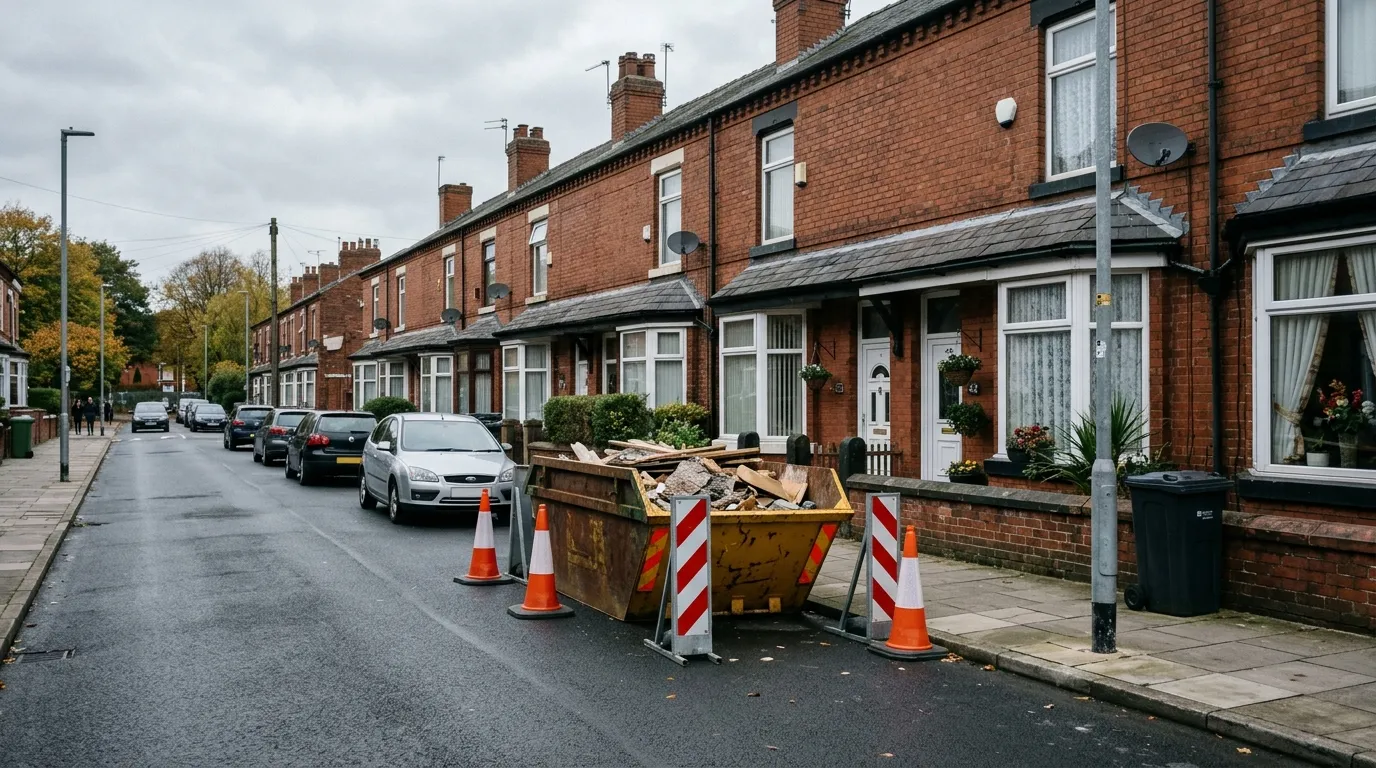
Typical council fees run from about £25 to £150 for a one to two week period, with central London boroughs charging several hundred pounds, and most councils want two to five working days' notice. Conditions are standard: cones and reflective markings, lamps at night, the skip clear of junctions, crossings and the footway, and the company's name and phone number on the side.
Loading has one rule that catches people out. A skip must be loaded level with the top rail. A heaped or sheeted load can be refused on collection, because it cannot be sheeted down safely for the road, and the driver will simply leave it. Heavy material goes across the base first, light bulky material on top, and nothing is wedged above the rail "just for the drive round the corner".
What you cannot put in it
- Plasterboard and gypsum waste, which most suppliers require segregated into their own skip or bag
- Asbestos in any form, which needs a licensed contractor and consigned disposal
- Fridges, freezers and air conditioning units
- TVs, computers and other electrical items
- Tyres, gas bottles, paint, solvents, oils, batteries and chemicals
- Mattresses, which most firms take only for a separate fee
8 Yard Skip vs Other Sizes
| Size | Typical dimensions (L × W × H) | Volume | Suits |
|---|---|---|---|
| 4 yard | 2.6 × 1.5 × 1.0 m | 3.1 m³ | Soil and rubble only loads, small garden clearance |
| 6 yard | 3.0 × 1.6 × 1.2 m | 4.6 m³ | Bathroom rip-out, small clear-out |
| 8 yard | 3.5 × 1.7 × 1.25 m | 6.1 m³ | Kitchen refit, garage clearance, small building work |
| 10 yard | 3.6 × 1.8 × 1.5 m | 7.6 m³ | Mixed renovation waste, light and bulky |
| 12 yard | 3.7 × 1.8 × 1.8 m | 9.2 m³ | House clearance, light waste only |
| 14 yard | 3.7 × 1.8 × 1.9 m | 10.7 m³ | Large renovation or strip-out, light waste only |
Which skip size do I need
- Suggested skip size
- 8
Based on typical UK skip volumes. Round up if the waste includes bulky items that leave gaps, such as furniture, doors or kitchen units, and step down a size if the load is soil, rubble or concrete.
Working out the volume first
Take the bathroom and kitchen rip-out above. The bathroom gives roughly 2 m³ (sanitary ware, tiles, floor, boxing), the kitchen roughly 4 m³ once the units are broken down. That is 6 m³ in place, but broken material bulks up: allow a factor of about 1.3 for plaster, tiles and timber coming off in pieces, and about 1.25 for excavated soil. So 6 m³ becomes around 7.8 m³ loose, which is 10.2 cubic yards, and the honest answer is two 8 yard skips, or one skip exchanged partway through.
When to Step Up to a 12 or 14 Yard Skip
The trigger is bulky light waste, not weight. Step up when the job is:
- A full house soft strip, with carpets, ceilings, kitchen carcasses and old furniture
- A loft conversion strip-out, where timber, insulation and plasterboard offcuts fill volume with almost no tonnage
- Any job where two 8 yard exchanges would cost more than one 12 or 14 yard delivery
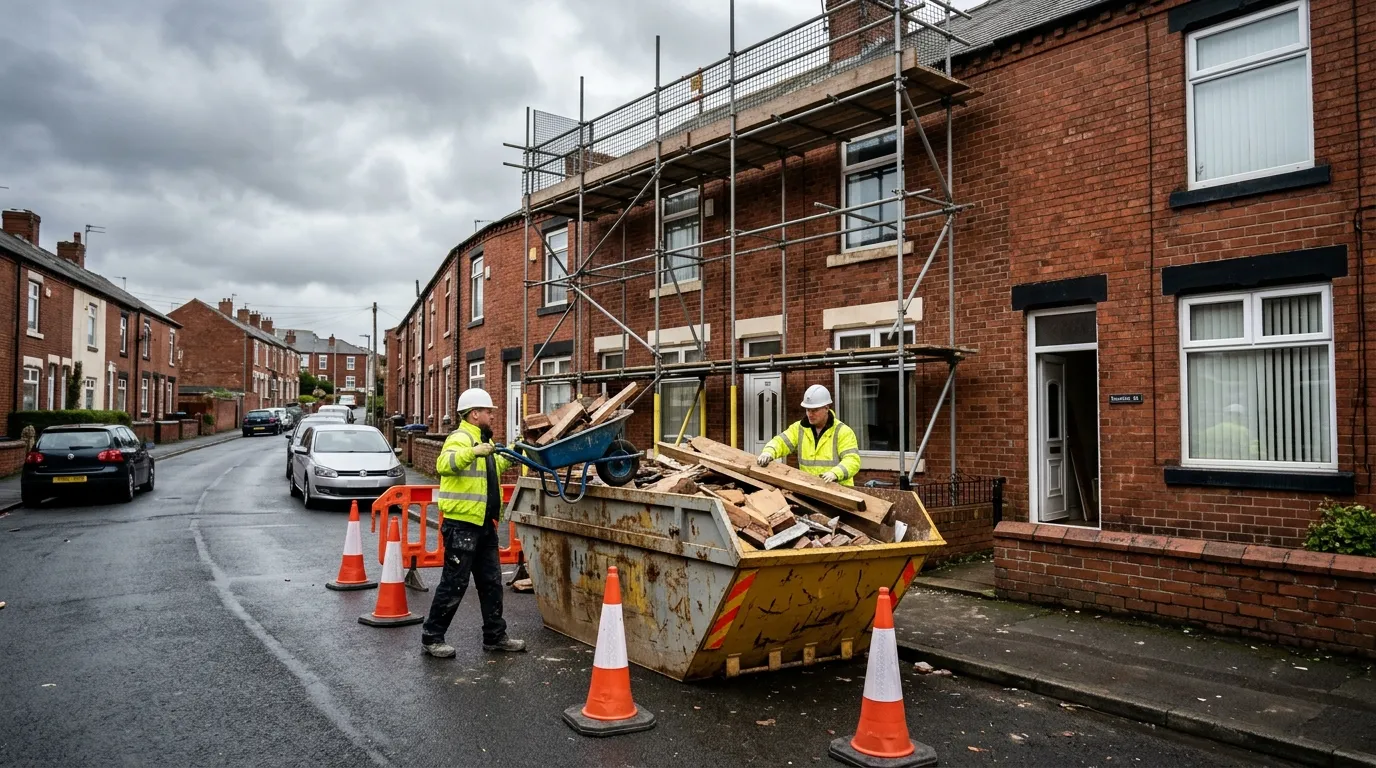
The warning that comes with it: 12 and 14 yard skips carry the same 8 tonne limit as the 8 yard, so operators take light waste only in them, and will refuse soil, rubble and concrete outright. For heavy loads the 8 yard is the largest skip most firms will supply.
Access decides it as much as volume does. A 12 or 14 yard skip is taller and needs more room for the lorry to drop and lift, so overhead cables, low branches, a narrow drive and parked cars rule it out on plenty of terraced and semi-detached streets where an 8 yard is fine. Where access is tight or the job runs over several weeks, two 8 yard skips exchanged partway through is often the practical answer.
Grab Lorry or Muck Away Instead
Once the waste is mostly soil and hardcore, and the volume runs past about 10 to 15 m³, skips stop being the cheap option. A grab lorry takes roughly 12 to 16 tonnes in one go and loads itself from the kerb, and muck away by tipper suits a dig that produces spoil faster than a skip can be swapped. The deciding factors are access for an 8 wheeler and whether the spoil can be stockpiled. Rates for both are on the skip hire cost guide.
Where Skip Hire Sits in an Estimate
On a priced job, skips are not a separate extra. They belong in preliminaries, alongside site protection, welfare, parking and permits, and preliminaries typically run at 10 to 15% of the job total, inside the total rather than added on top. On a kitchen or bathroom job that is one or two skips; on an extension it is a skip per phase, from demolition through to second fix. Builders who price the work and forget the waste lose that money twice, because the second skip is always needed and never quoted.
If you are pricing work that needs skips as part of a bigger build, our estimating service and self-estimating software price the whole project with the preliminaries in place, so the figure you work from matches what the job really costs from start to finish.
Last reviewed: November 2026. Prices are current UK market ranges including VAT.