
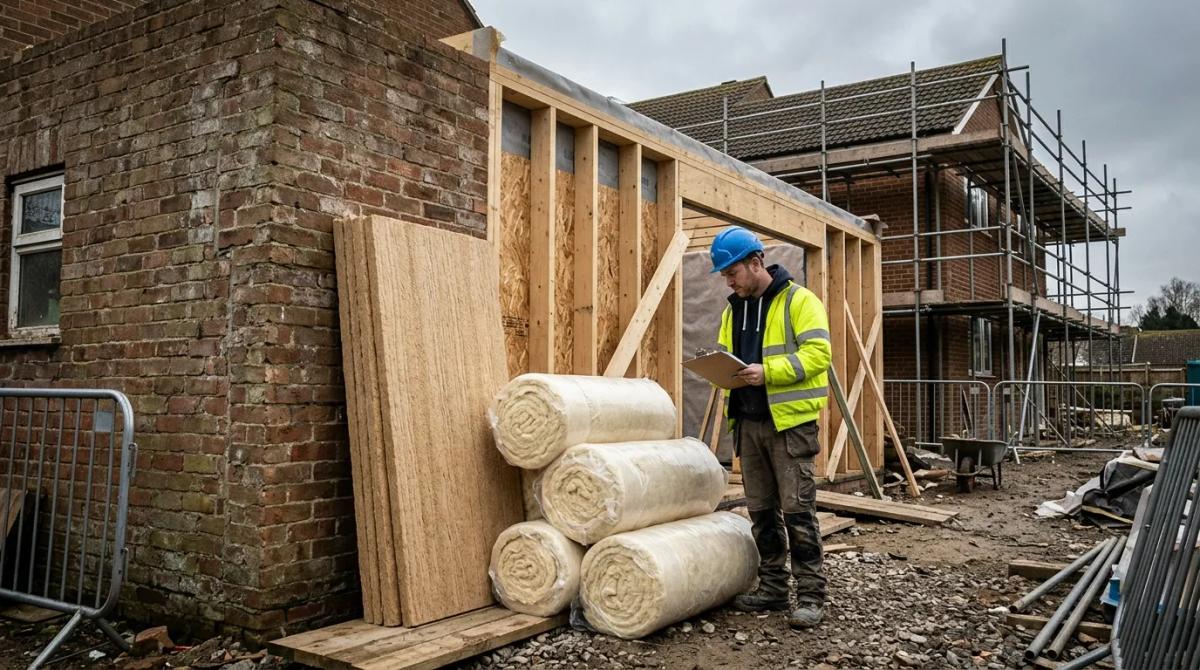
Eco-friendly building materials in the UK cost roughly 15% to 250% more than the standard product they replace, and a handful now cost the same or less. This page is for the builder pricing a job for a client: every range below is a finished UK price, supplied and fitted unless the row says otherwise, as a homeowner pays it including VAT.
Use it to see where the green premium is small enough to specify as standard, where it is big enough to quote as a client upgrade, and what the cheap end of an eco quote usually leaves out.
Embodied carbon and operational carbon, in plain terms
Operational carbon is what the house burns once people live in it: heating, hot water, power. Embodied carbon is what it took to make and deliver the stuff it is built from: the kiln that fired the brick, the furnace that made the steel, the lorry that brought it.
Insulation and airtightness cut operational carbon and show up on the client's bills. Timber, lime, hemp, reclaimed brick and recycled aggregate cut embodied carbon, which never shows up on a bill at all. Knowing which one a client is buying decides whether you present a material as a saving or as a choice they pay for.
What eco friendly building materials cost against the standard product
| Eco material | Standard material it replaces | Standard range (supplied and fitted) | Eco range (supplied and fitted) | Premium |
|---|---|---|---|---|
| Sheep's wool insulation | Mineral wool batt | £15–£28 per m² | £35–£55 per m² | 100–130% |
| Wood fibre board insulation | PIR board | £22–£35 per m² | £40–£65 per m² | 70–90% |
| Recycled cellulose (blown) | Blown mineral fibre | £18–£30 per m² | £20–£35 per m² | 10–20% |
| Timber frame wall (FSC softwood) | Blockwork inner leaf and cavity wall | £150–£220 per m² | £180–£280 per m² | 15–30% |
| CLT or glulam frame | Steel frame or loadbearing masonry | £250–£400 per m² of floor | £350–£600 per m² of floor | 40–55% |
| Hempcrete walling | Dense concrete block wall | £35–£55 per m² | £180–£250 per m² | 250%+ |
| Reclaimed brick | New facing brick | £85–£130 per m² of wall | £110–£180 per m² of wall | 15–40% |
| Low-carbon concrete (GGBS or recycled aggregate) | Standard ready mix, placed | £190–£260 per m³ | £200–£280 per m³ | 0–10% |
| Recycled steel beam | Standard steel beam | £1,100–£2,200 per beam | £1,100–£2,300 per beam | 0–5% |
| Lime render | Sand and cement render | £60–£95 per m² | £85–£140 per m² | 40–55% |
| Lime or clay plaster | Gypsum skim on board | £22–£35 per m² | £45–£80 per m² | 90–130% |
| Green (living) roof | Standard flat roof covering (EPDM, GRP, felt) | £90–£140 per m² | £130–£200 per m² | 40–50% |
| Reclaimed or FSC solid wood floor | Fitted laminate | £25–£40 per m² | £60–£110 per m² | 100–180% |
| Cork flooring or wall finish | Vinyl or standard laminate | £25–£40 per m² | £45–£75 per m² | 60–90% |
| Bamboo flooring | Engineered oak | £45–£80 per m² | £55–£95 per m² | 10–20% |
| Recycled plastic or composite decking | Softwood decking | £70–£110 per m² | £110–£180 per m² | 50–65% |
| Natural and low-VOC paint | Standard trade emulsion | £8–£14 per m² decorated | £10–£18 per m² decorated | 20–30% |
| Rainwater harvesting (underground tank system) | Mains supply only | nil | £3,000–£6,500 per house | new cost |
| FSC timber window, double glazed | uPVC double glazed | £400–£700 per window | £700–£1,200 per window | 40–85% |
Prices sit on the same scale throughout: the eco material doing the same job as the standard one, both finished and ready to use.
What the low price leaves out
The cheap end of an eco quote is almost always the material and nothing else. Natural materials are slower to work with, and that labour is where the money goes: sheep's wool is cut and friction-fitted by hand and takes longer per m² than slab mineral wool; lime render goes on in more coats and has to be protected and kept damp while it cures, so the scaffold stays up longer; hempcrete needs shuttering, then weeks of drying before anything can be plastered onto it; CLT needs a crane, a lifting plan and a dry slab to land on.
The other thing left out is a trade who has done it before. A lime render at the bottom of the range is usually a rendering crew pricing it like sand and cement, and it cracks. The gap comes back as extras, as a rushed job, or as work done to the letter but not to the standard the client pictured.
Insulation: sheep's wool, wood fibre and cellulose
Mineral wool and PIR are the default. Mineral wool batt runs £15–£28 per m² supplied and fitted, PIR board £22–£35 per m². Sheep's wool is £35–£55 per m², wood fibre board £40–£65 per m² (and more as external wall insulation, where it is part of a rendered build-up), and blown recycled cellulose £20–£35 per m², which is the smallest step up on the whole page.
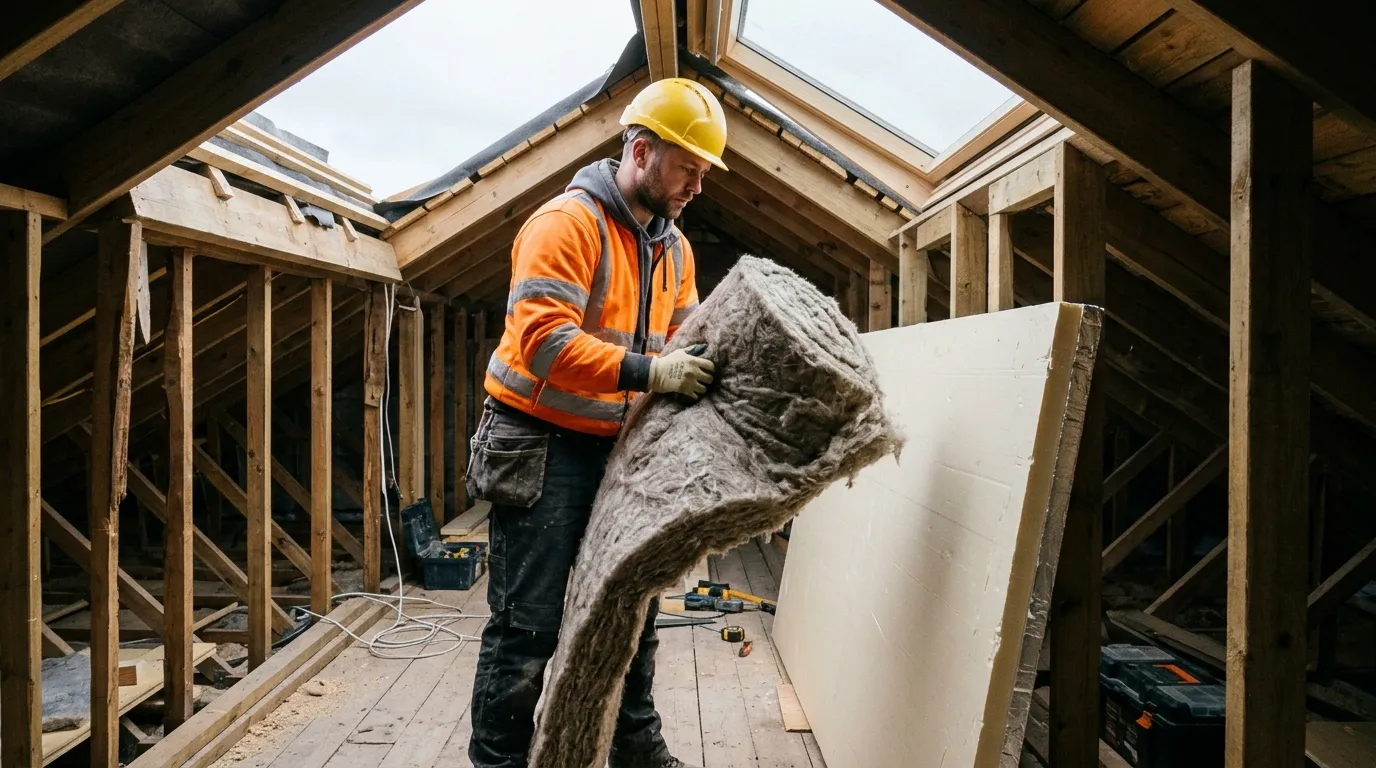
On a 40 m² loft, going from mineral wool to sheep's wool adds roughly £800–£1,100 to the job. That is the sort of figure a client can decide on in a minute, which is why insulation is the easiest eco upgrade to quote as an option line rather than burying it in the spec.
Timber frame, CLT and glulam against masonry
A masonry cavity wall, block inner leaf with brick or block outside, is £150–£220 per m² built. An FSC-certified timber frame wall, factory made and erected, is £180–£280 per m². On a fast programme the frame can land level with masonry overall, because the shell is weathertight in days instead of weeks and the scaffold, welfare and skip time come down with it.
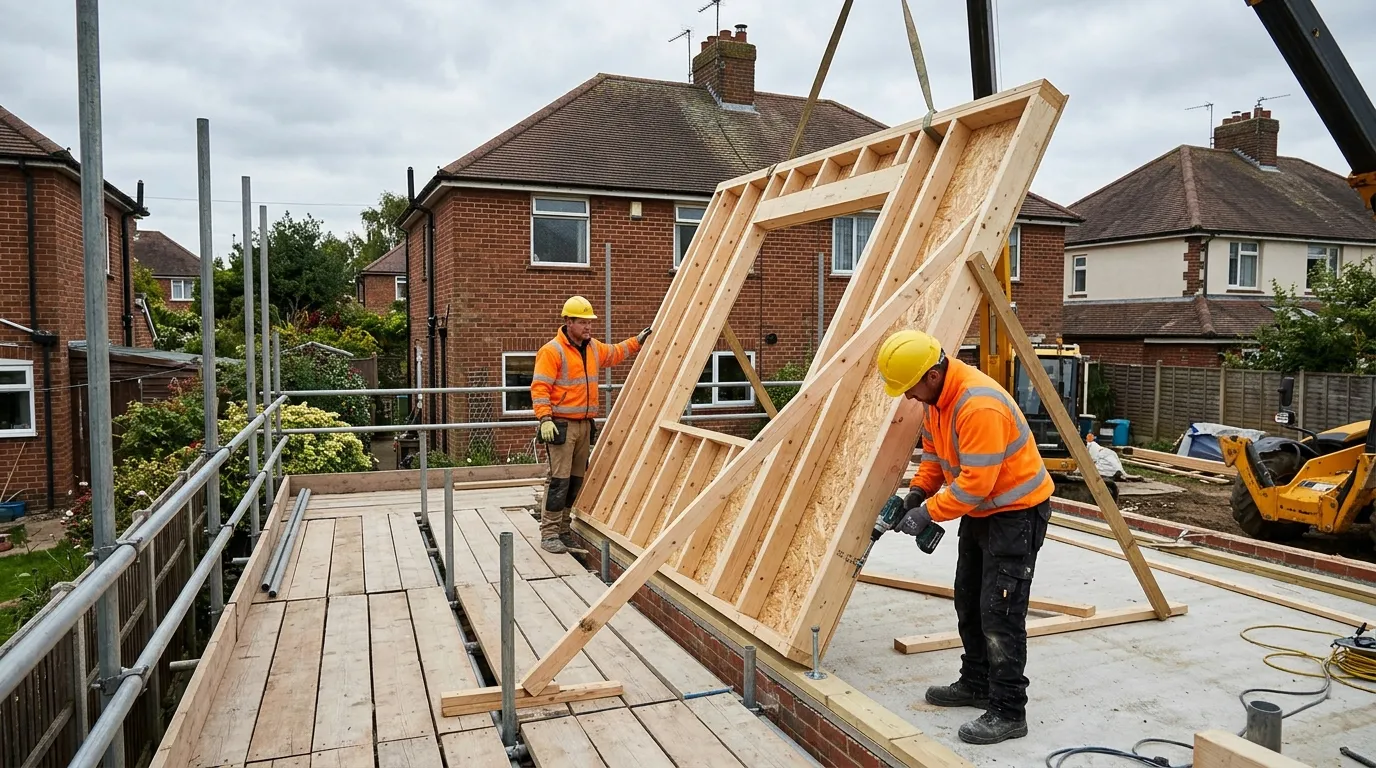
Cross laminated timber and glulam are a different league: £350–£600 per m² of floor area for the frame erected, against £250–£400 per m² for steel or loadbearing masonry. They are specified for exposed structure and embodied carbon, and they bring a crane, a tight delivery slot and a design that has to be finished before anything is cut. Reclaimed or FSC structural softwood for joists, rafters and studs is only 10–20% over standard C16 or C24, and it is the easiest swap on any domestic job.
Masonry, concrete and steel: the swaps that cost almost nothing
Not every eco option carries a premium, and a page that pretends otherwise is selling rather than pricing.
Low-carbon concrete, with GGBS or recycled aggregate replacing part of the cement, is £200–£280 per m³ placed against £190–£260 per m³ for standard ready mix: a few percent at most, and often nothing on a volume order. Recycled content steel is not priced separately in the UK at all, so a beam is £1,100–£2,300 supplied and fitted either way. Reclaimed brick is £110–£180 per m² of wall against £85–£130 per m² for new facings, but in parts of the country with a strong reclaim trade a common stock reclaim comes in level with a new brick of the same look, and on a repair or an extension to an older house it is the only thing that matches. Cellulose insulation is 10–20% over blown mineral fibre, and standard softwood timber frame is roughly level with blockwork on a short programme.
Lime, clay and natural finishes
Lime render is £85–£140 per m² supplied and fitted against £60–£95 per m² for sand and cement, and on a solid wall house it is the correct material, not an upgrade: cement traps moisture in walls that were built to breathe. Lime or clay plaster internally is £45–£80 per m² against £22–£35 per m² for gypsum skim on board.
Cork flooring is £45–£75 per m² fitted, cork wall finish much the same, bamboo flooring £55–£95 per m², and reclaimed or FSC solid wood £60–£110 per m², against £25–£40 per m² for fitted laminate. Natural and low-VOC paints add £2–£4 per m² decorated, a premium most clients accept without argument.
Green roofs and rainwater harvesting
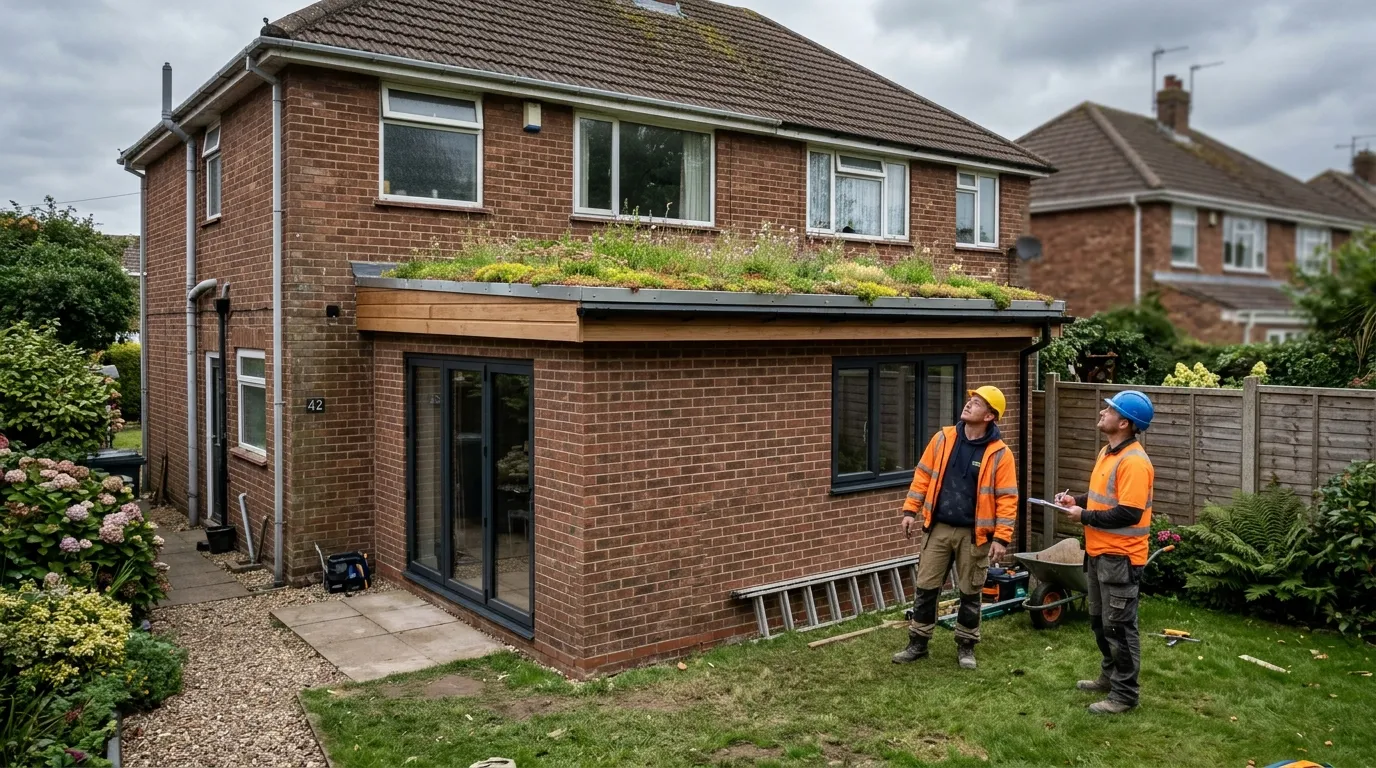
An extensive sedum green roof system is £130–£200 per m² supplied and fitted, against £90–£140 per m² for a standard flat roof covering in EPDM, GRP or felt. The deck below has to carry the extra saturated load, so a structural check is a separate fee line, not something to bury in the roof rate.
A rainwater harvesting system with an underground tank, pump and filtered supply to WCs and outside taps is £3,000–£6,500 per house supplied and fitted, or £1,200–£2,500 for a simple above-ground system feeding the garden only. On a new build it is far cheaper than retrofitting, because the drainage and the dig are already happening.
Where the premium pays back, and where it does not
Insulation is the only part of this list that pays back reliably. Topping a loft up to current depth costs £600–£1,100 on a typical semi and takes £150–£350 a year off the heating bill. Airtightness work during a refurbishment, tapes, membranes and sealing, is £8–£18 per m² of floor area and keeps paying every winter. A green roof membrane sits under the planting and is protected from UV, so the covering typically lasts longer than a bare flat roof and pushes the next replacement further out. Rainwater harvesting saves metered water, which on a typical metered household is a modest £60–£150 a year, so it is chosen for drought resilience and planning conditions more than for the sums.
Cork, bamboo, reclaimed brick, lime plaster and natural paints have no running-cost payback at all. They are bought for look, for breathability and for embodied carbon. Hempcrete is the same: at £180–£250 per m² it is a fabric and philosophy decision on a self-build, not a cost decision, and it is worth saying that to a client plainly rather than promising a return that will not arrive.
Where the extra money actually goes on an eco build
Clients see the parts they chose: the bamboo floor, the cork wall, the reclaimed brick slips in the kitchen. Most of the eco money is in the parts they will never look at again: the insulation depth, the airtightness layer, the breathable build-up, the frame. That is the same problem as every other job, where people happily spend £50,000 on a kitchen and resist paying to bring the floor level underneath it.
Price those fundamentals first and put the visible finishes in as a client budget, with the figures from the tables above. If something has to give, it gives in the finish, which can be changed any time, not in the fabric, which cannot be touched again without ripping the finish back out.
Preliminaries on an eco job
A job like this carries its own preliminaries and they are inside the total, not added to it: scaffold, protection, skip, parking, welfare, and dry covered storage. Storage matters more here than on a standard build. Sheep's wool, wood fibre board and structural timber have to stay dry on site, and lime work needs protection from frost and from drying out too fast. Preliminaries normally run 10–15% of the total on a domestic job, and the top of that band is realistic when the programme includes curing time.
Worked example: a 30 m² rear extension, two ways
A 30 m² single storey rear extension, built conventionally (cavity masonry, mineral wool and PIR, cement render, tiled or flat roof, standard internal finishes), comes out at £2,000–£2,800 per m², so £60,000–£84,000 all in, including preliminaries and VAT.
The same 30 m² extension with an FSC timber frame, wood fibre sheathing and sheep's wool insulation, lime render, a sedum roof and FSC timber windows comes out at £2,500–£3,400 per m², so £75,000–£102,000. The difference is roughly £15,000–£18,000 on the same footprint, of which about half is insulation and render and about half is the roof and the joinery. Both figures are for the finished, usable room, supplied and fitted.
Professional and statutory fees
These are separate lines, not part of the per m² rates above:
| Fee | Typical UK range |
|---|---|
| Structural engineer for a timber frame or CLT design | £750–£2,000 |
| Green roof structural check on an existing deck | £400–£900 |
| SAP assessment (new build or extension, design and as-built) | £250–£600 |
| EPC on completion | £60–£120 |
| Householder planning application in England | £528 |
| Lawful development certificate (proposed work) | £264 |
| Building control, single storey extension | £900–£1,800 |
Supply, lead times and the programme you quote
A normal builders merchant stocks mineral wool, PIR, cement, standard brick and softwood, and most of it is next day. The eco list splits in two. Cellulose, timber frame, low-carbon ready mix, FSC softwood and recycled steel come through normal supply chains with little or no wait.
Sheep's wool, wood fibre board, lime products, clay plaster, cork, bamboo, green roof systems, CLT and hempcrete come from specialist suppliers, and two to six weeks is normal, longer for CLT, which is made to the drawing. Several are imported, so a delivery date is not a promise until it is on the lorry. Quote the programme with that lead time in it and write down who carries the risk if the product is late.
Are eco material prices going up in 2026
Construction material prices are rising again, though not all at the same rate. The Department for Business and Trade publishes a monthly all work materials price index, and it is the clearest way to see whether timber, insulation or concrete inputs are moving before you commit to a specification. Rather than quote one figure here that will be out of date within weeks, check the current month's release in the Department for Business and Trade building materials statistics before you fix a price on an eco job with a long lead time.
Within the eco list, timber products (frame, CLT, wood fibre) move with the global timber market and with sterling, because a large share of UK softwood is imported. Lime, cement replacements and concrete move with energy prices, since they come out of kilns. Sheep's wool, cork, bamboo and most green roof systems are imported, so shipping costs and the exchange rate hit them before anything else does. Reclaimed brick moves with local demolition supply and has nothing to do with any of it.
If you are pricing months ahead, a short overview of why material costs move and how to keep a live view of them sits in our guide to real-time construction material costs.
The cheapest building materials right now
The cheapest conventional options are still the cheapest overall: dense concrete block at £35–£55 per m² built, mineral wool at £15–£28 per m², fitted laminate at £25–£40 per m², sand and cement render at £60–£95 per m².
The cheapest eco-leaning options sit right next to them: low-carbon ready mix at £200–£280 per m³ placed, blown cellulose at £20–£35 per m², reclaimed common brick at £110–£180 per m² of wall, and standard softwood timber frame at £180–£280 per m². Specify those four as the default and the client gets a measurably lower embodied carbon for a few percent, which is a much easier conversation than hempcrete.
What the regulations are pushing towards
Part L sets the fabric and carbon standard for new work, including extensions. The Future Homes Standard was published on 24 March 2026 as the 2026 edition of Approved Document L, and new dwellings must comply from 24 March 2027, producing at least 75% less carbon than a home built to the 2013 standard. Minimum fabric U-values stay broadly in line with Part L 2021, so the big change is heat pumps and solar rather than the walls, but the direction is one way. A short overview of the current rules sits on our UK building regulations page.
Embodied carbon is not yet a building regulations requirement for a house, but it is routinely asked for on larger schemes and by planners on urban sites, which is where the questions about timber frame, reclaimed brick and low-carbon concrete usually start.
Offsite manufacture overlaps heavily with this list, since most of it is timber based; see modular construction in the UK for how that prices. For a wider look at timber against plastics and composites, see wood versus synthetic building materials.
Eco-friendly material upgrade cost calculator
Eco-friendly material upgrade cost
- Extra cost over the standard material
- £960
Typical current UK price premiums per m² for the finished job, supplied and fitted, including VAT. Confirm the supplier's lead time and price before you quote.
Settle these with the client before you price
- Where does the breathable build-up stop? Lime render outside and gypsum inside is a half-finished idea.
- Who buys the material, you or the client, and who stores it?
- What certification is required: FSC or PEFC chain of custody, BBA approval, a declared U-value?
- Does the specification allow an equivalent product, or is it that product only?
- Who carries the lead time risk if the specified material is six weeks out?
- What happens if it is discontinued or unavailable: who chooses the substitute and who pays the difference?
- Is the eco specification needed for compliance, for a planning condition, or because the client wants it? That decides whether it can be value-engineered later.
- Who pays for the extra site protection and the drying time in the programme?
- Is there crane or delivery access for a frame, and where does the lorry stand?
- Which parts are a client budget (floor, paint, windows) and which are fixed in the spec?
Pricing a job with an eco specification
Put the fabric in at the rates above, keep the client-chosen finishes as budget lines, and set the lead times into the programme before you give a date. If you want it priced properly from your drawings, Builder Expert produces a detailed estimate by trade and phase, so you can show a client exactly what each upgrade adds and what it adds nothing to. You can see how the trades and tasks are split in our estimate tasks breakdown, or build and compare two specifications yourself in minutes with our estimating software.
Last reviewed: November 2026. Regulation dates from the Approved Document L 2026 publication; material price movement from the Department for Business and Trade building materials and components statistics.